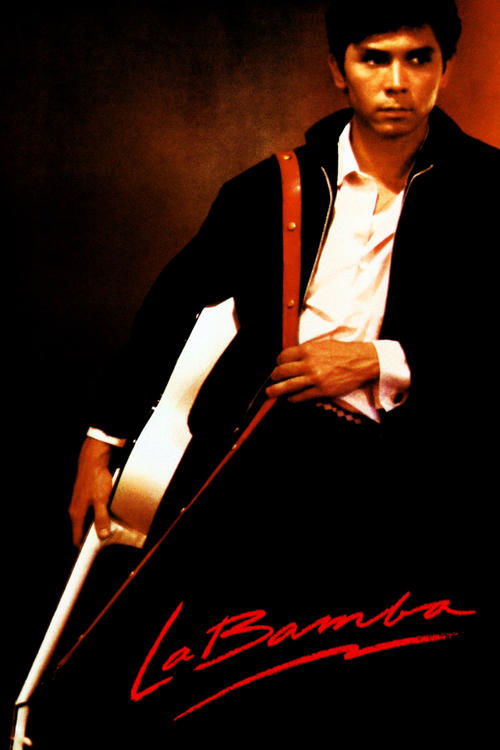
La Bamba
1987 · Luis Valdez
For when you want music that makes you move and a story that makes you feel — a nostalgic night that earns its tears honestly. Comfort viewing with a lump in its throat.
What it's about
Pacoima teenager Richard Valenzuela picks oranges with his family one summer and, months later, is Ritchie Valens — one of the first Mexican American rock 'n' roll stars, launched at seventeen by a love song he wrote for a girl named Donna. Rising fast through the 1958 record business, he carries his family with him: a proud, hardworking mother and an older brother, Bob, whose love for Ritchie is tangled up with jealousy and self-destruction. The music lifts everyone; the family strains under the weight of it.
The experience
Warm, propulsive, and openhearted, driven by the songs — then quietly aching, because the film lets you feel how young everyone is and how briefly the good times get to last. It plays like a summer memory you already know will end.
Performances
Lou Diamond Phillips makes Ritchie's sweetness feel real rather than saintly, and Esai Morales is volatile and wounded as brother Bob — the film's storm system, giving it a charge the biopic formula rarely has.
The craft
Luis Valdez, founder of the farmworkers' theater El Teatro Campesino, directs the rock biopic as a Chicano family drama, giving the labor camps and Pacoima streets the same care as the recording studios. Los Lobos' recordings of Valens's songs are the engine — turn the speakers up; the title track is built to fill a room.
Why it matters
A rare 1987 studio hit with a Chicano director and largely Latino cast, it put Valens back on the radio (Los Lobos took 'La Bamba' to number one) and proved a mainstream audience for Mexican American stories.
Snapshot
La Bamba is a biographical drama about Ritchie Valens, the Pacoima teenager born Richard Steven Valenzuela who became one of the first Mexican American rock 'n' roll stars and died at seventeen in the February 3, 1959 plane crash that also killed Buddy Holly and J.P. "The Big Bopper" Richardson. Written and directed by Luis Valdez — founder of El Teatro Campesino, the farmworkers' theater company born out of the 1965 Delano grape strike — the film compresses roughly eight months of Valens's life into a story that is at least as much about a family and a pair of brothers as it is about a music career.
Its historical significance is disproportionate to its modest scale. La Bamba was released in 1987 by Columbia Pictures and became a genuine mainstream success — the rare Hollywood studio feature with a Chicano director, a predominantly Latino cast, and a Mexican American subject that did not have to be marketed as a specialty item. Its soundtrack, on which Los Lobos re-recorded Valens's catalog rather than licensing the originals, produced a number one single in the title track and became a substantial hit record in its own right. In the historiography of Chicano cinema, the film sits at a hinge point: after the independent and activist filmmaking of the 1970s and early '80s, and before the wider industrial diversification that would not really arrive for another generation.
The film's core dramatic proposition is unusual for a music biopic. Valens's brief public life offers little in the way of career arc — no long apprenticeship, no fall, no comeback. Valdez consequently builds the picture around the fraternal conflict between Ritchie and his older half-brother Bob Morales, and around a premonition of death that the audience carries from the first frame. It is a biopic constructed as an elegy, its outcome known in advance and its suspense relocated from what happens to what it costs.
Industry & production
La Bamba was produced by New Visions Entertainment, the company formed by Taylor Hackford, with Hackford and Bill Borden producing, and released through Columbia Pictures. Hackford had directed An Officer and a Gentleman (1982) and would later make the Chuck Berry documentary Hail! Hail! Rock 'n' Roll (1987); his interest in music-driven narrative and in giving Valdez a studio berth was central to the project reaching production at all. Valdez had made Zoot Suit (1981) for Universal — an adaptation of his own landmark stage musical about the 1942 Sleepy Lagoon case and the wartime Zoot Suit riots — and that film's commercial disappointment made a second studio feature far from certain. La Bamba was, in effect, Valdez's second and, as it turned out, last major theatrical feature as director; his subsequent work returned largely to television and the stage.
The budget was modest by mid-1980s studio standards, and the production reflects that: Southern California locations standing in for period Pacoima and the San Fernando Valley, a compact shooting schedule, limited crowd work, and a concert-scene strategy that favors intimate stages and television studios over spectacle. Columbia's marketing leaned on the soundtrack, and the release strategy included an innovation worth noting — a Spanish-language version of the film was prepared and distributed to selected theaters, an acknowledgment of a bilingual audience that studio distribution had generally ignored. The picture's commercial performance substantially exceeded expectations for a film of its budget and subject; precise figures vary by source, so the safest characterization is that it was a clear and somewhat surprising success, and that its soundtrack's chart performance amplified the film's visibility considerably.
Casting was a genuine risk. Lou Diamond Phillips, then largely unknown, played Ritchie; Esai Morales, who had appeared in Bad Boys (1983), played Bob; Rosanna DeSoto played their mother Connie Valenzuela; Elizabeth Peña played Bob's partner Rosie; and Danielle von Zerneck played Donna Ludwig. The supporting cast folded in figures from the Chicano theater and film worlds alongside music-scene casting — Marshall Crenshaw as Buddy Holly, Howard Huntsberry as Jackie Wilson, Brian Setzer as Eddie Cochran — a strategy that gives the concert sequences a texture of period authenticity without requiring extended impersonation.
Technology
La Bamba is not a technically adventurous film, and its production technology is standard for a 1987 mid-budget studio drama: 35mm color negative, spherical rather than anamorphic framing, conventional dolly and crane coverage, and post-production sound finishing in Dolby Stereo. What is technologically interesting about it lies elsewhere — in the film's relationship to recorded sound, both as subject and as method.
The decision to have Los Lobos re-record Valens's material rather than use the original masters was partly aesthetic and partly practical. Valens's 1958–59 Del-Fi recordings, produced by Bob Keane, were made quickly and cheaply; their sonic thinness would have sat awkwardly against a modern stereo mix and against the film's dramatic close-ups. Re-recording allowed the songs to be performed to the demands of the scene — tempo, length, and dynamics shaped to editing — while preserving arrangement fidelity. Los Lobos, a band steeped in both East Los Angeles rock and Mexican traditional forms, were uniquely positioned to render "La Bamba" itself, a son jarocho from Veracruz that Valens had transformed into a rock record, with an understanding of both ends of that transformation.
The film also depicts the technology of its period with unusual attention: the small independent studio, the acetate, the local radio station, the television broadcast, the tour bus and the chartered light aircraft. These are not decorative. The plot turns on the material conditions of the late-1950s record business — a small label, a producer-manager with significant control, and a touring economy that put teenage performers into unheated buses and small planes in Midwestern winter.
Technique
Cinematography
Adam Greenberg shot the film. Greenberg, an Israeli-born cinematographer who had photographed The Terminator (1984) and would go on to Ghost (1990) and Terminator 2 (1991), brings a warm, relatively soft palette to the period material — golds and browns in the domestic and agricultural scenes, cooler and harder light for the industry spaces and the winter tour. The visual approach is classical: medium shots and close-ups that privilege faces, coverage that keeps the family in frame together, and a general avoidance of the high-contrast stylization common in 1980s period pictures.
Two visual registers stand apart from the naturalistic base. The first is the dream imagery of the plane crash, which recurs with a heightened, unmoored quality — the film's most overtly expressive photography, deliberately set off from the surrounding realism. The second is the sequence in Tijuana, where Ritchie and Bob visit a curandero; here the light and the staging shift toward the ritual and the mythic, a register drawn less from Hollywood biopic convention than from Valdez's theatrical vocabulary.
The performance sequences are shot for legibility and energy rather than for documentary immersion. Cameras stay close enough to read Phillips's hands and face, and the geography of small stages is established quickly so that cutting can be free without becoming disorienting.
Editing
Sheldon Kahn edited the film. Kahn's credits include One Flew Over the Cuckoo's Nest (1975), Out of Africa (1985), and Ghostbusters (1984) — a background in mainstream dramatic construction that shows in La Bamba's clean, unfussy cutting. The film's most consequential editorial decision is structural: it opens with the crash premonition, so that every subsequent scene is played against a known ending. This is a deliberate exchange of surprise for dread, and it changes how the audience reads ordinary moments — a family dinner, a recording session, a coin toss for an airplane seat.
The parallel construction between Ritchie's ascent and Bob's disintegration is maintained throughout, with cross-cutting used to keep the brothers in dramatic contact even when they are geographically apart. The film's climactic movement — the final tour, the crash, and its aftermath in Pacoima — is edited with restraint: the crash itself is handled elliptically rather than as spectacle, and the emotional weight is placed on Bob receiving the news, alone, in a scene that Esai Morales carries almost entirely on his face and body.
Mise-en-scène / staging
Valdez's staging carries the clearest fingerprint of his theatrical background. El Teatro Campesino's actos — short, presentational pieces performed on flatbed trucks for farmworker audiences — trained him in composition that reads clearly, in the use of a small number of significant objects, and in blocking that externalizes social relationships. In La Bamba this manifests as an emphasis on thresholds and shared spaces: the crowded Valenzuela house, the yard, the doorway, the small stage. Family scenes are frequently staged with several actors in a single frame at varying depths, so that reaction and hierarchy are visible without cutting.
The film's production design contrasts three worlds — the agricultural and working-class Pacoima home; the white suburban world of Donna's family, where Ritchie's presence is a problem to be managed; and the industry spaces of studio, stage, and television. The Tijuana sequence stands outside all three, a deliberate excursion into a symbolic mode where the snake ritual and the curandero's blessing establish a mythic frame for what follows.
Sound
Sound is the film's most fully realized technical dimension. Carlos Santana composed the score, with Miles Goodman contributing; the score's guitar-based textures and Latin percussion place the film's emotional interiority in the same musical world as its subject rather than in generic orchestral underscoring. Santana, himself a foundational figure in the fusion of Latin musical idiom with rock, is a pointed choice: the score's presence is an argument about lineage.
The Los Lobos recordings — "La Bamba," "Come On, Let's Go," "Donna," "Ooh! My Head," and others — function diegetically as Valens's performances, with Lou Diamond Phillips performing to playback. The band's Cesar Rosas and David Hidalgo carry the vocals. The film also uses period recordings and re-creations for the other performers on the tour bill, giving the concert scenes a plausible sonic variety.
The mix uses silence and ambient sound pointedly around the crash: the film has been loud with music for most of its length, and the withdrawal of music at the end is felt as a structural absence, not merely a quiet passage.
Performance
Lou Diamond Phillips plays Ritchie with a deliberate ordinariness — polite, contained, more focused than charismatic offstage, and transformed onstage. It is a performance built to avoid the biopic trap of playing a legend rather than a person; Phillips lets the songs carry the star quality and keeps the character modest between them. Esai Morales has the harder and more theatrical role, and Bob Morales is the film's most complex figure: talented, angry, alcoholic, abusive to Rosie, genuinely loving toward his brother, and destroyed by the loss. Morales plays the contradictions without softening them.
Rosanna DeSoto's Connie is the film's structural anchor — the parent whose ambition and denial drive much of the plot — and Elizabeth Peña gives Rosie a weary interiority that resists the victim role the script could have imposed. Joe Pantoliano plays Bob Keane, the Del-Fi producer, with a mixture of genuine belief and commercial calculation that keeps the industry figures from becoming cartoon villains.
Narrative & dramatic mode
The film's dominant mode is domestic melodrama in a biographical frame. Its engine is not the career but the family, and specifically the asymmetry between two brothers: one who is given everything and one who is given nothing, in a household where the mother's investment in the younger son is visible to everyone including him. Valdez structures the film so that success is always a wound to someone.
Three narrative devices govern the film's shape. First, the foreknowledge of death: the opening dream announces the ending, converting the story into tragedy in the formal sense — the outcome is fixed, and the interest lies in the character's movement toward it. Second, the recurring dream itself, which functions as both psychological symptom and structural motif; Valens's aviophobia is grounded in a real event, the January 1957 midair collision over Pacoima Junior High School, which the film uses as the origin of the fear. Third, the coin toss, a compressed image of arbitrary fate that the film treats without irony.
The screenplay compresses and reorganizes freely, as biopics do. The chronology is tightened, the Donna relationship is shaped for dramatic economy, and Bob's arc is given more narrative weight than a strict chronicle would support. The film is honest about being a story rather than a record, but it also draws on family testimony — Bob Morales and Connie Valenzuela were consultants — which gives its domestic material a specificity that pure invention rarely achieves.
Genre & cycle
La Bamba belongs to the rock biopic, a durable cycle running from The Buddy Holly Story (1978) and Coal Miner's Daughter (1980) through Great Balls of Fire! (1989) and onward to Ray (2004) and Walk the Line (2005). Within that cycle it is notable for its brevity of subject: most rock biopics chart decades, while La Bamba covers less than a year of public life. The consequence is a film with almost no third-act decline — no drugs, no divorce, no comeback — which forces the drama into the family and makes the picture closer in feeling to a working-class family melodrama than to the rise-fall-redemption template.
It also belongs, decisively, to the small body of Chicano feature filmmaking that reached theatrical distribution in the period: Valdez's own Zoot Suit (1981), Robert M. Young's The Ballad of Gregorio Cortez (1982), Gregory Nava's El Norte (1983), Ramón Menéndez's Stand and Deliver (1988), and later Edward James Olmos's American Me (1992) and Nava's Mi Familia / My Family (1995). La Bamba is the commercial outlier in that group — the one that crossed fully into the mainstream — and its success is frequently cited as having helped make Stand and Deliver and Mi Familia possible.
Authorship & method
Luis Valdez is the film's decisive authorial presence, but his authorship is unusual in that it derives primarily from theater and from political organizing rather than from film. Born in Delano, California to farmworker parents, Valdez founded El Teatro Campesino in 1965 in direct support of the United Farm Workers strike, developing a presentational, bilingual, deeply vernacular performance form. His major stage work — Zoot Suit (1978), which became the first Chicano play on Broadway — established a method of blending realism with heightened symbolic figures.
That method carries into La Bamba in muted but detectable form: the mythic Tijuana sequence, the dream imagery, the emphasis on family as social unit rather than psychological backdrop, and the film's willingness to hold on the collective rather than isolating the protagonist. Valdez wrote the screenplay himself, which is central to its perspective — the film's treatment of assimilation, of the Anglicized stage name, of Ritchie's inability to speak Spanish while singing in it, comes from a writer for whom these are lived rather than researched conditions.
His key collaborators shape the film in specific ways. Adam Greenberg (cinematography) supplies a warm classical realism that keeps the material accessible. Sheldon Kahn (editing) brings mainstream narrative discipline, holding the structure together across its shifts in register. Carlos Santana (score, with Miles Goodman) supplies a musical identity that is culturally continuous with the subject. Los Lobos function as something close to a collaborative authorial voice on the soundtrack — their re-recordings are interpretations, not reproductions, and their presence links Valens's 1958 East LA to the East LA of the 1980s. Taylor Hackford and Bill Borden as producers made the studio configuration possible; Hackford's advocacy is a real factor in the film's existence.
Movement / national cinema
La Bamba is a Hollywood studio production, but it is more usefully placed within Chicano cinema — a body of work emerging from the Chicano Movement of the 1960s and '70s, initially in documentary and short form (I Am Joaquín, Yo Soy Chicano, Requiem-29), and moving into narrative features through the late 1970s and '80s. Chicano cinema in this period was defined by its subject matter, its makers, and its explicit engagement with questions of labor, migration, cultural retention, and representation.
La Bamba's position is genuinely contested within that tradition. It is the movement's greatest commercial breakthrough, and it brought a Chicano director and a Chicano story to a mass audience without significant dilution of its cultural specificity — Spanish is spoken and untranslated, the family's class position is unglamorized, and the racial dynamics of Ritchie's relationship with Donna and of his renaming are treated directly. At the same time, some scholars have argued that the film's crossover success depends on a relatively soft treatment of structural racism, on a redemptive family narrative, and on a protagonist whose success is presented as individual triumph rather than collective struggle — a distance from the organizing politics of El Teatro Campesino that is real, whatever one concludes about it. Both readings are defensible, and the tension between them is precisely what makes the film significant in the historiography.
Era / period
Two periods are in play. The film depicts 1957–1959, the moment when rock 'n' roll was consolidating as a commercial form and when American popular music was, in practice, racially segregated in ways the music itself kept violating. Valens's career is inseparable from that structure: a Mexican American teenager recording for a small independent label, given an Anglicized name to sell records, singing a Veracruz folk song to a national audience that had no idea what it was hearing. The film is precise about the mechanisms — the name change is a scene, not a footnote.
The second period is 1987, and La Bamba is a product of its moment in several respects. It arrived during a broad 1980s vogue for the American 1950s, in a decade when the movie soundtrack had become a major commercial engine, and at a point when the film industry was beginning — slowly and inconsistently — to acknowledge a Latino audience. It also arrived during a period of intensified public argument about immigration and bilingualism in California, which gives its bilingual release and its untranslated Spanish a charge they might not have carried a decade earlier.
Themes
Assimilation and its price. The film's central thematic material is the negotiation between Mexican American identity and American commercial success. Ritchie is renamed by his producer; he sings in Spanish he does not speak; his girlfriend's father objects to him on racial grounds. The film neither denounces the accommodation nor pretends it is costless.
Brotherhood and the economics of family favor. Bob's ruin is the film's moral center of gravity. He is the older brother who worked, who has a child, who has talent as an artist, and who is systematically passed over. The film understands his rage as a response to something real, which is what keeps it from being a simple story of a bad brother and a good one.
Fate and foreknowledge. The recurring dream, the Pacoima Junior High collision, the coin toss, the curandero's ritual — the film builds an architecture of premonition that treats Valens's death as something moving toward him rather than something that merely happens.
Music as inheritance and as transformation. "La Bamba" itself is the film's thesis: a traditional son jarocho, learned imperfectly, turned into a rock record by a teenager who did not speak the language, and then returned to circulation by Los Lobos in 1987 for a new mass audience. The song's journey is the film's argument about cultural continuity.
Class and labor. The film opens in the fields, and it never forgets where the family started. Migrant labor is not backdrop; it is the condition from which everything else in the film departs.
Reception, canon & influence
Critical reception in 1987 was broadly favorable. Reviewers consistently praised the performances — Esai Morales's Bob in particular drew strong notices — and the music, while some critics found the screenplay conventional in its biopic mechanics and thin on Valens's inner life, a reasonable complaint given how little the historical record supplies. The most common critical formulation held the film to be more successful as family drama than as portrait of an artist. Its commercial success was widely reported as a milestone for Latino representation in American film, and the soundtrack's chart performance — Los Lobos's "La Bamba" reaching number one — gave the film a cultural presence beyond its theatrical run.
Influences on the film (backward). The most direct antecedent is The Buddy Holly Story (1978), which established the modern rock biopic's template and which shares a subject in Holly himself; Coal Miner's Daughter (1980) supplied the model of the working-class musical biography rooted in family. American Graffiti (1973) stands behind the film's period-music texture. More fundamentally, Valdez's own Zoot Suit — both the 1978 play and the 1981 film — is the film's real ancestor, supplying the theatrical-symbolic register, the concern with Chicano identity under Anglo pressure, and the willingness to move between realism and myth. Behind all of it stands twenty years of El Teatro Campesino practice and the documentary and narrative tradition of Chicano Movement filmmaking.
Legacy (forward). La Bamba's clearest effect was demonstrating a commercial market for Latino-centered studio films, which is regularly cited in accounts of how Stand and Deliver (1988), American Me (1992), Mi Familia / My Family (1995), and Selena (1997) reached production. Selena in particular follows La Bamba's template closely: a young Mexican American musician, a family-centered narrative, an early death, and a star-making lead performance. The film launched Lou Diamond Phillips's career and consolidated Esai Morales's, and it gave Los Lobos their widest audience.
It also had an effect on the biopic form itself, though a diffuse one: its foreknowledge structure and its relocation of dramatic weight from career to family recur in later musical biographies. And it durably restored Ritchie Valens to public memory — a performer whose eight-month career had been largely reduced to a footnote in the Holly crash, and who since 1987 has been understood as a founding figure in the history of Latino rock. Valens was inducted into the Rock and Roll Hall of Fame in 2001; the film is inseparable from that reassessment.
In 2017, La Bamba was selected for preservation in the United States National Film Registry by the Library of Congress, a formal recognition of the cultural significance that its audience had established thirty years earlier.
A Deleuzian reading
A coin goes up in freezing air and two young musicians watch it turn.
The full Deleuzian reading of La Bamba →
Reception
A sleeper hit in the summer of 1987 that turned Lou Diamond Phillips into a star overnight, it has since been canonized as a landmark of Chicano cinema — the Library of Congress added it to the National Film Registry in 2017.
How La Bamba was received, from release to now →
How to watch La Bamba: what to notice on a first viewing
- Watch for the recurring dream that interrupts the story. Valdez opens with this dream and returns to it several times, shooting it in an unmoored, heightened style that Adam Greenberg keeps distinct from the warm realism everywhere else. You are told upfront what this story is shadowed by, which changes how every ordinary scene afterward feels.
- Watch how many family members share the frame at once. Valdez, trained by El Teatro Campesino's flatbed-truck theater, stages the Valenzuela household with several actors visible together at different depths, so hierarchy and reaction read without a single cut. You can read who matters to whom just from where each person stands in the shot.
- Watch Ritchie's face while he sings the Spanish lyrics. Lou Diamond Phillips plays Ritchie singing words in a language he cannot actually speak, his body committed and fluent even where his Spanish is not. One posture at a microphone carries a whole history of assimilation that no line of dialogue explains.
- Listen for guitar and Latin percussion under the story scenes. Carlos Santana's score uses guitar-based textures and Latin percussion for the film's quiet, non-performance moments, keeping the same musical world running under the story that Ritchie performs onstage. The score and the songs come from the same well, so the music never feels bolted onto the story.
- Notice the light change during the Tijuana ritual scene. When Ritchie and Bob visit a curandero, Valdez shifts the light and staging into a ritual, mythic register drawn from his theater work rather than ordinary biopic realism. The film briefly steps outside its own realism to admit that some things here work by belief, not explanation.
The whole guide to watching La Bamba, with the keys for a rewatch →
Influences: the films it descends from and the films it influenced
- The Buddy Holly Story (1978) — Established the rock-biopic structure La Bamba adopts wholesale — career told as a chain of complete, uninterrupted performance numbers with the band playing live on set rather than miming to studio masters — and Valdez inherits its subject (Holly) and its refusal to show the crash, ending on the last Winter Dance Party stage.
- Coal Miner's Daughter (1980) — Supplied the working-class musical-biography template in which dramatic weight sits in the household — kitchen, wages, siblings, the mother's face — and the star's rise is measured by what it costs the family, plus the convention of the lead singing/fronting the numbers in-camera rather than being cut around.
- American Graffiti (1973) — The wall-to-wall period-45s soundtrack treated as continuous ambient texture (car radios, sock hops, transistor sets) rather than score, and the foreknowledge device of announcing a character's death outside the story's present — Lucas's end titles are the structural ancestor of La Bamba's recurring plane-crash premonition.
- Zoot Suit (1981) — Valdez's own translation of El Teatro Campesino's actos to film — a presentational register in which a heightened symbolic figure (El Pachuco) can step out of realist space — survives in muted form as La Bamba's Tijuana curandero sequence and the expressionist snake/dream inserts, the same realism-to-myth gearshift on a naturalistic chassis.
- The Ballad of Gregorio Cortez (1982) — Built a film outward from a corrido — treating a folk song as the historical record and the film as its expansion — and used untranslated Spanish as dramatic material rather than obstacle; La Bamba does the same inverted trick, building a life story backward from the song's title and staging Ritchie's inability to speak the Spanish he sings.
- Boulevard Nights (1979) — The two-brothers armature of Chicano barrio melodrama — one brother working toward respectability, the other bound to the vida loca — cut in parallel so the responsible brother's ascent is timed against the other's descent, exactly the Ritchie/Bob cross-cutting rhythm.
- The Jolson Story (1946) — Codified the ghost-voice convention of the musical biopic — the star lip-syncs to a substitute vocal presented as the subject's own — which La Bamba updates by having Los Lobos re-record the Valens catalog for Lou Diamond Phillips to perform to, with the re-recordings then released as the authoritative hit versions.
- The Terminator (1984) — Adam Greenberg's signature there — hard sodium and neon key sources punching through smoke-diffused blacks, faces sculpted by a single colored side light — is the lighting grammar he carries into La Bamba's dream inserts and the Tijuana night sequence, where a naturalistically shot family film abruptly turns expressionist.
- Stand and Deliver (1988) — Reached studio distribution directly on La Bamba's commercial proof, and repeats its production grammar: East L.A. locations shot as ordinary domestic space rather than social-problem terrain, bilingual code-switching left unsubtitled, and a Chicano ensemble carrying a mainstream three-act structure.
- American Me (1992) — Extends the parallel-brothers/carnales editing scheme into a generational crime chronicle, cross-cutting a bound pair whose fates diverge, and keeps Valdez's insistence that the family unit, not the individual psyche, is the film's protagonist — here inverted into indictment.
- Blood In Blood Out (1993) — Hackford's own expansion of the structure he produced: three-way parallel arcs among blood relatives in an East L.A. household, with mixed-race/mixed-language identity dramatized through the light-skinned cousin's Anglicization — the Ricardo Valenzuela-to-Ritchie Valens problem stretched to epic length.
- Mi Familia / My Family (1995) — Takes over La Bamba's alternation between naturalist household scenes and saturated mythic inserts (river crossings, angelic light) and casts Esai Morales as Chucho, the doomed pachuco brother — an explicit continuation of the Bob performance, right down to the collective narration that keeps the family rather than one son at the center.
- Selena (1997) — Follows the template beat for beat: a young Mexican American singer, a father-run family as the narrative unit, a star-making lead lip-syncing to the catalog, and — most specifically — the elliptical catastrophe, ending at the threshold of the killing and cutting to the real performer's footage rather than staging the death.
- Ray (2004) — Hackford's return to the form as director carries forward the dead-brother device La Bamba pioneered — a drowning that recurs as a short, non-realist, water-lit insert breaking into scenes decades later — the same use of expressionist flash-inserts to carry a guilt the dialogue never states.
- Walk the Line (2005) — Rebuilds a musician's life around a brother's death and a father's blame rather than around career milestones, and restores the live-vocal, whole-number staging of the performances — the two La Bamba inheritances that reset the modern biopic's center of gravity from the stage to the kitchen table.
- Bohemian Rhapsody (2018) — Established the jukebox-biopic architecture in which the artist's catalog functions as narrative chapter-markers and the film's emotional climax is a live-performance recreation — the precise device Bohemian Rhapsody scales up with the Live Aid sequence.
- Bound by Honor (1993) — Hackford produced it; it is the direct template for the studio-scale-craft-plus-Chicano-authorship hybrid and for the period-source-music strategy aimed squarely at a Latino audience.
- What's Love Got to Do with It (1993) — Precedent for the re-recorded-vocals technique—a contemporary act cutting new masters of the subject's catalog while the actor performs to playback—exactly the method by which Tina Turner re-recorded her songs for Bassett to embody.
- Near Dark (1987) — Greenberg's other 1987 film, and the clearest cross-reference for his method: wide-open highway blacks lit by practicals and firelight, the same anamorphic-feeling isolation of a figure in a dark exterior that La Bamba uses for the crash-premonition and desert-vision material.
- Chuck Berry Hail! Hail! Rock 'n' Roll (1987) — Made the same year by La Bamba's producer and running the identical restoration project — recruiting contemporary players to re-perform a 1950s catalog so a founding rock figure is heard live again rather than archivally — Hackford's music-first production method (build the picture around fully realized performances, then cut drama to them) is what La Bamba is engineered on.
- Corridos! Tales of Passion and Revolution (1987) — Valdez's contemporaneous televised staging of Mexican ballads as living tableaux — actors freezing into corrido illustration while the song narrates — is the undiluted version of the teatro device La Bamba deploys sparingly, and confirms the mythic Tijuana passage as method rather than flourish.
Similar films
- American Graffiti (1973) — influence & lineage
- Walk the Line (2005) — influence & lineage
- The Terminator (1984) — influence & lineage
- El Norte (1983) — shared sensibility
- Under the Same Moon (2007) — shared sensibility
- Real Women Have Curves (2002) — shared sensibility
- Bound by Honor (1993) — shared sensibility
- Latin Blood – The Ballad of Ney Matogrosso (2025) — shared sensibility