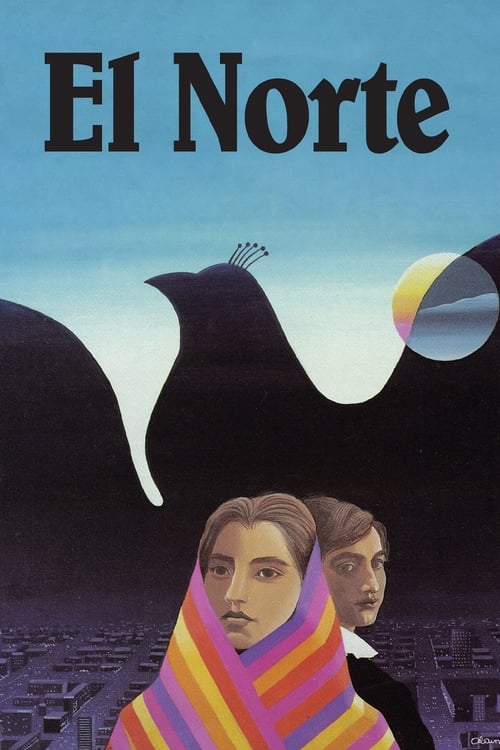
El Norte
1983 · Gregory Nava
For when you want a film that makes you feel deeply and think about the world — a serious, moving watch to sit with, not escape into. Bring tissues and someone to talk to afterward.
What it's about
Enrique and Rosa, a Maya brother and sister, flee military violence in their Guatemalan village and head north — through Mexico, across the border, and into Los Angeles — chasing the version of America they've seen in magazines. The film follows their whole journey in three movements: what they lose at home, what the crossing costs, and what the promised land actually offers.
The experience
Epic in scope but intimate in feeling — tender, harrowing, and quietly furious, with flashes of dreamlike beauty amid the hard realism. It builds an emotional weight that stays with you long after it ends.
Performances
Zaide Silvia Gutiérrez and David Villalpando are extraordinary as the siblings — open-faced, hopeful, and heartbreaking, carrying the film with a naturalness that never feels like acting.
The craft
Its three-part structure gives an intimate story the sweep of an epic, and the way it weaves Maya imagery and dreamlike touches into unflinching realism is unlike anything else in American independent film. Shot under famously difficult conditions, it has a handmade urgency you can feel.
Why it matters
A foundational work of Latino cinema in the United States — the first major American film told from the perspective of Central American migrants — and decades later it has only grown more relevant.
Snapshot
El Norte is a three-part epic of displacement and survival, following Guatemalan siblings Enrique and Rosa Xuncax as they flee military terror in their highland Maya village, traverse Mexico, cross the US border through a rat-infested drainage tunnel, and attempt to build lives in Los Angeles. Written by Gregory Nava and Anna Thomas and co-produced through the PBS American Playhouse program, it stands as the foundational text of Chicano and Latino cinema in the United States — the first film made primarily by and about Central American characters to receive broad national theatrical and television distribution. Its triptych structure, its fusion of magical realism with unsparing social naturalism, and its refusal of both sentimentality and schematic political allegory distinguish it as a singular achievement in American independent cinema. Enrique and Rosa do not represent a condition; they are specific people, and the film holds that specificity even as the forces arrayed against them are systemic and historical.
Industry & production
El Norte was produced outside the Hollywood studio system through a collaboration between Gregory Nava and Anna Thomas, working under their company Independent Productions. The film received partial funding from American Playhouse, the PBS drama strand that throughout the 1980s supported independent and minority-authored films that commercial studios would not greenlight — including contemporaries such as Testament (1983) and, later, Stand and Deliver (1988). The PBS co-production model was essential to the film's existence: it guaranteed a national broadcast audience following a limited theatrical run, giving the film a reach entirely disproportionate to its modest budget, while providing enough capitalization to shoot on location and cast professional actors across the full production.
Filming took place primarily in Mexico — in and around Oaxaca and other locations — rather than Guatemala itself. The decision was pragmatic and sobering: Guatemala in 1982–1983 was in the grip of a genocidal counter-insurgency campaign, making on-the-ground production impossible and dangerous. That the filmmakers were unable to shoot in Guatemala became itself a form of documentation — the violence was ongoing and absolute. Mexican locations were chosen to approximate the visual and ecological texture of the Guatemalan highlands, and they succeed convincingly; the production design and landscape photography create a deeply felt sense of Mesoamerican topography and community life without false exoticism.
The cast is almost entirely Latin American. David Villalpando plays Enrique and Zaide Silvia Gutiérrez plays Rosa, both delivering performances of extraordinary force in career-defining roles. The film was shot with its leads performing in Spanish and in highland Maya dialogue in the Guatemalan sequences. The decision to cast authentic Latin American actors rather than North American actors of Hispanic heritage gave the film a cultural and physical specificity rare in Hollywood or independent productions of the period, and it remains one of the cleaner arguments in the film's favor against the tendency of mainstream cinema to cast across ethnic and national specificity.
Technology
El Norte was shot on 35mm film by director of photography James Glennon. Glennon uses the full photochemical palette of the era: lush, saturated color in the highland Guatemala sequences, warmer and more dust-blown tones for the Mexican border landscapes, and a cooler, fluorescence-tinged palette for the Los Angeles sections. This chromatic progression is a sustained argument in light, tracking the narrative movement from communal rootedness through dislocation toward alienation.
No unusual technological innovations are documented in the production record. The film's technical achievement lies not in novelty but in the skilled deployment of available tools to serve the story's emotional and political demands. The practical constraints of a limited budget are absorbed into the aesthetic: scenes are frequently lit with naturalistic, available-light approaches that give the drama an unmediated, present-tense quality. The border-crossing tunnel sequence — shot in a physically constrained, genuinely hostile environment — achieves its terror through location shooting and minimal artifice rather than through constructed sets or effects.
Technique
Cinematography
Glennon's work on El Norte is among the most carefully differentiated cinematographic projects in American independent cinema of the decade. The film's triptych — Guatemala, Mexico, Los Angeles — is visually keyed at every register: color temperature, lighting ratios, depth of field, and camera movement all shift between sections to mark the protagonists' changing relationship to their environment.
The Guatemala sequences are the most visually generous. Glennon shoots the highland village and surrounding landscape with a warmth and depth that communicate both the beauty of the place and the fragility of its community. Faces are lit with care; there is an intimacy to the framing of the Xuncax family that makes the violence against them all the more devastating. The magical realist passages — butterflies appearing at moments of grief and spiritual transition, the visual vocabulary of indigenous textile and ceremony — are handled with restraint, integrated into the photographic texture rather than announced as effects.
The border-crossing tunnel sequence is a formal tour de force of a different kind: claustrophobic, shot in conditions approximating those the characters endure, with available light becoming scarce and unreliable. The threat of the rats is made visceral by the limits of what the camera can show. The image cannot fully contain the horror; the imagination is recruited.
The Los Angeles sequences are deliberately flattened by comparison with the film's opening — not ugly, but stripped of the warmth and depth that marked home. This is a cinematographic argument about what the North costs, made without a word of dialogue.
Editing
The editing follows the film's structural logic with discipline. Each of the three sections has its own pacing signature: the Guatemala sequences move with the unhurried rhythms of village life before accelerating into terror; the Mexican journey is elliptical, compressing distance and time into a series of encounters and thresholds; the Los Angeles sequences are fragmented, mirroring the discontinuous, shift-work temporality of undocumented labor.
Cuts between Guatemala and California are never deployed for ironic juxtaposition in the manner of agitprop — the film trusts its materials enough not to underline. Where contrasts are made, they emerge from the dramatic logic of the scene rather than editorial commentary. The film earns its emotions before it asks for them.
Mise-en-scène / staging
Nava's staging carries a consistent and legible spatial politics. In the Guatemalan sequences, characters inhabit space with confidence — they know where they are, how to move, what surrounds them. As Enrique and Rosa move through Mexico and into the United States, their relationship to space becomes tentative and surveilled. They huddle; they keep close to walls; they read the geography of rooms for exits and threats. This is not stated in dialogue; it is lived in the choreography of bodies in space.
The magical realist elements in the Guatemalan sequences are staged with absolute seriousness. The yellow butterflies that appear at key moments of grief and transition — drawn from a symbolic vocabulary shared with the broader Latin American magical realist tradition — are presented without irony or condescension. They are the surviving language of a culture in the process of being destroyed, and the film treats them as such.
The tunnel crossing is the film's defining set piece. It places the characters in a literally underground space, below the border, below legal status, below visibility. The staging makes the metaphysics explicit through physical reality: the body must contort, must make itself smaller than human, to achieve the crossing that the political order denies them. The rats are not symbolic. They are rats.
Sound
The sound design registers the shift between the film's three environments with precision. The Guatemalan highlands carry ambient sound that is organic and specific — birds, wind, the acoustic texture of a working community embedded in its landscape. The border region is more exposed and empty, sound carrying farther across open terrain. Los Angeles is the most sonically congested: traffic, kitchen machinery, the compressed polyglot noise of the informal economy. Each soundscape is a form of geography.
The music draws on traditional Guatemalan marimba, indigenous melodic structures, and more conventionally scored dramatic passages. The decision to anchor the score in actual Guatemalan musical culture rather than a generically "Latin" idiom was aesthetically and politically significant — it insists on specificity against the tendency, common in both Hollywood and independent cinema of the period, to collapse all Latin American cultures into an undifferentiated exotic.
Performance
David Villalpando and Zaide Silvia Gutiérrez give performances of exceptional complexity and restraint. Both convey the specific intelligence and pragmatic adaptability of people who have survived political violence and must now survive systems — immigration bureaucracy, labor exploitation, cultural dislocation — equally inhospitable to their full humanity. Neither performance reaches for martyrology; both characters want things, make choices, feel joy as well as grief.
Rosa's warmth and humor in the early Los Angeles sequences is crucial to the film's moral arithmetic. Without it, her death would be pathos. With it, it is annihilation — the loss of a person who had everything a person needs, and who needed only to be allowed to exist. Gutiérrez carries this dimension of the character with complete naturalness, making Rosa's death land as both a plot event and a political fact.
The performances are calibrated to the emotional scale of the film's different registers — the Guatemalan community scenes have an ensemble looseness; the border-crossing sequences are physically committed; the Los Angeles scenes require both actors to sustain long arcs of hope and erosion across an extended narrative.
Narrative & dramatic mode
El Norte is structured as a three-part epic, each section announced by a title card establishing place. The framework is borrowed from the classical journey narrative and the picaresque, but that generic armature is subverted throughout by the film's insistence on the cost of movement. Unlike the picaresque hero who moves freely through social strata by wit and improvisation, Enrique and Rosa move through a world systematically hostile to their movement and their survival. Mobility is not liberation; it is the desperate consequence of extermination.
The film's dramatic mode oscillates between social realism and magical realism, and the balance shifts as the narrative progresses. In Guatemala, the magical realist register is fully active — the world of the community contains its spiritual life as a visible dimension of reality, not as a supplement to it. As the siblings move north, this dimension recedes. By Los Angeles, it has almost entirely withdrawn. The trajectory is a loss of worldview as much as a loss of homeland.
The United States does not destroy Enrique and Rosa through violence alone. It destroys Rosa through the biological consequence of the crossing itself — the rat bites she sustains in the tunnel develop, with horrible logic, into the illness that kills her. The crossing that is meant to begin a life ends one. Enrique, who works toward advancement with discipline and intelligence, encounters the structural ceiling of his undocumented status: a ceiling that is not about individual merit or failure but about the legal conditions under which his labor is maximally exploitable.
The film refuses the consolation arc. The American Dream as narrative structure — arrival, struggle, assimilation, earned success — is not delivered. Enrique's final moments, returning to day labor after Rosa's death, closing the circle he had hoped to escape, are a structural argument about the limits of individual aspiration against systemic exclusion.
Genre & cycle
El Norte belongs to several overlapping generic and historical cycles. As immigration cinema, it is the landmark precursor of a tradition that would include Sin Nombre (Cary Joji Fukunaga, 2009) — its most direct structural heir, another journey north through Mexico, another young woman whose fate is determined by the crossing — as well as The Visitor (Thomas McCarthy, 2007), Dheepan (Jacques Audiard, 2015), and the broader international art cinema of displacement. Its triptych journey structure participates in a long lineage of odyssey narratives, with John Steinbeck's and John Ford's The Grapes of Wrath (1940) as an acknowledged structural antecedent: the dispossessed family driven from home by forces beyond individual control, seeking a North that turns out not to be what was promised.
As political cinema, El Norte belongs to the early 1980s cycle of American films engaging Reagan-era Central American policy: alongside Missing (Costa-Gavras, 1982), Under Fire (Roger Spottiswoode, 1983), and Salvador (Oliver Stone, 1986), it constitutes a body of work reckoning with US complicity in Latin American political violence. El Norte is the most intimate of these films — the least interested in US characters as protagonists or witnesses, the most committed to the interiority of those on the receiving end of that policy.
As independent American cinema, it is a founding document of a tradition of Chicano and Latino filmmaking that predates the Sundance-era independent film boom by a decade, operating with resources and distribution mechanisms that had little to do with the emerging festival circuit infrastructure.
Authorship & method
Gregory Nava (born 1949, San Diego) is a Chicano director whose career has been shaped by the tension between the mainstream commercial work he is capable of and the politically committed, culturally specific films he makes with Anna Thomas. El Norte was the breakthrough that established both their reputations. Nava's subsequent feature My Family / Mi Familia (1995), produced with New Line Cinema, addressed the multigenerational experience of a Mexican-American family in Los Angeles with comparable ambition; Selena (1997) was a mainstream biographical musical. The trajectory from El Norte to these later films traces the absorptive pressure that commercial success exerts on minority-authored cinema — Nava has continued working in both registers without fully resolving the tension between them.
Anna Thomas co-wrote the screenplay and produced the film; the collaboration between Thomas and Nava is foundational to El Norte's achievement, and it is impossible to assess the film's authorship without accounting for her contribution across both creative and logistical dimensions. Thomas and Nava spent significant time in research with Guatemalan communities, and the screenplay's grounding in the specific details of highland Maya cultural life — the weaving traditions, the community structures, the forms of indigenous political consciousness — reflects sustained engagement with the material rather than ethnographic shorthand. Thomas and Nava received an Academy Award nomination for Best Original Screenplay for El Norte, the most prominent institutional recognition the film received on its initial release.
James Glennon's cinematographic contribution is central to the film's visual argument. His subsequent career — which included work with Todd Solondz on Welcome to the Dollhouse (1995) and Happiness (1998) — confirms a consistent alignment with the American independent sector and its preference for the photographic register of social reality over spectacle.
Movement / national cinema
El Norte is the foundational film of Chicano cinema in the sense of having achieved the widest visibility of any film in that tradition up to its date and having established the terms on which Latin American experience would be addressed in American independent film for the following decades. The Chicano cinema movement had produced significant work before El Norte — the films of Jesús Salvador Treviño, the documentary work that emerged from the civil rights movement, Luis Valdez's theatrical and film work — but none had achieved comparable national distribution or critical recognition within the dominant culture's institutions.
The film is also legible as a contribution to Latin American political cinema more broadly. It shares its concern with indigenous community, military state violence, and the consequences of American hemispheric policy with the New Latin American Cinema movement — the Brazilian Cinema Novo, the Argentine and Chilean political films of the 1960s and early 1970s — while being made from a position outside Latin America and within the US independent system. The magical realist register connects it to a wider tradition of Latin American cultural production in which the spiritual and the political are understood as continuous rather than separate registers of experience, a tradition the film neither exoticizes nor abandons.
Era / period
El Norte was made and released in 1983, one of the most politically turbulent years in recent Central American history. The Guatemalan army's counter-insurgency campaign against indigenous highland communities — later adjudicated as genocide by Guatemalan courts — was at its height during the film's production. The Reagan administration's provision of military and economic support to successive Guatemalan governments was a subject of active domestic political debate in the United States. The film does not engage in editorial commentary on this policy landscape; it situates two people inside the consequences of that policy and allows their experience to be the argument. This is a more durable form of political cinema than the kind that names its targets.
The era is also defined, for American independent cinema, by the emergence of the PBS co-production model, the early infrastructure of what would become the Sundance ecosystem, and the gradual consolidation of American independent film as a recognizable cultural category. El Norte precedes and in some ways enables this consolidation, operating in the gaps of the industry rather than within an established independent distribution system. Its existence proves that such films were possible before the infrastructure to support them was fully built.
Themes
The film's central thematic concern is the destruction of home and the structural impossibility of its replacement. The Guatemalan sequences establish the Xuncax family's life as embedded in a specific culture, landscape, ecology, and spiritual system — a life that already has, in lived form, what the North is imagined to promise. The violence that destroys this life is political and external; the dream of El Norte is born not from poverty alone but from the annihilation of what already existed.
The American Dream functions in the film as a myth whose primary effect is to redirect attention from the political causes of displacement toward the individual's capacity to succeed within a new order. This is the film's sharpest ideological argument, and it is made through narrative structure rather than through dialogue or editorial statement. Enrique, who pursues advancement with intelligence and genuine effort, encounters a ceiling that is not about individual merit but about the legal architecture within which his labor is maximally exploitable.
Cultural identity and its attrition under assimilative pressure is treated with precision. Rosa and Enrique are not opposed to the United States; they find things to love in it, moments of humor and genuine aspiration within the harshness. The film refuses the trap of homeland romanticism as well as the trap of immigrant triumphalism. What it will not grant is the erasure of cultural identity as a tolerable price of survival. Rosa's delirium near death — in which she reverts entirely to Mayan language and imagery, speaking of the world she came from — is the film's implicit claim that this dimension of a person cannot be surrendered without losing something that cannot be recovered.
Labor exploitation is documented with specificity. Enrique's trajectory through Los Angeles is through the restaurant and service economy — dishwasher, busboy, potential supervisor — and the film documents the conditions of this work with ethnographic accuracy. Rosa's work in domestic service is similarly grounded. The threat of INS enforcement that structures the daily life of both characters is operational and constant, shaping every decision and relationship. The film does not present this as an aberration; it presents it as the system functioning as designed.
Reception, canon & influence
Critical reception at the time of release was strong, with particular recognition for the screenplay and the performances. The Academy Award nomination for Best Original Screenplay, shared by Nava and Thomas, was the most prominent marker of institutional recognition. American critics generally responded to the film's political urgency and its visual ambition, though some framing — particularly in mainstream venues — reduced it to "issue film" in ways that obscured its formal and generic complexity. The PBS broadcast substantially widened the audience beyond what the limited theatrical release could sustain, giving the film a national reach unusual for work of its kind.
Influences on El Norte: The film's major antecedents in the American tradition include The Grapes of Wrath (Ford, 1940), whose dispossessed Okies provide the structural parallel Nava himself has acknowledged — the journey north toward a promised land that turns out to be merely another form of exploitation. The Italian Neorealist tradition (Rossellini, De Sica, Visconti) is present in the combination of location shooting, non-professional or debut actors, and contemporary social subjects that produce a moral weight unavailable to studio artifice. The magical realist register draws from the Latin American literary tradition, with García Márquez as the obvious entry point, though the specifically Mayan cultural context connects the film's visual symbolism to a pre-Columbian worldview that predates and exceeds the García Márquez synthesis. The political cinema of Latin America — particularly the Argentine and Chilean films made before the military coups of the mid-1970s — provides a precedent for integrating personal and political drama without subordinating one to the other.
Legacy and forward influence: El Norte's most direct legacy is the tradition of Central American and Latin American immigrant narratives in American and international independent film that it inaugurated. Sin Nombre (Fukunaga, 2009) is its clearest structural heir — another journey from Central America through Mexico, another young woman whose fate is sealed by what the crossing costs. More broadly, the film established that the experience of the undocumented Central American immigrant could be the unmediated, primary subject of a serious American film, not a background condition or supporting element in a story about North American protagonists. That this proposition needed establishing in 1983, and that El Norte established it, defines the film's historical position.
El Norte was selected for preservation in the United States National Film Registry by the Library of Congress, recognizing its cultural, historical, and aesthetic significance — an institutional affirmation that ratifies what decades of film scholarship and curricula had already confirmed. The film is a standard text in Chicano/Latino Studies and American Film Studies programs, and its claim to have inaugurated a tradition is largely uncontested. The record of influence running forward from El Norte — through the Chicano filmmaking of the 1990s, through the independent Latin American films of the 2000s, through the contemporary wave of migration narratives — is the record of a film that defined the terms of a conversation that is still ongoing.
A Deleuzian reading
The rats come back first.
The full Deleuzian reading of El Norte →
Reception
A scrappy indie shot under genuinely dangerous conditions, it broke through in 1983 with a surprise Oscar nomination for Best Original Screenplay — rare air for an independent film then — and has only grown in stature since, entering the National Film Registry in 1995 and the Criterion Collection.
How El Norte was received, from release to now →
Influences: the films it descends from and the films it influenced
- The Grapes of Wrath (1940) — Nava explicitly adapted Ford's three-part journey structure — dispossession in the homeland, the crossing, exploitation in the promised land — including the ironic inversion that arrival merely transforms the migrants' subjugation rather than ending it.
- Bicycle Thieves (1948) — The Italian neorealist method of shooting working-class subjects in their actual environments with available light establishes the formal template for a moral authority unavailable to studio artifice — the direct inheritance Nava acknowledged in El Norte's location-first production approach.
- La Terra Trema (1948) — Casting community members to perform versions of their own economic dispossession — Sicilian fishermen in situ — set the ethical precedent for El Norte's use of Guatemalan villagers and debut actors to ground the film's spatial politics of displacement in genuinely inhabited space.
- Los Olvidados (1950) — Buñuel's technique of embedding surrealist dream sequences within a rigorously social-realist structure — so the oneiric register emerges from and returns to the material world without rupturing the film's political credibility — is the direct formal precedent for El Norte's magical-realism integration.
- Salt of the Earth (1954) — The only significant US-made precedent for placing Mexican-American workers as the unmediated political subjects of a serious film, shot in available light on actual labor sites — El Norte's anti-American dream and its spatial staging of exploitation both build on the ground this film broke.
- Blood of the Condor (1969) — Sanjinés placed Quechua-speaking indigenous protagonists at the center of an anti-imperialist narrative in their own language without subordinating their cultural specificity to the political thesis — the direct model for El Norte's bilingual Maya-Spanish performance register and its refusal of agitprop juxtaposition.
- El Chacal de Nahueltoro (1969) — Littín's section-differentiated structure — each chapter of a peasant's life shot and cut at a distinct rhythmic and visual register to mark the ruptures between episodes — is the formal template for El Norte's three-section editing strategy, where pacing itself carries the film's argument about geographic and temporal displacement.
- Like Water for Chocolate (1992) — Extends El Norte's formal strategy of making magical realism a structural mechanism rather than atmospheric decoration — here the supernatural literally transmits emotional states through food — developing into Mexican melodrama the precedent El Norte set for Latin American film.
- My Family (1995) — Nava's direct extension of El Norte's multigenerational immigrant narrative uses section-differentiated cinematography — distinct lenses and color temperatures for different eras — to carry the triptych logic of accumulated displacement across three generations of a single Mexican-American family.
- Bread and Roses (2000) — Translates El Norte's spatial politics of displacement into the Los Angeles service-sector workplace — the janitorial space as a zone where immigration status is actively weaponized for labor control — extending El Norte's staging of the same workers in the same city into their daily economic captivity.
- Maria Full of Grace (2004) — Structures a Colombian protagonist's crossing to the US as the same ironic anti-American dream El Norte defined: arrival provides survival but not liberation, with naturalistic non-professional performance producing the testimonial texture El Norte established for immigrant cinema's central register.
- Sin Nombre (2009) — The most structurally faithful heir: Central American youth traveling north through Mexico in a section-paced narrative, with available-light chromatic naturalism differentiated by geographic zone and an anti-American dream endpoint where the crossing costs more than it yields.
- The Golden Dream (2013) — Guatemalan indigenous youth journeying north, shot entirely in available light with non-professional actors drawn from the depicted communities — El Norte's formal and cultural method for immigrant cinema carried to its fullest realization thirty years later.
- Real Women Have Curves (2002) — Founded the US Latino indie idiom Cardoso works within—neorealist immigrant-family drama shot on location with Spanish-language authenticity rather than Hollywood gloss.
- Under the Same Moon (2007) — Founds the U.S. Spanish-language border-crossing film on the crosscut village-to-crossing structure and the gap between the imagined and the real 'North' — the migration-cinema template Riggen inherits directly.
- Pixote (1980) — Babenco's casting of actual street children to perform their own precarity — blurring documentary and fiction in a way that makes structural violence legible without spectacle — shares El Norte's ethical commitment to non-professional performance as testimonial form for subjects the industry renders expendable.
- Zoot Suit (1981) — The immediate Chicano theatrical-cinematic tradition from which Nava emerged: Valdez's bilingual performance register and hybrid formal vocabulary address Mexican-American political experience without defaulting to assimilationist framing or agitprop didacticism — the movement context El Norte inhabited.
- Alsino and the Condor (1982) — Littín's Nicaraguan-set film integrates a boy's flight fantasies as structural magical realism within a Central American war narrative — the closest contemporary model for El Norte's technique of allowing the magical-realist register to recede as political reality becomes untenable, rather than maintaining it decoratively.
Similar films
- Maria Full of Grace (2004) — influence & lineage
- The Grapes of Wrath (1940) — influence & lineage
- Like Water for Chocolate (1992) — influence & lineage
- Norte, the End of History (2014) — shared sensibility
- Innocent Voices (2005) — shared sensibility
- Minari (2021) — shared sensibility
- Under the Same Moon (2007) — shared sensibility
- Y Tu Mamá También (2001) — shared sensibility
All the films related to El Norte →