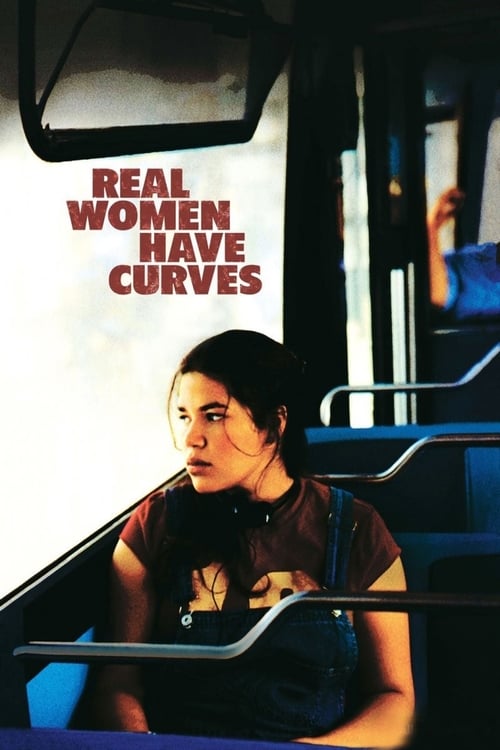
Real Women Have Curves
2002 · Patricia Cardoso
For when you want a coming-of-age story that actually feels like life — a comfort watch with a spine, good for a night when you need to believe in someone choosing herself.
What it's about
Ana García is eighteen, sharp, and first in her family to have a shot at college — a scholarship to Columbia is on the table. Her mother has other plans: marriage, children, and long summer days sewing dresses at the family's cramped factory in East LA. The film follows one hot season in which Ana works the factory floor and fights, lovingly and furiously, for the right to her own life.
The experience
Warm, funny, and quietly defiant — it plays like a family argument you're invited into, full of gossip, sweat, and sudden grace. You come out lighter than you went in, and prouder of everyone in it.
Performances
America Ferrera, in her first-ever role, is instantly a star — funny, stubborn, and completely real — and Lupe Ontiveros makes the mother infuriating and heartbreaking in the same breath.
The craft
Patricia Cardoso shoots the dress factory not as misery but as a world — labor, banter, and stubborn dignity in the heat — and the film's most famous scene, in which the women shed their shame along with their blouses, became a landmark of body acceptance on screen. The writing, adapted from Josefina López's play, keeps every character loose and specific instead of dutiful.
Why it matters
It won the Sundance Audience Award, launched America Ferrera, and became a foundational film for Latina representation in American movies — beloved far beyond what the industry gave its director afterward.
Patricia Cardoso's adaptation of Josefina López's play arrived from Sundance in 2002 with an Audience Award and a discovery: eighteen-year-old America Ferrera, in her first role, as Ana García of East Los Angeles, caught between a scholarship to Columbia and a mother who needs her at the family's cramped Boyle Heights dress factory. What could have been a dutiful issue picture is instead loose, funny, and precisely observed — Cardoso, a Colombian-born director trained as an archaeologist, shoots the factory not as a site of misery but of labor, gossip, and stubborn dignity, and the celebrated scene in which the women shed their shame along with their blouses in the sweltering heat became an instant landmark of body acceptance onscreen. The film's fortunes tell their own story about the industry: acclaimed, beloved, and yet Cardoso struggled for years to mount a follow-up. In 2019 it entered the National Film Registry, making her the first Latina director so honored — a canonization the culture took seventeen years to catch up to.
Reception
A Sundance darling in 2002 (it won the Audience Award), it was quietly loved but under-distributed as an HBO Films indie — then fully canonized when the Library of Congress added it to the National Film Registry in 2019, making Patricia Cardoso the first Latina director in the Registry.
How Real Women Have Curves was received, from release to now →
Influences: the films it descends from and the films it influenced
- Salt of the Earth (1954) — Cast actual working-class and nonprofessional Chicana women to dramatize a wife's double burden of labor and domestic servitude, setting the template for social-realist drama built around Latina worker solidarity.
- El Norte (1983) — Founded the US Latino indie idiom Cardoso works within—neorealist immigrant-family drama shot on location with Spanish-language authenticity rather than Hollywood gloss.
- Stand and Deliver (1988) — Rendered a specific East LA Chicano milieu through restrained naturalism and Spanglish dialogue used as a marker of lived authenticity, not exotic coloring.
- Mi Vida Loca (1993) — Assembled a non-glamorized ensemble of Echo Park Latinas using community casting and unpolished handheld naturalism, prioritizing texture over plot mechanics.
- My Family / Mi Familia (1995) — Structured a multigenerational Mexican-American saga around parent-child rupture across the assimilation divide—the mother/daughter-versus-tradition frame Real Women inherits wholesale.
- Secrets & Lies (1996) — Built a mother-daughter class melodrama through long improvisation-rooted rehearsal, the naturalist-ensemble method underneath Real Women's kitchen-table confrontation scenes.
- Selena (1997) — Centered a father policing his ambitious daughter's body and public presentation—the exact parental-control-of-the-daughter dynamic Cardoso stages between Ana and her mother.
- Quinceañera (2006) — East LA coming-of-age indie that centers a Latina teen's body—her pregnancy—against family shame and class precarity, extending Ana's body-and-honor conflict.
- Precious (2009) — Anchors a body-and-class drama on an un-idealized, plus-size breakout lead locked in a brutal mother-daughter war, extending the un-glamorized-body-plus-newcomer-actress craft.
- Mosquita y Mari (2012) — Inherits Real Women's first-generation, working-class Chicana textures and quiet naturalism, then pushes the coming-of-age into queer desire.
- Girlhood (Bande de filles) (2014) — Uses a naturalist working-class girl-collective and the body/self-image as narrative engine, echoing the peer-and-body reclamation at Real Women's core.
- The Farewell (2019) — Culturally specific immigrant-family drama pivoting on a young woman negotiating tradition against self-determination—the generation-gap-across-assimilation craft carried forward.
- Bread and Roses (2000) — Applied Loach's observational, documentary-plain realism to LA's immigrant Latina laborers, the same garment-district labor politics staged without melodramatic uplift.
- Girlfight (2000) — A Sundance breakout debut vehicle for a working-class Latina lead whose bodily self-possession drives the arc, paralleling Ferrera's debut and physical-presence casting.
- Raising Victor Vargas (2002) — Same-year Sundance naturalism using nonprofessional Latino teens and cramped, lived-in apartment interiors to make a coming-of-age feel documented rather than scripted.
- Real Women Have Curves (stage-to-screen method) (2002) — Preserves Josefina López's single-location factory as a theatrical pressure-cooker set, keeping the play's confined staging as the film's dramatic engine.
- Saving Face (2004) — Same 2000s indie register of immigrant mother-daughter generational friction and a young woman's fight for bodily and life autonomy against maternal expectation.
Similar films
- El Norte (1983) — influence & lineage
- The Joy Luck Club (1993) — shared sensibility
- The Second Mother (2015) — shared sensibility
- All About My Mother (1999) — shared sensibility
- Lady Bird (2017) — shared sensibility
- Saving Face (2004) — shared sensibility
- La Ciénaga (2001) — shared sensibility
- I'm Still Here (2024) — shared sensibility