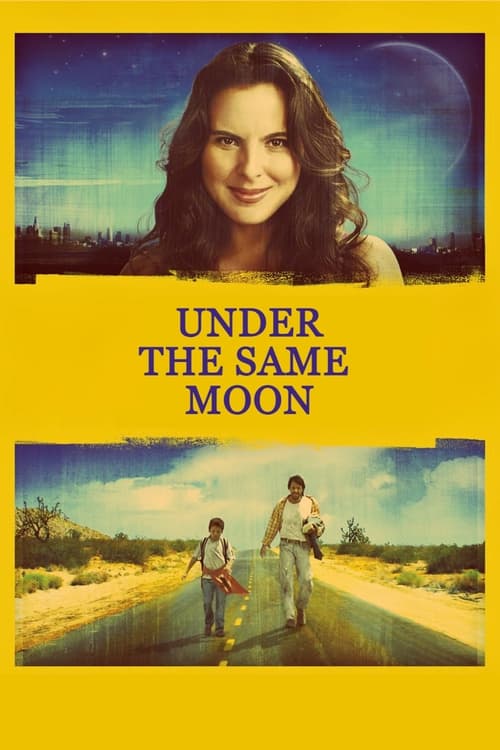
Under the Same Moon
2007 · Patricia Riggen
For when you need a good cry and want it earned by real stakes — family separation, hope, the ache of a phone call. Comfort viewing in the sense that it believes in people, even when the journey is hard.
What it's about
Rosario works without papers as a domestic in Los Angeles, sending money home; her nine-year-old son Carlitos lives with his grandmother in Mexico, knowing his mother only through a weekly phone call. When circumstances leave the boy on his own, he sets out to cross the border and find her himself — and the film cuts between mother and son as they move toward each other.
The experience
Openly emotional and unashamed of it — a warm, propulsive tearjerker that alternates peril with kindness and keeps the two-strand structure pulling you forward. It aims straight for the heart and hits it.
The craft
Patricia Riggen and screenwriter Ligiah Villalobos build the film on parallel editing — two lives intercut across a border — so the geography itself becomes the antagonist. Its bilingual, ground-level view of migrant life gives the melodrama documentary texture without ever slowing the story down.
Why it matters
A Sundance 2007 breakout that sparked an unusually fierce bidding war for a Spanish-language debut, it proved a bilingual immigration story could be a mainstream audience hit and became a touchstone film for Mexican-American families.
Snapshot
Under the Same Moon (Spanish title La misma luna) is a bilingual melodrama built on one of the sturdiest engines in narrative cinema: two people separated by distance and circumstance, cutting toward each other for the length of a film. Its innovation is not formal but demographic and political. Directed by Patricia Riggen from a screenplay by Ligiah Villalobos, the film tells the parallel stories of Rosario, an undocumented Mexican domestic worker in Los Angeles, and her nine-year-old son Carlitos, left behind in Mexico with his grandmother. When the grandmother dies, Carlitos sets off alone across the U.S.–Mexico border to find his mother. The picture premiered at the 2007 Sundance Film Festival, where it drew notice both for its emotional directness and for a bidding response unusual for a Spanish-language debut feature. It went on to become one of the more commercially successful Spanish-language releases in the United States of its period. Its enduring interest lies in how it wraps a heated contemporary subject — migration, family separation, and the interior life of the undocumented — inside the accessible, deliberately sentimental grammar of the road movie and the maternal melodrama.
Industry & production
The film arrived at a specific industrial moment: the mid-2000s recognition by American independent distributors that U.S. Latino audiences represented a large, underserved market, coinciding with intense national debate over immigration reform. Riggen, a Mexican director trained partly in the United States, made Under the Same Moon as her narrative feature debut. It was produced with Mexican and U.S. involvement, positioning it as a cross-border production in both subject and financing.
Its breakout event was Sundance 2007, where the film generated a competitive acquisition situation — it was picked up for U.S. distribution by Fox Searchlight in partnership with the Weinstein Company, a notable outcome for a subtitled Spanish-language drama by a first-time feature director. That dual-distributor arrangement signaled that the majors' specialty arms saw crossover potential beyond the arthouse. The picture was released theatrically in 2008 and performed strongly relative to its scale, becoming a reference point for the viability of Spanish-language theatrical releases in the U.S. market. I want to flag that precise budget and final box-office figures should be confirmed against a primary source rather than asserted here; the salient, well-established fact is its comparative commercial success as a Spanish-language release, not a specific gross.
Technology
Technologically the film is unremarkable by design, and that plainness is worth stating rather than dressing up. It was produced within the conventional late-2000s framework of a modestly budgeted narrative feature: photochemical or digital-intermediate finishing consistent with the era, naturalistic location shooting on both sides of the border, and no reliance on visual effects, elaborate camera rigs, or novel capture systems. The technological "advance," insofar as there is one, is distribution-side rather than production-side: the film is a small artifact of the moment when specialty distributors began treating a bilingual, subtitle-dependent release as a mainstream-adjacent theatrical proposition rather than a purely festival object. The record on specific cameras, stocks, or post-production pipeline is thin, and I won't manufacture detail; the honest summary is that the film's tools serve invisibility, keeping attention on faces and journeys.
Technique
Cinematography
The cinematography, by Checco Varese, favors legibility and warmth over stylization. The visual strategy is organized around the film's central structural conceit — cross-cutting between two locations — so the photography works to keep the two worlds distinct yet rhymed: Carlitos's dusty, sunlit Mexican passage and Rosario's cooler, more enclosed labor in Los Angeles interiors and affluent households. The camera stays close to the child, frequently at or near his eye level, which both aligns the audience with his vulnerability and keeps the epic scale of a border-crossing odyssey grounded in a small body moving through large, indifferent spaces. This is functional, emotionally directed camerawork rather than showy composition; its ambition is empathy, not spectacle.
Editing
The editing carries the film's entire architecture, because the movie is fundamentally a parallel-montage machine. Its meaning depends on the intercutting of mother and son — two people we know are converging before they do — so that the audience holds the connection the characters cannot yet feel. The title itself ("the same moon") names the device: cutting between two people under one sky. The film's suspense and its sentiment are both generated in the cut, timing the withheld reunion for maximum accumulated longing. I'd rather not attribute the editing to a named editor without confirmation, but the technique is unambiguous: classical crosscutting deployed for melodramatic tension, structured as a countdown toward contact.
Mise-en-scène / staging
Staging is built on contrast between kinds of space. Carlitos moves through transitional, liminal environments — buses, back rooms, roadside stops, the border zone itself — while Rosario is repeatedly framed inside other people's homes, performing domestic labor in spaces that are intimate but not hers. This spatial logic quietly dramatizes the migrant condition: the mother is physically inside American domestic life yet excluded from it, the child is perpetually in motion and belonging nowhere. Props and small objects — a phone booth, a photograph, money folded and hidden — recur as tokens of connection across distance, giving the mise-en-scène a chain of tangible links standing in for the severed physical bond.
Sound
Sound and music work openly in the sentimental register. The score by Carlo Siliotto underlines emotional beats without apology, and the film integrates Mexican regional and popular music as both texture and statement — most memorably in an on-screen appearance by the norteño group Los Tigres del Norte, whose presence is itself a piece of cultural signification, tying the story to a musical tradition long associated with migration narratives and border life. Bilingual dialogue is a structural sound element as much as a linguistic one: the movement between Spanish and English maps the characters' movement between worlds, and code-switching marks who holds power in a given room.
Performance
Performance is where the film lives or dies, and it is largely carried by two: Adrián Alonso as Carlitos and Kate del Castillo as Rosario. Alonso's work is the load-bearing element — a child performance asked to sustain an entire odyssey while avoiding the twin traps of cloying cuteness and false toughness. Del Castillo plays Rosario with a restrained ache, a woman whose sacrifice is expressed less in speeches than in fatigue and withheld emotion. The film also uses the comic actor Eugenio Derbez in a more dramatic register as Enrique, the reluctant traveling companion Carlitos acquires, and features America Ferrera and the veteran Carmen Salinas in support. The casting mixes established Mexican-industry names with figures recognizable to U.S. Latino audiences, another sign of the film's crossover design.
Narrative & dramatic mode
The dramatic mode is unabashed melodrama in the classical sense: a story that externalizes moral and emotional stakes, builds toward an ordained reunion, and trusts feeling as a legitimate route to meaning. Structurally it is a double narrative — a maternal melodrama braided with a child's quest — and it borrows the shape of the road movie for the boy's line, complete with the episodic encounters, temporary companions, and threshold ordeals that genre supplies. The engine is dramatic irony sustained across the whole film: the audience always knows the geography of the reunion the characters are blindly working toward. The mode is deliberately non-ambiguous; where a more austere art-cinema treatment of the same material (and there are several) would refuse catharsis, Under the Same Moon commits to emotional payoff as its reason for being.
Genre & cycle
The film sits at the intersection of two genre traditions. First, the family melodrama, with its focus on separation, sacrifice, and the mother-child bond as the site of the deepest feeling. Second, the border narrative — the body of films concerned with the U.S.–Mexico frontier as a physical and symbolic passage. Within that cycle, Under the Same Moon belongs to a mid-2000s wave of screen works that put migration and the undocumented experience at the center rather than the margin, a wave that included both harsher, more naturalistic treatments and, as here, more accessible humanist ones. Its distinguishing move within the cycle is point of view: it foregrounds the child and the mother — the domestic, intimate, sentimental face of migration — rather than the criminalized or violent framing more common in border thrillers.
Authorship & method
Patricia Riggen's authorship here is legible as a commitment to humanist accessibility: taking politically charged material and rendering it through warmth, clarity, and identification rather than provocation. This debut established a method she would carry forward into English-language studio work — foregrounding resilience, family, and ordinary heroism — later visible in her Hollywood assignments. The screenplay by Ligiah Villalobos is the film's true structural author, since the parallel-story architecture and the withheld reunion are script-level decisions; Villalobos's design is what makes the movie work as a suspense mechanism as much as a tearjerker. Among key collaborators, cinematographer Checco Varese supplied the film's grounded, face-forward look, and composer Carlo Siliotto supplied its emotional scoring; the music also functions through curated Mexican regional selections, including the Los Tigres del Norte appearance. The editorial authorship — the discipline of the crosscutting — is central to the film's effect even where I'd want to confirm the individual credit before naming it.
Movement / national cinema
The film is best understood within contemporary Mexican cinema's transnational turn, the period in which Mexican filmmakers and stories circulated across the U.S. border both as subject and as industry. It is not a work of the auteurist "New Mexican Cinema" associated with the era's internationally feted directors; it belongs instead to a more populist, cross-border commercial strand aimed squarely at Spanish-speaking and bicultural audiences on both sides of the frontier. As such it is a document of a binational cinema — Mexican in language, cast, and sensibility, American in setting, distribution, and market ambition — and of the growing recognition that "national cinema" is an inadequate box for stories about people who live between nations.
Era / period
Under the Same Moon is very much a film of the mid-to-late 2000s United States, and it cannot be separated from that moment's immigration politics. It reached audiences during a period of failed comprehensive immigration reform, heightened enforcement, and vociferous public debate over undocumented workers — the same climate that fueled large-scale immigrant-rights marches in 2006. The film's emotional argument, that behind the abstraction of "illegal immigration" are specific mothers and specific children, was a direct intervention in that discourse, timed to a period when the topic was inescapable in American public life. Its sentimentality is period-appropriate strategy: a bid to move a mainstream audience on an issue usually argued in statistics and slogans.
Themes
The governing theme is maternal sacrifice — the cost, borne by women, of providing for children across an enforced distance. Braided with it are the theme of family separation as the human interior of migration policy, and the theme of belonging: both mother and son exist in spaces that are not theirs, defined by the gap between physical presence and legal or emotional inclusion. The title crystallizes the film's central metaphor of connection across separation — one moon over two lands — and the recurring motif of the weekly phone call, made from a fixed public phone booth, gives that abstraction a concrete ritual. Money, too, is a persistent thematic object: remittance as love made material, the dollar as the medium through which care crosses the border. Underneath runs a quieter theme about childhood agency — a boy who refuses to wait, and whose journey inverts the usual direction of protection between parent and child.
Reception, canon & influence
Critically, the film met a divided but largely warm response typical of accomplished melodrama: praise for its emotional power, the performances (especially the young Alonso), and its humane framing of an urgent subject, set against reservations from some critics about its sentimentality and the neatness of its resolution. That split — moved audiences, wary critics — is characteristic of the genre it embraces, and the film has generally been treated as an effective, sincere popular work rather than a formal landmark.
Looking backward, its influences are clear: the long tradition of maternal melodrama, the road movie's episodic quest structure, and the specific lineage of border and migration cinema that precedes it. The prominence of Los Tigres del Norte also connects the film to a musical tradition of migration storytelling that long predates it.
Looking forward, the film's most concrete legacy is industrial and cultural rather than stylistic. Its Sundance reception and comparative commercial success helped make the case, at a pivotal moment, that Spanish-language and bilingual films about the Latino experience could find a substantial theatrical audience in the United States — an argument that mattered for how distributors and studios subsequently approached that market. It also functioned as a launch and consolidation point for Riggen's transnational career. Perhaps most durably, it endures as a widely taught and widely screened humanist text on migration and family separation, its central image — mother and child under the same moon — retaining resonance as the political questions it dramatized have only intensified in the years since its release.
Reception
Critics in 2007-08 largely shrugged it off as shameless tearjerker melodrama, but audiences never got the memo — it became one of the highest-grossing Spanish-language films ever released in the US, and years of immigration headlines have only made its mother-son separation story feel more current, not less.
How Under the Same Moon was received, from release to now →
Influences: the films it descends from and the films it influenced
- Intolerance (1916) — Originates the accelerating parallel-montage of separate storylines toward a climax — the crosscutting-across-independent-narratives grammar Riggen borrows to run mother and son as one suspense engine.
- Stella Dallas (1937) — Codifies the maternal-sacrifice melodrama built on separation and a mother watching her child from outside a barrier — the withheld-proximity structure whose emotional logic underwrites the film's deferred reunion.
- Bicycle Thieves (1948) — Neorealist episodic city-quest anchored to a child kept at the parent's side, shot at the boy's height with a nonprofessional child lead — the child-eye-level, face-forward observational register Checco Varese echoes.
- The Grapes of Wrath (1940) — Builds the migration narrative as an episodic road structure of a displaced family moving between way-stations, each leg a self-contained dignity-under-hardship vignette — the quest architecture Villalobos gives the son.
- El Norte (1983) — Founds the U.S. Spanish-language border-crossing film on the crosscut village-to-crossing structure and the gap between the imagined and the real 'North' — the migration-cinema template Riggen inherits directly.
- Central Station (1998) — Pairs a child with a reluctant adult on an episodic road journey toward an uncertain parental reunion, powered by the surrogate-guardian dynamic and a deferred, unguaranteed meeting.
- A Better Life (2011) — Renders an undocumented parent-child bond in Los Angeles through the same humanist register of ordinary heroism and resilience — warmth and identification over provocation — that defines Riggen's method.
- Sin Nombre (2009) — Transposes the migration road movie onto La Bestia, using the moving freight train as an episodic set for way-station encounters northward — extending the border-crossing journey structure into kinetic set-piece form.
- La Jaula de Oro (2013) — Follows child migrants' northbound journey and takes its title from the Los Tigres del Norte corrido, extending the diegetic norteño migration-song tradition Riggen foregrounds into a full narrative feature.
- Which Way Home (2009) — Carries the child-eye migration story into documentary, tracking unaccompanied minors toward the U.S. border at their own height — the nonfiction extension of the film's child-lead perspective on separation.
- Instructions Not Included (2013) — A bilingual transnational family melodrama structured around a child lead and a withheld parental truth, whose record U.S. Latino box office cashes the market argument Riggen's crossover success first made.
- Icebox (2018) — Stages family separation from the detained child's point of view, sustaining dramatic irony between a minor inside the system and a parent outside it — the child-perspective separation drama updated to the detention era.
- Sleepless in Seattle (1993) — Runs a double-narrative on pure crosscut dramatic irony — two people the audience knows are converging but who never meet until a single withheld final reunion, the exact suspense mechanism of Villalobos's script.
- Babel (2006) — Deploys transnational hyperlink crosscutting across languages and borders, imperiling a child through an adult's undocumented crossing — the bilingual, border-spanning parallel-montage architecture shared with Riggen's design.
- Maria Full of Grace (2004) — Grounded, face-forward Spanish-language Latin American migration realism that proved a subtitled Latino-experience film could hold U.S. theatrical audiences — the industrial precedent Riggen's Sundance success consolidated.
- Frozen River (2008) — A mother-driven border-smuggling drama staging maternal desperation as physical risk across a national line, extending the maternal-sacrifice melodrama into the concrete geography of the crossing.
Similar films
- El Norte (1983) — influence & lineage
- Central Station (1998) — influence & lineage
- Babel (2006) — influence & lineage
- Y Tu Mamá También (2001) — shared sensibility
- Minari (2021) — shared sensibility
- Amores Perros (2000) — shared sensibility
- I Dream in Another Language (2017) — shared sensibility
- Like Water for Chocolate (1992) — shared sensibility