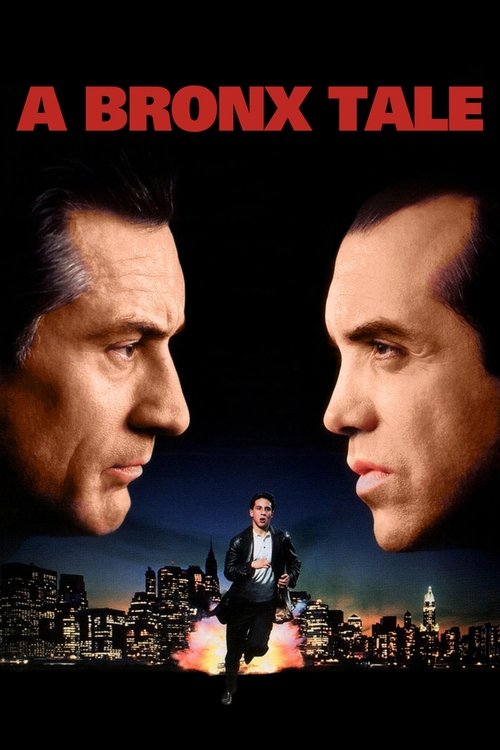
A Bronx Tale
1993 · Robert De Niro
For a satisfying, old-school night in — when you want a crime movie with heart, or a coming-of-age story with teeth. Comfort viewing that still has something to say about the choices that make a man.
What it's about
In the Belmont neighborhood of the Bronx in the 1960s, an Italian-American boy grows up pulled between two fathers: his actual one, an honest, hardworking bus driver, and the local mob boss who takes the kid under his wing after a moment of street-code loyalty. As he becomes a teenager, his forbidden attraction to a Black girl from across the neighborhood line tests everything both men taught him.
The experience
Warm, nostalgic, and streetwise, with sudden flashes of real violence that remind you what's at stake. It plays like a memoir told out loud — funny, affectionate, and building to genuine moral weight.
Performances
Chazz Palminteri, adapting his own life story, gives the mob boss a magnetic mix of menace and genuine wisdom, and Robert De Niro deliberately underplays the bus-driver father so that decency itself becomes compelling. The two models of manhood feel equally persuasive, which is the whole point.
The craft
De Niro's directorial debut, adapted by Palminteri from his autobiographical one-man stage play, and the writing keeps the play's voice — pungent neighborhood talk, hard-earned aphorisms. Period detail and a doo-wop-to-soul soundtrack root every scene in its block and its decade.
Why it matters
It launched Palminteri's screen career, proved De Niro as a director, and earned a lasting afterlife as one of the most quoted and beloved neighborhood crime dramas — its lessons about wasted talent passed around like folklore.
Snapshot
A Bronx Tale is Robert De Niro's directorial debut, a coming-of-age crime drama adapted by Chazz Palminteri from his autobiographical one-man stage play of the same name. Set in the Belmont section of the Bronx across two windows of the 1960s, it follows Calogero "C" Anello, an Italian-American boy pulled between two competing models of manhood: his father Lorenzo, a proud, honest city bus driver, and Sonny, the neighborhood's charismatic mob boss, who takes a liking to the boy after C declines to identify him as a killer to the police. The film braids a warm neighborhood memoir with a moral fable about mentorship, loyalty, and the costs of the choices a young man inherits. Its second movement layers in an interracial romance — C's attraction to Jane, a Black girl bused into the area — that tests the racial tribalism of the block. Modest in scale and reception on release, the film has become a durable touchstone of the American mob-adjacent genre, admired for its performances, its period texture, and the unusual generosity with which it treats both the "good" father and the "bad" mentor.
Industry & production
The project's origin is the most-cited fact about it, and rightly so: Palminteri developed A Bronx Tale as a solo stage show in the late 1980s, performing every character himself, first in Los Angeles and then off-Broadway in New York. The show's success drew Hollywood offers to buy the material, but Palminteri famously refused to sell the screen rights unless he could both write the screenplay and play Sonny — a stance he has recounted repeatedly in interviews, framed as a refusal to be cut out of his own life story. De Niro saw the show and became the partner who could make those conditions viable, agreeing to let Palminteri write and star while De Niro himself directed and took the co-lead as Lorenzo.
The film was produced through the orbit of De Niro's newly formed Tribeca operation, with Jane Rosenthal — De Niro's longtime producing partner — and Jon Kilik among the producing team. It was released in 1993 by Savoy Pictures, a short-lived distributor of the era. The commercial results were unspectacular; the film did not become a hit in first release, and I will not cite specific grosses, but the general record is one of a modest theatrical performer that found its far larger audience later on home video and cable. Its production stands as a case study in an actor-director leveraging his own stature to protect a first-time screenwriter's authorship — an arrangement rare enough that it remains the film's defining behind-the-scenes narrative.
Technology
Technologically, A Bronx Tale is a conventional early-1990s studio-scale production shot photochemically on 35mm color film and finished for standard theatrical projection. It does not participate in the digital-effects or nonlinear-editing revolutions then gathering pace elsewhere in Hollywood; its ambitions are entirely in the service of period realism rather than technical novelty. The relevant "technology" here is analog craft: film stock and lighting used to render two moments of the 1960s, practical period dressing of streets and interiors, and vehicles (the bus, the era's cars, the bikers' motorcycles) deployed as tactile props. There is no meaningful visual-effects dimension to discuss, and the film makes no claim to one.
Technique
Cinematography
The photography is credited to Reynaldo Villalobos, a cinematographer with a background in character-driven American features. His approach suits a memoir: warm, saturated tones for the neighborhood's nostalgic surfaces, with the camera generally kept legible and unshowy so that performance and blocking carry scenes. The film distinguishes its two time periods partly through the growth of its protagonist and its cast rather than through radical shifts in visual grammar. Where the camera does assert itself, it tends to do so in set-pieces — the bar, the stoop, the street — staged so that the geography of the block reads clearly, reinforcing the sense of a closed, knowable world in which everyone is watched by everyone.
Editing
The cutting is classical and largely invisible, prioritizing clarity of story and the rhythm of Palminteri's dialogue over montage effects. Scenes are built to let confrontations breathe — the extended tension of set-pieces like the biker standoff depends on holding shots and controlling the release of information rather than on rapid cutting. I do not want to overstate specifics of the editorial credits, which I cannot verify with confidence here; what is clear from the finished film is a preference for continuity editing that keeps the audience oriented inside the neighborhood's tight spaces.
Mise-en-scène / staging
This is the film's strongest formal dimension and the clearest inheritance from its theatrical source. The world is built around a few recurring stages: the front stoop where C narrates and observes; Sonny's bar as a court of male authority; the street corner; the family apartment. De Niro stages the block as a kind of theater-in-the-round, where reputation is public and every gesture is a performance for an audience of neighbors. Period production and costume design do heavy narrative work, using cars, clothes, and storefronts to fix the two 1960s moments. The staging repeatedly frames the boy as a spectator learning to read adult behavior, which literalizes the film's coming-of-age structure.
Sound
The soundtrack is one of the film's signature pleasures and a primary tool of period-building: it leans heavily on doo-wop, R&B, and pop needle-drops of the era, using source music to date scenes and to lend the neighborhood its emotional weather. Music functions less as underscore than as environment — the songs are part of the world the characters live in. On the question of an original score and its composer, the record as I can reliably attest is thin, and the film's musical identity is carried overwhelmingly by its period song selections rather than by a prominent thematic score; I will not attribute a composer I cannot confirm.
Performance
Performance is where A Bronx Tale earns its reputation. Palminteri's Sonny is the engine: watchful, philosophical, capable of sudden violence, and genuinely tender toward the boy, he embodies the film's refusal to make the gangster a simple villain. De Niro, directing himself, gives Lorenzo a quiet, unglamorous dignity — the harder role, since the honest father must remain compelling against the seductive criminal. The young Calogero is played across the two eras by Francis Capra (as a child) and Lillo Brancato (as a teenager), the latter often noted for a De Niro-like quality. Taral Hicks plays Jane, the object of C's forbidden affection. The ensemble of neighborhood men and wiseguys gives the block its populated, lived-in feel.
Narrative & dramatic mode
The film's mode is retrospective first-person memoir: an adult Calogero narrates his own boyhood, a device carried directly from the stage monologue and preserved in voiceover. This framing gives the film its confessional, storytelling warmth and its moral clarity — we are hearing a man make sense of the forces that formed him. Structurally it is a bildungsroman in two movements separated by several years, each anchored to a defining episode: in the first, eight-year-old C witnesses Sonny commit a murder and protects him; in the second, the teenage C navigates his loyalty to Sonny, his love for Jane, and the danger posed by a pack of local troublemakers. The dramaturgy is essentially a debate between two value systems — labor and honesty versus power and fear — dramatized through the competing love of two father figures for the same boy, and resolved not by defeating one but by the boy absorbing lessons from both.
Genre & cycle
A Bronx Tale sits at the intersection of the coming-of-age drama and the Italian-American crime film. It arrives within the long cycle of mob cinema shaped by The Godfather and, more immediately, by GoodFellas (1990) — a film to which it is inevitably compared given De Niro's presence and the shared milieu of neighborhood wiseguys. Yet it deliberately positions itself to the side of that cycle: it is not a rise-and-fall gangster epic but a domestic and neighborhood story in which organized crime is one gravitational field among several. It also belongs to the tradition of the ethnic-neighborhood memoir film, works concerned with a specific block, dialect, and community at a specific historical moment. Its interracial-romance strand connects it, more loosely, to the era's films about racial division in New York.
Authorship & method
The film is a genuinely double-authored work. Chazz Palminteri is the source of the material and its voice: the screenplay, the character of Sonny, the aphoristic dialogue ("the saddest thing in life is wasted talent"; the "door test" for judging a partner; the question of whether it is better to be loved or feared) all originate with him, and much of it is rooted in his own Bronx boyhood. Robert De Niro is the shaping intelligence of the film as cinema — his method as a first-time director draws on his decades inside the performances of Scorsese, Coppola, and others, and it shows in his patience with actors, his trust in staging over stylistic display, and his insistence on authentic period and neighborhood texture. Among key collaborators, cinematographer Reynaldo Villalobos gives the film its warm period look. On the composer and editor credits I have deliberately hedged above rather than assert attributions I cannot verify; the safest authorship claim is that this is Palminteri's story told through De Niro's actor-centered, realist directorial sensibility.
Movement / national cinema
The film is squarely within mainstream American narrative cinema and does not belong to a formal movement. Its most meaningful lineage is the New York school of Italian-American filmmaking associated above all with Martin Scorsese — the tradition of neighborhood-specific, morally serious films about crime, family, and Catholic-inflected guilt. De Niro's entire screen identity was forged inside that tradition, and A Bronx Tale can be read as his attempt to author, from the director's chair, a companion to the world he had inhabited as an actor. It is a New York film in the deepest sense: place, dialect, and ethnic community are not backdrop but subject.
Era / period
Two temporal registers matter. The story is set in the 1960s, and the film is invested in the specificity of that decade in a Bronx Italian-American enclave — its music, its cars, its racial geography, its codes of masculine honor. The film's treatment of the period is nostalgic but not uncritical: it lovingly reconstructs the block while also dramatizing its bigotry, particularly through the neighborhood's hostility to C's relationship with a Black girl and through the escalating racial violence of the later section. As a made object, it belongs to the early-1990s moment in Hollywood, released in the wake of GoodFellas into a market receptive to mob material, and it reflects that moment's appetite for the well-crafted, mid-budget, adult drama — a category that would grow scarcer in the decades after.
Themes
The film's central theme is the transmission of values between generations — the idea that a boy is shaped by the men he chooses to emulate, and that the honest man's harder, less glamorous example may ultimately be the more durable one. Around this sit several linked concerns: the dignity of labor versus the seduction of power ("a working man is a sucker," Sonny warns, against Lorenzo's insistence that showing up every day is its own kind of strength); the psychology of fear versus love as instruments of authority; and the tension between loyalty to community and the moral cost of that loyalty's tribalism. The interracial romance foregrounds racism as a learned inheritance the protagonist must consciously reject. Threaded throughout is the elegiac motif of "wasted talent" — the tragedy of potential squandered to violence, poverty, or grievance — which the film offers as Sonny's hard-won wisdom and its own moral thesis.
Reception, canon & influence
Critically, A Bronx Tale was received as a strong, sincere directorial debut, with particular praise for Palminteri's Sonny, for De Niro's restraint both in front of and behind the camera, and for the film's evocation of place; its emotional generosity and its refusal to caricature either father figure were widely noted as strengths. It was not, in first release, a commercial breakout — its lasting stature was built through home video, cable, and word of mouth, and I will avoid citing box-office figures I cannot verify.
Looking backward, the film's influences are clear: the Italian-American crime tradition of The Godfather and GoodFellas, De Niro's own formation under Scorsese, and the deeper current of first-person neighborhood memoir. Its raw material, uniquely, is autobiography rather than adaptation of another film — Palminteri's own childhood in the Bronx.
Looking forward, its legacy is substantial relative to its modest debut. It launched De Niro as a director and helped establish Palminteri as a screenwriter and actor of note. Its dialogue entered the wider culture, quoted and referenced well beyond cinephile circles, and its "door test" and "loved or feared" formulations became shorthand. The story proved unusually portable: it returned to the stage as a Broadway musical adaptation in the 2010s (with Palminteri again central to the project and De Niro among its creative principals), a rare full-circle journey from solo play to film to large-scale musical. Within the crime-drama tradition, it endures as the genre's warmest and most morally hopeful entry — proof that a film about gangsters can be, at heart, a film about how to raise, and how to become, a good man.
Reception
A modest hit with warm-but-quiet reviews in 1993, it's since climbed to beloved-classic status — the gangster movie people now insist deserves a seat near Goodfellas rather than in its shadow.
How A Bronx Tale was received, from release to now →
How to watch A Bronx Tale: what to notice on a first viewing
- Notice how often scenes happen on the same stoop. De Niro returns repeatedly to the stoop, the bar, and the street corner, staging the block as a small theater where everyone is watched by everyone else. The neighborhood becomes a stage where reputation is always a public performance.
- Listen for the doo-wop and R&B playing under scenes. Period songs run through the film as environment rather than underscore, dating each scene and giving the neighborhood its own emotional weather. The music feels like part of the world these characters actually live in.
- Watch how tender Sonny is toward the boy despite his violence. Chazz Palminteri plays the mob boss as watchful and philosophical, capable of sudden brutality but also genuine warmth toward young Calogero. The performance refuses to let you settle into treating him as a simple villain.
- Watch how quiet and unglamorous De Niro plays the father. Robert De Niro directs himself as Lorenzo, giving the honest bus driver a plain dignity rather than any obvious charisma to compete with Sonny. The harder role is making an honest man just as compelling as a charismatic criminal.
- Notice that an adult narrator frames the whole story. The film is told in retrospective voiceover, a grown Calogero making sense of his own boyhood rather than events simply unfolding as they happen. You are always hearing a memory being shaped, not watching a story happen live.
The whole guide to watching A Bronx Tale, with the keys for a rewatch →
Influences: the films it descends from and the films it influenced
- On the Waterfront (1954) — Kazan's Actors Studio realism—morality dramatized through restrained close-quarters performance rather than camera style—is the exact directorial grammar De Niro reaches for, trusting his actors and the block over flourish.
- Marty (1955) — Paddy Chayefsky adapting his own teleplay establishes the Bronx Italian-American naturalist mode—ordinary neighborhood speech and social ritual carried from a theatrical source—that Palminteri's self-adapted solo play echoes.
- The Godfather (1972) — Sonny's 'is it better to be loved or feared' is a direct descendant of the Corleone calculus of power; this is also De Niro's own formation as an actor inside Italian-American crime iconography.
- The Godfather Part II (1974) — Its dual-era structure—with De Niro himself cast as the young Vito—models the two-movement, two-age casting (child C and teenage C) that organizes A Bronx Tale's bildungsroman.
- Mean Streets (1973) — Scorsese's street-corner staging—wiseguys as a fixed social ecology anchored to one block, with a young man torn between neighborhood loyalty and conscience—is the template De Niro absorbed on set and restages in Belmont Avenue.
- GoodFellas (1990) — The first-person voiceover memoir of a boy seduced by the local mob, scored wall-to-wall with period pop, is the immediate model—De Niro starred in it two years before directing his own doo-wop-driven neighborhood remembrance.
- American Graffiti (1973) — Pioneers the wall-to-wall diegetic period-pop soundtrack as memory-machine, the needle-drop doo-wop wallpaper A Bronx Tale uses to fix its early-'60s Bronx in time.
- The Wanderers (1979) — A 1963 Bronx Italian-American ethnic-enclave street-gang picture scored to doo-wop and organized around turf and interracial anxiety—the same period, borough, and musical texture.
- Once Upon a Time in America (1984) — Leone's boyhood-to-adulthood two-movement structure of neighborhood loyalty, wasted lives, and elegiac memory—again with De Niro—prefigures the 'wasted talent' lament and dual-era architecture.
- Stand By Me (1986) — Frames a boyhood as first-person voiceover recollected by the grown narrator, the adult-looking-back memoir device that opens and threads A Bronx Tale.
- Sleepers (1996) — Extends the New York ethnic-enclave boyhood told in adult first-person voiceover, again casting De Niro as the moral authority figure of a working-class Catholic neighborhood.
- Donnie Brasco (1997) — Carries forward the mentor–protégé wiseguy morality tale played in a low-key, performance-first register that prizes actorly restraint over stylistic display, the De Niro directorial value.
- Summer of Sam (1999) — Returns to the period Bronx Italian-American enclave as a closed community policing its own through racial and sexual paranoia—the same borough, era, and block-level insider/outsider dynamics.
- A Bronx Tale (Broadway musical) (2016) — Completes the rare solo-play-to-film-to-large-scale-musical circuit, De Niro and Palminteri restaging the same doo-wop-scored, dual-era memoir as staged theater once more.
- Do the Right Thing (1989) — Compresses interracial racism into the theater-in-the-round staging of a single block, the same single-neighborhood pressure-cooker of ethnic tension A Bronx Tale dramatizes through Calogero's romance.
- Boyz n the Hood (1991) — A coming-of-age-crime bildungsroman built on a father figure explicitly transmitting how-to-be-a-man wisdom to a boy amid neighborhood violence—the generational value-transmission spine shared with Lorenzo and Sonny.
- This Boy's Life (1993) — A memoir bildungsroman about a boy formed by a dominating older male, with De Niro anchoring it through the same actor-centered restraint he practiced as director that year.
- The War (1994) — Parallel coming-of-age fable in which a boy is morally tutored by a principled father against neighborhood violence, structured as a didactic lesson about choosing nonviolence.
Similar films
- Once Upon a Time in America (1984) — influence & lineage · same viewing thread · often watched together
- Mean Streets (1973) — influence & lineage · same viewing thread
- GoodFellas (1990) — influence & lineage · often watched together
- Donnie Brasco (1997) — influence & lineage · often watched together
- Boyz n the Hood (1991) — influence & lineage · often watched together
- The Godfather (1972) — influence & lineage
- The Godfather Part II (1974) — influence & lineage
- Raging Bull (1980) — same viewing thread · often watched together
All the films related to A Bronx Tale →
Watch it with: curated runs of related films
- American Crime, Long Memory — A run of mob epics, noir, and neighborhood tragedies that all circle the same wound — loyalty, masculine violence, and the past that never lets go — so watch them close together and let the decades and cities blur into one long American story.