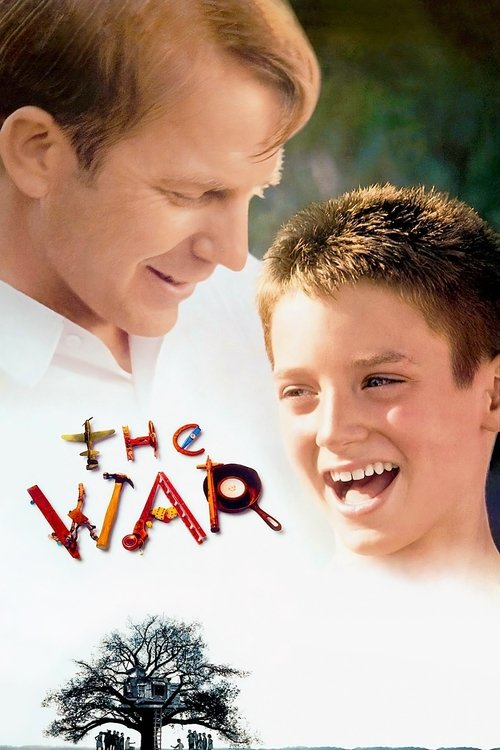
The War
1994 · Jon Avnet
For a sincere, old-fashioned family drama night — when you want a coming-of-age story that will probably make you cry and leave you wanting to call your dad. Comfort viewing with a lump in the throat, not a challenge.
What it's about
In 1970s rural Mississippi, a Vietnam veteran comes home carrying wounds nobody can see — he can't hold a job, and his family is barely scraping by. His young son, meanwhile, is fighting a smaller war of his own: a summer-long feud with a pack of rougher neighborhood kids over a treehouse. Father and son each have to decide what fighting back is worth, and the film keeps rhyming their two battles against each other.
The experience
Warm and nostalgic on the surface, with real bruises underneath — it moves like a lazy Southern summer but keeps landing sudden gut-punches about what violence costs. Expect to get misty; it aims straight for the heart and doesn't apologize for it.
Performances
Kevin Costner plays the broken father with a gentleness that cuts against his usual heroics, and a young Elijah Wood carries the film's emotional weight with startling openness.
The craft
Jon Avnet, fresh off Fried Green Tomatoes, shoots the Deep South with a golden, storybook glow — sun-dappled swimming holes and a treehouse that feels like a kingdom. The writing works in fable logic, setting a father's hard-won pacifism against a kid's instinct to hit back, and letting the two arguments collide.
Why it matters
A modest entry in the 1990s wave of films reckoning with Vietnam's aftermath at home rather than in combat — remembered now mostly as an early showcase for Elijah Wood and a rare soft-spoken Costner turn.
Snapshot
The War is a 1994 American drama that tries to braid two stories usually kept apart: the domestic aftermath of the Vietnam War, carried home in the damaged psyche of a returned veteran, and a child's-eye fable about a treehouse, a feud, and the temptations of retaliation. Directed by Jon Avnet in the immediate wake of his hit Fried Green Tomatoes (1991), and set in the rural Mississippi of the early-to-mid 1970s, it follows Stephen Simmons (Kevin Costner), a Vietnam veteran wracked by post-traumatic stress and unable to hold work, and his son Stu (Elijah Wood), who is waging his own small war with a pack of poorer, meaner neighborhood children, the Lipnickis. The film's organizing conceit is the rhyme between these two conflicts: the father, having seen where violence leads, preaches an almost saintly pacifism and tries to inoculate his children against the cycle of payback, even as the children build a treehouse that becomes contested ground. It is an earnest, openly sentimental "message movie" about nonviolence, poverty, and inheritance — a film whose ambitions are larger than its critical reputation, which has remained modest. The scholarly and critical record on it is genuinely thin, and much of what follows must be read as a careful account of a minor, sincerely made studio drama rather than of a canonical work.
Industry & production
The War is, in industrial terms, a story about a spec script. The screenplay by Kathy McWorter, a then-little-known writer, was a celebrated sale of the early-1990s spec boom: it was acquired in February 1993 (by Island World, the entity associated with producers including Jordan Kerner and Avnet's production company) for a reported $500,000 — a figure that made McWorter a brief emblem of the era's appetite for original screenplays commanding large sums. That provenance matters: the film's slightly schematic, theme-forward construction — the deliberate parallelism between adult war and childhood war — reads as the kind of clean high-concept premise that sold well on the page.
The project was assembled by the producing partnership of Jon Avnet and Jordan Kerner, with Eric Eisner and Todd Baker also credited as producers, and distributed by Universal Pictures. Avnet directed off the considerable goodwill of Fried Green Tomatoes, and The War extends that film's Southern-set, multi-generational, emotionally direct register. Kevin Costner joined in mid-1993, at or near the peak of his stardom following Dances with Wolves (1990) and The Bodyguard (1992); casting a major leading man as a broken, gentle, marginal figure was a deliberate choice to play against his heroic image. Elijah Wood, already an established and unusually capable child actor, anchors the film as Stu, and much of its weight rests on him. Principal photography ran from August 1993 into early 1994, shot on location in the Lowcountry and Georgia — Beaufort, South Carolina, and Coweta and Tate counties in Georgia — standing in for 1970s Mississippi. The film opened November 4, 1994, and earned roughly $16 million domestically, a soft commercial result for a star-led studio drama.
Technology
The War is a conventional photochemical 35mm production of its moment, with no notable technological innovation; its "technology" is entirely the standard apparatus of a mid-1990s studio location shoot. What is worth noting is its commitment to physical, practical production: the centerpiece treehouse and the climactic sequence at a water tower are built, staged, and shot as real spaces and real stunts rather than as effects set-pieces, in keeping with a film whose whole sensibility is tactile, period, and handmade. The period-1970s setting is achieved through production design, costume, and location dressing rather than any digital intervention. In short, the film sits squarely within the pre-digital, craft-based studio filmmaking of its day, and makes no claim on the technological frontier.
Technique
Cinematography
Geoffrey Simpson, the Australian cinematographer who had also shot Fried Green Tomatoes for Avnet, photographs The War in a warm, golden, nostalgic key appropriate to a memory-tinted Southern childhood. The palette leans into amber light, dust, summer haze, and the saturated greens of the rural landscape — a visual idiom that frames the children's world as a kind of lost Eden even as it is invaded by cruelty and want. Simpson's camera favors a classical, legible coverage that keeps the children and their adventures readable, while reserving a more subdued, shadowed treatment for Stephen's interior scenes of distress and the flashback-inflected imagery of his war trauma. The cinematography is in service of feeling rather than formal experiment: its job is to make the audience nostalgic for, and protective of, a childhood that the film then threatens.
Editing
Debra Neil-Fisher edited the film. The central editorial challenge is structural — managing the film's deliberate intercutting between the adult drama of Stephen's unraveling and the parallel children's-feud plot, so that the rhyme between the two registers without becoming mechanical. The film also carries Vietnam as a haunting presence rather than as extended flashback; the editing must keep the war offscreen and interior, surfacing it through Stephen's behavior and fragmentary memory rather than through sustained combat sequences. Critics at the time noted that the film juggles a great many strands — Janet Maslin's review faulted it for contending with "too many minor plot threads" — and that diffuseness is partly an editorial and structural problem: the assembly struggles to subordinate its abundance of incident to a single through-line.
Mise-en-scène / staging
The film's staging is rooted in a carefully dressed early-1970s Southern milieu: a poor-but-proud family home, a small town marked by the period's economic and social textures, and above all the treehouse, the single most important staged space in the film. The treehouse is the children's utopia and battleground at once — built from scavenged materials, it concretizes the themes of ownership, labor, generosity, and territory. The recurring antagonism with the Lipnicki children is staged across a handful of charged locations (the treehouse, a junkyard, a swimming hole, the water tower) that escalate the children's conflict toward genuine danger. Avnet stages the family interiors for intimacy and the outdoor sequences for a child's sense of scale and adventure, so that the eventual irruption of real peril lands as a violation of that pastoral.
Sound
Thomas Newman composed the score, and it is among the film's most distinctive assets. Working in the period of his career that produced his celebrated, texturally inventive scores, Newman supplies music that is lyrical, tender, and elegiac, underscoring the film's nostalgia and its sorrow without — at its best — tipping wholly into the saccharine that the screenplay courts. The score leans on warm, folk-inflected and Americana textures suited to the rural Southern setting and to the elegiac framing of childhood. More broadly the sound design keeps Vietnam present as an aural ghost in Stephen's experience, the war intruding on the home front through sound and memory rather than spectacle.
Performance
Performance is where the film is strongest and most uneven at once. Kevin Costner plays Stephen Simmons against his star image: gentle, wounded, and morally insistent, a man whose pacifism is both hard-won wisdom and a symptom of damage. The role gives him long passages of soft-spoken moral instruction — the film's emotional and thematic core resides in his speeches to his children about cruelty, mercy, and the refusal to answer hurt with hurt — and reactions diverge on whether this registers as moving sincerity or as sermonizing. Elijah Wood gives the more consistently praised performance as Stu; even Roger Ebert, who was unpersuaded by the film's fusion of war trauma and family drama, singled out Wood. Mare Winningham brings grounded warmth as the mother Lois, and Lexi Randall is notable as the daughter Lidia, who in some respects narrates and centers the film's moral perspective. Christine Baranski appears in support. The ensemble's child performances, in particular, carry much of the film's credibility.
Narrative & dramatic mode
The film operates in the mode of the sentimental coming-of-age memory drama, structured around an explicit thematic parallel: the literal war the father survived and the figurative "war" the children wage. Its dramatic engine is moral rather than suspenseful — the question is less what will happen than will the children absorb their father's lesson, whether the cycle of retaliation can be broken. The narrative is retrospective and elegiac in tone, framed as a remembered Southern childhood, and it builds toward a crisis (centered on the water tower) in which the costs of escalation become literal and grave, forcing the children to choose between vengeance and grace. The mode is unabashedly didactic; the film wants to teach, and it stages its incidents as moral exempla. That earnestness is the source both of its sincerity and of the critical resistance it met.
Genre & cycle
The War sits at the crossing of several genres: the family melodrama, the coming-of-age childhood film, and the Vietnam-aftermath drama. As a film about the domestic consequences of Vietnam — the war as it persists in a veteran's family rather than in combat — it belongs to a cycle of 1980s–90s American films reckoning with the war's long shadow at home, a register distinct from the combat film (Platoon, Full Metal Jacket) and closer to the veteran-readjustment tradition that runs from The Best Years of Our Lives (1946) through Coming Home (1978) and Born on the Fourth of July (1989). As a Southern-set childhood memory piece, it is kin to the nostalgic Americana of films like To Kill a Mockingbird (a clear ancestor in its child's-eye moral education and Southern setting) and to Avnet's own Fried Green Tomatoes. Its insistence on a pacifist moral also aligns it with the "issue" family film of the early 1990s.
Authorship & method
The film is most coherently read as a producer-director's project shaped by a strong original script. Jon Avnet, directing his second feature after Fried Green Tomatoes, brings a consistent sensibility: Southern settings, emotional directness, multi-generational family feeling, and a willingness to risk sentimentality in pursuit of uplift. His method here is to take Kathy McWorter's high-concept spec — the double meaning of "the war" — and render it with star casting and lush period craft. McWorter's screenplay supplies the schematic moral architecture; how much of the finished film's didacticism is hers and how much is Avnet's emphasis is not something the public record cleanly resolves, and it would be speculation to apportion it. The key collaborators are a notably strong craft team: cinematographer Geoffrey Simpson (continuing his partnership with Avnet), composer Thomas Newman, and editor Debra Neil-Fisher. Newman in particular lends the film a level of musical craft beyond its reputation. Costner's participation as a producer-scale star also shapes the film's center of gravity around the father's moral voice.
Movement / national cinema
The War belongs to no movement; it is a mainstream Hollywood studio drama, a product of Universal's mid-1990s slate aimed at the adult/family prestige-drama market. If it can be placed within any larger tendency, it is the early-1990s wave of Southern-set, emotionally earnest American films — a vein Avnet himself had tapped lucratively with Fried Green Tomatoes — and the broader studio appetite of the period for "heartwarming" issue-driven family pictures. It is wholly American in setting, subject, and sensibility, preoccupied with regional (Deep South) and national (post-Vietnam) self-understanding.
Era / period
The film is doubly periodized. Its setting is the early-to-mid 1970s rural South — a moment of returning veterans, economic hardship, and a national psyche still processing Vietnam — and it uses that period to dramatize the war's reach into ordinary families. Its making, in 1993–94, places it within the post–Cold War American cinema that returned repeatedly to Vietnam as unfinished moral business, and within the spec-script and star-vehicle economics of early-1990s Hollywood. The film's pacifist message and its nostalgia for an imperiled childhood both speak to the reflective, retrospective mood of American cinema in that interval, looking back on the wounds of the 1960s and '70s from the vantage of the '90s.
Themes
The governing theme is the cycle of violence and the possibility of breaking it — the father's insistence that cruelty answered with cruelty only propagates harm, and the children's testing of that creed. Around it cluster: the domestic aftermath of war, trauma carried home and transmitted across generations; poverty and class, dramatized in the contrast between the Simmons family and the even poorer Lipnickis, complicating any simple division of the children into heroes and villains; mercy and generosity as moral acts, crystallized in the film's central gestures of giving rather than retaliating; childhood as a contested Eden, the treehouse as a small world of ownership and loss; and inheritance, the question of what fathers pass to their children — damage, or wisdom. The film's title is its thesis: that "the war" is not only Stephen's but a condition reproduced in every schoolyard unless someone chooses to stop it.
Reception, canon & influence
Critically, The War was received with marked ambivalence and is, on balance, a minor and somewhat overlooked film. American reviews were mixed-to-cool: Roger Ebert awarded two stars, objecting to the film's fusion of war trauma and intimate family drama while praising Elijah Wood; Janet Maslin acknowledged the performances but found the film overstuffed with minor plot threads. Its aggregate standing is low (a Rotten Tomatoes rating around 25%), though it had defenders — Empire, for instance, rated it highly, calling it a superior film that matched metaphor to performance — and its $16 million domestic gross marked it a commercial disappointment relative to Costner's drawing power. The split is characteristic: admirers respond to its sincerity, its child performances, and Newman's score; detractors find it sentimental and schematic, its message underlined too heavily.
Looking backward, the film's influences are legible: the Southern child's-eye moral fable in the lineage of To Kill a Mockingbird; the Vietnam-veteran-readjustment drama (Coming Home, Born on the Fourth of July) translated into a domestic, child-centered key; and Avnet's own Fried Green Tomatoes as immediate stylistic and tonal template. Looking forward, The War left a slight footprint. It is not a film that founded a cycle or shaped a school; its legacy lives mostly in the careers it touched — a notable early-career showcase for Elijah Wood ahead of his later prominence, and an instance of Kevin Costner consciously playing against his heroic persona — and as a representative artifact of 1990s Hollywood's earnest, sentimental engagement with the long domestic shadow of Vietnam. Its place in Sightlines is best understood as a node in that aftermath-of-war family-drama tradition rather than as an originator of influence, and the honest assessment is that its reach has been modest.
Sources: Wikipedia: The War (film)) · Roger Ebert review · IMDb · Rotten Tomatoes
A Deleuzian reading
Start with the hands.
The full Deleuzian reading of The War →
Reception
A box-office disappointment on release in 1994 with rough reviews (critics knocked the script even while praising the cast), it's since settled into warm 90s-nostalgia territory — the kind of film people rediscover and defend as an underrated childhood staple.
How The War was received, from release to now →
Influences: the films it descends from and the films it influenced
- To Kill a Mockingbird (1962) — Establishes the template The War copies wholesale: a Southern summer rendered through a child's-eye memory POV, with the father (Atticus/Costner) as the film's didactic moral conscience delivering pacifist lessons against a backdrop of communal violence.
- Shane (1953) — Pioneers the child-witness framing of adult violence and the cycle-of-violence parable staged as a defended homestead — the formal blueprint for The War's treehouse-as-fortress siege seen through children's eyes.
- The Night of the Hunter (1955) — Source for the contested-childhood-eden motif: children physically barricading and defending a sanctuary of innocence against encroaching adult menace, with menace rendered in expressionist, near-fairy-tale terms.
- The Yearling (1946) — Model for the lush, golden-hued rural Southern childhood-as-eden, where a tender father gently schools a son in loss and moral responsibility against a poverty backdrop.
- Sounder (1972) — Supplies the dignity-of-the-poor framing — Depression-era Southern rural poverty and class hardship filtered through a child's perspective on a beleaguered but loving family.
- Coming Home (1978) — Founds the Vietnam-veteran domestic-readjustment drama that The War transposes into a child-centered key, locating the war's damage in the returned soldier's struggle to function at home.
- The Deer Hunter (1978) — Originates the technique of rendering combat trauma as an aural/sensory ghost that intrudes on the homefront — the 'war-as-aural-ghost' device of flashback sound bleeding into peacetime scenes.
- Born on the Fourth of July (1989) — Carries the veteran's psychic and bodily trauma home as the drama's engine, modeling the wounded father-figure whose unhealed war defines the family's emotional weather.
- Stand By Me (1986) — Establishes the boyhood-gang adventure structured by retrospective nostalgic narration and a 1950s/60s period childhood treated as an irrecoverable lost eden.
- Sling Blade (1996) — Extends the Southern gentle-fable craft: a child bonding with a damaged adult amid simmering domestic violence, building to a redemptive moral reckoning in a sun-soaked rural key.
- October Sky (1999) — Continues the nostalgic working-class period boyhood with a golden palette and an uplifting score, dramatizing a son's struggle against a hard father in an impoverished company town.
- The Tree of Life (2011) — Refines the golden-nostalgic-palette childhood-as-contested-eden into pure form — a Southern boy's memory of a stern father and lost innocence, the impressionist apotheosis of the craft The War handled literally.
- Fried Green Tomatoes (1991) — Avnet's immediate prior feature and direct stylistic template — same Southern setting, multi-generational sentiment, and Geoffrey Simpson's warm cinematography carried straight into The War.
- The Shawshank Redemption (1994) — Same-year showcase for Thomas Newman's signature nostalgic-Americana scoring — sustained piano-and-strings figures evoking memory and grace that he applies near-identically to The War.
- Shine (1996) — Sibling in Geoffrey Simpson's cinematography, sharing the luminous golden-amber palette and soft period glow Simpson developed across his Avnet collaborations.
- A Bronx Tale (1993) — Parallel coming-of-age fable in which a boy is morally tutored by a principled father against neighborhood violence, structured as a didactic lesson about choosing nonviolence.
Similar films
- October Sky (1999) — influence & lineage
- Warrior (2011) — shared sensibility
- Forrest Gump (1994) — shared sensibility
- American Sniper (2014) — shared sensibility
- A Tree Grows in Brooklyn (1945) — shared sensibility
- Dances with Wolves (1990) — shared sensibility
- Eve's Bayou (1997) — shared sensibility
- Tae Guk Gi: The Brotherhood of War (2004) — shared sensibility