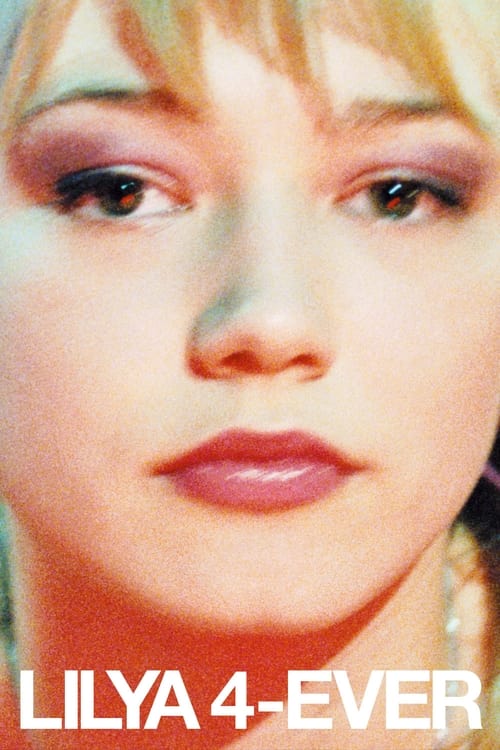
Lilya 4-ever
2002 · Lukas Moodysson
For when you're ready to be wrecked by a film and want that wreckage to mean something — this is a deliberate act of witness, not an evening's entertainment. Absolutely a challenge, not a comfort; save it for when you have the reserves.
What it's about
In a crumbling post-Soviet industrial town, sixteen-year-old Lilya is abandoned when her mother emigrates to America without her. Left to fend for herself in poverty, her only real bond is with a younger boy as adrift as she is — until a charming young man offers her a job in Sweden and a way out that isn't what it seems. It's grounded in the real economics of human trafficking in the region.
The experience
Devastating and unflinching — a film of enormous compassion that refuses to soften what it shows. It moves with the intimacy of a small character study while the ground steadily gives way beneath its heroine, and it will stay with you for a long time.
Performances
Oksana Akinshina is extraordinary as Lilya — tough, hopeful, and heartbreakingly young, holding the camera through nearly every scene without a false note.
The craft
Lukas Moodysson, previously known for warm humanist comedies, turns his gift for teenage intimacy toward a subject with no consolation, and the tenderness he still finds is what makes it cut so deep. Handheld, close, and stripped of melodrama, it treats its social horror as documentary fact.
Why it matters
One of the most influential European films ever made about human trafficking — screened for lawmakers and used in anti-trafficking advocacy — and the film that redefined Moodysson from feel-good chronicler of youth to moral witness.
Snapshot
Lilya 4-ever is Lukas Moodysson's third feature and the film in which the Swedish director broke, decisively and deliberately, from the tender humanism that had made his name. After the teenage romance of Show Me Love (Fucking Åmål, 1998) and the shaggy commune warmth of Together (Tillsammans, 2000), Moodysson turned to a subject with no available consolation: the abandonment and sexual trafficking of a sixteen-year-old girl in the ruins of the post-Soviet economy. Lilya, played by Oksana Akinshina, is left behind in a decaying industrial town when her mother emigrates to America; her sole tenderness comes from a younger, glue-sniffing boy named Volodya. A charming young man, Andrei, promises her work in Sweden. The promise is a trap, and the film follows her into confinement, rape, and finally suicide, framed throughout by a religious iconography of angels. Widely received as one of the most harrowing European films of its decade, it remains a landmark of social-realist cinema and a fixture in public discourse about human trafficking.
Industry & production
The film was produced by Memfis Film, the Swedish company run by Lars Jönsson, Moodysson's regular producer, who had backed his two previous features. It was a Scandinavian co-production, drawing on the public-funding architecture typical of Swedish art cinema — the Swedish Film Institute and Nordic and public-broadcaster support — that allowed a director with two domestic hits behind him to make a commercially forbidding film. Moodysson had arrived as something close to a national phenomenon: Show Me Love was an enormous Swedish success and Together consolidated his reputation abroad, giving him the leverage to pivot toward material that no market logic would have recommended.
Production notably relocated much of the shoot to Estonia. The unnamed post-Soviet town — the film pointedly refuses to name a country, universalizing the wreckage — was largely realized in Paldiski, a former closed Soviet naval base near Tallinn, whose genuine dereliction supplied the film's blasted concrete landscape without set-building. The Swedish sequences were shot in Malmö. Moodysson has stated that the film was prompted by real reporting on the trafficking of young women out of the former Eastern Bloc; he has referred to an actual case of a trafficked girl as a catalyst. The specifics that circulate in secondary accounts should be treated with care, but the film's grounding in documented trafficking patterns is not in dispute and is central to how it was made and received.
Technology
Lilya 4-ever was made with the naturalistic, available-light, handheld toolkit that Moodysson and his cinematographer had developed on the earlier films, in the same period when Dogme 95 and cheap consumer video were pushing Scandinavian cinema toward stripped-down immediacy. The image favors grain, desaturation, and the visible texture of real, unglamorous locations over any polish. Where the film reaches beyond strict realism is in a small number of effects shots realizing its angel motif — Volodya with wings, Lilya's imagined flight — and these are handled with deliberate modesty rather than spectacle, keeping the supernatural at the level of a child's drawing rather than digital effect. The exact capture format is a point on which the public record is thin; the look is consistent with the 16mm/Super 16 and handheld practice of Moodysson's team of that era.
Technique
Cinematography
The cinematography — the credited work is Ulf Brantås, Moodysson's collaborator from the earlier features — is built on restless handheld framing that stays close to Akinshina's face and body, refusing the composed distance that might aestheticize her suffering. The palette is cold and drained: gray concrete, overcast skies, the sickly interiors of stairwells and flats. Crucially, the camera adopts Lilya's point of view at the film's most violent passages. In the sequence of her forced prostitution, the film cuts to a first-person, subjective view looking up at the faces of the men — a formal decision that converts the camera into her experience and denies the audience any voyeuristic remove. This subjective strategy is the film's signature technical gesture and the source of much of its devastating force.
Editing
The editing sustains a patient, accumulating rhythm rather than sensationalizing. Long stretches dwell on boredom, waiting, and small kindnesses — Lilya and Volodya's basketball, their scavenged play — so that the descent, when it comes, feels earned rather than exploited. Michal Leszczylowski, a fixture of Swedish and Scandinavian art cinema and an editor associated with Moodysson's work, is credited with the cutting; the precise co-editing credits are a detail on which sources are less consistent. The film's structure is book-ended and partly framed in flashback, opening near its own catastrophe before circling back, so that dread is present from the first frames.
Mise-en-scène / staging
Staging is the film's most eloquent instrument. The post-Soviet town is a landscape of entropy — dead factories, graffitied stairwells, apartments stripped of anything that once made them homes. The physical environment does the ideological argument: this is what abandonment looks like at the scale of a society, not just a mother. Against it, Moodysson places the tender, hand-scaled world the two children improvise. The recurring angel imagery — wings, a poster, Lilya's prayers before an icon — is staged as naïve, almost childish iconography, which is precisely why it is affecting rather than pious. The Swedish apartment where Lilya is imprisoned is staged as sterile and anonymous, the affluent counterpart to the Eastern ruin, indicting the destination as much as the origin.
Sound
Sound is dominated by one overwhelming choice: Rammstein's "Mein Herz brennt," which bookends the film and detonates over its opening and climactic running sequences. The industrial German-metal wall of sound is deployed against the frail figure of the girl to shattering effect, its aggression standing in for a violence the film often withholds from the image. Beyond this, the soundscape is largely naturalistic — the ambient drone of a dying town, the muffled interiors of confinement — with music used sparingly and shatteringly rather than continuously. The record on any original underscore is thin; the film's musical identity rests overwhelmingly on the Rammstein cue.
Performance
The film rests on Oksana Akinshina, who was a young teenager at the time and who gives a performance of extraordinary unguardedness — moving from adolescent bravado and flirtation to a hollowed-out numbness without any of the actorly signaling of "suffering." Her Lilya is neither saint nor victim-symbol but a specific, willful, sometimes unlikable girl, which is what makes her fate unbearable. Artyom Bogucharsky, as the younger boy Volodya, supplies the film's only sustained tenderness and its most humane presence; his fate is as crushing as Lilya's. The two child performances, drawn largely from a Russian-speaking cast, anchor the film's realism and its refusal to sentimentalize.
Narrative & dramatic mode
The dramatic mode is tragic realism pushed toward the parable. The narrative is linear in its descent but framed by foreknowledge of the end, so the film operates less as suspense than as inexorability — the classical structure of tragedy, in which the outcome is fixed and the meaning lies in watching it arrive. Onto this social-realist spine Moodysson grafts a frankly religious register: the angel motif, Lilya's prayers, and a final movement that imagines transcendence. This fusion — Bressonian fatalism plus explicit Christian iconography plus documentary-grade grime — is the film's distinctive dramatic signature. Some viewers read the ending's angelic uplift as consolation; others as a bitterly ironic gesture, a beauty the world denied her granted only in death. The film sustains both readings.
Genre & cycle
Formally the film belongs to European social-realist drama, in the lineage of Ken Loach and the Dardenne brothers, crossed with the "issue" film about trafficking and post-communist collapse. It arrived within a broader turn-of-the-millennium cycle of films reckoning with the human costs of the post-Soviet transition and the westward flow of exploited labor and bodies. As a portrait of a doomed adolescent it also joins a long art-cinema tradition of the sacrificed young girl. Its unusual generic feature is its willingness to breach realism with the metaphysical, which sets it apart from the strict materialism of most films in the trafficking cycle.
Authorship & method
Lilya 4-ever is the hinge of Lukas Moodysson's authorship. The first two features had established him as Sweden's great empathetic realist of ordinary life; here he retained the empathy but removed every safety net, beginning a movement toward the confrontational and formally punishing work of A Hole in My Heart (2004) and Container (2006). His method throughout is grounded in non-professional or young, relatively unknown performers, real and degraded locations, handheld intimacy, and a moral seriousness that risks accusations of despair. The key collaborators extend that method: cinematographer Ulf Brantås, whose drained handheld image had defined the earlier films; editor Michal Leszczylowski, working within Scandinavian art-cinema practice; and producer Lars Jönsson of Memfis Film, whose continued backing made a deliberately unsellable film possible. Moodysson wrote the screenplay himself, as on his other work of the period. The musical authorship is essentially curatorial — the decisive act is the appropriation of Rammstein rather than composition.
Movement / national cinema
The film is a central document of the Swedish and broader Nordic cinema revival of the late 1990s and 2000s, the wave that also carried Roy Andersson's return, the Dogme 95 movement in neighboring Denmark, and a new international visibility for Scandinavian realism. Moodysson was frequently positioned as the leading Swedish director of his generation, and Lilya 4-ever is where that national cinema confronted the geopolitics on its own doorstep — the traffic in people from the collapsed East into affluent Scandinavia. In refusing to name the country of origin while naming Sweden as the destination, the film explicitly implicates its own national audience, an unusual and pointed gesture within a national cinema more often given to self-examination of a gentler kind.
Era / period
Made and set in the early 2000s, the film is inseparable from the specific historical moment of the post-Soviet decade: the social wreckage left by the dismantling of the command economy, mass unemployment, emigration, and the criminal economies — including sex trafficking — that filled the vacuum. It belongs to the cultural aftermath of 1991, viewed from the vantage of Western Europe a decade on, when the human consequences had become visible enough to reach reportage and then cinema. It also sits at a technological threshold, made just as digital tools were democratizing low-budget realism, and just before the trafficking issue would become a staple of NGO campaigning and, later, of glossier genre treatments.
Themes
The governing theme is abandonment at every scale — maternal, national, divine. Lilya is failed by her mother, her relatives, her state, her church, and, the film implies, by the prosperous West that consumes what her poverty produces. Trafficking is the mechanism, but the deeper subject is the commodification of a human being and the total evaporation of any adult who might protect a child. Against this the film sets faith and childhood tenderness — the angel imagery, the friendship with Volodya — as the only counterweights, and it is scrupulously honest that they are not enough. Class and geography are moral coordinates: the film draws a straight line from Eastern dereliction to Western apartment, insisting the two are one system. The final theme is transcendence, offered ambiguously — whether the closing flight is grace or the film's most bitter irony is left, deliberately, unresolved.
Reception, canon & influence
Critically, the film was received as a major and shattering work, widely praised for Akinshina's performance and for the integrity of Moodysson's refusal to look away, while also drawing the criticism that inevitably attends unrelenting bleakness — that its accumulation of suffering risks the manipulative or the numbing. It traveled widely on the festival and art-house circuit following its 2002 premiere and collected awards across European festivals; it was positioned as one of the significant European films of its year and was put forward as Sweden's contender in the international-feature Oscar race, though the granular record of individual prizes and votes should be checked against primary sources rather than taken from summary.
Its backward influences are legible. Robert Bresson's Mouchette, with its doomed rural girl and closing suicide, is the clearest ancestor, and the film's subjective austerity and moral fatalism are Bressonian in spirit; the social realism of Ken Loach and the Dardenne brothers (whose Rosetta shares its close-bodied handheld pursuit of a cornered young woman) supplies the other lineage. Italian neorealism stands behind both. Moodysson's own earlier tenderness is the necessary precondition — the darkness lands because the same sensibility once made warmth.
Forward, the film's afterlife has been unusual for an art film. It became a reference point in public and educational discourse on human trafficking, cited and screened well beyond cinephile circles, and it set a high-water mark against which subsequent trafficking dramas were measured. Within Moodysson's own career it is the pivot into his most radical, difficult period. More broadly it helped consolidate the international standing of a socially engaged Nordic realism and demonstrated that a national cinema could turn its most beloved director loose on its own complicity — an example whose severity later filmmakers have invoked more often than they have equaled.
Reception
Landed in 2002 as a gut-punch pivot — the guy who made the warm, beloved Show Me Love and Together suddenly delivered one of the bleakest films of the decade, and audiences were split between devastated admiration and 'why would you do this to us.' It's since settled into canon as the definitive fiction film about trafficking, its reputation only hardening over time.
How Lilya 4-ever was received, from release to now →
How to watch Lilya 4-ever: what to notice on a first viewing
- Notice how close the handheld camera stays to Lilya. Brantås keeps the frame restless and near, refusing the kind of composed distance that might make her situation look attractive or removed. The camera refuses you any comfortable distance from what she's going through.
- Notice how gray and drained the color looks throughout. Gray concrete, overcast skies, and sickly stairwell light dominate the palette, giving the town's decay a visual register the story never has to explain. The look tells you what abandonment looks like before a single line of dialogue does.
- Listen for the wall of metal music that opens the film. Rammstein's industrial track detonates over the opening, standing in for a violence the images themselves often hold back. The soundtrack carries an aggression the picture mostly withholds from what you actually see.
- Notice the angel wings and the poster on her wall. The imagery is naive and almost childish, a poster, a prayer before an icon, staged plainly rather than with any religious grandeur. Its plainness is what makes it affecting rather than something to roll your eyes at.
The whole guide to watching Lilya 4-ever, with the keys for a rewatch →
Influences: the films it descends from and the films it influenced
- Mouchette (1967) — Bresson's flat, expressionless 'model' performance and a neglected girl's terminal descent to death by water supply the template for Lilya's fatalistic austerity and closing overpass leap.
- Germany, Year Zero (1948) — Rossellini stages an abandoned child amid authentic bombed-out ruins and ends on the boy's suicidal jump — the exact staging logic behind Lilya's post-Soviet rubble and rooftop fall.
- Bicycle Thieves (1948) — The neorealist method of casting non-professionals in real degraded streets and building tragedy through the accumulation of small daily defeats underlies Lilya's accumulative rhythm.
- Rosetta (1999) — The Dardennes' nape-of-the-neck handheld pursuit of a cornered working-class girl is directly modeled in Ulf Brantås's close-bodied, breathless camera on Lilya.
- Kes (1969) — Loach's observational, drained-handheld social realism built around a working-class child played by a non-professional supplies the Anglo lineage of Lilya's performance grammar.
- The 400 Blows (1959) — Truffaut's unmediated attention to a neglected boy's face and the runaway momentum toward an entrapping non-resolution inform Lilya's naturalistic teen lead and flight-then-trap structure.
- Show Me Love (Fucking Åmål) (1998) — Moodysson and Brantås's drained, handheld intimacy with teenage non-professionals here established the exact visual grammar Lilya later strips of its warmth.
- Together (2000) — The empathetic ensemble naturalism and Memfis production method are the tenderness Lilya deliberately inverts using the same authorial toolkit.
- Breaking the Waves (1996) — Moodysson transposes von Trier's female-martyrdom structure into Scandinavian social realism, using handheld available-light documentary photography to chronicle a teenage girl's sexual exploitation toward a transcendence that echoes Bess's—the licensed-pop counterpoint (Rammstein, Britney Spears) functioning as ironic chapter-marker in direct formal inheritance.
- A Hole in My Heart (2004) — Extends Lilya's confrontational rendering of bodily degradation into formally punishing, fragmented territory — the next radical step of the same authorship and collaborators.
- Import/Export (2007) — Seidl carries Lilya's post-Soviet trafficking and bodily commodification into rigorous fixed-frame tableaux of Eastern-to-Western degradation.
- Fish Tank (2009) — Arnold's handheld, boxed-in immersion in a volatile teenage girl played by a non-professional extends Lilya's cornered-youth subjectivity and desaturated estate realism.
- Loveless (2017) — Zvyagintsev's cold, desaturated compositions of post-Soviet apartment blocks framing an abandoned child as societal indictment echo Lilya's staging of post-Soviet ruin and abandonment.
- Beanpole (2019) — Balagov applies a saturated-then-drained palette and intimate handheld proximity to damaged young women in a ruined post-war Russian city, prolonging Lilya's aesthetic of tender bodies in wreckage.
- The Silence of Lorna (2008) — The Dardennes return to Lilya's terrain — an Eastern-European woman commodified through a marriage/immigration racket — in their shared close handheld pursuit of a trapped protagonist.
- 4 Months, 3 Weeks and 2 Days (2007) — Romanian New Wave long-take realism dramatizes the commodification of a young woman's body under post-communist decay, sharing Lilya's unblinking refusal to cut away from suffering.
- Requiem for a Dream (2000) — Shares Lilya's subjective-POV rendering of bodily degradation (looming johns / substance highs) and an inexorable downward-spiral cutting rhythm, in a maximalist rather than realist register.
Similar films
- Fish Tank (2009) — influence & lineage · same viewing thread
- Together (2000) — influence & lineage
- Beanpole (2019) — influence & lineage
- Christiane F. (1981) — same viewing thread
- Dancer in the Dark (2000) — often watched together
- Germany, Year Zero (1948) — influence & lineage · often watched together
- Breaking the Waves (1996) — often watched together
- My Life as a Dog (1985) — often watched together
All the films related to Lilya 4-ever →
Watch it with: curated runs of related films
- No One Coming to Save Her — Watch these in a run for the same unblinking gaze on girls left to fend for themselves — abandoned by their mothers, circled by predatory men, and armed with nothing but their own nerve.