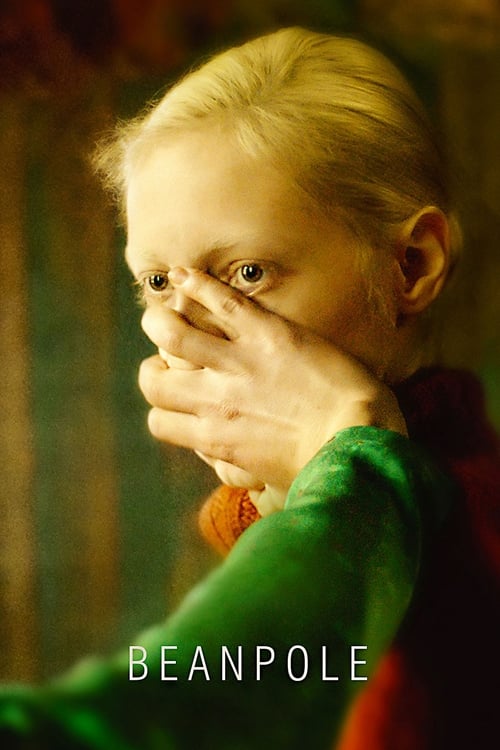
Beanpole
2019 · Kantemir Balagov
For when you want serious, demanding art cinema that you'll carry around for days — a film to surrender an evening to, not to half-watch. Save it for when you have the emotional reserves.
What it's about
Leningrad, autumn 1945. The siege is over, the war is won, and the city is a ruin of hospitals and communal flats. Iya — a towering, gentle nurse everyone calls Beanpole — and Masha, her fierce friend just demobilized from the front, try to rebuild something like a life together amid the wreckage, bound to each other by shared damage and a need that has no easy name.
The experience
Slow, hushed, and almost unbearably intense — long takes hold on faces until you can hardly breathe, and the emotional blows land in near-silence. It's heavy, but it's also strangely ravishing to look at; the beauty and the pain arrive together.
Performances
Viktoria Miroshnichenko and Vasilisa Perelygina, both newcomers, are extraordinary — two of the most raw, unguarded performances in recent European cinema, carrying the whole film between them.
The craft
Kantemir Balagov drenches postwar Leningrad in saturated greens and rust-reds — trauma rendered as color — inside a boxy, intimate frame that presses you close to the two women. The compositions are painterly enough that it genuinely rewards a big screen despite its stillness.
Why it matters
It won Best Director in Un Certain Regard at Cannes and announced Balagov, still in his twenties, as one of the most distinctive new voices in Russian arthouse cinema.
Snapshot
Kantemir Balagov's second feature is set in the wreckage of Leningrad in autumn 1945, months after the siege's end. Two young women — Iya, a laconic, physically enormous nurse nicknamed "Beanpole" (Dzhanybek in Russian), and Masha, a gunner freshly demobilized from the front — negotiate trauma, reproductive loss, and a need for each other that exceeds any conventional category of friendship. Shot in a compressed Academy ratio and drenched in institutional green, Beanpole refuses the consolations of Soviet heroism and postwar reconstruction narrative alike. It won the Best Director prize in Un Certain Regard at Cannes 2019, along with the FIPRESCI Prize, establishing Balagov as one of the most distinctive voices to emerge from Russian arthouse cinema in the 2010s.
Industry & production
Beanpole was produced by Non-Stop Production, a Moscow-based company with a track record in internationally oriented Russian arthouse. The film received support from the Russian Ministry of Culture's Cinema Department, though its tonal distance from state-affirming WWII commemoration — a genre in near-constant revival in Putin-era Russia — made its institutional backing quietly notable. The production was modest by any standard outside of the art-film circuit, relying on controlled interiors and a restricted cast to contain costs. Its Cannes Un Certain Regard premiere gave it the international platform that a Berlinale or TIFF slot might not have guaranteed for a second-feature Russian director; sales to European and North American arthouse distributors followed. In Russia, the film was selected as the country's submission to the Academy Awards for Best International Feature Film but did not advance to the shortlist. The critical response outside Russia substantially outpaced its domestic commercial reach.
Technology
Cinematographer Ksenia Sereda shot Beanpole on digital, using the Academy ratio (1.33:1) — a deliberate departure from the widescreen standard that the bulk of contemporary production employs. The boxy frame was chosen partly to compress space around Iya's imposing, elongated body, making her simultaneously conspicuous and trapped. The format also echoes the dimensions of Soviet-era documentary and institutional photography, lending the images an archival quality without resort to grain filtration or desaturation. Color grading reinforced a palette established in pre-production across costume, set dressing, and location: a dominant institutional green — the green of Soviet hospital walls, of moss, of fabric dye that has bled — punctuated by hot reds and rusts that carry their own symbolic charge. This is a highly controlled and pre-visualized chromatic scheme rather than a naturalistic rendering of postwar Leningrad.
Technique
Cinematography
Sereda's camera is intimate to the point of claustrophobia. The film favors medium close-ups and close-ups of faces — frequently sustaining them past the point at which a conventional editor would cut away — and the telephoto lens compression turns the already narrow Academy frame into something airless. Wide shots are used sparingly, almost ceremonially, and when the camera does pull back, the effect is one of sudden, inhospitable exposure rather than relief. Rack-focus moves attention within a shallow plane of field without recourse to the more rhetorical devices of tracking or crane work. The palette — deep greens, ochres, the scarlet of Masha's hair and dress — is rigorously controlled, drawing on a production design scheme that treated color as narrative grammar. Interiors dominate; the ruined exterior city is glimpsed rather than displayed, keeping the film's emotional register interior even when its characters briefly leave the hospital wards.
Editing
The film is edited by Kira Shalashova. The editing grammar respects the duration of the cinematographer's takes: cuts are withheld, and the camera's sustained attention to a face or a stillness acquires weight by refusal of relief. Iya's cataleptic episodes — during which she freezes, eyes open, body rigid, and the world continues around her — are rendered without trick editing; the camera simply holds on the fact of her absence inside her own body, a formal choice that makes the episodes feel physiologically real rather than expressionistically distorted. The film's pacing is slow in the manner of European arthouse, but its deliberateness is structural rather than merely atmospheric: scenes often run until the emotional stakes have shifted once beyond their opening position, so that the viewer enters and exits scenes in different registers.
Mise-en-scène / staging
Balagov works with actors in close physical proximity, staging scenes so that bodies are in near-constant contact or tension of near-contact. The hospital wards, cramped communal apartments, and narrow corridors of postwar Leningrad are rendered not as picturesque ruin but as lived constraint. Blocking tends toward stillness within the frame rather than movement through it. Iya's height — Viktoria Miroshnichova stands nearly six feet — is insistently staged against low ceilings, compressed corridors, and smaller bodies, making her a figure of both imposing presence and uncomfortable visibility. The color design of costumes and spaces is a central mise-en-scène element: the green hospital environment, the scarlet Masha wears, and the gradual migrations of color across the film function as a coded emotional underscore.
Sound
The film's sound design privileges ambient and diegetic textures over a conventional score. Hospital sounds — machinery, distant moaning, the rustle of institutional fabric — occupy the soundtrack in a way that keeps the viewer inside the material world of the postwar ward. The relative quiet of the mix, especially in scenes of intimacy between Iya and Masha, amplifies the register of small physical sounds and breathing. Musical scoring is used sparingly; the film does not deploy a thematic score in the manner of classical drama. Reliable attribution of the film's musical elements to a specific composer has been unclear in publicly available credits, and this account declines to specify one rather than risk misattribution.
Performance
Viktoria Miroshnichova, in her screen debut, carries the film's emotional and physical logic with an economy that could only be achieved through collaboration rather than raw instinct. Her Iya is simultaneously formidable and absent: the cataleptic episodes that interrupt her consciousness are registered through Miroshnichova's face and body with a specificity that suggests deep preparatory work with Balagov. Vasilisa Perelygina's Masha — smaller, mobile, willful, and damaged in different registers — provides a counterforce that keeps the film from settling into elegy. The two performances work dialectically: Masha's directed energy against Iya's frozen receptivity generates the film's central dramatic tension. Supporting performances, including Andrei Bykov as the hospital director who develops a relationship with Iya, maintain the film's register of studied restraint.
Narrative & dramatic mode
Beanpole is structured around two partially concealed traumas that the narrative gradually surfaces. The film opens after the event: Iya has, during a cataleptic episode, suffocated the child Masha left in her care — a death whose full weight is withheld from the viewer for some time. When Masha returns, she wants Iya to bear a child for her, having been rendered unable to do so by a wartime injury. The dramatic engine is not revelation but negotiation — the ongoing, unspoken, and sometimes brutal process by which two people who have survived unimaginable things make claims on each other. Balagov and screenwriter Andrei Zolotarev resist psychological explanation and backstory; motivation is deduced from behavior rather than confessed. The film ends without resolution or redemption, positioning itself against the consolation structure of trauma narrative.
Genre & cycle
The film belongs to the post-heroic WWII film — a strand that insists on wartime experience not as sacrifice but as wound, and that registers the aftermath of conflict as a kind of ongoing violence. In the Russian context this places Beanpole in deliberate counter-tradition to the Soviet "Great Patriotic War" genre and its contemporary state-commissioned descendants: films like Stalingrad (Bondarchuk, 2013) or the 28 Panfilov Guardsmen (Shalaopa/Kozlov, 2016). Internationally it belongs to a cycle of female-centered postwar European drama — films that attend to what women's bodies carry across and beyond the event of war — alongside the more recently prominent strand of Eastern European arthouse that addresses historical violence through intimate, domestic scale rather than spectacle.
Authorship & method
Balagov was born in 1991 in Nalchik, Kabardino-Balkaria, in the Russian North Caucasus, and studied filmmaking under Alexander Sokurov at a workshop Sokurov established there — a mentorship relationship that has shaped a minor wave of internationally visible Russian arthouse directors. Sokurov's influence is discernible less in specific stylistic tics than in a shared insistence on the body as historical and philosophical material, and in a willingness to let duration and stillness carry dramatic weight. Balagov's first feature, Closeness (Tesnota, 2017), addressed a community in the same North Caucasus region and announced similar formal priorities — tight framing, the textures of physical life, restrained plotting. The collaboration with Ksenia Sereda as cinematographer and Kira Shalashova as editor represents a consistent creative unit working with strong pre-production design logic. Screenwriter Andrei Zolotarev co-wrote the script from a brief inspired by Svetlana Alexievich's oral-history volume The Unwomanly Face of War (first published 1985), which compiled accounts from Soviet women who served in WWII. Balagov has cited Alexievich's book as the germinal source — specifically its cataloging of female bodies altered, violated, and made strange by combat — though the film draws no specific characters or incidents from the testimonies.
Movement / national cinema
Beanpole is a Russian-language film and a product of Moscow's production infrastructure, but its director comes from outside the cultural centers of Russian cinema, and the film's relationship to official Russian film culture is uneasy. The Sokurov workshop in Nalchik represents a deliberate alternative institution; its graduates — including Kira Kovalenko (Unclenching the Fists, 2021) — have produced films that circulate primarily in the international arthouse festival economy rather than in Russian domestic distribution. This positions Beanpole within a current of contemporary Russian cinema that is in productive tension with both Soviet tradition and the state-backed patriotic cinema of the present decade. The film was made before the geopolitical ruptures of 2022, which have since complicated the international reception and distribution of Russian-language work, though Beanpole's festival life and critical reputation were established in a different context.
Era / period
The film arrived at a moment of renewed international attention to Eastern European and Russian arthouse — a period in which Cannes' Un Certain Regard section was functioning as an important amplifier for films that would not reach theatrical audiences at scale but that circulated widely in critical discourse. The late 2010s also saw intensifying global interest in female-centered war narratives and in cinema that addresses traumatized female bodies without aestheticizing victimhood. Beanpole's particular focus on reproductive loss, bodily autonomy, and female intimacy spoke to those preoccupations without being reducible to a topical response.
Themes
The film's central material is the persistence of war inside the body after the formal end of conflict — the way that Iya's catalepsy and Masha's reproductive injury constitute an ongoing war that no armistice has touched. Around this organizes a cluster of connected concerns: the ethics of care between women under conditions of scarcity and trauma; the question of what motherhood means when a body has been altered by violence; the limits of language in communicating damage that precedes language. The film is also quietly attentive to the institutional machinery of Soviet care — the hospital as both refuge and bureaucratic space — and to the way class and gender shape who is permitted grief and who is expected to manage it. The color scheme encodes much of this thematically: green as the institutional, the preserved, the living but suppressed; red as desire, blood, maternity, the wound that won't close.
Reception, canon & influence
Critical reception. Beanpole opened to strong critical acclaim at Cannes 2019, where the Un Certain Regard Best Director prize signaled the jury's estimation of Balagov's formal control. Reviews in Variety, The Guardian, Sight & Sound, and Cahiers du Cinéma consistently emphasized the cinematographic achievement and the performances, placing Balagov in the company of Sokurov, Zvyagintsev, and other Russian arthouse directors with international profiles. The film appeared on numerous year-end critical lists for 2019 and has consolidated its reputation in subsequent years as one of the more significant films to emerge from Russia in the decade.
Influences on the film (backward). The most directly cited source is Alexievich's The Unwomanly Face of War, which shaped the film's thematic and tonal orientation. Soviet cinema provides an implicit counter-tradition: Larisa Shepitko's Wings (1966) and The Ascent (1977) — films that located WWII experience in female consciousness and refused heroic narrative — are the most pertinent Soviet antecedents, though Balagov has not been extensively documented citing Shepitko directly. Sokurov's attention to bodies, interiors, and historical weight is a methodological inheritance. The film's palette-driven approach to cinematography is consistent with a broader European arthouse tradition of treating color as dramaturgy rather than decoration, from Kieslowski onward. Kira Muratova's uncompromising attention to embodied performance in Russian-language arthouse provides another lineage, as does the Hungarian and Romanian cinema of the 2000s in its insistence on static observation and withheld catharsis.
Legacy and forward influence. Beanpole's most immediate legacy has been within the Sokurov workshop's output: Kira Kovalenko's Unclenching the Fists (2021), which won Un Certain Regard at Cannes — the same section — extended a related sensibility and confirmed the workshop as a genuine new-wave formation within Russian cinema. Balagov himself was subsequently reported to be developing projects with American production involvement, though his output since Beanpole has not yet been publicly released. The film's color-design approach has been discussed among cinematographers as an example of integrated pre-production palette work, and Sereda's profile has risen significantly as a result. Beanpole has entered syllabi for contemporary world cinema and for courses addressing gender and war; its canonical status within the arthouse-festival circuit is established, though its reach into broader critical consciousness remains proportionate to the specialized audience for subtitled arthouse cinema.
A Deleuzian reading
Start with the freezing.
The full Deleuzian reading of Beanpole →
Reception
It arrived already garlanded — Un Certain Regard Best Director and the FIPRESCI prize at Cannes 2019, then Russia's Oscar shortlist — and its stature has only grown as one of the defining international films of its year, now inseparable from Balagov's story as a director who later left Russia after the invasion of Ukraine.
How Beanpole was received, from release to now →
Influences: the films it descends from and the films it influenced
- Wings (1966) — Establishes the post-heroic WWII female-consciousness mode Balagov inherits: a Soviet woman's wartime experience rendered through domestic alienation and interior stasis rather than battlefield action, refusing heroic or redemptive narrative resolution.
- The Ascent (1977) — Deploys sustained close-up interrogation of faces under WWII moral duress as the film's primary dramatic instrument — the physiognomic method Balagov directly inherits, where endurance and moral weight are registered in the body and face rather than in action or dialogue.
- Mother and Son (1997) — Sokurov's workshop methodology transmitted directly to Balagov: the body held in extreme stillness as philosophical material, with duration itself functioning as dramatic weight rather than as a container for events.
- Come and See (1985) — Establishes the Soviet anti-heroic WWII physiognomic method — psychological annihilation registered across a single young face via sustained close-up, where the face becomes the battlefield and heroism is replaced by traumatic dissolution of self.
- The Asthenic Syndrome (1990) — Embodied performance as primary cinematic subject: Muratova's insistence on physical mannerism, exhaustion, and compulsive behavior sustained without psychological explanation — the performance discipline Balagov applies to both dialectical leads.
- Jeanne Dielman, 23 Commerce Quay, 1080 Brussels (1975) — Duration and domestic bodily routine as dramatic subject: static camera refusing to editorialize on a woman's constrained existence, where withheld catharsis is structural — the formal template for Balagov's staging of women's bodies in post-war domestic entrapment.
- Three Colors: Blue (1993) — Pre-production chromatic system where a single dominant hue carries psychological weight as dramaturgy rather than decoration — the European arthouse practice Balagov and Sereda systematize into their pre-visualized green-and-red palette.
- Rosetta (1999) — Sustained close-up camera attached to a single female body in physical and social constraint — the camera as physical extension of the protagonist's bodily labor and duress, refusing establishing shots that would provide contextual relief.
- The Turin Horse (2011) — Structural slow pacing where duration is itself the dramatic event, not a container for events; diegetic ambient texture — wind, repetitive physical labor — deployed as primary emotional register in place of musical scoring.
- 4 Months, 3 Weeks and 2 Days (2007) — Long-take static camera paired with anti-redemption narrative structure — trauma the film refuses to resolve through catharsis or moral legibility — establishing the Romanian new wave template Balagov applies to post-WWII female experience.
- Ida (2013) — Academy 1.33 ratio deployed as a deliberate historical photographic register for WWII-legacy drama, with bodies placed in the lower frame quadrant and space withheld above — the immediate formal model for Beanpole's aspect ratio choice and compositional logic.
- Loveless (2017) — A younger Russian filmmaker working with a tightly controlled desaturated palette, emotional-opacity performance, and figural-separation staging in post-Soviet interiors — the specific formal syntax Zvyagintsev and Krichman codified, here applied to Leningrad 1945 as post-trauma social diagnosis rather than marital one.
- Unclenching the Fists (2021) — Direct Sokurov workshop descendant — female protagonist's physical and psychological compression held in tight frame, sustained observation of the constrained body in a confined domestic space — extending Beanpole's formal vocabulary and winning the same Cannes Un Certain Regard section.
- The Headless Woman (2008) — Sustained close-up on a female face experiencing unresolved trauma, with narrative information structurally withheld as a formal device rather than a plot mechanism — the same technique Balagov applies to leads whose histories remain off-screen.
- Son of Saul (2015) — Academy ratio combined with shallow-focus extreme close-up that keeps a single body foregrounded while WWII violence recedes out-of-frame into blur — a parallel strategy of restricting viewer access to historical violence through radical framing rather than depiction.
- Closeness (2017) — Balagov's formal laboratory with cinematographer Ksenia Sereda — identical priorities of tight framing on constrained bodies, withheld catharsis, and North Caucasus social texture; the immediate precursor in which Beanpole's formal vocabulary was developed and tested.
- Dear Comrades! (2020) — Balagov's Academy ratio framing and post-war Soviet intimate historical mode foreground ideological interiority through behavioral performance rather than explained psychology, the same method Vysotskaya deploys under Konchalovsky.
- Petrov's Flu (2021) — Contemporary post-Soviet art cinema turning illness and trauma into expressive, color-coded mise-en-scène — the same scene Serebrennikov consolidates internationally.
Similar films
- The Ascent (1977) — influence & lineage
- Come and See (1985) — influence & lineage
- The Cranes Are Flying (1957) — shared sensibility
- The Girl with the Needle (2024) — shared sensibility
- Nostalgia (1983) — shared sensibility
- Mirror (1975) — shared sensibility
- All We Imagine as Light (2024) — shared sensibility
- The Painted Bird (2019) — shared sensibility
All the films related to Beanpole →