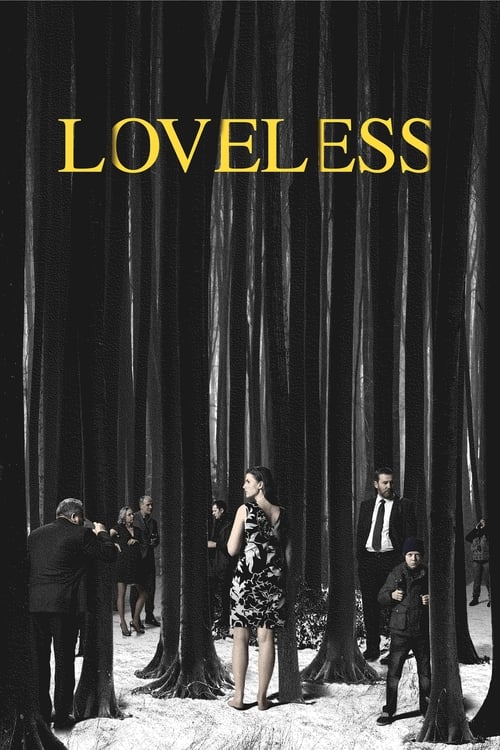
Loveless
2017 · Andrey Zvyagintsev
When you want a serious film to chew on for days and you're braced for bleakness — this is a challenge, not a comfort, best when you're in the mood to be confronted rather than consoled.
What it's about
In wintry Moscow, Zhenya and Boris are grinding through a poisonous divorce, each already living for a new partner and a new life, with their 12-year-old son Alyosha treated as an inconvenience to be disposed of. After the boy overhears one of their fights, he disappears — and the search forces two people who can barely stand each other into the same rooms again.
The experience
Cold, controlled, and quietly devastating. It moves with the tension of a missing-child thriller but refuses thriller comforts; instead it holds a hard, steady stare at people who cannot love, and one early scene of a child's silent grief is among the most haunting images in recent cinema. It leaves a bruise.
Performances
Maryana Spivak is fearless as Zhenya, playing a mother's coldness without begging for sympathy, which makes the rare cracks in the surface hit that much harder.
The craft
Zvyagintsev composes with surgical precision — long, immaculate takes, snowbound landscapes, apartment interiors lit like morgues — so the visual chill mirrors the emotional one. The volunteer search sequences through forests and abandoned buildings have an eerie, procedural beauty. It rewards patience and total attention.
Why it matters
It won the Jury Prize at Cannes and an Oscar nomination, cementing Zvyagintsev as Russia's most acclaimed living filmmaker and its most piercing internal critic — the family's failure read widely as a portrait of a whole society's.
Snapshot
A Moscow couple in the final stages of a corrosive divorce — each already installed in a new relationship, each desperate to shed the life they share — discover that their twelve-year-old son Alyosha has vanished after overhearing one of their fights. Loveless (Russian: Нелюбовь, Nelyubov) folds a missing-child thriller into a portrait of a society that has lost the capacity for genuine attachment. It is Andrey Zvyagintsev's fifth feature and his most politically explicit, shooting its allegory — a Russia that cannot love its own future — in the cold light of a Moscow winter. The film won the Jury Prize at the 2017 Cannes Film Festival and received an Academy Award nomination for Best Foreign Language Film, confirming Zvyagintsev's place alongside the most formally rigorous directors working anywhere in world cinema.
Industry & production
The film was produced by Alexander Rodnyansky and Sergey Melumad under the Non-Stop Production banner, the same partnership that backed Leviathan (2014). Rodnyansky, a major figure in Russian and pan-European independent production, has been the consistent commercial architect of Zvyagintsev's international career, securing co-production funds and festival positioning that Russian state backing alone could not have delivered. The film received partial financing from France and Belgium, following a co-production model common to prestige Eastern European auteur cinema, and was sold internationally by Wild Bunch.
Notably, Loveless was produced without funding from the Russian Cinema Fund, the state body that had controversially supported Leviathan before that film's critique of provincial corruption drew official displeasure. This independence from state subsidy gave Zvyagintsev and his collaborators latitude for a film whose implicit commentary on Russian society and the Ukraine conflict is unmistakable. The production received no significant domestic theatrical support: Russian state cultural institutions maintained a studied distance from it, even as it traveled the festival circuit as Russia's official submission to the Academy Awards — a tension that tracks the ambiguous relationship between the Russian state and its most internationally celebrated filmmaker.
Technology
Loveless was shot digitally, continuing the collaboration between Zvyagintsev and cinematographer Mikhail Krichman that has used digital acquisition since at least Elena (2011). The precise camera body used in production has not been widely documented in publicly available technical credits; the visual precision and tonal control are consistent with high-end digital cinema cameras of the mid-2010s (the Arri Alexa line dominated prestige European production in this period), but I cannot confirm the specific system from the established record.
Krichman's lighting and exposure choices favour a desaturated, cool palette in which the whites of snow and bare concrete compress against a gray sky, while domestic interiors — warmed slightly by artificial light — never feel genuinely warm. The film is 2.39:1 anamorphic widescreen, a format Zvyagintsev has favoured since The Return (2003), exploiting the wide frame for compositions that dwarf figures or cleave them to opposite edges of the screen.
Technique
Cinematography
Krichman's work on Loveless is among the most disciplined of his career. The film's signature visual motif — bare, frost-laced trees recorded in tight lateral compositions — appears in the opening and closing shots and returns as a structural refrain. These images borrow from a tradition of Russian landscape painting (Levitan, the Wanderers) while rhyming with the stripped-bare domestic interiors Krichman constructs inside the family apartment: each space emptied of warmth, furniture already claimed or abandoned.
Camera movement is sparse and deliberate. When the camera moves, it tends to track horizontally along corridors or through the rooms of the apartment — a slow revelation of absence rather than presence. Long takes predominate; cuts feel almost reluctant, as if the camera wished to outlast the characters in their discomfort. There is a sustained shot of young Matvey Novikov (Alyosha) weeping silently in a hallway — the camera fixed, watching without intervening — that condenses the film's ethical stance in a single image.
Editing
Anna Mass, who has edited Zvyagintsev's films since Elena, maintains the measured pacing the director requires. Cuts are structurally purposeful rather than rhythmically expressive: the film moves between the two parents' new domestic situations with a cold symmetry that enforces comparison rather than identification. The editing does not manipulate time in service of suspense in the conventional thriller sense; instead, it allows duration — the long wait during volunteer search operations, the empty apartments after Alyosha's disappearance — to accumulate into dread. The film runs approximately 127 minutes and never feels padded, because Mass and Zvyagintsev treat duration as content.
Mise-en-scène / staging
Zvyagintsev has described his approach to staging as finding the drama's geometry before committing the actors to it. In Loveless, this produces a series of compositions in which the conjugal apartment functions almost as a laboratory of estrangement: Zhenya and Boris occupy opposite ends of the same frame in every shared scene, the space between them not tenderness but dead air. The film's locations — a characterless Moscow suburb, a disused industrial building where searchers comb through rubble, a half-finished apartment complex — have a post-Soviet blankness that carries ideology without commentary. The volunteer search organization depicted is a lightly fictionalized version of Liza Alert, a real Russian organization founded after the 2010 disappearance of a child named Liza Fomkina, whose body was found only after an inadequate official search. The incorporation of this recognizable institution grounds the film's narrative in a specific social reality.
Sound
The Galperine brothers (Evgueni and Sacha Galperine), who also composed the score for Leviathan, contribute a soundtrack that privileges atmosphere over emotional cues. String textures are used sparingly; silence, ambient winter sound (wind through bare branches, the creak of a derelict building), and the diegetic noise of smartphones — notifications, video calls, the tinny chatter of news channels — carry most of the film's aural weight. The news broadcasts Zhenya and Boris's partners watch in the background are reporting on the conflict in eastern Ukraine in 2014–15: this is not subtle symbolism but it is controlled, present in the room without being foregrounded. Sound design integrates political reality at the threshold of attention.
Performance
Maryana Spivak as Zhenya delivers a performance of striking opacity — Zvyagintsev and Oleg Negin's screenplay gives her no redemptive arc, and Spivak resists any impulse to soften the character's self-absorption. Aleksey Rozin as Boris is similarly denied exculpation: his passivity is as damning as Zhenya's aggression. Matvey Novikov's brief, devastating appearance — above all, the hallway-weeping scene — was widely noted by critics; Zvyagintsev elicited from a child actor a performance of almost unbearable authenticity. The emotional flatness of the adult leads is not failure but strategy: both characters have performed feeling for so long that the audience registers the performance as such, never the feeling.
Narrative & dramatic mode
Loveless operates through a structural irony: the missing-child narrative, which a genre film would place at the center, functions here as a diagnostic tool. The disappearance of Alyosha does not change his parents; they remain as self-enclosed after the crisis as before it. The film is thus closer to Antonioni's alienation cinema than to the procedural thriller — the search is present, methodical, even procedurally accurate (the Liza Alert volunteers are shown with detailed verisimilitude), but it exposes the parents rather than redeeming them.
The narrative withholds resolution for Alyosha in a manner that some critics found cruel and others found the film's most honest gesture: to resolve the child's fate would grant the parents a narrative they do not deserve. The epilogue — set some years later, depicting the same domestic routines now simply relocated — closes the film with an image of stasis that implicates the broader society rather than merely these two individuals.
Genre & cycle
The film inhabits a recognizable European art-cinema genre sometimes called "cold domestic drama" or "bourgeois-critique cinema," associated above all with Michael Haneke but present across a wide range of contemporary European and Scandinavian work. It shares with films like Caché (2005), Amour (2012), and (from a different tradition) Ruben Östlund's work a preoccupation with the failure of comfortable Western or semi-Western subjects to sustain ethical relationships. Within Russian cinema, Loveless fits a post-Soviet cycle that uses family disintegration as social cartography — a mode Zvyagintsev himself helped establish with Elena (2011), and that has parallels in the work of directors such as Alexei Popogrebsky and Boris Khlebnikov, though at a different scale of ambition and budget.
Authorship & method
Zvyagintsev developed the film with his regular co-writer Oleg Negin, who has been his collaborator since The Banishment (2007). Their working method, as Zvyagintsev has described it in interviews, begins with moral and philosophical questions rather than story situations: for Loveless, the animating question was the condition of nelyubov — unlove, or the absence of love — as a social disease. The narrative is constructed to display that condition from multiple angles rather than to resolve it.
Mikhail Krichman has been Zvyagintsev's cinematographer on every feature from The Return onwards, a collaboration of unusual consistency in contemporary world cinema. Their shared visual language is characterized by compositional precision, extreme economy of camera movement, and a willingness to let locations speak at length without intervention. Anna Mass as editor and the Galperine brothers as composers complete the core team that has worked together since Elena; the consistency of this group gives Zvyagintsev's films a coherence of texture that reinforces his authorial singularity.
Producer Alexander Rodnyansky functions as more than financier: he is the primary interlocutor between Zvyagintsev's aesthetic commitments and the international marketplace, and his role in securing festival placement and foreign co-production has been indispensable to the films' reach.
Movement / national cinema
Zvyagintsev is the dominant figure of a loose "new wave" of Russian art cinema that emerged in the early 2000s following the relative freedom of the Yeltsin period and whose relationship to the Putin state has grown progressively more contentious. Where filmmakers of the Soviet era navigated censorship through allegory for structural reasons, Zvyagintsev's generation has navigated it through co-production and festival circuits that partly bypass domestic cultural politics. Loveless is the most overtly political of his films, in that its social critique is embedded in the present moment — the news broadcasts from eastern Ukraine, the consumer aspiration and spiritual vacancy of its Moscow milieu — rather than displaced to a parable past.
The film connects to a broader European tradition of severe, humanist social cinema — Bergman's marital analyses (Scenes from a Marriage is an obvious precedent), Bresson's affectless ethical rigor, the late Antonioni of L'Avventura and L'Eclisse — but its specific cultural address is Russian in ways that cannot be entirely read off from the European template.
Era / period
Loveless was shot and set in the mid-2010s, a period of sustained economic pressure on the Russian middle class (the rouble crisis of 2014–15 forms part of its background texture) and of escalating social atomisation. The film explicitly situates its domestic crisis inside a larger political crisis: the television news cycles about Donbas and the "Russian world" rhetoric are not decorative; they suggest a society at war with itself at every scale. The film's epilogue, by advancing the story several years and changing nothing essential, implies that the forces it diagnoses are durable rather than contingent.
Themes
The film's central preoccupation is the transmissibility — or non-transmissibility — of love: whether people who were not loved adequately can learn to love, and what the cost of their failure is to those who depend on them. Zhenya and Boris are implicitly shown as themselves casualties of inadequate parenting (a scene with Zhenya's mother is among the film's most chilling), which does not excuse them but locates the pathology in a longer chain.
Secondary themes include: the colonization of intimate life by digital technology and consumer aspiration (both parents are shown as obsessively phone-bound, emotionally present only through screens); the failure of Russian state and civil society to protect vulnerable citizens (the police are briefly shown as indifferent; only the volunteers take the search seriously); the relationship between private moral failure and public political decay; and the specifically gendered distribution of blame in post-Soviet Russia, where Zvyagintsev's screenplay tracks with some care the different social pressures on Zhenya (whose sexual vitality is treated as suspect by her new partner's mother) and Boris (whose new partner is pregnant, offering a second chance that the film suggests he will also waste).
Reception, canon & influence
Influences on the film (backward): The debt to Ingmar Bergman's anatomy of marital collapse is widely acknowledged, particularly the cold chamber-drama mode of Scenes from a Marriage (1973). Michelangelo Antonioni's alienation trilogy — L'Avventura (1960), La Notte (1961), L'Eclisse (1962) — informs both the compositional strategy (figures diminished by architecture and landscape) and the narrative mode (absence as structural principle). Haneke's bourgeois-critique films, especially Caché and Amour, provide a nearer precedent for the clinical domestic gaze. Within Zvyagintsev's own filmography, Elena (2011) is the immediate precursor: it established the Moscow milieu of comfortable but morally evacuated contemporary Russia that Loveless revisits at greater scale and explicitness. Tarkovsky's influence — on Zvyagintsev's feel for duration, for landscape, for the spiritual charge of the natural world — operates at a more diffuse level but is endemic to his entire practice.
Critical reception: Loveless was received with near-unanimous critical acclaim at Cannes 2017, where it competed for the Palme d'Or (the jury was presided over by Pedro Almodóvar; the Palme went to Ruben Östlund's The Square) and won the Jury Prize. International reviews consistently praised the film's formal austerity and thematic ambition; several critics placed it among Zvyagintsev's finest work, some preferring it to Leviathan for the greater precision of its targets. It appeared on numerous year-end best-of lists for 2017 and received the Academy Award nomination that confirmed Zvyagintsev's status as one of world cinema's canonical living directors. Russian domestic reception was more muted, and the film performed modestly in its home market — unsurprisingly, given the absence of state support and the film's unflattering portrait of contemporary Russian life.
Legacy and forward influence: It is too early, as of the mid-2020s, to map the full forward influence of Loveless with confidence. What can be said is that Zvyagintsev's body of work — and Loveless in particular — has consolidated a model of socially diagnostic art cinema from the post-Soviet space that has given younger Russian-language filmmakers a formal and ethical template. The film has been taught widely in film studies curricula alongside Haneke and Antonioni as a case study in how formal severity can carry political content without didacticism. Zvyagintsev's subsequent projects were interrupted by Russia's full-scale invasion of Ukraine in 2022, after which he left Russia; the political readings of Loveless — and especially of its ending, with Zhenya jogging on a treadmill in Russia-branded sportswear, going nowhere — acquired a retrospective sharpness that no amount of critical foresight could have fully anticipated at the time of release.
A Deleuzian reading
Behind a door, a boy.
The full Deleuzian reading of Loveless →
Reception
It arrived acclaimed — Jury Prize at Cannes 2017, an Oscar nomination for Best Foreign Language Film — and hasn't needed a reappraisal; it's settled in as one of the defining bleak masterpieces of 2010s world cinema and the standard pairing with Leviathan in any Zvyagintsev conversation.
How Loveless was received, from release to now →
Influences: the films it descends from and the films it influenced
- L'Avventura (1960) — Loveless inherits Antonioni's narrative principle of organizing a search around a missing figure whose absence is a pretext to anatomise the moral vacancy of those searching — mystery functions as diagnostic device rather than genre engine, and the found person would dissolve the film's reason for existing.
- La Notte (1961) — Krichman's lateral tracking shots through modernist Moscow interiors to chart a couple's spatial estrangement descend directly from Rotunno's lateral movement through EUR-district Milan, where the architecture of postwar prosperity functions as externalization of marital void rather than setting.
- Scenes from a Marriage (1973) — The extended confrontation scenes between Boris and Zhenya — static camera, relentless dialogue, no redemptive deflection — enact Bergman's cold-anatomy-of-a-dead-marriage mode in which performance is stripped of every self-protective gesture and the viewer is left with no point of identification.
- Stalker (1979) — The post-industrial landscape sequences — the abandoned building where the boy hid, the winter forest — absorb Tarkovsky's method of loading diegetic ambience (dripping water, wind through debris) with spiritual and political weight, so that the Russian landscape becomes a moral register rather than backdrop.
- The Return (2003) — Established the Krichman-Zvyagintsev compositional vocabulary — anamorphic long takes, lateral framings, figures diminished and isolated in wide frames against landscape and architecture — that Loveless inherits as its fully matured formal grammar.
- Caché (2005) — Haneke's bourgeois domestic thriller structure — comfortable middle-class life shown to rest on suppressed violence, the uninflected camera positioning viewer as moral judge of characters too self-absorbed to perceive their own guilt — provides the direct formal template for Loveless's diagnostic-thriller mode and its refusal to exonerate.
- The Banishment (2007) — First Negin-Zvyagintsev collaboration, developing the oppressive rural cold-domestic mode and the emotional opacity of marital roles as formal strategy; Loveless relocates this grammar to urban Moscow and makes its social critique more explicitly indexed to contemporary Russia.
- Elena (2011) — Immediate precursor establishing the post-Soviet Moscow milieu of comfortable moral vacancy, the Krichman palette of cool corporate interiors and flat winter light, and the anti-redemptive ending — the formal and thematic template Loveless revisits at greater scale and political explicitness.
- Amour (2012) — Anti-redemptive durational domestic observation refusing audience consolation at the level of form — static camera, minimal score, no cathartic release, confined setting — the same template Loveless applies to a younger couple in marital rather than terminal dissolution.
- Leviathan (2014) — Companion piece sharing the Krichman anamorphic landscape palette, diegetic-ambience sound design, Galperine score, and anti-redemptive arc; its rural setting and masculine protagonist make it the spatial and gendered inverse of Loveless within the same diagnostic critique of post-Soviet corruption.
- A Separation (2011) — Uses a domestic rupture and a withheld event (the missing child) to expose a society's fault lines through a coldly naturalistic ensemble, inheriting Farhadi's incident-as-x-ray structure.
- Lilya 4-ever (2002) — Zvyagintsev's cold, desaturated compositions of post-Soviet apartment blocks framing an abandoned child as societal indictment echo Lilya's staging of post-Soviet ruin and abandonment.
- Beanpole (2019) — A younger Russian filmmaker working with a tightly controlled desaturated palette, emotional-opacity performance, and figural-separation staging in post-Soviet interiors — the specific formal syntax Zvyagintsev and Krichman codified, here applied to Leningrad 1945 as post-trauma social diagnosis rather than marital one.
- Yellow Letters (2026) — The child-witness shot as structural device — a boy held silently behind a door frame while his parents argue offscreen — and the disappearance that is never dramatized, converting the rest of the film into procedural search through indifferent institutions.
- The Headless Woman (2008) — Shares the diagnostic-thriller structure organized around bourgeois guilt and suppressed knowledge, using lateral reframings and the deliberate exclusion of crucial information from frame as formal method — the protagonist's emotional opacity treated simultaneously as psychological subject and compositional principle.
- Force Majeure (2014) — Cold Scandinavian diagnostic-thriller mode applied to marital collapse through a single crisis event, using static long-take framing and anti-redemptive social dissection to expose the contractual rather than affective basis of modern couplehood — the same anatomy Loveless performs through prolonged parental absence.
- Winter Sleep (2014) — Cannes-honoured anamorphic widescreen anatomy of bourgeois self-deception built on extended dialogue confrontations in isolated interiors, with durational pacing used to expose the moral bankruptcy beneath the protagonist's self-image — a parallel festival-circuit formal practice to Zvyagintsev's.
- Happy End (2017) — Simultaneous extension of the bourgeois-critique clinical domestic gaze into multi-generational atomization, using the smartphone screen as a new register of emotional disconnection — Haneke developing in parallel the same diagnostic project whose 2017 summit is Loveless.
- Roma (2018) — Zvyagintsev shares Roma's compositional grammar of lateral tracking shots and wide-frame staging in which human figures are diminished by architectural and landscape space, using this geometric coldness to encode the structural indifference of social systems toward individual lives — wide-frame smallness as political argument.
- About Elly (2009) — Uses an unresolved child-disappearance whose search indicts the searchers, refusing narrative closure so the absence becomes a moral verdict on those left behind.
Similar films
- Leviathan (2014) — influence & lineage
- Beanpole (2019) — influence & lineage
- Amour (2012) — influence & lineage
- Close (2022) — shared sensibility
- Blue Heron (2026) — shared sensibility
- Dry Leaf (2026) — shared sensibility
- Sound of Falling (2025) — shared sensibility
- Die My Love (2025) — shared sensibility
All the films related to Loveless →