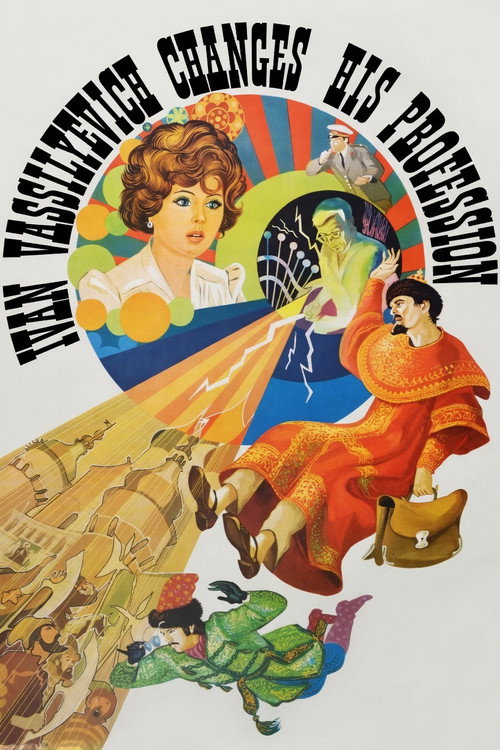
Ivan Vasilyevich Changes His Profession
1973 · Leonid Gaidai
For when you want to laugh without homework — a family-friendly classic farce that's aged into pure comfort food, especially fun with someone who already knows the lines. Zero challenge, maximum grin.
What it's about
A Moscow engineer's home-built time machine short-circuits, flinging Tsar Ivan the Terrible into a cramped 1973 apartment while stranding two contemporaries — a timid building manager and a suave burglar — in the sixteenth-century Kremlin. Since the meek manager happens to be the Tsar's exact double, both eras must be bluffed: a functionary plays autocrat before the royal court, and a medieval autocrat contends with elevators, tape recorders, and Soviet bureaucracy.
The experience
Pure comic machinery — mistaken identities, chases, musical interludes, sight gags timed like clockwork. It's fast, silly, endlessly quotable, and carries a sly wink about power and officialdom that slips by at farce speed.
The craft
Leonid Gaidai adapts a Mikhail Bulgakov stage farce with his trademark precision timing, running the double-role engine at full tilt — one actor toggling between cowering clerk and thundering tsar. The anachronism gags cut both ways, medieval and modern, and the pacing never lets a joke sit longer than it needs.
Why it matters
One of the most beloved Soviet comedies ever made, still a television perennial whose catchphrases live in everyday Russian speech — the peak of Gaidai's reign as the USSR's king of popular comedy.
Snapshot
Ivan Vasilyevich Changes His Profession (Иван Васильевич меняет профессию) is a Soviet eccentric comedy of temporal displacement, adapted by Leonid Gaidai from Mikhail Bulgakov's stage farce Ivan Vasilievich. A Moscow engineer's home-built time machine short-circuits, hurling the sixteenth-century Tsar Ivan IV ("the Terrible") forward into a cramped 1973 apartment block while dispatching two hapless contemporaries — the timid house-manager Ivan Vasilyevich Bunsha and the smooth burglar Georges Miloslavsky — back into the Kremlin of Ivan's reign. Because Bunsha is the Tsar's physical double, the film runs on a classic engine of mistaken identity, doubling the meekest of Soviet functionaries against the most fearsome of Russian autocrats. It became one of Gaidai's most beloved works and one of the great popular successes of the late-Soviet screen, its lines absorbed wholesale into Russian everyday speech. The picture sits at the confluence of three things Gaidai did better than almost anyone in Soviet cinema: physical slapstick, verbal satire aimed obliquely at bureaucracy and authority, and the recycling of a suppressed literary source into mass entertainment.
Industry & production
The film was produced at Mosfilm, the flagship state studio, and belongs to the mature phase of Gaidai's career, following his run of blockbuster comedies — Operation Y, Kidnapping, Caucasian Style, The Diamond Arm, and his Ilf-and-Petrov adaptation The Twelve Chairs. Working inside the fully state-financed and state-distributed system of Soviet cinema, Gaidai occupied an unusual position: a director whose comedies drew enormous audiences and hard-currency-equivalent box-office returns for Goskino, which gave him a degree of latitude even as his material brushed against the regime's sensitivities.
The source itself carried an ideological history. Bulgakov wrote Ivan Vasilievich in the mid-1930s; the play was rehearsed but effectively suppressed and went unperformed in his lifetime, surfacing publicly only during the post-Stalin thaw. Adapting it, Gaidai and co-writer Vladlen Bakhnov moved the action from Bulgakov's 1930s to the consumer-inflected present of 1973, a transposition that let the film satirize contemporary Soviet life — housing committees, foreign goods, black-market hustle — while keeping the historical Kremlin scenes intact.
The production is generally reported to have negotiated censorship over specific lines and gestures, some references to the state, the tsar's authority, and everyday Soviet friction being softened or altered before release; the precise catalog of cuts is the kind of detail that circulates in Russian film lore, and I would treat individual anecdotes cautiously rather than assert them as documented fact. On release the film was among the leading Soviet box-office draws of its year, reportedly drawing on the order of sixty million admissions — a figure widely cited but which I flag as an approximate, memory-of-the-record number rather than a verified accounting.
Technology
The film was shot photochemically on 35mm within Mosfilm's studio infrastructure, combining soundstage construction of both the modern apartment interior and the tsar's palace with substantial location work. Its most demanding technical dimension is optical: the time machine's operation required visible dematerialization — walls dissolving, figures vanishing between eras — achieved through in-camera and optical-printer trickery of the period, matte work, and staged disappearances rather than the electronic or digital compositing that lay decades ahead. These are the standard tools of early-1970s effects cinema, and the film's charm lies partly in their frank theatricality; the machine sparks, flashes, and belches in a register closer to fairground magic than to hard science fiction.
Technique
Cinematography
The visual scheme is built on strong contrast between two worlds: the boxy, cluttered, low-ceilinged modern flat and the deep, gilded, torch-lit spaces of Ivan's court. Gaidai's comedy depends on legibility — the camera frames wide enough to hold whole bodies and the geography of a gag, in keeping with a slapstick tradition that needs the viewer to see cause and pratfall in a single shot. The historical exteriors were realized through location shooting at a genuine Russian kremlin; the celebrated chase along the fortress walls is filmed at the Rostov Kremlin (Rostov Veliky), whose whitewashed ramparts and towers supply an authentic sixteenth-century canvas that no studio backlot could match. I am confident of the Rostov location; the specific cinematographer's individual authorship is less discussed in the general record, and I will not attribute the photography to a named operator I cannot verify here.
Editing
The cutting serves the comedy's rhythm above all: brisk match-action across the two timelines, quick reveals of the Bunsha/Ivan double, and the accelerating momentum of chase and farce. Gaidai was famous for a metronomic sense of comic timing, trimming gags to their sharpest length, and the film's set-pieces — the palace banquet, the pursuit, the machine's malfunctions — are built on that instinct for the beat. Detailed credit for the editing is not something I can specify without inventing a name, so I leave the individual attribution open.
Mise-en-scène / staging
Staging is where the adaptation's wit concentrates. The 1973 apartment block is a compressed catalog of Soviet domestic life — the shared building, the officious house-manager, the neighbor's dentist flat stocked with coveted goods — against which the intrusion of a robed, sceptre-wielding tsar reads as pure incongruity. In the Kremlin scenes, the joke inverts: Bunsha, a nonentity, is dressed in the regalia of absolute power and must perform majesty he does not possess, while Miloslavsky, a thief, slips into court life with a con man's ease. Gaidai stages the doubling so that costume and throne do the satirical work — authority as a borrowed robe.
Sound
The score is by Alexander Zatsepin, Gaidai's regular composer, whose bright, hummable idiom is inseparable from these films' popular appeal. The songs, with lyrics by Leonid Derbenyov (a frequent Zatsepin partner), became standards in their own right; the wistful "Разговор со счастьем" ("A Conversation with Happiness") and the lyrical number associated with the engineer's actress-wife are among the film's most durable exports into Soviet and post-Soviet culture. I am confident of Zatsepin's authorship and of Derbenyov's lyric collaboration; the identity of individual playback vocalists I would not state without confirmation. Sound design otherwise leans on comic punctuation — the machine's electrical crackle, the clang of the court — supporting rather than complicating the visual gags.
Performance
Performance is the film's crown. Yuri Yakovlev takes the dual role of Ivan the Terrible and Ivan Vasilyevich Bunsha, differentiating the two entirely through bearing and voice — the tsar all coiled menace and wounded majesty, Bunsha all flinching timidity — so that the running joke never tires. Leonid Kuravlyov's Miloslavsky is the film's live wire, a rogue whose charm carries the audience's sympathy. Around them Gaidai deploys a company of Soviet comic favorites: Alexander Demyanenko as the inventor Shurik — reprising the earnest-everyman persona he had made iconic in Gaidai's earlier hits — Natalya Selezneva as his wife Zina, Vladimir Etush as the acquisitive dentist Shpak, Mikhail Pugovkin as the philandering film director Yakin, and Savely Kramarov in a cross-eyed comic turn at court. The ensemble's fluency in Gaidai's style — big, precise, theatrically scaled — gives the farce its engine.
Narrative & dramatic mode
The dramatic mode is farce built on a symmetrical premise: two men are thrown into a world that mistakes them for someone else, and the comedy harvests every misunderstanding the swap allows. The structure cross-cuts between the two eras, each timeline generating its own escalating chaos — the tsar loose in a modern flat, the impostors improvising rule in the Kremlin — until the machine can reunite everyone. The film frames the whole adventure, in a device the adaptation adds around Bulgakov's material, as something the inventor Shurik experiences after a blow to the head, letting the fantastical be both indulged and gently disclaimed. This dream-logic framing is characteristic of the era's fantastika comedies, licensing the impossible without asking the censor to endorse it as real.
Genre & cycle
The film is a hybrid of the Soviet kinokomediya — the eccentric, slapstick-forward comedy tradition — and light science fiction, using the time machine purely as a comic pretext rather than a speculative subject. It belongs squarely to Gaidai's own cycle of literary-adaptation comedies and star-vehicle farces, and more broadly to a Soviet appetite for fantastika that let filmmakers stage social satire at a safe imaginative distance. Within the time-travel subgenre it is a "fish out of water" comedy in both directions at once — the past invading the present and the present bungling the past — which distinguishes it from the more common one-way displacement plot.
Authorship & method
Gaidai is the decisive author here, and the film exemplifies his method: take a canonical or once-forbidden literary comedy, translate it into broad cinematic slapstick, cast a repertory of beloved comic actors, and drive the whole with musical numbers and metronomic timing. His co-writer Vladlen Bakhnov shaped the screenplay's transposition of Bulgakov to 1973. The musical authorship belongs to composer Alexander Zatsepin with lyricist Leonid Derbenyov, a partnership central to Gaidai's sound. The historical location work at the Rostov Kremlin is a signature production choice. Beyond these, individual craft credits — cinematographer, editor — are less prominent in the general record, and I have declined to attach names I cannot confirm rather than risk a false attribution. The presiding creative intelligence remains Bulgakov-via-Gaidai: the source supplies the satirical skeleton of power and impersonation; Gaidai supplies the pace, the stars, and the songs.
Movement / national cinema
The film is a product of mature Soviet studio cinema of the Brezhnev era, made entirely within the state system yet aimed at mass popular pleasure rather than the art-cinema or ideological registers that dominate Western accounts of Soviet film. It belongs to a lineage of Soviet comedy — alongside directors like Eldar Ryazanov — that used humor as one of the few licensed spaces for social observation. Gaidai's particular contribution to that national tradition is a Hollywood-inflected physical comedy grafted onto Russian literary satire, a synthesis that made him the most commercially reliable comic director in Soviet cinema.
Era / period
Released in 1973, the film is a document of the "stagnation" years — a period of relative material stability, consumer aspiration, and quiet cynicism about officialdom. Its 1973 setting is not incidental: the dentist's imported goods, the house-manager's petty authority, the burglar's opportunism, and the film-director subplot all sketch a society preoccupied with status objects and small hustles. The historical Kremlin material, meanwhile, taps a deep Russian fascination with Ivan IV, a figure whose looming presence in national memory — and in Eisenstein's monumental Ivan the Terrible — Gaidai cheerfully deflates into farce.
Themes
The film's central theme is the contingency and theatricality of authority: strip a tsar of his throne and he is a bewildered old man in someone's flat; dress a cringing bureaucrat in royal robes and courtiers bow. Power, the doubling insists, is a costume. Alongside this runs a satire of Soviet daily life — bureaucratic pettiness embodied in the house-manager, acquisitiveness and the shadow economy embodied in the dentist and the thief, vanity embodied in the film director. Identity and impersonation thread through every strand, and Bulgakov's original anxiety about who really wields power, and how easily it is counterfeited, survives beneath the slapstick. The dream framing adds a lightly reflexive note about wish-fulfillment and the comedy of the impossible.
Reception, canon & influence
The film was received as a major popular success and has only grown in stature, becoming one of the most quoted and rewatched comedies in the Russian-language canon; its dialogue is a fund of everyday catchphrases, and the picture recurs perennially on television. Its critical standing rests less on formal innovation than on its near-perfect execution of Gaidai's comic craft and the enduring performances, above all Yakovlev's dual turn.
Its backward influences are clear and layered. The primary source is Bulgakov's suppressed play, itself a satirical fantasy of power and doubling; behind that stand the broader traditions of Russian literary comedy and the international slapstick lineage — silent-comedy chase-and-pratfall logic — that Gaidai openly admired and adapted throughout his career. The looming cultural shadow of Ivan the Terrible as a historical and cinematic figure gives the film a target worth deflating.
Its forward legacy lies mainly in language and popular memory: the film seeded phrases and gags that circulate independently of it, and it stands as a touchstone of the Soviet comedy tradition that later Russian filmmakers and audiences measure comic cinema against. Claims of specific later works directly modeled on it are the kind of assertion the record does not clearly support, so I would frame its influence as cultural saturation — a film absorbed into the common idiom — rather than a traceable chain of formal imitation. On that measure it is one of the most successfully canonized comedies its national cinema produced.
Reception
A monster hit on release — the top-grossing Soviet film of 1973, with over 60 million tickets sold — and it never needed a reappraisal: half a century of constant TV rotation has turned it from popular comedy into something closer to national folklore.
How Ivan Vasilyevich Changes His Profession was received, from release to now →
Influences: the films it descends from and the films it influenced
- Escamotage d'une dame chez Robert-Houdin (The Vanishing Lady) (1896) — The time machine's optical dematerialization of bodies descends directly from Méliès's stop-substitution conjuring, where a splice makes a person blink out of frame.
- Sherlock Jr. (1924) — Its dream-frame — a sleeping protagonist whose fantastical adventure is revealed as slumber — is the exact device that closes Ivan Vasilyevich, whose whole time-jaunt turns out to be Shurik's dream.
- The Great Dictator (1940) — The single actor playing both a meek commoner and the tyrant he physically doubles, deflating despotism through the resemblance, is the dual-role engine Yakovlev drives as both Bunsha and Ivan the Terrible.
- A Connecticut Yankee in King Arthur's Court (1949) — Establishes the anachronism-comedy grammar of a modern man dropped into a royal court, mining humor from present-day idiom colliding with medieval protocol.
- Ivan the Terrible, Part I (1944) — Supplies the monumental costume-grandeur and Tsar iconography — throne, crown, brocade — that Gaidai parodies and deflates via costume-as-authority when a thief dons Ivan's regalia.
- Operation Y and Shurik's Other Adventures (1965) — Introduces the recurring bespectacled inventor-hero Shurik and the chase-and-pratfall episodic structure Gaidai reuses for the machine-building protagonist here.
- Kidnapping, Caucasian Style (1967) — Locks in the Zatsepin–Derbenyov song-driven ensemble method — beloved comic character actors carried by embedded pop numbers — that structures Ivan Vasilyevich's sound.
- The Diamond Arm (1969) — Perfects the metronomic comic-timing editing and the fully integrated Zatsepin–Derbenyov musical number as a set-piece within slapstick, a template repeated here.
- The Twelve Chairs (1971) — Immediately-prior instance of Gaidai's signature method: transposing a canonical satirical literary comedy into broad cinematic slapstick, exactly as he then does with Bulgakov.
- Bill & Ted's Excellent Adventure (1989) — Descends in the time-comedy line by colliding incongruous historical epochs and figures, harvesting anachronism as the primary comic device.
- Les Visiteurs (1993) — National-comedy analog that inverts the premise — displacing period figures into the modern world — while reusing the identical fish-out-of-water slapstick of era-swapped characters.
- The Irony of Fate (1975) — Sibling Soviet kinokomediya built on a structural doubling gag (identical apartments/mistaken belonging) laced with diegetic songs, measured against the same comedy tradition.
- The Pokrovsky Gate (1983) — Extends the theatricality-of-authority and farce-of-doubling staging in a stylized Soviet comedy, foregrounding performance and costume as social mask.
- Back to the Future (1985) — Parallel time-travel comedy whose engine is a malfunctioning contraption and the fish-out-of-water gag of a present-day sensibility stranded in another era.
- Kin-dza-dza! (1986) — Sibling Soviet fantastika-comedy that satirizes power and rank through low-tech, absurdist optical effects and displacement rather than spectacle.
- Heart of a Dog (1988) — Fellow Bulgakov screen adaptation transposing his suppressed satirical fantasy of transformation and authority into cinema, the same source-to-screen craft as Ivan Vasilyevich.
Similar films
- The Great Dictator (1940) — influence & lineage
- The Death of Stalin (2017) — shared sensibility
- Courier (1986) — shared sensibility
- Battleship Potemkin (1925) — shared sensibility
- Russian Ark (2002) — shared sensibility
- Time Bandits (1981) — shared sensibility
- Michael Madana Kama Rajan (1990) — shared sensibility
- Dr. Strangelove or: How I Learned to Stop Worrying and Love the Bomb (1964) — shared sensibility
All the films related to Ivan Vasilyevich Changes His Profession →