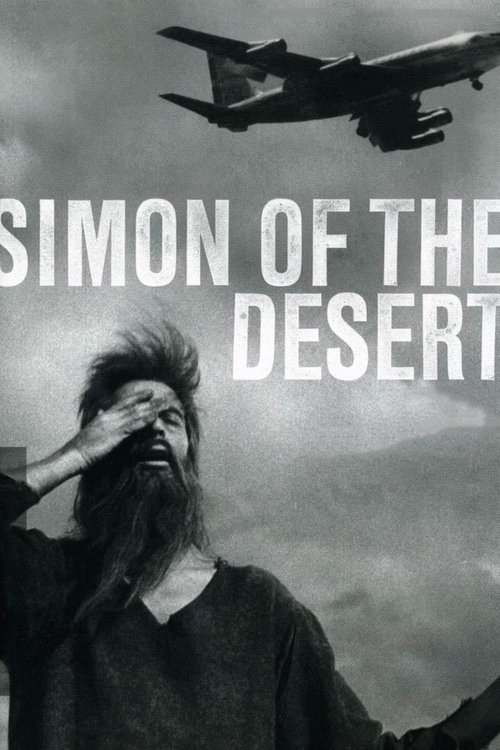
Simon of the Desert
1965 · Luis Buñuel
For when you want something short, strange, and sharp — a single-sitting provocation that leaves you laughing and arguing. More a bracing espresso than a comfort watch.
What it's about
Simon, a desert ascetic in late antiquity, has spent years standing atop a stone pillar to be closer to God, dispensing blessings and miracles to the pilgrims, priests, and cripples milling below. The Devil wants him down, and keeps arriving in seductive new disguises to tempt, needle, and humiliate him. It's a battle of wills between one stubborn holy man and an adversary with infinite patience — told in a brisk 45 minutes.
The experience
Dry, wicked, and very funny — the miracles land with a shrug, the piety curdles into absurdity, and every temptation is staged with deadpan mischief. It ends with a swerve so audacious you'll want to talk about it immediately.
Performances
Silvia Pinal is a delight as the Devil, slipping between disguises with sly, flirtatious menace, and Claudio Brook plays Simon with a granite solemnity that makes every deflation funnier.
The craft
Luis Buñuel shoots the desert plainly and lets the absurdity do the work — miracles are filmed without fanfare, which somehow makes them funnier and more unsettling. At 45 minutes it's ruthlessly concentrated, its famously abrupt shape (the money ran out mid-production) turned into one of its greatest jokes.
Why it matters
The caustic capstone of Buñuel's Mexican period, it distills his lifelong war with religious hypocrisy into miniature and remains a touchstone for surrealist satire.
Snapshot
Simon of the Desert (Simón del desierto) is Luis Buñuel's caustic, compact fable of Christian asceticism, loosely drawn from the life of the fifth-century Syrian stylite Saint Simeon, who reputedly spent decades atop a pillar in the desert. (The TMDB grounding note places the story in the fourth century; the historical Simeon Stylites the Elder is conventionally dated to the fifth, and Buñuel treats the period as legendary rather than exact.) Running only about 45 minutes, it is the shortest of Buñuel's mature works and one of the most concentrated distillations of his lifelong anticlericalism, surrealist wit, and moral irony. It is best known for two things: its abrupt, unfinished state — production money ran out before Buñuel could shoot the full script — and its extraordinary ending, which teleports the holy man from his ancient column into a throbbing 1960s discotheque. The film closed the informal trilogy Buñuel made in Mexico with producer Gustavo Alatriste and actress Silvia Pinal, after Viridiana (1961) and The Exterminating Angel (1962), and it won the Special Jury Prize (Silver Lion) at the 1965 Venice Film Festival.
Industry & production
The film was a Mexican production financed by Gustavo Alatriste, the businessman-producer (and Silvia Pinal's husband) who had bankrolled Buñuel's two preceding Mexican-Spanish provocations. By the mid-1960s Buñuel, a Spanish exile who had built a durable career inside the Mexican studio system since the late 1940s, was operating with an unusual degree of creative freedom under Alatriste's patronage, having achieved international prestige with the Cannes-winning, Franco-scandalizing Viridiana.
The most consequential production fact about Simon of the Desert is that it is incomplete. Buñuel wrote a longer film — accounts describe planned additional episodes, including further temptations and a journey involving pilgrims — but financing collapsed before shooting was finished, leaving the picture at roughly medium-length. This is the standard explanation in the Buñuel literature and in the director's own recollections; the precise sequence of events (and exactly how much footage was foregone) is reported with some variation, and the fine detail is one place where the record is genuinely thin. Rather than pad or abandon the work, Buñuel devised the compressed, jarring nightclub finale to bring it to a close — turning a budgetary accident into one of his most celebrated ruptures. The result is that the film's brevity is not a formal choice so much as a scar that Buñuel absorbed into the design.
Despite its truncation, the film was taken seriously as a major work on release, its Venice prize confirming Buñuel's standing at the height of the 1960s international art-cinema boom.
Technology
Simon of the Desert was shot on 35mm black-and-white film with direct location and studio work in Mexico, in the standard tools of mid-1960s monochrome production. There is nothing technologically experimental about the apparatus; Buñuel was famously indifferent to gadgetry and to the seductions of technique for its own sake, preferring efficient, unfussy coverage. What is notable is the deliberate retention of black-and-white at a moment when color was fast becoming the international norm, a choice that suits the austere desert setting and aligns the film with the sculptural monochrome tradition of its cinematographer, Gabriel Figueroa. The film's technological modesty is itself expressive: the plainness of means throws all weight onto composition, gesture, and the shock of the final cut to contemporary sound and space.
Technique
Cinematography
The cinematography is by Gabriel Figueroa, the towering figure of Mexican photography whose deep-focus, high-contrast monochrome — with its dramatic skies and monumental framing of figures against landscape — had defined the "golden age" look for directors like Emilio Fernández. Here Figueroa turns that grandeur to ironic ends. Simón perched on his column is repeatedly composed against vast, empty sky, the low angle lending him a spurious monumentality that the film's content steadily undercuts. The barren desert (in fact a Mexican landscape standing in for the Syrian wilderness) becomes an abstract stage, isolating the saint as a tiny vertical mark in a horizontal void. Figueroa's clarity and gravity give the absurdist material an unexpected classical dignity, and the tension between his reverent imagery and Buñuel's irreverent story is one of the film's essential pleasures.
Editing
Edited by Carlos Savage (a frequent Buñuel collaborator in Mexico), the film is cut in Buñuel's characteristically plain, transparent style for most of its length — steady, unemphatic, letting scenes play. The editing becomes conceptually radical only at the very end, where a single, unmotivated cut hurls the narrative across roughly fifteen centuries into a modern nightclub. That temporal jump — abrupt, unexplained, and irreversible — is the film's defining formal gesture, a montage rupture that substitutes for the conventional resolution the lost financing denied. It is a reminder that Buñuel's surrealism operated less through optical trickery than through the shock of juxtaposition and the refusal of expected transitions.
Mise-en-scène / staging
The staging is organized vertically and repetitively, mirroring the stasis of Simón's vocation. The column is the fixed axis of the world; pilgrims, monks, beggars, and clergy cluster at its base while the saint remains aloft, and much of the drama consists of who ascends, who watches, and who tempts. Buñuel exploits the inherent comedy of this arrangement — the practical absurdities of a man living atop a pillar (food hauled up, bodily needs, the tedium of prayer) are staged with deadpan literalism. Recurrent props and gestures accrue meaning: Simón blessing everything reflexively, the offered morsels, the ecclesiastical processions. Silvia Pinal's Devil enters this rigid geometry as a disruptive, mobile, shape-shifting force — appearing as a coquettish schoolgirl, as a bearded figure evoking Christ, and elsewhere — her fluidity set against the saint's fixity.
Sound
The sound design is spare for most of the film — wind, prayer, the murmur of the crowd — consistent with the ascetic setting. Buñuel, generally sparing with non-diegetic music, reserves his most pointed use of sound for the climax, when the ancient silence gives way to the amplified rock music of the discotheque. The eruption of modern pop noise into a film that had been defined by desert quiet is a sonic shock as decisive as the visual one, and it does much of the work of the ending's meaning. Precise credits for sound personnel are the kind of technical detail that circulates less reliably for a Mexican production of this period; the effect, however, is unmistakable.
Performance
Claudio Brook plays Simón with a straight-faced, ascetic conviction that is essential to the comedy: he never signals the absurdity, treating the saint's rigors and reflexive piety with complete gravity, which lets Buñuel's irony land without editorializing. Silvia Pinal, in her third and final collaboration with Buñuel, is the film's spark as the Devil, playing multiple guises with sly relish — most memorably the tempting girl who exposes her legs and the false Christ. The contrast between Brook's stillness and Pinal's protean mischief is the performative engine of the film. The supporting cast of monks, pilgrims, and beggars is played in a broad, earthy register that grounds the fable in bodily reality.
Narrative & dramatic mode
The film is structured as a series of loosely connected episodes rather than a driving plot — a tableau of temptations, miracles, and interruptions arranged around the immovable figure on the column. Its dramatic mode is ironic parable: Buñuel poses the ascetic ideal in its most extreme form and then lets reality corrode it through farce. The most famous episode has Simón miraculously restore the amputated hands of a thief, who promptly uses them to strike his child — a perfect Buñuelian joke about the futility of holiness in a fallen world. The narrative refuses catharsis; the truncated ending, by design or necessity, leaves the "story" unresolved and replaces closure with dislocation. This episodic, anti-teleological shape is characteristic of Buñuel's surrealist sensibility, in which meaning arrives through pattern and juxtaposition rather than causal development.
Genre & cycle
Classified as comedy, drama, and fantasy, the film sits at the intersection Buñuel made his own: the blasphemous religious satire crossed with surrealist fantasy. It belongs to the loose Mexican cycle Buñuel produced with Alatriste and Pinal — Viridiana, The Exterminating Angel, and Simon of the Desert — a run of films unified by their attack on religious and bourgeois pieties, their taste for the absurd, and their refusal of naturalistic resolution. Within the broader "art film" of the 1960s it stands as a short, concentrated instance of the anticlerical fantasy, kin to Buñuel's later French provocations (The Milky Way, The Discreet Charm of the Bourgeoisie) that treat theology and social ritual as fields for surreal comedy.
Authorship & method
Simon of the Desert is a signature Buñuel work, co-written by the director with Julio Alejandro, the Spanish screenwriter who collaborated on several of Buñuel's Mexican and Spanish films (including Viridiana). The authorial fingerprints are everywhere: the anticlericalism rooted in Buñuel's Jesuit-educated, Aragonese Catholic upbringing (which he spent a lifetime interrogating), the deadpan surrealism inherited from his youthful collaborations with Salvador Dalí, and the moral irony that treats sanctity and sin with equal skepticism. Buñuel's method here is economical and anti-virtuosic — he distrusted flashy camerawork and worked fast and efficiently — which makes the collaboration with Gabriel Figueroa telling: the director's plainness is elevated by the cinematographer's monumental image-making. Editor Carlos Savage and producer Gustavo Alatriste round out the core creative unit. The film has no conventional score of note; its music is essentially the diegetic pop of the finale, another mark of Buñuel's suspicion of emotional underscoring. The overall method is that of a filmmaker converting constraint — including the literal loss of funds — into form.
Movement / national cinema
The film is a product of Mexican cinema, made within the industry where Buñuel rebuilt his career from 1946 onward after his surrealist beginnings in France (Un Chien Andalou, 1929; L'Age d'Or, 1930) and years of hardship. Yet its deepest affiliation is with Surrealism: Buñuel was among the movement's founding cinematic figures, and even his most "commercial" Mexican assignments carry its logic of desire, transgression, and irrational juxtaposition. Simon of the Desert thus straddles two contexts — the national-industrial framework of 1960s Mexican production (and the world-class craft of Figueroa) and the international avant-garde lineage of Surrealism that Buñuel personally embodied. It is also, unavoidably, a Spanish exile's film, informed by Buñuel's fraught relationship with Catholic Spain.
Era / period
Made in 1965, the film belongs to the golden decade of international art cinema, when European and Latin American auteurs commanded festival attention and critical prestige. Its ending is pointedly of its moment: the discotheque, the rock-and-roll dance, the miniskirted youth represent the mid-1960s modernity that the ancient saint is dropped into. Buñuel, then in his mid-sixties, uses the contemporary setting to collapse the distance between medieval fanaticism and modern hedonism, implying an unbroken continuity of human folly. The film also arrives at the tail end of Buñuel's Mexican period; shortly after, he would return to French production for the celebrated late run beginning with Belle de Jour (1967).
Themes
The central theme is the futility — and the vanity — of extreme religious asceticism. Simón's self-mortification, however sincere, produces nothing useful: his miracles misfire, his blessings are reflexive and empty, and his elevation above humanity is literalized as an absurd perch. Temptation runs throughout, but Buñuel refuses the pious framework in which temptation ennobles the saint; instead the Devil is livelier, wittier, and more humane than the holiness she assails. Related themes include the corruption or triviality of institutional religion (the attending monks and clergy), the persistence of bodily and worldly reality against spiritual pretension, and the irony that virtue may be indistinguishable from pride. The ending broadens the critique into a bleak historical joke: swap the desert for the dancefloor and the pillar for the discotheque, and human beings remain caught in ecstasies that lead nowhere. Beneath the comedy lies Buñuel's abiding fascination with faith itself — an unbeliever's persistent, almost tender obsession with the religious impulse he cannot share.
Reception, canon & influence
Simon of the Desert was well received critically and honored with the Special Jury Prize (Silver Lion) at the 1965 Venice Film Festival, a significant endorsement despite — or partly because of — its unusual brevity and audacity. Over time it has become a cherished minor-major work in the Buñuel canon: too short and too strange to sit beside his acknowledged masterpieces in scale, yet frequently singled out for the perfection of its irony and the brilliance of its ending. Its preservation and circulation (including a Criterion Collection release) have secured its availability to later generations.
Looking backward, the film draws on hagiographic legend (the life of Simeon Stylites), on Buñuel's Surrealist formation with Dalí, and on the monumental monochrome tradition of Mexican cinematography embodied by Figueroa. It also extends the anticlerical project Buñuel had pursued since L'Age d'Or and refined in Viridiana.
Looking forward, its influence is felt less in direct imitation than in its model of surreal religious satire and its device of the temporally dislocating ending. The abrupt leap from the ancient world into a modern nightclub — history collapsed by a single cut — anticipates the free temporal play of Buñuel's own later French films (The Milky Way, The Phantom of Liberty) and has been admired by filmmakers drawn to blending the sacred and the absurd. Its reputation as a "perfect fragment," a film whose accidental incompleteness became an aesthetic virtue, has itself become part of its legacy, a touchstone example of an artist turning limitation into meaning. Claims of specific, traceable homages in later cinema should be made cautiously; the film's clearest legacy is atmospheric and conceptual — its demonstration that a 45-minute fable could hold as much irony, beauty, and blasphemy as a feature twice its length.
A Deleuzian reading
A thief's hands have been cut off for stealing.
The full Deleuzian reading of Simon of the Desert →
Reception
It took a Special Jury Prize at Venice in 1965 but was long treated as a truncated oddity — the abandoned last gasp of Buñuel's Mexican period. Now its 45 minutes are treasured as a perfect miniature, routinely called one of the greatest 'short' features ever made.
How Simon of the Desert was received, from release to now →
How to watch Simon of the Desert: what to notice on a first viewing
- Watch how small Simón looks against the empty sky. Figueroa composes him with grand, low-angle monumentality atop the column, an isolated vertical mark in a vast horizontal void. The grandeur of the image keeps undercutting the man it is supposedly honoring.
- Watch Simón bless things reflexively, again and again. Claudio Brook plays the gesture with total, unwavering seriousness, never once signaling that it might be funny or empty. His straight face is what lets the joke land without the film ever having to point at it.
- Notice the basket hauled up with Simón's food and water. The film stages the practical logistics of living on a pillar with deadpan literalism, treating sainthood as a job with daily chores. Holiness here has to eat and drink like everyone else, and the film never lets you forget it.
- Watch Silvia Pinal change her look and manner between scenes. She arrives as a coquettish schoolgirl and keeps shifting her manner, sliding between guises with sly relish. Her fluidity is set directly against Simón's fixity, and she is by far the livelier of the two.
- Listen for how quiet the desert stays: wind, prayer, a crowd's murmur. Buñuel keeps music almost entirely out of the film, letting the ascetic setting's near-silence stand on its own. The quiet makes you feel exactly how little happens on top of that column.
The whole guide to watching Simon of the Desert, with the keys for a rewatch →
Influences: the films it descends from and the films it influenced
- Un Chien Andalou (1929) — Establishes the shock-cut montage-rupture logic — an incongruous match cut yoking unrelated spaces — that Simon's final jump from the ancient pillar to a modern nightclub recapitulates.
- L'Age d'Or (1930) — Founds Buñuel's anticlerical surrealist provocation, juxtaposing sanctity against carnal absurdity, the blasphemous grammar Simon refines into saint-mockery.
- The Passion of Joan of Arc (1928) — Models ascetic hagiographic cinema built on the suffering ascetic's face and spare martyr iconography, the devotional register Simon ironizes.
- Río Escondido (1948) — Gabriel Figueroa's low-angle monumental compositions against vast cloud-filled skies — the pillar-and-sky monochrome grammar he reprises on Simon's column.
- Los Olvidados (1950) — First fuses Figueroa's hard Mexican monochrome with a surrealist dream-eruption, the exact director-cinematographer collaboration template Simon inherits.
- Él (1953) — Anatomizes Catholic obsession and religious paranoia through deadpan clinical observation, the interrogation of faith-as-neurosis Simon extends to the ascetic ideal.
- Nazarín (1959) — Sets the itinerant holy fool whose sanctity is serially tested in episodic encounters, shot by Figueroa — the narrative-and-crew blueprint for Simon's parable.
- Viridiana (1961) — Co-writer Julio Alejandro's anticlerical parable structure and the desecration of a devout innocent carry directly into Simon's script.
- Macario (1960) — Figueroa's stark deep focus and emptied low-horizon skies continue the anticlerical fable, isolating a single sanctified figure exactly as Macario isolates its woodcutter.
- The Young One (1960) — Continues the Claudio Brook–Buñuel collaboration begun here, again isolating a single tested figure in a bare microcosm to strip moral certainty.
- The Milky Way (1969) — Extends Simon's era-collapsing cut into a full episodic religious-heresy travelogue where characters step abruptly across centuries within a single walk.
- El Topo (1970) — Mexican-shot surrealist religious allegory sending a mystic ascetic across a symbolic desert, descending from Simon's fusion of the sacred and the absurd.
- The Discreet Charm of the Bourgeoisie (1972) — Matures Simon's ironic detachment into deadpan surrealist social satire structured on interrupted repetition and thwarted ritual.
- The Holy Mountain (1973) — Climaxes a blasphemous surrealist religious spectacle with a reality-breaking rupture into the filming present, echoing Simon's temporally dislocating ending.
- The Phantom of Liberty (1974) — Realizes Simon's anti-teleological impulse as a full chain of non sequiturs that refuse narrative resolution and hand the film from one episode to the next.
- Life of Brian (1979) — Comic anticlerical satire that literally mocks pillar-hermits and desert ascetics, extending Simon's deflation of performed sanctity into farce.
- The Devils (1971) — Weaponizes anticlerical blasphemy, treating sanctity and carnal temptation as absurd grotesquerie — the desecration impulse behind Russell's mockery of ecclesiastical hypocrisy.
- Cronos (1993) — Del Toro cast Claudio Brook as Dieter de la Guardia to import Buñuel's Mexican period bodily; Brook's deadpan ascetic-grotesque register — flesh mortified in pursuit of the eternal — is carried from the pillar saint to a cancer patient sealed in a plastic-sheeted penthouse.
- Post Tenebras Lux (2012) — The devil rendered as a banal, physically present visitor rather than an effect — arriving, doing something mundane, leaving — which is precisely the register of Reygadas's red figure carrying a toolbox up a staircase.
- The Exterminating Angel (1962) — The same Alatriste/Silvia-Pinal/Figueroa production unit staging a deadpan surreal parable of figures trapped by an inexplicable metaphysical rule.
- Teorema (1968) — Builds a sacred-intrusion parable in the same episodic, anti-psychological register, treating a metaphysical visitor with deadpan formal detachment.
- Songs from the Second Floor (2000) — Deadpan static-tableau religious-absurdist satire in the same anti-teleological episodic-parable mode, treating faith and folly with equal dry irony.
Similar films
- The Exterminating Angel (1962) — influence & lineage · same viewing thread
- Nazarín (1959) — influence & lineage · same viewing thread
- The Phantom of Liberty (1974) — influence & lineage · same viewing thread
- The Discreet Charm of the Bourgeoisie (1972) — influence & lineage · same viewing thread
- Un Chien Andalou (1929) — influence & lineage
- The Young and the Damned (1950) — influence & lineage
- El Topo (1970) — influence & lineage
- Él (1953) — influence & lineage · same viewing thread
All the films related to Simon of the Desert →
Watch it with: curated runs of related films
- Buñuel and the Bourgeoisie — A run of surrealist provocations where every dinner, prayer, and marriage bed hides an appetite polite society can't admit — watch them together for the way Buñuel (and Pasolini's Theorem) keep pulling the tablecloth out from under the well-heeled.