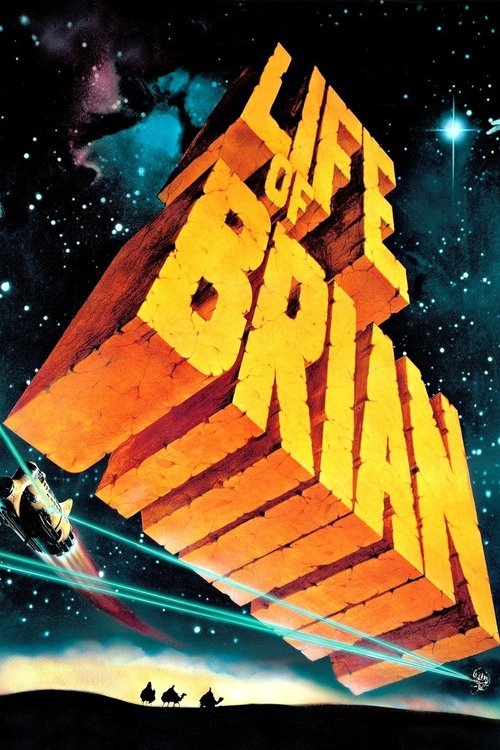
Life of Brian
1979 · Terry Jones
For when you want to laugh at the machinery of belief and bureaucracy alike — a rewatchable crowd-pleaser that doubles as the smartest satire you'll quote for weeks.
What it's about
Brian Cohen is born in the stable next door to Jesus on the same night, and his life never stops rhyming with the wrong messiah's. An ordinary young man in Roman-occupied Judea — henpecked by his mother, entangled with a fractious separatist movement that spends more time on acronyms than revolution — Brian is catastrophically mistaken for the Messiah and can't shake the followers no matter how hard he insists he isn't him.
The experience
Relentlessly, quotably funny — absurd sketch energy welded to an actual story, so the gags build instead of just accumulating. It's the rare comedy that gets sharper the more you know about religion, politics, and committees.
Performances
Graham Chapman grounds the madness as the eternally exasperated Brian, while the rest of the Pythons rotate through dozens of roles — Michael Palin's Pontius Pilate scene is one of the most famous sustained bits in screen comedy.
The craft
Unlike pure sketch comedy, it commits to one coherent narrative, which is why it's widely considered the Pythons' most fully realized film. The production has surprising period sweep for a comedy, and it closes on one of the most famous musical endings in movie history.
Why it matters
Banned in several countries and denounced from pulpits, its censorship battle became a defining moment for free expression in comedy — and it now routinely tops polls of the greatest comedy films ever made.
Snapshot
Monty Python's Life of Brian is the second wholly original feature by the British comedy troupe and, by wide critical consensus, the most fully realized. Where Monty Python and the Holy Grail (1975) had refracted its medieval material through the group's sketch-comedy instincts, Brian tells a single sustained story: the life of Brian Cohen, born in the stable next door to Jesus on the same night, who is repeatedly and catastrophically mistaken for the Messiah. The film is at once a religious satire, an anti-authoritarian comedy, and a structurally conventional biographical narrative played entirely for absurdity. It occupies a permanent place in the history of screen comedy both for its formal coherence and for the censorship controversy that surrounded its release — a controversy that helped define the limits of religious satire in late-1970s Britain. It is also notable as the film that, in effect, founded a production company: HandMade Films, created by George Harrison to rescue a project the established British industry had abandoned.
Industry & production
The production history of Life of Brian is one of the most frequently cited episodes in modern British film financing. EMI Films, under Bernard Delfont, had agreed to back the picture, but withdrew shortly before shooting — by the troupe's account, after senior figures actually read the script and balked at the religious content. With the Pythons committed and pre-production advanced, the gap was closed by George Harrison, the former Beatle and a friend of Eric Idle, who arranged financing through his and Denis O'Brien's newly formed HandMade Films. Harrison reportedly mortgaged property to raise the money; Idle's much-repeated quip that it was "the most expensive cinema ticket ever bought," because Harrison simply wanted to see the film, captures the unusual, almost personal nature of the deal. HandMade went on to become a significant force in 1980s British cinema, and Brian was its foundational title.
Principal photography took place in Tunisia, in and around Monastir and the ruins near Carthage, locations that doubled for Judea. The production took advantage of standing sets and infrastructure left from Franco Zeffirelli's television epic Jesus of Nazareth (1977), an economy that also lent the comedy an incongruously handsome, large-scale biblical look. The budget was modest by epic standards but generous by the Pythons' own, and the film's relatively lavish appearance — crowds, deserts, Roman architecture — is part of its comic strategy: the gravity of the setting plays straight against the silliness of the dialogue.
Technology
Life of Brian is a conventionally photochemical production of its era, shot on 35mm color film for theatrical exhibition. It does not represent a technological landmark in the way some of its contemporaries do; its innovations are tonal and structural rather than mechanical. The one area where the Python films had long shown a distinctive technical signature is animation, and Terry Gilliam's cutout animation appears here, most prominently in the opening titles. By comparison with Holy Grail, however, animation is used sparingly — a reflection of the decision to make a narratively continuous film rather than a sketch-and-link structure. I have not found a detailed, authoritative account of the specific camera and lens packages used, and will not invent one.
Technique
Cinematography
The director of photography was Peter Biziou, who would later win an Academy Award for Mississippi Burning (1988) and shoot films including Pink Floyd – The Wall and The Truman Show. His work on Brian is significant precisely because it refuses to signal comedy. The Tunisian exteriors are shot with the breadth and natural light of a historical epic — wide vistas, hard desert sun, deep crowd scenes — so that the visual register supports the premise that this is a "real" biblical world into which absurdity intrudes. The famous Sermon on the Mount sequence, in which distant listeners mishear "Blessed are the peacemakers" as "Blessed are the cheesemakers," depends on this seriousness: the long-shot scale and atmospheric distance make the mishearing plausible and the joke land. Biziou's restraint is a textbook case of cinematography serving comedy by underplaying it.
Editing
The film was edited by Julian Doyle, a key technical collaborator across several Python projects who also handled production duties. The editing's central achievement is rhythmic control over set-piece comedy within a continuous story. Sequences such as the haggling-over-the-gourd scene, the stoning, the "What have the Romans ever done for us?" meeting, and Pilate's audience chamber are built on comic timing — the held beat, the cut to a reaction, the escalation of a list — that has to function as both sketch and plot. Compared with the deliberately fragmentary Holy Grail, Brian uses editing to sustain momentum and causality, carrying Brian from one misadventure to the next without losing the verbal precision on which the gags depend.
Mise-en-scène / staging
Terry Jones's direction is most visible in the staging. He favoured a relatively classical, unfussy presentation that lets ensemble performances and dialogue dominate the frame, with the production design — period costume, Roman and Judean architecture, dense crowds — establishing an authentically epic environment. Gilliam served as designer (as well as performer and animator), and the look is consistent and grounded. The staging repeatedly juxtaposes institutional grandeur with farce: Pilate's formal audience hall becomes the stage for the "Biggus Dickus" speech-impediment routine; the organized squalor of the anti-Roman factions plays out in colonnaded ruins; the mass following gathers in genuinely epic crowd compositions before dissolving into bickering. The film's running gag about competing splinter groups — the People's Front of Judea, the Judean People's Front, and so on — is as much a matter of staging (small clusters of men solemnly convened in grand spaces) as of script.
Sound
The score was composed by Geoffrey Burgon, whose orchestral and choral writing lends the film a straight-faced ecclesiastical and epic quality that heightens the satire. The single most consequential element of the soundtrack, however, is Eric Idle's song "Always Look on the Bright Side of Life," performed during the closing crucifixion sequence. Whistled and sung by the condemned, it transforms the film's darkest image into a music-hall finale and has since taken on an independent cultural life well beyond the film. The contrast between Burgon's solemn underscore and Idle's chirpy vaudeville number encapsulates the film's tonal method.
Performance
As with all the troupe's work, the Pythons play multiple roles. Graham Chapman takes the central, largely straight part of Brian — a relatively restrained leading turn that anchors the surrounding chaos, and one often noted as evidence of his range as the troupe's most conventional "leading man." Around him, John Cleese, Eric Idle, Terry Jones, Michael Palin, and Terry Gilliam each play numerous characters: Cleese's Reg, the bureaucratic revolutionary; Palin's nervous, lisping Pilate; Jones's shrill Mandy, Brian's mother; Idle's various hustlers and the cheerful crucifixee. The performance style mixes deadpan commitment with sudden bursts of the surreal, and much of the comedy is verbal — the precise delivery of escalating lists, pedantic grammar (the "Romanes eunt domus" Latin lesson), and bureaucratic jargon.
Narrative & dramatic mode
The film's most important formal decision is to be a story. Brian adopts the shape of a biographical epic — birth, calling, ministry, persecution, execution — and runs its protagonist through that arc as a hapless ordinary man who never wanted any of it. The dramatic mode is ironic and satirical: the audience always knows more than the crowd within the film, who insistently read divine meaning into Brian's every accident (the lost sandal, the gourd, "He has spoken to us out of his arse"). This dramatized critique of how followers manufacture a messiah is the film's structural engine. Crucially, the satire is aimed not at Jesus — who appears briefly and is treated straight, delivering the Sermon on the Mount — but at credulity, dogmatism, and the human appetite for authority. The continuous narrative also allows for genuine pathos and bleakage of darkness, most of all in the unrescued crucifixion ending, which the film declines to soften except through song.
Genre & cycle
Life of Brian sits within the cycle of Monty Python feature films, between Holy Grail (1975) and The Meaning of Life (1983), and represents the troupe's fullest move from sketch revue toward sustained narrative comedy. It belongs more broadly to the British tradition of irreverent, anti-establishment screen comedy, and within the niche genre of biblical-epic parody it is the defining example. Its satire of political sectarianism also connects it to a strain of comedy about ideological hair-splitting. The film's lasting influence on the religious-satire subgenre is such that later works treating faith comedically are routinely measured against it.
Authorship & method
Authorship of a Python film is collective by design. The screenplay is credited to all six members — Graham Chapman, John Cleese, Terry Gilliam, Eric Idle, Terry Jones, and Michael Palin — developed through the group's established method of writing in pairs and subgroups and then reading material aloud to the whole, with what survived the others' laughter making the cut. Terry Jones directed alone (he had co-directed Holy Grail with Gilliam), and the consensus in the troupe's own retrospective accounts credits Jones with pushing for narrative discipline and a coherent visual world. Gilliam's contributions were design and animation as well as performance. Among non-Python collaborators, the most important were cinematographer Peter Biziou, composer Geoffrey Burgon, and editor/production hand Julian Doyle. Eric Idle's authorship of "Always Look on the Bright Side of Life" gives him a distinct individual mark on the film's legacy. The method's signature is verbal precision and structural play harnessed, this time, to a single throughline.
Movement / national cinema
The film is a product of British comedy and the post-Flying Circus careers of its makers; it has no allegiance to a stylistic movement so much as to the institution of Monty Python itself. Its production circumstances, however, made it a landmark in British national cinema: the founding of HandMade Films through George Harrison's intervention created an independent producer that would shape 1980s British film. In that sense Brian belongs to a story about the survival of idiosyncratic British production at a moment when the established studios (here, EMI) were unwilling to take risks on controversial material.
Era / period
Released in 1979, Brian arrived at the close of a decade and on the cusp of major political shifts in Britain. Its satire of squabbling revolutionary factions and impotent committee politics reads, to many later commentators, as a comment on the fractious left-wing politics of 1970s Britain, though the film wears this lightly and aims primarily at dogmatism in general. Its reception belongs squarely to its moment: the blasphemy controversy unfolded in a Britain where religious sensibility still carried real institutional and legal weight, and where television could stage a serious public debate about a comedy film.
Themes
The film's governing theme is the critique of blind faith and the manufacture of authority: the crowd's determination to find a messiah, and Brian's inability to escape the role thrust upon him, dramatize how belief can be projected onto an unwilling and unremarkable object. Closely related is the satire of dogmatism and sectarianism — the interchangeable liberation fronts who hate each other more than their common enemy, and whose meetings substitute procedure for action. A celebrated thematic beat is the crowd's insistence on conformity ("You're all individuals!" / "I'm not!"), which turns the rhetoric of individualism into mass obedience. The "What have the Romans ever done for us?" sequence skewers reflexive ideological grievance by piling up the concrete benefits the speakers cannot deny. Underlying all of this is a humane skepticism: the film is anti-authoritarian rather than anti-religious, mocking institutions and followers while leaving the figure of Jesus untouched.
Reception, canon & influence
On release, Life of Brian was both commercially successful and intensely controversial. It was accused of blasphemy, condemned by religious groups, and subject to bans and restrictions in a number of jurisdictions — it was banned outright in some places (including, for a period, parts of Ireland and Norway) and prohibited by various local councils in Britain under their licensing powers, in some cases in towns that had no cinema. The Norwegian ban gave rise to the much-quoted Swedish marketing line promoting it as the film "so funny it was banned in Norway." The controversy peaked in a now-famous televised debate on the BBC's Friday Night, Saturday Morning, in which John Cleese and Michael Palin faced the writer Malcolm Muggeridge and the Bishop of Southwark, Mervyn Stockwood; the encounter is frequently revisited as a study in the clash between satirists and religious authority.
Critical estimation rose steadily over the following decades, and the film is now widely regarded as among the greatest comedies in the English language and as the Pythons' finest feature; it routinely places highly in polls of best British and best comedy films, though I will not attribute specific rankings without the source to hand. Its influences run backward to the biblical epic (Zeffirelli's Jesus of Nazareth, whose sets it borrowed, and the Hollywood and Italian sword-and-sandal traditions it parodies) and to the British music-hall and Goon Show lineage that shaped the troupe's verbal comedy. Forward, its legacy is broad: it set the template for feature-length religious and historical satire, demonstrated that controversy could be navigated and even harnessed, and gave the culture an enduring anthem in "Always Look on the Bright Side of Life," which has migrated into funerals, football terraces, and stage musicals. The film's production saga, finally, seeded HandMade Films and thereby shaped a chapter of independent British cinema beyond anything its makers set out to do.
A Deleuzian reading
Far at the back of the crowd on the mountainside, too far to actually hear, a small group is doing its best.
The full Deleuzian reading of Life of Brian →
Reception
In 1979 it was denounced as blasphemous, banned in Norway and Ireland, and refused screenings by dozens of UK local councils — some of which hadn't even watched it. Now it routinely tops British polls as the greatest comedy film ever made, and even many clergy have come around to it as satire of dogmatism rather than faith.
How Life of Brian was received, from release to now →
Influences: the films it descends from and the films it influenced
- Monty Python and the Holy Grail (1975) — Jones's prior co-direction established the method of grafting the troupe's pair-written, read-aloud sketches onto a single sustained quest narrative — the discipline Brian extends into one coherent biographical arc.
- And Now for Something Completely Different (1971) — First cinema transfer of the Pythons' multiple-role ensemble performance and verbal-precision writing, the troupe's baseline film technique that Brian harnesses to a throughline.
- Jesus of Nazareth (1977) — Brian physically reused Zeffirelli's Tunisian sets and inherited its earnest location realism, which Biziou's long-shot cinematography then plays deadpan-straight against the farce.
- Ben-Hur (1959) — Supplies the widescreen Hollywood-epic grammar of Roman pomp, crowds and processional grandeur that Brian's staging mimics faithfully in order to puncture it.
- The Greatest Story Ever Told (1965) — Its reverent, star-cameo Life-of-Christ tableau staging is the exact register Brian parodies — the distant, mishearing crowd at the Sermon on the Mount ('blessed are the cheesemakers').
- Spartacus (1960) — The mass-solidarity set piece is directly inverted: Spartacus's selfless 'I'm Spartacus' becomes the crucifixion line's self-serving 'I'm Brian, and so's my wife.'
- Carry On Cleo (1964) — The native British music-hall tradition of anachronism, double-entendre and deflating Roman pomp on a borrowed peplum set, the low-comedy lineage behind Brian's verbal play.
- Bedazzled (1967) — Cook and Moore's theological farce proved postwar British comedy could make God and religion the direct comic target without merely mocking believers — the satirical license Brian inherits.
- Simon of the Desert (1965) — Comic anticlerical satire that literally mocks pillar-hermits and desert ascetics, extending Simon's deflation of performed sanctity into farce.
- Monty Python's The Meaning of Life (1983) — Same troupe and writing method but reverting to portmanteau sketch structure, which retrospectively reveals Brian's single-narrative discipline as the deliberate exception.
- Time Bandits (1981) — The first feature financed by HandMade Films — the company George Harrison created to rescue Brian's funding — carrying Gilliam's design sensibility into independent British cinema.
- Wholly Moses! (1980) — An immediate Hollywood attempt to clone Brian's exact formula — an ordinary man mistaken for the scriptural prophet — running parallel to the canonical story.
- Dogma (1999) — Extends Brian's template of feature religious satire that courts blasphemy charges while insisting it targets institutions and dogma, not faith itself.
- Four Lions (2010) — Carries Brian's satire of sectarian splinter-group infighting (the People's Front of Judea vs. the Judean People's Front) into modern jihadist farce.
- Hail, Caesar! (2016) — Affectionate parody of the studio-era biblical epic's production apparatus, inheriting Brian's mode of mocking the genre by lovingly and accurately recreating it.
- Jesus Christ Superstar (1973) — Shot in the same Tunisian/Israeli biblical-location idiom and welding the Passion story to pop music, paralleling Burgon's score and Idle's terrace-anthem 'Always Look on the Bright Side.'
- History of the World, Part I (1981) — Feature-length irreverent send-up of the biblical/historical epic (the Last Supper, the Roman Empire) working in the same anachronism-against-grandeur register Brian codified.
Similar films
- Monty Python and the Holy Grail (1975) — influence & lineage
- Ben-Hur (1959) — influence & lineage
- Dogma (1999) — influence & lineage
- Life Is Beautiful (1997) — shared sensibility
- The Great Dictator (1940) — shared sensibility
- The Gospel According to St. Matthew (1965) — shared sensibility
- Groundhog Day (1993) — shared sensibility
- Viridiana (1962) — shared sensibility