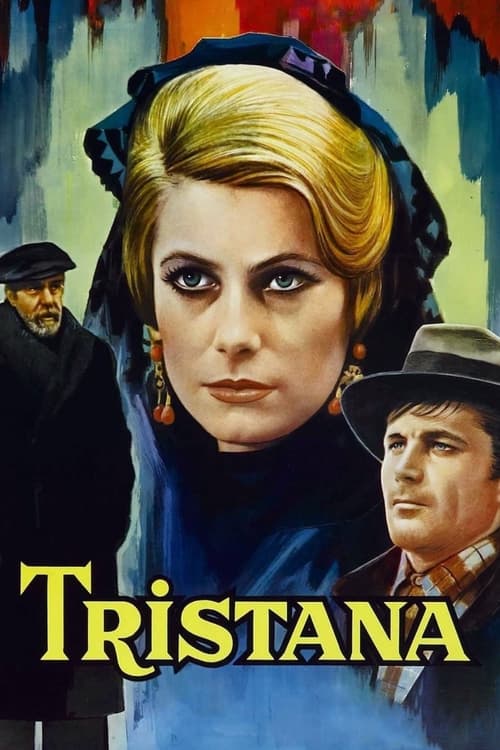
Tristana
1970 · Luis Buñuel
For when you want something elegant and wicked — a slow, needling character study about power, hypocrisy, and revenge that trusts you to read between the lines. More a film to think about than to be swept up by.
What it's about
In the old Spanish city of Toledo, the orphaned Tristana is taken in by Don Lope, an aging gentleman of high-minded principles and low private conduct, who makes her both his ward and his possession. When she falls for a young painter, Horacio, she begins a long struggle to claim a life of her own — and the balance of power between guardian and ward starts to shift in unexpected ways.
The experience
Cool, precise, and quietly perverse — it plays like a sedate period drama while something corrosive works underneath. The tone stays dry and controlled, which makes its ironies land harder; you finish it unsettled without being able to point to a single raised voice.
Performances
Catherine Deneuve charts Tristana's transformation from docile innocence to something colder and harder with remarkable economy, and Fernando Rey makes Don Lope both contemptible and pitiable — a self-styled free thinker who can't see his own tyranny.
The craft
Buñuel, nearly seventy, directs with deceptive plainness: unshowy framing, Toledo's streets and bells as a character, and small surreal touches slipped into an otherwise realist surface. The restraint is the point — every barb is delivered deadpan.
Why it matters
One of only two features Buñuel made in Spain after his exile, it stands among the great late works of his career and a sly reckoning with the country and pieties he'd spent a lifetime skewering.
Snapshot
Tristana is Luis Buñuel's late-career adaptation of Benito Pérez Galdós's 1892 novel, shot in Toledo in 1969 and released in 1970, when the director was sixty-nine. It is the second of his three collaborations with Catherine Deneuve (after Belle de jour, 1967) and one of only two features he made inside Spain after his exile — the other being Viridiana (1961), which the Franco regime disowned within days of its Palme d'Or. That Tristana was permitted at all marks a specific moment in late Francoism, when the ministry under Manuel Fraga Iribarne and its film apparatus were courting international prestige and a measure of controlled liberalization.
The film is deceptively plain. A young orphan, Tristana, is taken in by Don Lope Garrido, an impoverished nobleman of ostentatious principle — anticlerical, contemptuous of work, chivalrous in theory — who makes her his ward and then his lover. She escapes with the painter Horacio, returns years later with a tumor that costs her a leg, marries Don Lope out of something closer to contempt than resignation, and at the end withholds the help that might save his life. Around this armature Buñuel builds one of his most disciplined studies of how domination reproduces itself: the victim does not transcend the master's cruelty but inherits it.
Stylistically, Tristana belongs to the austere register of Buñuel's final period. There are almost no optical effects, little camera flourish, a near-total absence of scored music, and a mise-en-scène of doorways, stairwells, and gray Toledo stone. The two or three overt dream images — the severed head of Don Lope swinging as a bell clapper, most famously — land with more force precisely because the surrounding surface is so matter-of-fact. It was nominated for the Academy Award for Best Foreign Language Film (as Spain's entry) and stands, alongside Belle de jour, The Discreet Charm of the Bourgeoisie (1972), and That Obscure Object of Desire (1977), among the works that secured Buñuel's late international canonization.
Industry & production
The film was a Spanish–Italian–French co-production, the standard financing architecture of European art cinema in this period: pooled national subsidies, a star with cross-border marquee value, and post-synchronized dialogue that made a multilingual cast workable. The Spanish producer was Época Films, with Buñuel's regular late-period producer-collaborator Serge Silberman not yet in place — Silberman's run with Buñuel began with The Discreet Charm of the Bourgeoisie. Deneuve's participation supplied the French leg and the international sales value; Fernando Rey, Buñuel's most durable late-career actor, anchored the Spanish side.
The production's central fact is political. Buñuel had left Spain after the Civil War, worked in the United States and then for nearly two decades in Mexico, and returned in 1960 to make Viridiana under state auspices — a gambit that ended in scandal when the Vatican newspaper attacked the film and the regime stripped it of its Spanish nationality after Cannes. That Tristana could be shot in Spain a decade later reflects a calculated thaw: the Fraga-era ministry wanted films that would travel, and Buñuel wanted to work in Castilian landscape and language again. He had in fact attempted Tristana earlier in the 1960s and been blocked; the project's revival was itself a barometer of the regime's shifting tolerances.
Censorship still shaped the film, and here the record deserves care. It is well established that Buñuel altered the novel's setting and chronology — moving Galdós's Madrid to Toledo, and setting the action in the late 1920s and early 1930s, spanning the fall of the monarchy and the coming of the Republic — and that the film's anticlericalism and its treatment of sexual power were negotiated with Spanish authorities. The precise inventory of cuts demanded and concessions granted varies between accounts, and where sources conflict it is more honest to say that the film emerged from a bargaining process than to specify terms with false precision.
Shooting took place substantially on location in Toledo, a city with deep personal resonance for Buñuel: in the 1920s he and his Residencia de Estudiantes circle — including Federico García Lorca and Salvador Dalí — had founded the mock-chivalric "Order of Toledo," and Buñuel returned to the city throughout his life. The choice is not neutral tourism. Toledo is the imperial-clerical capital of old Castile, a city of El Greco and cathedral bells, and it functions in the film as the physical form of everything Don Lope claims to despise and cannot leave.
Technology
Tristana was shot in 35mm color at the standard 1.66:1 European widescreen ratio, using Eastmancolor-type stock. There is nothing technologically ambitious about it, and that is deliberate. Buñuel had used color only intermittently — his Mexican films are largely black-and-white, and even Belle de jour, his first major color success, deploys it with restraint. Here the palette is deliberately drained: grays, browns, ecclesiastical blacks, the ochre of Toledo stone, with color reserved for a few charged accents.
The one technical decision with real aesthetic consequence is the sound recording method. Like nearly all Spanish and Italian production of the era, the film was shot without usable production sound and dubbed in post. Deneuve, who did not speak Spanish, was voiced in the Spanish version by another performer; the French version dubs the Spanish cast. This is worth stating flatly because it complicates any claim about "performance" in the film: there is no single authoritative soundtrack, and viewers of the two principal versions are hearing meaningfully different objects. The post-synchronized track also produces the slightly denatured, acoustically flat quality that characterizes so much Buñuel — voices sitting on top of the image rather than inside the space — which he exploited rather than fought.
Prosthetic and effects work is minimal. Tristana's amputation is handled almost entirely by staging, costume, and framing rather than by trick photography: the crutches, the trouser leg, the way she is positioned in doorways. The dream image of the bell clapper is achieved in-camera and by cutting, not by optical printing.
Technique
Cinematography
José F. Aguayo shot the film, as he had Viridiana, and the continuity matters: Aguayo understood Buñuel's preference for a camera that observes rather than comments. The dominant grammar is the medium shot at roughly eye level, with cuts rather than camera movement doing the work of emphasis. Buñuel distrusted the expressive tracking shot and the ostentatious composition; his standard practice, well documented across his career, was to shoot economically, with few setups and little coverage, and to cut in his head before shooting.
What Aguayo does supply is a controlled study in interior geometry. Don Lope's house is photographed as a system of thresholds — doorframes, the stairwell, the shuttered windows onto the street — and characters are repeatedly framed through apertures, watched or watching. The film's most famous compositional motif is vertical: Tristana at the top of the stairs or the belfry, looking down. Exteriors in Toledo are photographed with a documentary plainness, gray and unbeautified, refusing the postcard version of a famous city.
Color is used as a semantic system rather than a decorative one. The mourning blacks, the white of Tristana's early dresses, and the sudden intrusion of red are legible as a scheme without ever becoming a symbolic code the film explains.
Editing
Pedro del Rey cut the film. The editing is classical in construction — continuity, clear eyelines, no elision for its own sake — but Buñuelian in its treatment of time. The film covers roughly a decade, and the ellipses are brutal and unannounced: Tristana leaves, and the next scene has already moved years forward with no dissolve, no title, no establishing gesture to cushion the jump. The compression around her illness and amputation is especially severe; we are given the diagnosis and then the aftermath, with the surgery itself withheld.
Two other editing habits deserve note. First, the abrupt insertion of dream or fantasy images without transitional signaling — the bell-clapper vision arrives with no marker separating it from the waking film, and this refusal to bracket the irrational is a signature Buñuel had been refining since Un chien andalou. Second, the final passage, which cuts backward through the film's own imagery in a rapid reverse-motion recapitulation as Don Lope dies, a formal gesture almost unique in Buñuel's late work and one of the few moments where the film's editing calls attention to itself.
Mise-en-scène / staging
This is the film's richest register. Buñuel builds meaning through the arrangement of objects and bodies in space with a materialist's patience.
The house is the primary instrument. Don Lope's rooms are cluttered with the residue of a class that no longer functions: swords, a sideboard, formal chairs, all maintained by the servant Saturna while Don Lope sells off possessions to keep up appearances. His decline is staged as a slow emptying of the frame. Conversely, Tristana's ascent to power is staged vertically and architecturally — she takes the upper floor, she commands the stairs, and in the film's most notorious image she opens her robe on the balcony to the deaf-mute boy Saturno, exposing herself in a gesture that is not liberation but the exercise of a newly acquired capacity to wound.
Objects carry the argument. The severed head of the Christ in the cathedral, examined and then repurposed in the dream; the columns of the cloister; the two chickpeas Tristana is offered as a choice ("both the same" — a refusal of choice that becomes the film's model of freedom); the dog that appears repeatedly, tied and beaten. The crutches are the film's most sustained material invention: after the amputation, Tristana's body itself becomes a staging problem, and Buñuel resolves it by making her prosthetic presence — the sound of the crutches on floorboards, the empty pinned trouser leg — the dominant physical fact of every scene she enters.
Costume tracks the moral arc precisely: girlish white and modest dark dresses early, a widow-like severity later, until the final Tristana is a figure of high-collared, black-clad authority who resembles nothing so much as the clerical order she was raised to despise.
Sound
Tristana is close to a scoreless film, and this is one of its most radical choices. Buñuel had a lifelong aversion to non-diegetic music — he stated repeatedly that music imposed on an image was a form of cheating — and by the late period he had largely eliminated it. What music exists here is sourced: a piano being practiced, a passage of Chopin, the sounds of a town.
In its place, the film builds an ambient architecture of bells. Toledo's cathedral bells are a near-constant presence, marking time, marking the Church's grip on the city, and setting up the dream image in which Don Lope's head is the clapper — the film's sonic environment and its most violent fantasy fused into a single object. Beyond the bells: footsteps, doors, the crutches, the dog barking, the noise of the street.
The deaf-mute Saturno introduces a further sonic problem. His scenes are structured around a character who cannot hear the film's own sound design, and Buñuel repeatedly stages exchanges in gesture and signing, forcing the audience into a different attentional mode. The dubbing regime discussed above means that the "voice" of every performance is a constructed artifact, and Buñuel's flat, unemphatic approach to post-synchronization keeps dialogue slightly detached from the bodies speaking it.
Performance
Catherine Deneuve gives what is arguably her most severe performance for Buñuel. Where Belle de jour asked her to hold an opaque, glassy surface across which fantasy played, Tristana asks for a hardening across a decade — from a physically open, slightly awkward girl to a woman of contained, deliberate cruelty. The transformation is played almost entirely in posture, tempo, and the eyes; there is no showpiece scene of transformation, and Deneuve's characteristic reserve is used as the film's structural asset rather than fought against. The dubbing complicates evaluation, but the physical performance — especially the choreography of the crutches, which she carries with unshowy authority — is unmistakably hers.
Fernando Rey's Don Lope is one of the great performances in Buñuel's filmography and the foundation of their subsequent partnership (The Discreet Charm of the Bourgeoisie, That Obscure Object of Desire). Rey plays him not as a monster but as a man of genuine, comically rigid conviction: an anticlerical who will not go to church, a gentleman who will not work, a seducer with an elaborate ethics of honor that he violates at every turn without apparent self-awareness. The tragedy of the performance is that Don Lope becomes pitiable exactly as he becomes contemptible — old, cold, financially ruined, finally sitting with the priests he spent his life mocking.
Lola Gaos as the servant Saturna supplies the film's grounded, unsentimental class perspective, and Franco Nero, cast for co-production reasons as Horacio, plays the painter as a decent, ultimately conventional man whose liberalism proves no more capable of granting Tristana freedom than Don Lope's tyranny.
Narrative & dramatic mode
The film's mode is ironic realism with a substratum of dream. Surface events are presented with a novelistic plainness inherited from Galdós — a nineteenth-century realist whose method Buñuel admired and adapted twice, here and in Nazarín (1959). Causality is clear, chronology is linear, motivation is legible. Buñuel then does two things to this surface.
First, he inserts the irrational without warning or framing. Dreams are not marked as dreams; they simply occur, and the film moves on. The effect is not confusion but contamination: once the bell-clapper image has arrived, every subsequent bell in the sound design carries it.
Second, he structures the whole as a reversal that is also a repetition. The story appears to be about emancipation — ward escapes guardian, discovers desire, asserts will — and it is, but the emancipation delivers Tristana into the position of the oppressor rather than out of the system. She returns; she marries him; she rules the house; she withholds the telephone call that might summon the doctor and opens the window to the winter air. Buñuel is not writing a fable of empowerment but a diagnosis of how power circulates. The famous ending, in which the film's own images run backward, formalizes this: the story has not progressed, it has closed a loop.
The chronological frame reinforces this. By setting the action across the end of the monarchy and the arrival of the Republic, Buñuel invites the political reading without stating it — the old order collapses, the new one inherits its furniture, and by 1970 the audience knows exactly what came next.
Genre & cycle
Tristana sits at the intersection of several traditions. It is a literary adaptation in the tradition of European art-cinema prestige filmmaking, and it belongs to the specifically Spanish lineage of Galdós adaptation. It is a domestic melodrama in construction — guardian, ward, lover, house, illness, marriage — which Buñuel systematically de-melodramatizes by refusing music, refusing emphasis, and refusing catharsis.
Within Buñuel's own filmography it belongs to a distinct cycle: the studies of a woman caught in a system of desire and domination that runs from Susana (1951) and Él (1953) through Viridiana to Belle de jour, Tristana, and finally That Obscure Object of Desire. It also belongs to the smaller cycle of his Spanish-set, Spanish-language work — Viridiana and Tristana — where the target is specifically Spanish: the Church, the hidalgo class, the moral economy of honor and shame.
Read against the international art cinema of 1970, it is conspicuously unmodernist. While European auteur cinema had moved toward reflexivity and fracture, Buñuel offers a well-made, linear, classically shot literary adaptation. That apparent conservatism is a strategy; the subversion is in what the film says, not in whether it declares its own artifice.
Authorship & method
Buñuel co-wrote the screenplay with Julio Alejandro, his frequent Spanish-language collaborator (Nazarín, Viridiana, Simon of the Desert). Their method with Galdós was substantial adaptation rather than transcription: the novel's Madrid becomes Toledo, the period is moved forward by decades, and — decisively — the ending is changed. Galdós ends his novel in a mode of ambiguous, muted accommodation; Buñuel ends his film with Tristana's active refusal to save Don Lope, converting the novelist's melancholy into something colder and more analytic.
Buñuel's working method by this point was fixed and famously economical. He shot fast, ordered his setups tightly, disliked coverage, and edited largely in advance. He resisted the idea that his images required decoding, repeatedly deflecting symbolic interpretation of his own motifs while continuing to place them with obvious deliberation — a stance that is itself surrealist in origin, honoring the image's autonomy over its meaning.
His key collaborators here: José F. Aguayo (cinematography), a veteran Spanish DP whose work on Viridiana established the plain, high-legibility style repeated here. Pedro del Rey (editing), who cut for Buñuel in this period and executed the film's severe ellipses and its reverse-motion finale. Julio Alejandro (co-writer), the collaborator through whom Buñuel's Spanish-language literary projects were routed. There is no composer credit of consequence — the point of a Buñuel late film is that there is nothing for a composer to do. Fernando Rey, though an actor, functions almost as a co-author of the late period, supplying the specific register of decayed bourgeois self-regard that Buñuel would keep returning to.
Movement / national cinema
Buñuel's formation was surrealist: Un chien andalou (1929) and L'Âge d'or (1930), made with Dalí and within André Breton's orbit, remain foundational documents of the movement in cinema. Forty years later, the surrealism in Tristana is not a style but a habit of mind — the unannounced dream, the fetish object, the sudden violence of an image against a placid surface, the conviction that desire is not rational and social morality is a lie told to manage it.
Nationally, the film is a peculiar object: a Spanish film by an exile, made inside Spain under a dictatorship, in the Spanish language, about Spanish institutions. It stands adjacent to but apart from the Nuevo Cine Español of the 1960s and the emerging generation — Carlos Saura above all — who were developing coded, allegorical strategies for saying under censorship what could not be said directly. Buñuel's relation to that generation was foundational rather than participatory: Saura and others worked in a space his Viridiana had helped force open, and Saura in particular had helped facilitate Buñuel's return to Spanish production. As a French co-production with a French star, the film also belongs to the transnational European art cinema of its moment, and Buñuel had by then become one of that system's most bankable names.
Era / period
1970 finds Buñuel in the final, most acclaimed phase of a career that had spanned the surrealist avant-garde, documentary (Las Hurdes, 1933), commercial Mexican genre production, and international art cinema. The films that follow — The Discreet Charm of the Bourgeoisie, The Phantom of Liberty (1974), That Obscure Object of Desire — are looser, funnier, more structurally playful. Tristana is the last of his fully classical constructions, and its severity marks it as the end of a manner rather than the start of one.
Its historical setting is equally pointed. Spain at the turn of the 1930s — a collapsing monarchy, a Republic arriving, the Church entrenched, provincial Castile unchanged — is the world Buñuel came from and lost. Making the film in 1969 in Franco's Spain, about the moment just before the catastrophe, is an act of double-exposure that requires no explicit commentary to register.
Themes
Domination and its inheritance. The film's central proposition is that liberation from a tyrant does not produce a free person; it produces someone equipped to be a tyrant. Tristana's final cruelty is not a betrayal of her earlier innocence but its logical product.
The body as the site of power. Tristana's amputation converts an abstract question of autonomy into a physical one. Her mutilation makes her materially dependent and simultaneously grants her a terrible authority — over Horacio, who cannot love the changed body; over Don Lope, whose fetishization of her curdles into caretaking; over Saturno, to whom she displays herself.
Anticlericalism, and the Church as ambient condition. Buñuel's hostility to Catholic institutions is constant, but here it is atmospheric rather than polemical — bells, cassocks, the cathedral, the priests who finally sit in Don Lope's parlor. Don Lope, the professional anticlerical, ends surrounded by clergy: the institution absorbs even its enemies.
Choice and its refusal. The chickpea scene — two identical options, so choose whichever — is the film's compressed statement on free will. Freedom that consists of choosing between equivalent things is not freedom, and Tristana's escapes are all of this kind.
Class decay. Don Lope's hidalgo code — no work, no debts honored, honor above all — is played as both farce and tragedy, a class whose values have outlived its material basis.
Reception, canon & influence
Tristana was received on release as a major work by a major director and traveled widely on the international art-house circuit. It was Spain's submission for the Academy Award for Best Foreign Language Film and received a nomination, an outcome laden with irony given the fate of Viridiana nine years earlier: the same regime that had suppressed one Buñuel film now advanced another as a national credential. Critical reception in the anglophone press was strong, with particular attention to Deneuve's transformation and to Rey's Don Lope; the film's austerity divided some reviewers who found it cold, and the coldness has since come to be understood as the point. Precise contemporary box-office figures are not something I can state reliably, and the film's commercial performance is better described qualitatively: a prestige art-house success, not a popular hit.
Backward — what shaped it. Galdós is the primary source, and beyond the plot, his realist attention to money, property, and the material texture of Spanish provincial life. Behind Galdós stands the Spanish picaresque and the Goya of the Caprichos and the black paintings — Buñuel's most consistently acknowledged visual ancestor, and the source of the film's particular fusion of the grotesque and the ordinary. Surrealism supplies the treatment of the dream image and the fetish. Buñuel's own Viridiana is the closest formal precedent: same country, same cinematographer, same anatomy of a religious-patriarchal household, same structure of a young woman's innocence being processed by an older man's desire and by a social order that has no place for her.
Forward — what it shaped. Tristana consolidated the Buñuel–Rey partnership that produced two of the director's most celebrated films, and it completed the Deneuve diptych that made her, for a generation of viewers, the definitive Buñuelian figure of impenetrable surface. Its influence on Spanish cinema is diffuse but real: the film is a reference point for the post-Franco generation's reckoning with patriarchy, the Church, and the family as a political institution, a lineage that runs through Saura and, in a very different key, into the work of Pedro Almodóvar — whose obsessive returns to the desiring, damaged, and finally ungovernable woman, and whose casting of Deneuve-like icons, are legible as an inheritance. Tie Me Up! Tie Me Down! (1989) is the most frequently cited point of contact between Almodóvar and the Buñuelian captive-woman scenario, though the connection is one of shared preoccupation rather than documented homage.
More broadly, Tristana has become a standard text in accounts of how narrative cinema can be radical without being formally experimental. Its method — classical construction, plain photography, no music, unmarked dream, unrelieved irony — has been an available model for filmmakers who want to indict a social order from inside its own storytelling conventions. Its reputation has risen steadily: initially read as a lesser companion to Belle de jour, it is now widely regarded as one of Buñuel's most concentrated and pitiless achievements, and the film in which his lifelong subject — the impossibility of clean desire under an unjust order — receives its coldest statement.
A Deleuzian reading
Tristana dreams a bell.
The full Deleuzian reading of Tristana →
Reception
Respectfully received in 1970 — it even landed a Best Foreign Film Oscar nomination as Spain's entry — but long overshadowed by Belle de Jour and The Discreet Charm on either side of it; cinephiles have since promoted it to 'secretly one of Buñuel's best.'
How Tristana was received, from release to now →
How to watch Tristana: what to notice on a first viewing
- Notice characters framed through doorways, stairwells, and shuttered windows. Don Lope's house is photographed as a system of thresholds, with people repeatedly watched or watching through apertures rather than in open rooms. The house itself is monitoring the people living inside it.
- Watch which floor of the house each character occupies. Tristana's rise is staged vertically, moving toward the upper floor and the stairs, while Don Lope's rooms grow more cluttered with the leftovers of a class in decline. Who controls the stairs tells you who actually controls the house, long before anyone says so.
- Listen for how rarely any music plays under a scene. Buñuel largely eliminates non-diegetic score, letting the sourced sound of a piano, cathedral bells, and footsteps carry the film's emotional temperature instead. Without music telling you how to feel, ordinary sounds start to carry real weight.
- Watch Fernando Rey play Don Lope's contradictions without any self-awareness. He refuses to work, mocks the Church, and claims an elaborate code of honor, then violates all of it without appearing to notice. The comedy and the tragedy of the character come from the exact same blindness.
- Notice the bells of Toledo's cathedral, ringing again and again. They mark the hours, the Mass, and the Church's grip on the town, and Buñuel keeps returning to them across the whole film. The ringing feels like ordinary background noise until you start to notice how often it returns.
The whole guide to watching Tristana, with the keys for a rewatch →
Influences: the films it descends from and the films it influenced
- Un Chien Andalou (1929) — Establishes Buñuel's rule that a dream or fetish image is cut flush into the realist track with no dissolve, iris, or optical marking — the grammar Tristana reuses for the bell-clapper head and the reverse-motion staircase recapitulation, and the source of its treatment of a severed limb as erotic object rather than horror.
- Las Hurdes (Land Without Bread) (1933) — Buñuel's deadpan-observational method on Spanish provincial deprivation — neutral medium framing held on intolerable content, the irony generated by the gap between camera affect and subject — is the documentary root of Tristana's refusal to inflect Toledo's cruelty with either music or emphasis.
- Los olvidados (1950) — The blind beggar and the legless man are staged as predators and operators rather than objects of pity, disability treated as a social apparatus inside an otherwise neorealist surface — the exact handling Tristana extends when the amputation converts Tristana from ward into the household's governing power.
- Él (1953) — Gives Tristana its architecture of paranoid ownership: the proprietor-patriarch whose psychology is diagrammed by vertical space — staircases, balconies, the bell-tower ascent — so that a man's position in the frame's height literally states his claim over a woman below.
- Nazarín (1959) — First full working-out of the Buñuel–Julio Alejandro adaptation method later applied to Galdós's Tristana: transpose period and locale, compress the novel's episodes into flat frontal setups shot fast with minimal coverage, and strip the score so anticlerical argument arrives as plain observation rather than rhetoric.
- El cochecito (1960) — Azcona-scripted Spanish black comedy that films wheelchairs, crutches and prosthetics with matter-of-fact medium-shot neutrality and zero sentiment, establishing the domestic-grotesque register in which Tristana can show a woman swinging on crutches through a bourgeois parlor as ordinary furniture of Spanish life.
- Viridiana (1961) — Closest formal precedent — same cinematographer José F. Aguayo, same Julio Alejandro script partnership, same Fernando Rey patriarch, same anatomy of a house where an older man's desire processes a young ward — plus the shared device of the fetish object (shoes, corset, rope) carrying the erotic charge the dialogue never states.
- Diary of a Chambermaid (1964) — The boot-fetish sequence with Monsieur Rabour is the template for Tristana's fetish economy — an old man's desire routed entirely through an object attached to a leg — and its cool, unreadable servant-heroine in sustained medium shot is the acting register Deneuve inherits.
- Belle de jour (1967) — Makes Deneuve's impassive, unreadable surface the film's principal formal device rather than a performance choice, and rehearses the unmarked fantasy insert; Tristana keeps the mask but removes the compensating luxury of color, score, and fantasy relief.
- The Discreet Charm of the Bourgeoisie (1972) — Consolidates the Fernando Rey partnership Tristana cemented and pushes its unmarked-ellipsis editing to its limit: dreams nest inside dreams with identical lighting, lens and cutting rhythm, so the viewer has no formal cue to distinguish levels — Tristana's single unannounced nightmare made into a whole structure.
- The Spirit of the Beehive (1973) — Luis Cuadrado's desaturated ochre photography of a silent Castilian town, near-scoreless with wind, bells and footsteps carrying the track, and compositions built through doorways, window frames and thresholds — the Tristana visual system turned toward the same late-Francoist household as political institution.
- Cría cuervos (1976) — Post-Franco reckoning built on Tristana's premise that the bourgeois house is the state in miniature, with time slipping between memory and present across unmarked cuts inside the same rooms — Buñuel's dream-flush-with-reality editing repurposed for a child's account of inherited domination.
- That Obscure Object of Desire (1977) — Buñuel's final restatement of the Tristana contract with Fernando Rey again as the wealthy older suitor: the woman's impenetrable surface is literalized by casting two actresses in one role, and the desire that Tristana ends by simply switching off here ends in an explosion — the same refusal, escalated.
- The Skin I Live In (2011) — Shot around Toledo and built on the Buñuelian captive-in-the-house scenario, with a patriarch-surgeon who remakes a body to his specification and a prisoner who acquires power through the very alteration done to her — Tristana's amputation-as-inversion rewritten as surgery, retaining the cool, clinical framing of the operating and living quarters.
- Jamon Jamon (1992) — Fetishizes ordinary objects as carriers of morbid desire within a provincial Spanish setting, the fixation on charged props that drives Jamón Jamón's eroticism.
- Tie Me Up! Tie Me Down! (1990) — Dramatizes a man's possessive 'taming' of a dependent woman and her ambivalent attachment, the asymmetry of control-as-love that ¡Átame! inherits from the same Spanish auteur lineage Almodóvar claims.
- Peppermint Frappé (1967) — Dedicated to Buñuel and shot by Luis Cuadrado in the same drained Castilian register: an older provincial man remakes a young woman detail by detail into a fetish object, with legs, shoes and hair filmed as detachable components — Saura's Spanish translation of the Buñuelian possession-by-inventory.
- The Beguiled (1971) — Independently arrives at Tristana's structural hinge one year later — an amputation performed inside a cloistered religious household that inverts the erotic power relation permanently — and stages it in the same enclosed corridors-and-thresholds geography rather than as spectacle.
- Fontane Effi Briest (1974) — The other great austerity adaptation of a 19th-century realist novel about a woman traded under patriarchal property law: classical construction, frozen frontal tableaux, ellipses that skip years without transition, indicting the social order from inside its own storytelling conventions instead of from formal experiment.
- Jeanne Dielman, 23 quai du Commerce, 1080 Bruxelles (1975) — Takes Tristana's method to its endpoint — no score at all, diegetic sound only, fixed observational framing of a domestic interior, an ellipsis structure that withholds the decisive event — proving the same thesis that a woman's confinement is best exposed by filming its architecture neutrally rather than dramatizing it.
Similar films
- Belle de Jour (1967) — influence & lineage · same viewing thread
- Diary of a Chambermaid (1964) — influence & lineage · same viewing thread
- The Discreet Charm of the Bourgeoisie (1972) — influence & lineage · same viewing thread
- That Obscure Object of Desire (1977) — influence & lineage · same viewing thread
- Nazarín (1959) — influence & lineage · same viewing thread
- The Young and the Damned (1950) — influence & lineage
- Él (1953) — influence & lineage · same viewing thread
- Viridiana (1962) — same viewing thread
All the films related to Tristana →
Watch it with: curated runs of related films
- Buñuel and the Bourgeoisie — A run of surrealist provocations where every dinner, prayer, and marriage bed hides an appetite polite society can't admit — watch them together for the way Buñuel (and Pasolini's Theorem) keep pulling the tablecloth out from under the well-heeled.