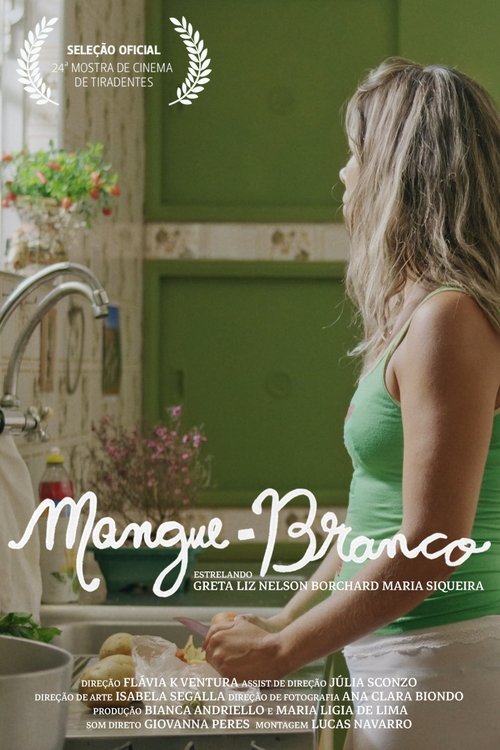
White Mangrove
2020 · Flávia K. Ventura
For a patient, contemplative evening when you want to sink into someone else's daily life rather than be swept up by plot — more a quiet meditation than an easy comfort watch.
What it's about
Maíra works as a masseuse at a resort in a small Brazilian seaside town, her days settled into a flat routine: a job that uses her hands but not her attention, a husband who has drifted out of reach, long walks through streets that are postcard scenery for tourists and just the neighborhood to her. Then one afternoon an encounter cuts through the numbness, and she starts quietly re-examining the life she stopped questioning.
The experience
Slow, hushed, and observational — the film sits with Maíra rather than pushing her, letting the textures of work, weather, and small-town light do the talking. It builds a low ache instead of big scenes, and it stays with you the way an overheard conversation does.
The craft
Flávia K. Ventura directs by immersion: long attentive takes, real-feeling labor, and a coastal landscape that's as much a character as anyone in it. The drama is built through accumulation — routine repeated until you feel its weight — rather than through incident, which asks a little patience of you and repays it with intimacy.
Why it matters
Part of a vital current in contemporary independent Brazilian cinema that centers Black working-class lives far from the tourist-brochure Brazil, finding its drama in everyday pressure rather than eruption.
Brazilian independent cinema in its quiet, observational register: Flávia K. Ventura's drama attends to Maíra, a masseuse at a coastal resort whose days have settled into a low hum — a job that asks for her hands but not her presence, a husband who has drifted somewhere out of reach, long walks through a seaside town that is scenery for tourists and routine for her. Ventura works by immersion rather than incident, letting the texture of labor and landscape accumulate until a single afternoon's encounter begins to loosen everything Maíra has stopped questioning. The film belongs to a rich contemporary current in Brazilian cinema — alongside filmmakers like Adirley Queirós and Juliana Antunes — that centers Black working lives far from the postcard Brazil, finding drama not in eruption but in the slow pressure of a life examined. The mangrove of the title is the film's governing image: a tree that thrives in brackish water, roots exposed, holding the shoreline together — an emblem of endurance that the film gradually complicates into a question about what endurance costs, and what it might make possible.
Reception
How White Mangrove was received, from release to now →
Influences: the films it descends from and the films it influenced
- Black Girl (La Noire de…) (1966) — Establishes the template of a Black domestic worker's invisible labor rendered under a leisure-class/tourist gaze, with interior voiceover set against an alien coastal-resort geography.
- Jeanne Dielman, 23 quai du Commerce (1975) — Real-time durational choreography of repeated domestic tasks, where narrative emerges from the accumulation of labor-gestures rather than plot — the slow-cinema-accumulation grammar White Mangrove inherits.
- La Ciénaga (2001) — Off-screen servant labor and humid bourgeois torpor built through dense sound design and withheld causality, producing plotless slow pressure in a resort-adjacent setting.
- Colossal Youth (2006) — Fixed long takes of non-professional dispossessed subjects performing their own endurance, an observational-immersion method that dignifies marginal working lives without dramatization.
- Neighbouring Sounds (2012) — Ambient class dread accumulated through the invisible security and domestic labor surrounding a leisure-class Brazilian landscape, unease built structurally rather than through incident.
- Branco Sai, Preto Fica (2014) — Named influence: hybrid, patient real-time staging of Black peripheral Brazilian lives, letting bodies inhabit space in extended duration rather than serve a plot engine.
- The Second Mother (Que Horas Ela Volta?) (2015) — Dramatizes invisible live-in domestic labor and class estrangement, structured around a single catalytic arrival that ruptures a household's silent equilibrium.
- Baronesa (2017) — Named influence: observational immersion with non-professional Black women enacting their own everyday waiting, long durational takes treating endurance and idle labor as the film's substance.
- Beau Travail (1999) — Choreographs laboring bodies against a postcolonial coastal landscape through elliptical, near-plotless structure, converting repetitive physical work into rhythmic formal device.
- Silent Light (Stellet Licht) (2007) — Marital estrangement rendered in a durational, landscape-anchored slow register with non-professional actors, emotion carried by held time and environment rather than dialogue.
- Stray Dogs (2013) — Relational and marital estrangement stretched across punishingly long static takes, where endurance of duration becomes the viewer's shared experience of precarious labor.
- Neon Bull (Boi Neon) (2015) — Sensory, observational study of Brazilian working bodies that drifts plotlessly through the texture of manual labor, foregrounding gesture and milieu over event.
- Araby (Arábia) (2017) — Itinerant chronicle of Brazilian working-class labor accumulated through quiet, first-person duration, dignifying invisible workers via patient attention to their routines.
- The Fever (A Febre) (2019) — Observational contemporary Brazilian drama of a port worker's invisible labor, using ambient slow pressure and a single unsettling encounter to voice estrangement.
- Aquarius (2016) — Anchors class and endurance to a specific coastal/beachfront property, letting a single figure's stubborn persistence against encroachment structure a slow, place-bound film.
Similar films
- La Ciénaga (2001) — influence & lineage
- The Currents (2025) — shared sensibility
- The Metamorphosis of Birds (2021) — shared sensibility
- Little Forest (2018) — shared sensibility
- Bergman Island (2021) — shared sensibility
- Manas (2024) — shared sensibility
- Invisible Life (2019) — shared sensibility
- All We Imagine as Light (2024) — shared sensibility