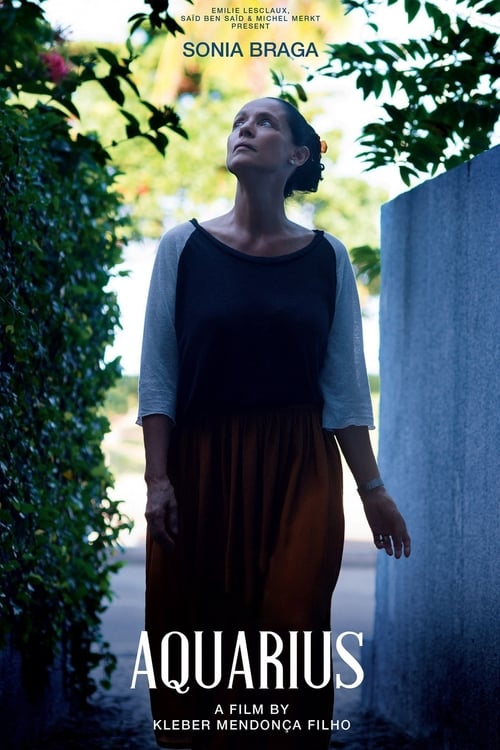
Aquarius
2016 · Kleber Mendonça Filho
Bacurau's cult keeps growing, and The Secret Agent's Cannes double win (director plus actor for Wagner Moura) made him Brazil's arthouse standard-bearer and a 2025 Oscar-season fixture.
For when you want a rich, novelistic character study to sink into — a film about dignity and standing your ground that rewards patience. Choose it when you have an evening to give it; it earns every minute.
What it's about
Clara, a retired music critic and widow in her sixties, is the last holdout in the Aquarius, a graceful 1940s apartment building on the Recife beachfront. A development company has bought out every other unit and wants her gone so they can raze it for a luxury tower — and as their pressure tactics escalate, Clara digs in, defending not just an apartment but the whole accumulated life inside it.
The experience
Unhurried and immersive — it luxuriates in music, sun, family lunches, and the texture of a lived-in home, while a low hum of menace builds underneath. You come out feeling you've inhabited a life, and quietly furious on Clara's behalf.
Performances
Sônia Braga is magnificent — regal, sensual, funny, and flinty, turning Clara into one of the great screen heroines of the 2010s. It's the kind of complete, lived-in performance entire careers get remembered for.
The craft
Mendonça Filho structures the film in named chapters with a 1980 prologue, so the present-day siege is always shadowed by memory, and he uses music — Clara's vinyl collection is practically a character — to carry whole histories. The widescreen images of Recife's coastline and the sound design's needle-drops reward good speakers.
Why it matters
It premiered in competition at Cannes, where its cast's red-carpet protest made it a lightning rod in Brazilian politics, and it confirmed Mendonça Filho as a major world-cinema voice while handing Braga a triumphant late-career landmark.
Snapshot
Aquarius is a nearly two-and-a-half-hour chamber epic about a woman, a building, and the erosion of a way of life. Clara (Sônia Braga), a retired music critic and widow in her sixties, is the last resident of the Aquarius, a modest 1940s beachfront apartment block on Recife's Avenida Boa Viagem. A development firm has bought out every other unit and wants the site for a luxury tower; Clara refuses to sell. From this deceptively small standoff Kleber Mendonça Filho — in only his second narrative feature — builds a sprawling study of memory, class, the female body, and the predatory tempo of Brazilian real-estate capital. The film is structured in three named chapters and prefaced by a 1980 prologue, so that the present-day siege is constantly shadowed by the accumulated life the apartment holds. It premiered in competition at the 2016 Cannes Film Festival, where its cast and crew turned the red carpet into a political demonstration, and it became one of the most discussed Latin American films of the decade — as much for the controversy around its reception at home as for its formal command.
Industry & production
Aquarius is a Brazil–France co-production, made through Mendonça Filho's Recife-based company CinemaScópio together with Vidéo Filmes — the outfit associated with Walter and João Moreira Salles, which had also backed his debut — and French partners including SBS Productions, with the participation of the kind of state and broadcast support (Globo Filmes and Brazilian public film funding) typical of ambitious Brazilian features of the period. The precise financing breakdown and budget are not something I can state with confidence, and I won't invent figures; what matters industrially is the model it represents: a regionally rooted auteur production, shot in and about Recife rather than the Rio–São Paulo axis, scaled up with European co-production money into a festival-competition title.
The film's most consequential industrial episode came after release. Its Cannes premiere protest — cast and crew holding signs denouncing the impeachment proceedings against President Dilma Rousseff as a "coup" — collided with domestic politics. Aquarius was subsequently not chosen as Brazil's submission for the Academy Awards' international category by the selecting body, a decision widely read by the film community as politically motivated retaliation and one that generated significant public dispute. The film also received an unusually restrictive age rating from Brazilian classification authorities, which critics likewise suspected of political coloring. These controversies are well documented in the film's reception history; the internal motives of the officials involved are contested, so I flag them as disputed rather than settled.
Technology
I don't have reliable documentation of the exact capture format — camera body, whether photochemical or digital — and won't guess at a specific system. What can be said honestly is that the film's technological sensibility is analog-facing. Its emotional and thematic center is Clara's vinyl record collection, and the movie repeatedly stages the physical apparatus of listening: the turntable, the sleeve pulled from the shelf, the needle drop. A pivotal narrative device is a printed interview and a physical LP that carry the residue of the past. Whatever the acquisition medium, the film was finished for widescreen theatrical presentation and cut on a modern digital editing platform. Its interest is less in showcasing image technology than in dramatizing obsolescence — the way objects, formats, and buildings are declared expendable by a market that profits from their replacement.
Technique
Cinematography
Photographed by Pedro Sotero and Fabricio Tadeu, Aquarius favors patient, composed widescreen framing over restless coverage. Mendonça Filho's camera tends to hold, to observe rooms and thresholds, and to let bodies move through deep, furnished space. The apartment itself is shot as a character: recurring compositions register its light across different times of day and across decades, so that the same corners accrue meaning. The film alternates this domestic interiority with the exteriors of Boa Viagem — the beach, the boardwalk, the glare of the Atlantic — using the coastline both as leisure space and as the contested real estate the plot turns on. There is a notable expressive gesture in which the camera performs slow, almost editorial pans or zooms toward objects and photographs, treating inanimate things as repositories of history. The palette is warm and tactile, keyed to wood, paper, skin, and vinyl.
Editing
Cut by Eduardo Serrano, the film moves at a deliberately unhurried, novelistic pace across its long running time. The editing's boldest stroke is temporal: the 1980 prologue and the tripartite present-day structure let the film jump decades and then live inside the present at length. Rather than cross-cutting for suspense in the developer plot, Serrano and Mendonça Filho build accumulation — scenes are allowed to run to their social and emotional conclusions, so that the siege on Clara registers as attrition rather than incident. Transitions frequently pivot on music and on objects, binding the cutting logic to the film's themes of memory and the material trace.
Mise-en-scène / staging
This is the film's richest register. The Aquarius apartment is a designed accretion of a life — books, framed photographs, furniture, and above all records — and Mendonça Filho stages action so that the décor is never mere backdrop. Blocking exploits the layout of rooms and the boundary of the front door, across which the developers repeatedly, unwelcomely, arrive. Public and social scenes — a family gathering, a birthday, an outing with friends — are populated with the density of a real social world, letting class and generation coexist in the frame. The building's decay is staged materially, culminating in the discovery of infestation upstairs, a literal rot introduced from above that literalizes the developers' strategy of making the property uninhabitable.
Sound
Sound is arguably Mendonça Filho's signature strength — his debut Neighboring Sounds was celebrated for its dense, faintly menacing soundscape — and Aquarius extends that command. The film has no wall-to-wall orchestral score; instead it uses source music from Clara's collection as its emotional spine, foregrounding popular Brazilian and international recordings played diegetically on vinyl. (I recall the film making pointed use of a Queen track and Brazilian popular standards, but I won't attribute specific songs or cues I can't verify precisely.) Ambient sound — the sea, the city, the hum and creak of the building — is worked with unusual care, so that silence, noise from the empty flats, and the intrusions from above become instruments of dread. The contrast between the intimacy of a needle on a record and the offscreen violence done to the building is largely a sound-designed effect.
Performance
The film is, finally, a vehicle for Sônia Braga, and her performance is its defining achievement. Braga plays Clara as sensual, imperious, tender, and stubborn without softening any of it into likability-for-its-own-sake; she carries the film's insistence on the older woman as a full erotic, intellectual, and political subject. The role foregrounds the body — Clara is a breast-cancer survivor, and the film treats her mastectomy and her sexuality with directness rather than pathos. Around Braga, the ensemble (family members across generations, friends, and the smoothly menacing young developer Diego) provides a lived-in social field, but the film's gravity is always Clara's, and Braga's stillness and flashes of temper anchor every scene.
Narrative & dramatic mode
The dramatic mode is realist and durational, closer to the character novel than to genre plotting. Its engine is a single refusal — Clara will not sell — and the film's tension comes from watching a slow campaign of pressure, flattery, and sabotage break against that refusal. The tripartite structure ("Clara's Hair," and subsequent chapters organized around people and relationships in her orbit) frames the story as a portrait rather than a thriller, privileging texture, memory, and social observation. Yet Mendonça Filho braids a note of quiet menace throughout — the developers' politeness curdles, the empty building looms — so that by the climax the film can deliver a genuinely charged confrontation without abandoning its realist grain. The prologue's 1980 set-piece, honoring an aunt whose memories and defiant sexuality prefigure Clara's, establishes the film's method: the present is only legible through the layered past.
Genre & cycle
Aquarius sits at the intersection of the character-driven art-house drama and a distinctly 21st-century cycle of films about gentrification, displacement, and neoliberal urban development. It belongs to a global wave of cinema — and specifically a Brazilian one — preoccupied with real estate as the frontline of class conflict, a concern Mendonça Filho had already made central in Neighboring Sounds. It can also be read within a lineage of "resistant older woman" and single-protagonist siege dramas, and within Latin American slow-burn realism. What keeps it from any single generic slot is its refusal to become a courtroom or activist procedural; the political content is metabolized through domestic and sensory detail.
Authorship & method
Aquarius is unmistakably an auteur work, written and directed by Kleber Mendonça Filho, a former film critic and cinephile from Recife whose entire project has been to put his city on the world cinema map on his own terms. His method fuses meticulous, sound-forward realism with a critic's structural intelligence — chaptering, temporal layering, and a fondness for embedding cultural artifacts (records, films, photographs) as thematic keys. His key collaborators here recur across his filmography and matter to the result: cinematographers Pedro Sotero and Fabricio Tadeu, and editor Eduardo Serrano, who help realize his patient, composed style. The screenplay is his alone. Rather than a conventional composed score, his authorial signature leans on curated source music and designed ambience. Braga functions almost as a co-author of the film's meaning: casting a screen icon of earlier Brazilian cinema as the keeper of cultural memory is itself an authorial statement. Mendonça Filho would go on to co-direct the genre-inflected Bacurau (2019) with his production designer Juliano Dornelles, and Aquarius is best understood as the mature consolidation of the concerns and methods first sketched in his debut.
Movement / national cinema
The film is a landmark of contemporary Brazilian cinema and specifically of a Pernambuco/Recife regional cinema that emerged as a vital alternative to the southeastern industry. Mendonça Filho is its most internationally visible figure, and Aquarius advanced a project of decentralizing Brazilian filmmaking — telling nationally resonant stories from the Northeast, in Recife's specific geography and social texture. It also arrived as an implicitly political film at a moment of acute national crisis, and its Cannes protest tied it directly to the conjuncture around Rousseff's impeachment, making it a document of Brazilian democracy under strain as well as a regional art film.
Era / period
The narrative spans from a 1980 prologue to a present-day set roughly in the 2010s, and this doubling is thematically essential: the film measures a woman's life, and a country's, across the decades separating a remembered past of family and music from a present of financialized development. In production terms it is a mid-2010s festival-circuit auteur film, made in the shadow of Brazil's political rupture. Its concern with memory versus obsolescence — vinyl versus streaming, old building versus new tower — makes the passage of time and the violence of "progress" its explicit subject.
Themes
Its central theme is memory as resistance: Clara's refusal to sell is inseparable from her insistence that the objects, sounds, and spaces of a life have value the market cannot price. From this flow the film's other preoccupations — class conflict and the predatory logic of real-estate capital; gentrification as a slow, deniable violence; the older woman's body as a site of dignity, desire, and illness rather than erasure; the politics of cultural memory (music criticism, vinyl, the archive); and family across generations. The infestation motif crystallizes the film's political allegory: decay engineered from above to force out those below. Underlying all of it is a defense of the sensory, embodied, analog richness of living against forces that would abstract it into square footage and profit.
Reception, canon & influence
Critically, Aquarius was received internationally as a major work and a career-defining showcase for Sônia Braga, whose performance drew some of the strongest notices of her long career; the film was widely praised for its formal control, its sound and music, and its political acuity. Its domestic reception was inseparable from controversy — the Cannes protest, the disputed failure to be named Brazil's Oscar submission, and the contested age rating — which amplified its visibility and made it a cause célèbre for Brazilian film culture and free-expression debates. I won't cite specific award tallies or box-office figures I can't verify.
Looking backward, the film draws on a tradition of durational character-realism and on Mendonça Filho's own critical formation and his debut Neighboring Sounds, whose real-estate-and-class concerns and dense sound design it deepens; the use of Braga self-consciously invokes the legacy of earlier Brazilian and Latin American cinema she embodies. Looking forward, its influence is clearest in cementing Mendonça Filho as a leading world-cinema auteur and in strengthening the international standing of Recife/Pernambuco regional filmmaking — a trajectory that led directly to Bacurau. More broadly it stands as one of the defining entries in the 2010s cinema of gentrification and displacement, and as a touchstone for films centering older women as full political and erotic protagonists. Its lasting canonical position rests on that rare combination: a formally rigorous domestic drama that became, almost against its own intimate grain, an emblem of a national political moment.
Reception
Acclaimed from its Cannes 2016 premiere and never really dipped — but its stature has only grown as it became inseparable from Brazil's political turmoil, now standing as a landmark of the decade and the film that kicked off Kleber Mendonça Filho's international run culminating in Bacurau.
How Aquarius was received, from release to now →
How to watch Aquarius: what to notice on a first viewing
- Watch how long the camera holds on rooms before anyone moves. Sotero and Tadeu favor patient, composed widescreen framing that lets the apartment's light and furniture register before the actors even enter the shot. The patience tells you the apartment matters as much as any character in it.
- Listen for music playing from Clara's own record collection. Instead of an orchestral score, the film uses records from Clara's collection played on vinyl as its emotional spine, chosen and controlled by her. The music is her memory made audible, not the film's commentary on her.
- Look at the books, photographs, and furniture crowding every room. The apartment is staged as a designed accretion of an entire life, so the décor itself argues that this home is not simply real estate. The clutter is the case for staying, made in objects rather than words.
- Watch how directly the film treats Clara's body and her scars. Braga plays Clara as sensual, stubborn, and fully herself, and the film shows her mastectomy and her sexuality with directness rather than pity. Refusing to soften her is what makes her resistance to the developers feel whole, not symbolic.
- Notice the warm, tactile color of wood, paper, and skin. The palette stays warm and material throughout, keyed to the textures of the apartment's furniture, vinyl, and photographs rather than to a cooler, glossier register. The warmth argues for a way of living the glass tower cannot replace.
The whole guide to watching Aquarius, with the keys for a rewatch →
Influences: the films it descends from and the films it influenced
- Neighboring Sounds (2012) — Mendonça Filho's own debut, whose layered, foreground-designed ambient sound mapping class dread onto a block of Recife apartments is the direct blueprint Aquarius refines into a single building.
- Jeanne Dielman, 23 quai du Commerce, 1080 Bruxelles (1975) — Establishes the durational, real-time observation of a woman inside her apartment where domestic routine and the room itself become the drama — the template for Aquarius's apartment-as-character realism.
- A City of Sadness (1989) — Anchors national political rupture in patient, composed static long takes of domestic interiors, treating private space and memory as the register of History — the long-take/history method Aquarius inherits.
- Yi Yi (2000) — Novelistic, chaptered pacing that lets a family's life accrete across an apartment through composed widescreen framing, modeling Aquarius's temporal-chaptered durational structure.
- L'Eclisse (1962) — Uses modern architecture and real-estate development as an expressive character in composed widescreen, turning built space into an emotional and economic index the way Aquarius does with the Aquarius building.
- Vive L'Amour (1994) — Renders vacant real-estate apartments as dread-laden characters using ambient sound alone and no score, a scoreless designed-silence approach Aquarius shares.
- Dona Flor and Her Two Husbands (1976) — Established Sônia Braga as the national erotic screen icon, so her casting keys Aquarius's older-woman's-body theme — the performer's own film history becomes authorial meaning.
- Vidas Secas (1963) — Founds the Brazilian realist tradition of land, dispossession, and durational observation of bodies against economic force that Aquarius updates into an urban real-estate register.
- Bacurau (2019) — Extends Aquarius's Pernambuco land-and-capital allegory into genre with the same director and production-designer collaborators, carrying forward the community-vs-predatory-capital structure.
- The Last Black Man in San Francisco (2019) — A gentrification-displacement film that makes a contested house the repository of memory-as-resistance, echoing Aquarius's refusal-to-sell as an act of preserving personal and political memory.
- The Blue Trail (2025) — Installs an aging woman (Sonia Braga) as the narrative's resistant engine rather than its object, the template of agency-granted-to-the-aged that Weinberg's protagonist extends.
- In the Mood for Love (2000) — Deploys curated diegetic source music and cramped domestic architecture to encode memory and longing, the same use of records-as-thematic-keys that structures Aquarius's vinyl motif.
- Gloria (2013) — Centers an older Latin American woman as a full erotic and political protagonist through durational observational realism, the same commitment to the aging female body as subject rather than object.
- The Second Mother (2015) — A Brazilian domestic drama where the apartment's rooms and thresholds encode who is permitted where, using spatial mise-en-scène to stage class the way Aquarius uses its building.
- Neon Bull (2015) — Contemporary Northeastern-Brazilian sensory realism built on durational takes, labor, and bodies, part of the same Recife-adjacent regional wave Aquarius helped internationalize.
- Parasite (2019) — Stages class conflict as an architecture-and-real-estate allegory, making the design and ownership of domestic space the film's central battleground as Aquarius does.
- Vitalina Varela (2019) — Lusophone cinema of displacement rendered in composed, painterly interiors and durational stillness, treating the dispossessed's memory as the film's core material alongside Aquarius's memory-as-resistance.
- White Mangrove (2020) — Anchors class and endurance to a specific coastal/beachfront property, letting a single figure's stubborn persistence against encroachment structure a slow, place-bound film.
- Love for Sale (2006) — A female-centered realist portrait built entirely around one commanding central performance (Sônia Braga) and a woman's self-determination against pressure to leave.
- The Son of a Thousand Men (2025) — Extends the same contemporary-Brazilian move of making the household a living character — a repository of memory and identity — rather than mere setting.
Similar films
- Bacurau (2019) — influence & lineage
- The Second Mother (2015) — influence & lineage
- Barren Lives (1963) — influence & lineage
- The Secret Agent (2025) — shared sensibility
- I'm Still Here (2024) — shared sensibility
- Hour of the Star (1986) — shared sensibility
- Mars One (2022) — shared sensibility
- White Mangrove (2020) — shared sensibility