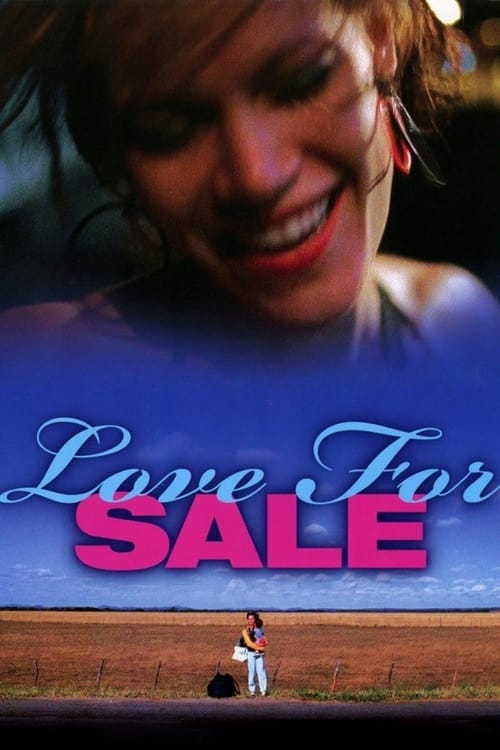
Love for Sale
2006 · Karim Aïnouz
For when you want an intimate character portrait with real backbone — a film about starting over that earns its hope the hard way. Quiet and grown-up, more slow-burn than tearjerker.
What it's about
In a small town in Brazil's arid northeast, a young mother named Hermila comes home from São Paulo with her baby son, waiting on a husband who has promised to follow. When she realizes she's been abandoned, she doesn't fold — she reinvents herself as 'Suely' and raffles off 'a night in paradise' with herself, scandalizing the town to raise the bus fare for a new life somewhere far away.
The experience
Spare, sensual, and quietly defiant — it moves at the unhurried pace of small-town heat, but there's a restlessness humming underneath. You feel the sting of being left behind and the exhilaration of a woman deciding her own terms, without the film ever begging for your sympathy.
Performances
Hermila Guedes carries nearly every frame — restless, wounded, and stubbornly alive, she makes Hermila's boldness feel like survival rather than provocation.
The craft
Karim Aïnouz shoots the Brazilian sertão with a sensuous eye — sun-bleached landscapes, neon-lit nights, and a horizon that feels both like a prison wall and a promise. The camera stays close to its heroine, favoring texture and gesture over exposition, so the place itself becomes part of her story.
Why it matters
A key film of the Brazilian cinema revival of the 2000s, it helped establish Aïnouz as one of the country's essential directors of women's inner lives and cemented his gift for stories of self-reinvention.
Snapshot
Love for Sale — released in Brazil as O Céu de Suely ("Suely's Sky") and circulated internationally as Suely in the Sky — is Karim Aïnouz's second feature, a spare and sensuous portrait of a young woman remaking herself against the horizon of Brazil's northeastern backlands. Hermila (Hermila Guedes) returns from São Paulo to her small hometown in the sertão with an infant son, waiting on a husband, Mateus, who has promised to follow and never does. When the waiting curdles into certainty of abandonment, she does not collapse into it: she reinvents herself as "Suely" and organizes a raffle whose prize is a night with her — "A Night in Paradise" — to raise the fare that will carry her as far from the town as a bus can go. The film's drama is less about sex for money than about a woman purchasing her own exit, converting shame into agency and a dead-end town into a point of departure. It is a work of restrained realism shot through with lyrical color, and it consolidated Aïnouz's standing, after Madame Satã (2002), as one of the most distinctive voices of Brazil's post-retomada generation.
Industry & production
Love for Sale is a four-country co-production — Brazil, France, Germany, and Portugal — assembled through the kind of layered financing that became standard for Brazilian art cinema in the 2000s. The anchor producer was VideoFilmes, the São Paulo company run by Walter Salles and João Moreira Salles, with Walter Salles and Maurício Andrade Ramos among the credited producers; the international partners were Celluloid Dreams (with Hengameh Panahi), the German outfit associated with Peter Rommel, and Portugal's Fado Filmes, alongside Shotgun Pictures. This constellation matters: VideoFilmes had been the incubator for a cohort of Brazilian directors, and Aïnouz belonged squarely to its orbit, having worked in and around Salles's projects before directing. Celluloid Dreams, a leading arthouse sales-and-production house of the era, gave the film the European backing and festival access that a modestly budgeted regional drama would otherwise struggle to secure.
The picture is a product of the retomada — the "rebirth" of Brazilian cinema after the industry's near-collapse at the start of the 1990s — and of the audiovisual incentive laws that rebuilt production through tax mechanisms and co-production treaties. Precise budget and box-office figures for the film are not well documented in the accessible record, and I will not invent them; but its scale is legible on screen, in the intimate cast, real locations, and economy of means. It premiered at the 2006 Venice Film Festival and traveled a long festival circuit thereafter, which is where a film of this kind earned both its critical reputation and much of its commercial life.
Technology
The exact capture format is not reliably documented in the sources available to me, so I flag that rather than guess at a stock or gauge. What can be said with confidence is that this is a photochemical-era film, made at the tail end of the period before digital acquisition became the Brazilian norm, and that its images bear the signature of cinematographer Walter Carvalho — grain, saturated warmth, and a tolerance for the harsh natural light of the sertão rather than an attempt to tame it. The technological interest of the film lies less in any novel apparatus than in its embrace of available light and real, weathered locations: dust, low sun, roadside neon, and the flat glare of a bus-station afternoon. It is a work made with the resources of a mid-decade international co-production deployed toward a deliberately unglamorous, textural realism.
Technique
Cinematography
Walter Carvalho — one of Brazil's most esteemed cinematographers, whose credits include Central Station and Aïnouz's own Madame Satã — is the film's decisive craft presence. His camera treats the backlands not as picturesque poverty but as a field of color and light: burnt ochres, reds, and the immense pale sky that the Portuguese title invokes. The framing favors Hermila's body and face in the landscape, often isolating her against wide, empty space to make legible both her confinement and her yearning to be elsewhere. There is a tactile, close attention to skin, sweat, and fabric that grounds the film's sensuality in the physical, and a recurring pull toward the horizon and the road that visually rhymes with the character's single-minded desire to leave.
Editing
The film was cut by Isabela Monteira de Castro and Tina Baz le Gal, and its rhythm is patient and observational rather than dramatically propulsive. The editing lets scenes breathe — waiting, in a literal sense, is the film's early subject, and the cutting honors that duration before the raffle plot introduces momentum. The structure is essentially linear, tracking Hermila's psychological turn from expectation to resolve, and the montage tightens as her plan takes shape without ever abandoning the contemplative register established at the outset.
Mise-en-scène / staging
Aïnouz stages the drama in the ordinary rooms and thresholds of provincial life: a grandmother's house, a gas station, a bar, the bus terminal. The town itself — in the interior of Ceará — functions as a character, its low buildings and open roads pressing in on Hermila's sense of possibility. Costume and self-presentation carry real narrative weight, since the film is partly about a woman authoring a new persona; the shift from "Hermila" to "Suely" is enacted as much through look and bearing as through dialogue. The staging keeps money, the body, and desire in the same frame, refusing to sentimentalize the transaction at the film's center.
Sound
The score is credited to Berna Ceppas, Kamal Kassin, and João Nabuco; the precise division of labor among them is not something I can document, so I won't assign specific cues to specific hands. In keeping with the film's naturalism, music is used sparingly, threaded against a dense field of ambient sound — wind, engines, the murmur of the town — so that the sonic world feels lived-in rather than scored. The result supports the film's emotional restraint, letting silence and environment do much of the affective work.
Performance
Hermila Guedes's performance as Hermila/Suely is the film's center of gravity and its most-praised element. She carries an unusual combination of vulnerability and steel, playing a woman who is neither victim nor heroine in any tidy sense but a person improvising survival with defiant clarity. The performance won her a run of best-actress recognition on the Brazilian and international festival circuits, and it is what most reviewers single out. The surrounding ensemble — the family and men of the town — is played in a low-key, credible register that reinforces the film's documentary texture.
Narrative & dramatic mode
The dramatic mode is intimate realism inflected with lyricism — a character study built on observation rather than plot machinery. Its narrative engine is a single, morally charged decision: to raffle "A Night in Paradise" as a means to an end. Crucially, the film frames this not as degradation but as pragmatic self-determination, and it withholds the melodramatic beats a more conventional treatment would supply. There is no punishing arc, no redemptive rescue by a man; the emotional climax is bound up with departure — with Hermila choosing the farthest possible destination almost at random, geography standing in for freedom. The mode is closer to European art-cinema naturalism than to Brazilian commercial melodrama, even as it draws on melodrama's raw materials of longing, abandonment, and female endurance.
Genre & cycle
Nominally a drama, the film sits within a recognizable cycle of 2000s Brazilian cinema do sertão — films set in the arid northeastern interior that revisit the region long central to the national imagination, from Cinema Novo onward, but strip it of both folkloric romanticism and pure social misery. It also belongs to a broader international current of female-centered realist portraiture, and it can be read against the coming-of-age and self-liberation traditions. Aïnouz's particular contribution to the cycle is to fuse the sertão setting with a frankly embodied, sensual attention more often associated with urban or queer cinema — a combination that distinguishes the film from the harsher social-realist backlands dramas around it.
Authorship & method
Karim Aïnouz, born in Fortaleza in Ceará, is himself a son of the Northeast, and his work returns repeatedly to marginalized figures — queer men, sex workers, abandoned women — rendered with sensual sympathy rather than pity. Trained partly abroad and connected early to Walter Salles's VideoFilmes milieu, he arrived at Love for Sale off the acclaim of Madame Satã (2002), and the two films share a method: real locations, a strong central performance, saturated photography, and a refusal to moralize about desire or transgression. He co-wrote the screenplay with Felipe Bragança and Maurício Zacharias, collaborators drawn from the same generation of Brazilian film culture.
His key craft collaborators here form a notably strong team. Walter Carvalho brought the authority of a cinematographer who had helped define the look of retomada cinema. Editors Isabela Monteira de Castro and Tina Baz le Gal shaped the film's contemplative rhythm, the latter a reminder of the project's French-facing co-production dimension. The three-name music credit (Ceppas, Kassin, Nabuco) points to a collaborative approach to the score rather than a single authorial composer. Above all, the partnership with Hermila Guedes is central: Aïnouz's authorship in this film is inseparable from his direction of an actor, building the entire work around her presence.
Movement / national cinema
The film is a signal work of contemporary Brazilian cinema in the aftermath of the retomada, and specifically of the flourishing of Northeastern filmmaking — a regional cinema centered on Ceará and Pernambuco that gained national and international visibility in the 2000s. It is in dialogue with the legacy of Cinema Novo, which mythologized the sertão as the site of Brazil's social contradictions, but it belongs to a later sensibility that treats the region as ordinary lived space and centers individual interiority over allegory. As an international co-production, it also exemplifies how Brazilian auteur cinema of the decade sustained itself through European partnerships and the festival economy.
Era / period
Made and released in 2006, the film is very much of its moment: a mid-2000s art film produced within the co-production and incentive-law framework that structured Brazilian cinema after 2000, and made at the hinge between photochemical and digital production. Its aesthetic — patient, naturalistic, actor-driven, festival-oriented — is characteristic of world art cinema of the period. It is set in a contemporary present of bus stations, gas stations, and provincial routine, with no period trappings; the "era" it depicts is simply the now of small-town northeastern Brazil in the early twenty-first century.
Themes
At its core the film is about self-determination under constraint — a woman turning the very thing meant to shame her (her body, her abandonment) into the instrument of her freedom. Female desire and agency run through it without apology, as does the theme of departure: the dream of elsewhere, of the road and the horizon, against the gravity of a place that holds people in place. It meditates on abandonment and waiting, on the economics of intimacy in a poor town, and on reinvention — the making of "Suely" as a self that can survive what "Hermila" could not. Underpinning all of it is a refusal of judgment: the film insists on dignity and courage where a more conventional narrative would find only fall or rescue.
Reception, canon & influence
Critically, Love for Sale was well received as a confirmation of Aïnouz's talent, with particular and near-universal praise for Hermila Guedes's lead performance and for Walter Carvalho's cinematography. It premiered at the 2006 Venice Film Festival and won a substantial run of awards on the Brazilian and international circuits; among the firmest citations is the APCA (Associação Paulista de Críticos de Arte) award for Best Film, and Guedes drew multiple best-actress honors, though I would flag that the complete festival-by-festival tally is inconsistently recorded and I have not tried to enumerate it exhaustively.
Looking backward, the film draws on the sertão tradition of Cinema Novo and on the observational, character-driven strain of world art cinema, while inheriting the intimate sensuality and interest in marginal lives that Aïnouz established in Madame Satã. Looking forward, its clearest legacy is within its director's own body of work: the fascination with women's inner lives, abandonment, and yearning that animates Suely resurfaces most powerfully in Invisible Life (A Vida Invisível de Eurídice Gusmão, 2019), which won the Un Certain Regard prize at Cannes and became Aïnouz's international breakthrough, and it runs through Praia do Futuro (2014) and his later features. More broadly, the film helped consolidate the international profile of Ceará-and-Pernambuco Northeastern filmmaking and stands as an early landmark in the career of Hermila Guedes. Its influence is best understood not as the founding of a new genre but as a durable, exemplary instance of a regional-national cinema learning to speak, through one woman's story, to audiences far beyond the sertão.
Sources: Wikipedia — Suely in the Sky, Cineuropa, Enciclopédia Itaú Cultural, TMDB.
Reception
A quiet festival darling in 2006 — Venice, Toronto, then a sweep of Best Film, Director and Actress at Rio — it's since hardened into modern-classic status at home, with Brazil's film critics association (Abraccine) ranking it among the 100 greatest Brazilian films ever made.
How Love for Sale was received, from release to now →
Influences: the films it descends from and the films it influenced
- Vidas Secas (1963) — Founds the Cinema Novo sertão grammar Suely inherits: harsh, near-overexposed available light and tiny human figures dwarfed against arid backland, landscape as an economic and emotional pressure.
- Deus e o Diabo na Terra do Sol (1964) — Treats the sertão as expressive, near-abstract space through wide lateral movement of figures against sky and scrub — the figure-in-landscape as register rather than backdrop.
- Bye Bye Brasil (1980) — Establishes the road-out-of-the-Northeast structure of itinerant lives crossing real locations, feeding the departure-and-elsewhere yearning that drives Suely's bus-ticket plot.
- Central Station (1998) — The retomada template of a Northeastern journey anchored by one incandescent central performance, made in the VideoFilmes/Salles orbit where Aïnouz trained.
- Behind the Sun (Abril Despedaçado) (2001) — Cinematographer Walter Carvalho's saturated, sun-drenched sertão palette and backlit dust — the exact color and available-light method he carries directly into Love for Sale.
- Madame Satã (2002) — The director's own prior method distilled: real locations, saturated photography, and a single volcanic central performance framing marginal desire with sensual sympathy, never moral judgment.
- Rocco and His Brothers (1960) — The migrant-family neorealist template of leaving the poor South for elsewhere, staged in real locations with costume marking aspiration — the departure engine Aïnouz recasts as a woman's.
- Praia do Futuro (2014) — Extends departure-and-elsewhere with the same saturated-color longing and lone figures set against vast coastal and urban expanses, migration as sensual rupture.
- Invisible Life (2019) — Carries forward the fascination with women's inner lives and abandonment, refusing pity while intensifying the saturated palette into full melodramatic color.
- Bacurau (2019) — Cinema do sertão extended: the backland village shot as real-location landscape with figures held in wide frames, the Northeast as sovereign world rather than exotic margin.
- Arábia (Araby) (2017) — Northeastern itinerant-labor realism in available light and observational rhythm, a working person's mobility across real locations narrated with intimate, first-person plainness.
- Wanda (1970) — Grainy available-light observation of an aimless woman's self-determination, withholding melodramatic motive — the anti-explanatory portrait of a drifting female protagonist.
- Vagabond (Sans toit ni loi) (1985) — Builds the drifting-woman portrait from quasi-documentary tracking of a woman crossing an indifferent landscape, the observational figure-in-landscape Suely shares.
- Rosetta (1999) — Present-tense, bodily-close observational pacing that stays with a working-class woman's survival and refuses melodramatic uplift — the anti-melodrama grammar Suely applies to the sertão.
- Neighboring Sounds (2012) — Consolidates Pernambuco Northeastern cinema through real locations and dense, naturalistic ambient sound design as the primary carrier of place and unease.
- Aquarius (2016) — A female-centered realist portrait built entirely around one commanding central performance (Sônia Braga) and a woman's self-determination against pressure to leave.
Similar films
- Invisible Life (2019) — influence & lineage
- Madame Satã (2002) — influence & lineage
- Aquarius (2016) — influence & lineage
- Barren Lives (1963) — influence & lineage
- Black God, White Devil (1964) — influence & lineage
- Foreign Land (1996) — shared sensibility
- Lisbela and the Prisoner (2003) — shared sensibility
- Leila and the Wolves (1986) — shared sensibility