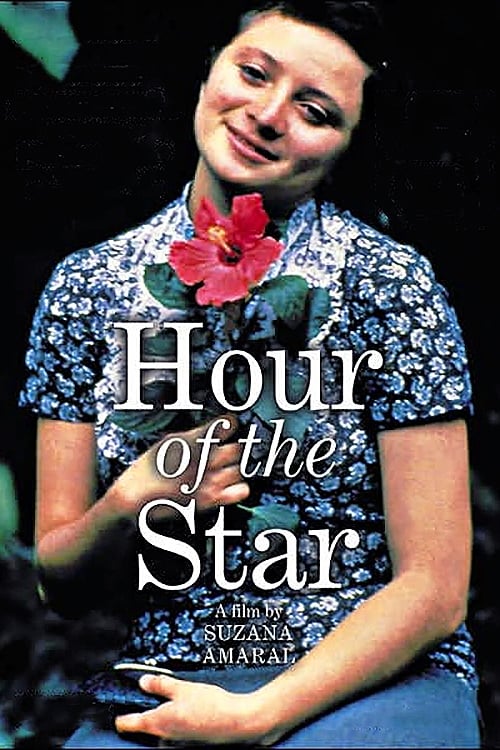
Hour of the Star
1986 · Suzana Amaral
When you want a film to sit with — a slow, humane character study for a reflective night, closer to challenge than comfort but deeply rewarding if you meet it halfway.
What it's about
Macabéa, an orphaned young woman from Brazil's poor Northeast, scrapes out a nearly invisible life in São Paulo: a typist job she's bad at, a shared room in a boarding house, a radio station that recites facts and the time, metro rides on Sundays for fun. Then she meets Olímpico, a fellow migrant with swaggering dreams of becoming a congressman, and stumbles into a lopsided courtship. It's a portrait of someone society has trained itself not to see.
The experience
Quiet, unsentimental, and cumulatively devastating — the film never begs for your pity, which is exactly why Macabéa gets under your skin. You watch small humiliations and smaller pleasures until her inner life feels enormous.
Performances
Marcélia Cartaxo's performance as Macabéa won the Silver Bear for Best Actress at Berlin, and it's easy to see why: she makes near-total passivity riveting, communicating whole weather systems of feeling through posture and a blank, hopeful face.
The craft
Suzana Amaral's debut adapts Clarice Lispector's final novella with restraint, trusting faces, rooms, and city noise over explanation. The film finds a visual language for invisibility — Macabéa framed at the margins of offices, boarding houses, and metro cars that barely register her existence.
Why it matters
A landmark of Brazilian cinema and of women's filmmaking — Amaral came to directing later in life and announced herself with one of the great literary adaptations of the 1980s.
Snapshot
A Hora da Estrela is a quiet, devastating portrait of a woman society has trained itself not to see. Adapted from Clarice Lispector's final novella (published in 1977, the year of her death), Suzana Amaral's debut feature follows Macabéa, an orphaned migrant from the impoverished Brazilian Northeast who scrapes out a barely-visible life as a typist in São Paulo. She eats cheap, listens obsessively to a radio station that recites facts and the time, rides the metro on Sundays for pleasure, and briefly, disastrously, falls into a courtship with Olímpico, a fellow nordestino with delusions of political grandeur. The film is celebrated above all for Marcélia Cartaxo's performance as Macabéa, which won the Silver Bear for Best Actress at the 1986 Berlin International Film Festival. Made by a woman who came to filmmaking in her fifties after raising a large family, it is one of the landmark Brazilian films of the 1980s and a touchstone of Latin American women's cinema.
Industry & production
The film was produced in the mid-1980s, a hinge moment for Brazilian cinema. Feature production still ran substantially through Embrafilme, the state film enterprise created in 1969, and the film emerged just as the military dictatorship gave way to the civilian New Republic in 1985. This was a period in which the radical energies of Cinema Novo had dispersed and a more intimate, character-driven strain of filmmaking had room to surface.
Amaral's project was in every sense a first feature by an outsider to the established industry. She had trained in film relatively late, including graduate study in the United States at New York University, and A Hora da Estrela was her feature debut. The production was modest in scale, shot in São Paulo, and depended on the kind of low-budget resourcefulness typical of Brazilian art cinema of the era rather than on any large commercial apparatus. Reliable, specific budget and box-office figures are not something I can state with confidence, and I will not invent them; what the record clearly establishes is that the film's outsized reputation rests on artistic achievement and festival success rather than on commercial scale.
Technology
Technologically the film is unremarkable in equipment terms and remarkable in restraint. It was shot on 35mm film in color, using the conventional synchronous-sound production methods of 1980s narrative cinema. There is no reliance on optical spectacle, elaborate camera rigs, or the visual-effects technologies then emerging elsewhere. The technological "choice" that matters here is essentially negative: Amaral and her collaborators refuse the glossier resources available to them, favoring available-light naturalism and a plain photographic surface that matches the drabness of Macabéa's world. The period's standard-format film stock and lenses render skin, cheap fabric, peeling walls, and gray urban light with an unglamorized clarity that is itself the point.
Technique
Cinematography
The photography — the cinematography is credited to Edgar Moura, one of the notable Brazilian directors of photography of the period — is observational and unshowy, built around the human face rather than the cityscape. The camera holds on Macabéa: her ill-fitting clothes, her stooped posture, the way she chews, the way she looks at things a beat too long. São Paulo appears not as a picturesque metropolis but as a maze of workplaces, boarding-house corridors, lunch counters, and transit platforms, framed to emphasize enclosure and anonymity. The lighting is naturalistic and often flat, refusing to flatter its subject or beautify her poverty. This visual plainness is a deliberate ethical stance: the film insists we look, without pity's usual cosmetic softening, at a person the world overlooks.
Editing
The cutting is patient and undramatic, giving scenes room to breathe and letting Macabéa's small routines play out at close to their real weight of time — the eating, the waiting, the listening to the radio. This deliberate rhythm is central to the film's effect, building empathy through duration rather than through incident. I am not able to attribute the editing to a specific credited editor with certainty, and I will flag that rather than guess; the important critical point is stylistic — the montage works by accumulation and restraint, not by momentum.
Mise-en-scène / staging
Amaral's staging is documentary-adjacent in its attention to the textures of working-class urban life. Interiors are cramped and cluttered with the specific junk of poverty; the boarding house Macabéa shares with three other women, the typing office, the cheap eateries, and the metro are rendered with an anthropologist's eye for detail. Props carry heavy meaning: the radio (a station that broadcasts facts and the time — Lispector's Rádio Relógio, "Clock Radio"), which stands in for Macabéa's starved hunger for knowledge and connection; the small consumer objects she desires; the mirror. Bodies are staged to communicate class and defeat — Olímpico's swagger against Macabéa's timidity, the crowding of the sidewalk and the train.
Sound
Sound is used sparingly and pointedly. The recurring radio broadcasts — a stream of trivia, times, and factoids delivered in a flat announcer's voice — form the film's most distinctive aural motif, a mechanical surrogate for the education and companionship Macabéa lacks. The soundscape is otherwise dominated by the ordinary noise of the city and the mundane rhythms of speech. The musical scoring is minimal, in keeping with the film's neorealist reticence; I cannot reliably attribute the score to a specific composer from memory and will not invent a credit, but the aesthetic tendency is clear — music is withheld far more than it is deployed, so that when feeling swells it does so through image and performance rather than orchestration.
Performance
Performance is where the film is most universally praised. Marcélia Cartaxo, then a young and largely unknown actress, disappears into Macabéa through a total physical transformation — the shuffling walk, the slumped shoulders, the open-mouthed absorption, the flickers of wonder and hurt across an unguarded face. It is a performance built out of smallness and interiority, refusing sentimentality while making Macabéa's inner life legible. The recognition it received — the Silver Bear for Best Actress at Berlin — confirmed it as one of the great performances of Brazilian cinema. José Dumont, as Olímpico, provides an essential counterweight: brash, self-mythologizing, and cruel in his ambition, he embodies a different, more predatory response to the same conditions of migrant poverty.
Narrative & dramatic mode
The dramatic mode is anti-melodramatic realism organized around a life almost devoid of conventional plot. The "story" is a series of small encounters and humiliations: getting and nearly losing a job, the courtship and rejection by Olímpico, a visit to a doctor, a visit to a fortune-teller. Lispector's novella famously deploys a self-conscious male narrator, Rodrigo S.M., who interrupts to comment on the difficulty of telling Macabéa's story; Amaral's adaptation largely strips away this literary framing device and delivers Macabéa to us directly, trading metafiction for observational intimacy. The narrative's tension is existential rather than causal — it is about whether a person of no consequence to anyone can be granted meaning — and it moves toward a climactic reversal in which a promised radiant future collides with sudden death, the "hour of the star" of the title, the paradoxical instant in which the invisible becomes, for one moment, the protagonist of her own life.
Genre & cycle
Nominally a drama, the film sits within the broad tradition of social-realist and neorealist-influenced cinema, and more specifically within a Latin American lineage concerned with poverty, internal migration, and the marginalized individual. It is also, importantly, a literary adaptation and a woman's picture in the fullest sense — a film that centers female subjectivity and the specific vulnerabilities of a poor woman. It resists the picaresque or the uplift arc that its migration premise might invite; there is no rags-to-redemption cycle here. Within Brazilian cinema it belongs to the intimate, author-driven films that followed the collective political cinema of the 1960s and early 1970s.
Authorship & method
The film is decisively an auteur work, and its authorship is inseparable from Suzana Amaral's biography. Amaral (1932–2020) came to filmmaking after raising a large family, turning to journalism and then to formal film study, including at NYU, before directing her first feature in her early fifties. This unusual path is widely cited as shaping the film's distinctive empathy and its unglamorous, patient attention to a woman's ordinary life — a perspective largely absent from the male-dominated Brazilian cinema of the time.
Amaral co-authored the screenplay adaptation of Lispector's novella; Alfredo Oroz is credited among the writers, though I will not overstate the precise division of authorial labor beyond what the credits establish. On the craft side, the cinematography by Edgar Moura is the most clearly documented technical collaboration and is central to the film's look. For the editor and composer, as noted above, I am not confident enough in specific names to assert them, and I flag that gap rather than fabricate attributions. Amaral's method as director is best described as one of concentrated attention: casting an actress capable of near-total transformation, then building the film around long, unhurried observation of her.
Movement / national cinema
The film is a key work of Brazilian cinema in the immediate post–Cinema Novo, late-dictatorship-into-democracy period. Amaral was not a member of the Cinema Novo generation, and A Hora da Estrela is not a Cinema Novo film; but it shares that movement's foundational concern with Brazil's dispossessed — particularly the nordestino migrant, a figure central to Brazilian art and cinema — while replacing the earlier movement's allegorical and overtly political register with intimacy and psychological realism. It also stands as one of the most important films directed by a woman in Brazilian cinema history, and is frequently discussed as a foundational text of Brazilian women's filmmaking. It predates the "Retomada," the mid-1990s revival of Brazilian cinema, and is sometimes read as a bridge toward that later intimate, realist sensibility.
Era / period
The film is very much of its 1980s moment. It was made as Brazil emerged from over two decades of military rule into the New Republic, amid economic hardship and the ongoing mass migration of poor Northeasterners to the industrial Southeast. Macabéa and Olímpico are avatars of that demographic upheaval; the São Paulo they inhabit is the era's engine of both opportunity and dehumanization. The film's texture — the consumer radio culture, the low-wage clerical work, the boarding-house economy — captures the specific material conditions of urban Brazilian poverty in the mid-decade with quasi-documentary precision.
Themes
The film's central theme is visibility — the moral and existential question of whether a life deemed worthless by everyone around it can nonetheless have meaning. Macabéa embodies alienation in its most literal form: undernourished of food, education, affection, and even language, she is a person who barely registers as a person to others. From this flow the film's related concerns: poverty and class as forms of erasure; the loneliness of the migrant in the anonymous metropolis; the false promises of consumer culture and mass media, distilled in the fact-spouting radio and in the fortune-teller's dazzling prophecy; and the cruelty of aspiration, embodied by Olímpico's self-serving dreams. Femininity runs through all of it — the film is acutely attuned to how Macabéa's poverty is also a specifically female condition of dependence and vulnerability. Finally there is the film's metaphysical undertow, drawn from Lispector: the idea, carried in the title, that death may be the one instant in which such a person becomes the "star" of her own existence — a bleak, ironic beatification.
Reception, canon & influence
Critically, the film was a major success and remains Amaral's most acclaimed work. Its most prominent honor was the Silver Bear for Best Actress awarded to Marcélia Cartaxo at the 1986 Berlin International Film Festival, an international recognition that established both the film and its lead. The film was widely praised at festivals and in Brazil, and I understand it to have been strongly recognized on the domestic festival circuit as well, though I will avoid asserting specific additional prizes I cannot verify. Over time it has entered the Brazilian canon: it is routinely cited among the most important Brazilian films, appearing on critics' and scholars' lists of the country's greatest cinema.
Looking backward, the film's clearest influence is literary — Clarice Lispector's novella, one of the most revered works of modern Brazilian literature, supplies not only the story but its philosophical preoccupations with language, existence, and the interior life of the insignificant. Stylistically, the film draws on the broad realist and neorealist tradition of attending to ordinary lives without melodrama, a lineage running through much socially engaged world cinema. Amaral's own late-blooming, internationally trained sensibility filters these sources into something personal.
Looking forward, the film's legacy is substantial for its scale. It is a foundational reference point for Brazilian women's cinema and for the intimate realism that would flourish in the Retomada and after. It helped consolidate Lispector as a source for screen adaptation and kept her difficult, interiorized fiction in cultural circulation. And it launched Marcélia Cartaxo, who built an enduring career in Brazilian film and returned decades later to acclaimed roles, her name permanently linked to Macabéa. More diffusely, A Hora da Estrela endures as a model of how cinema can confer dignity and full subjectivity on exactly the kind of person most films ignore — a small, unforgettable film about a life the world was determined to overlook.
Reception
It arrived a winner — festival acclaim at Berlin in 1986 and a sweep at Brasília — then spent decades as a hard-to-see Brazilian classic; the international Clarice Lispector revival of the 2010s sent a new generation of readers hunting it down, and restorations finally put it back in circulation.
How Hour of the Star was received, from release to now →
How to watch Hour of the Star: what to notice on a first viewing
- Watch Macabéa's shuffling walk and slumped shoulders. Marcélia Cartaxo builds the character from posture and habit: the walk, the stoop, the open-mouthed way she absorbs the world around her. Her body does the storytelling that the script's sparse dialogue leaves out.
- Notice the lighting never flattering Macabéa or her poverty. Edgar Moura shoots her in flat, naturalistic light with no glamorizing softness, refusing the visual cosmetics that usually accompany a story about the poor. The plainness forces you to look directly at a person the world has trained itself to skip over.
- Listen for the radio reciting facts and the time. A station that only broadcasts trivia and the hour plays again and again in Macabéa's room, a flat announcer's voice standing in for the education and company she lacks. The broadcast becomes her only steady companion, a mechanical stand-in for connection she cannot otherwise reach.
- Notice scenes lingering at their real, unhurried length. Eating, waiting and listening to the radio are allowed to play out close to their actual duration, instead of being trimmed down to their dramatic essentials. Duration builds a kind of attention for Macabéa that no plot incident by itself could produce.
- Notice how cluttered and cramped every interior looks. The boarding house, the typing office and the cheap eateries are filmed with an eye for the specific junk of poverty, not a generalized backdrop. The clutter itself tells you how little room this life has been given to exist in.
The whole guide to watching Hour of the Star, with the keys for a rewatch →
Influences: the films it descends from and the films it influenced
- Umberto D. (1952) — Establishes the neorealist grammar Amaral adopts of granting real-time, undramatized screen duration to an economically invisible person's survival rituals, so that ordinary routine (eating, waiting, small humiliations) becomes the whole subject rather than a backdrop to plot.
- Mouchette (1967) — Cartaxo's flattened, near-affectless embodiment of Macabéa descends directly from Bresson's 'model' method — withholding psychological explanation and expressive acting from a crushed poor girl so the audience must supply the interior life the world denies her.
- Vidas Secas (Barren Lives) (1963) — Supplies the Cinema Novo template of harsh available-light sertão realism and the nordestino drought-to-city migration that Amaral's post–Cinema Novo film inherits as Macabéa's Alagoas-to-São Paulo displacement.
- Jeanne Dielman, 23 Quai du Commerce, 1080 Bruxelles (1975) — Models the duration-based restraint of observing a woman's repetitive, menial labor in patient framing, letting elapsed real time — not incident — confer gravity on a life cinema conventionally treats as insignificant.
- Pixote (1981) — A Brazilian precursor in near-documentary staging of São Paulo's discarded people, using non-professional-adjacent naturalism and the unglamorous urban margin that Amaral's documentary-adjacent staging later inhabits.
- Wanda (1970) — Foundational women's-cinema portrait of a passive, inarticulate woman drifting through an indifferent world — the same refusal to editorialize or rescue its marginal heroine that Amaral practices with Macabéa.
- A Hora da Estrela (source novella framing) (1977) — Lispector's metafictional narrator Rodrigo S.M. supplies the stripped-metafiction device — a self-conscious authorial frame around a 'nobody' — that Amaral preserves as the film's reflexive commentary on who gets to tell such a life.
- Rosetta (1999) — Pushes Amaral's scoreless, present-tense pursuit of a poor young woman's survival to its limit — handheld, withheld scoring, no explanatory backstory — extending dignity-through-duration into a chase-like moral realism.
- Central Station (1998) — The Retomada landmark Amaral prefigures: it reactivates nordestino displacement and intimate realism about marginal lives, the very 'intimate realism' the dossier credits her with seeding for post-1990s Brazilian cinema.
- O Céu de Suely (Love for Sale) (2006) — Carries Marcélia Cartaxo's transformative embodiment method forward — she features in it — while extending Brazilian women's cinema on nordestino female subjectivity that Amaral's Silver Bear performance launched.
- Que Horas Ela Volta? (The Second Mother) (2015) — Continues the Brazilian women's-cinema project of conferring full subjectivity on the invisible domestic/migrant worker, dramatizing class erasure through restrained observation rather than melodramatic confrontation.
- A Vida Invisível (The Invisible Life of Eurídice Gusmão) (2019) — Takes Amaral's theme of women's erasure and its anti-melodramatic ethic and reworks melodrama itself to make legible the interior lives of women history overlooked, a direct extension of Brazilian women's cinema.
- Bacurau (2019) — Relocates the sertão-and-margins subject into genre while drawing on the acting lineage Amaral launched — Cartaxo among its ensemble — sustaining the nordestino-dignity tradition Hour of the Star helped canonize.
- Sans toit ni loi (Vagabond) (1985) — A near-contemporary quasi-documentary portrait of a young woman who refuses society, built from elliptical observation and withheld sympathy — the same anti-melodramatic distance from a female drifter that Amaral deploys the same year.
- Salaam Bombay! (1988) — Extends the same documentary-adjacent, available-light realism into the megacity slum, dignifying an overlooked migrant child through observational staging rather than plotted melodrama.
Similar films
- Central Station (1998) — influence & lineage
- Limite (1931) — shared sensibility
- Aquarius (2016) — shared sensibility
- Pixote (1980) — shared sensibility
- Nights of Cabiria (1957) — shared sensibility
- White Mangrove (2020) — shared sensibility
- Invisible Life (2019) — shared sensibility
- Manila in the Claws of Light (1975) — shared sensibility