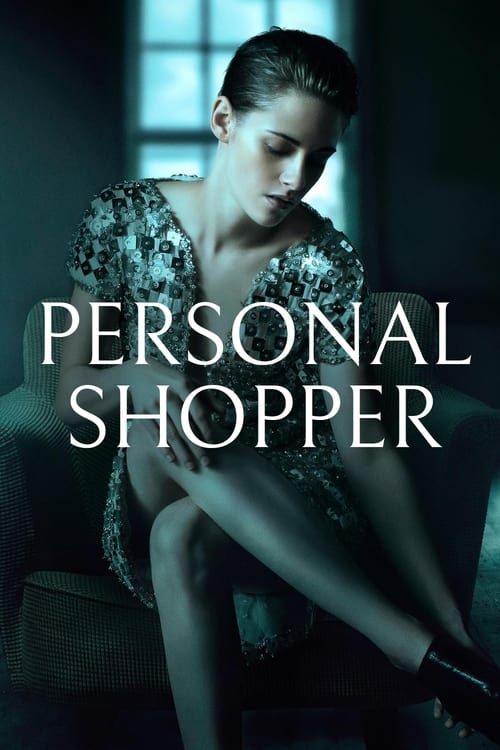
Personal Shopper
2016 · Olivier Assayas
For when you want a film to chew on for days — a slow-burn mystery for a solitary, contemplative night, not a jump-scare crowd-pleaser. Challenge viewing that rewards patience.
What it's about
Maureen spends her days buying couture for a celebrity she barely sees, ferrying garment bags across Paris on a scooter. She stays in the city for one reason: she's a medium, and she promised her twin brother — dead of the heart condition she shares — that whoever went first would send the other a sign. While she waits in his shuttered house for something to speak, an unknown number starts texting her, and the messages know too much.
The experience
Hushed, eerie, and strangely intimate — a ghost story told at the pace of grief, where a phone's typing indicator becomes as frightening as any apparition. It refuses easy answers and gets under your skin precisely because of it.
Performances
Kristen Stewart, in nearly every frame, doing career-best work: guarded, restless, thinkingly alive, she makes waiting and texting into riveting cinema. The film simply doesn't exist without her.
The craft
Assayas builds dread from modern textures — SMS threads, hotel corridors, the hushed backrooms of luxury fashion — and lets long wordless stretches carry the tension. The film glides between ghost story, stalker thriller, and portrait of precarious work without ever settling, which is exactly the point. It premiered in competition at Cannes, where Assayas won Best Director.
Why it matters
A defining film of Stewart's post-blockbuster reinvention and a touchstone for how cinema can make the smartphone genuinely cinematic — mourning conducted over text message.
Snapshot
Personal Shopper is Olivier Assayas's second consecutive film with Kristen Stewart, made immediately after Clouds of Sils Maria (2014), and it doubles down on that film's central discovery: that Stewart's particular quality of guarded, undemonstrative attention could carry an entire picture. Here she plays Maureen Cartwright, an American in Paris who buys clothes for a celebrity she barely sees and who is also, by her own account, a medium — waiting in a shuttered suburban house for a sign from her twin brother Lewis, dead of the same congenital heart defect she carries.
The film is a ghost story that refuses the consolations of the genre, a thriller whose menace arrives as an SMS thread, and a work-portrait of precarious labor in the luxury economy. It premiered in Competition at the 2016 Cannes Film Festival, where its first press screening was reported to have drawn audible booing — and where Assayas nonetheless shared the Best Director prize with Cristian Mungiu (for Bacalaureat). That split verdict has followed the film ever since: it is either Assayas's most formally daring picture or an unresolved hybrid, and the case for it rests on whether one accepts that its unresolve is the point.
What makes it durable is its confidence in the middle register. Assayas stages the supernatural without irony and without proof; he films online shopping and Chanel harnesses with the same even attention he gives to ectoplasm. The result is a film about mediation in every sense — the medium who channels the dead, the media that channel desire, the messages whose sender is never securely established.
Industry & production
Personal Shopper is a French-led European co-production of the kind that has sustained Assayas's career since the 1990s: modest budgets, festival-facing ambition, international casting, and financing assembled across national funds and pre-sales. CG Cinéma, the production company of Charles Gillibert, produced — Gillibert had also produced Clouds of Sils Maria, and the continuity of that relationship is the practical reason the film exists in the form it does. The picture was shot largely in Paris and its outskirts, with sequences in London and in Oman; the Oman material anchors the celebrity-employer subplot and gives the film its one deliberate excursion into elsewhere.
The industrial logic is worth stating plainly, because it explains the film's freedoms. A film at this budget level, backed by a director with a festival track record and starring an actor with genuine international profile, does not need to resolve its genre. It needs to be distinctive enough to travel — to Cannes, then to a network of arthouse distributors (IFC Films handled the United States release; it opened there in March 2017 after the 2016 festival run). Assayas has worked inside this system long enough to know exactly how much strangeness it will bear, and Personal Shopper tests the upper bound.
Casting Stewart was, in 2016, still a legible commercial argument as well as an artistic one. Her Twilight profile gave the film a distribution hook; her Sils Maria performance — which made her the first American actor to win a César, for Best Supporting Actress — gave it critical cover. Assayas has said in interviews around the film's release that he wrote it for her, and the screenplay's reliance on solitary, near-wordless sequences is only viable with an actor a producer will fund to be alone onscreen for minutes at a time.
The film's most-discussed production fact is a negative one: the text-message thread that occupies roughly the film's central third was shot as performance, not added in post as an afterthought. Stewart is reacting to messages in real time on set, which is why the sequence has the rhythm of acting rather than of graphics. Beyond that, the granular production record — shooting schedule, exact budget, day counts — is thinly documented in English-language sources, and I won't invent numbers to fill it.
Technology
Personal Shopper is a digital film, shot by Yorick Le Saux, and its digital capture matters less as a look than as a permission. Low-light interiors — the empty house at night, the stairwells, the hotel corridors — are photographed at levels that would have required either heavy lighting or a coarser grain on film stock. Assayas gets to keep the darkness dark and still see Stewart's face in it.
The more consequential technology is diegetic. The film is among the more serious attempts by a major director to make the smartphone a dramatic instrument rather than a plot inconvenience. Contemporary cinema's standard solutions — the floating text bubble, the over-the-shoulder screen insert — are both used sparingly here; Assayas's preferred shot is Stewart's face lit by the phone, with the device's content withheld or delayed. The suspense is generated by the interval between messages, the visible typing indicator, the choice of whether to reply. This is a filmmaker treating a messaging protocol the way an earlier one treated a telephone in a locked room.
Assayas had been circling this material for two decades. demonlover (2002) built a thriller out of online pornography distribution and the corporate war for its supply; Boarding Gate (2007) ran on international transactions and untraceable movement. Those films treated networked technology as an environment of dread. Personal Shopper narrows the aperture to a single handset and finds the dread is still there, now domesticated — which is a sharper observation.
The film also uses digital effects for its apparitions, and uses them badly on purpose, or at least unfashionably. The ectoplasmic figure that appears in the empty house is rendered as translucent, watery CGI that recalls nothing so much as the spirit photography of the nineteenth century and the effects vocabulary of an earlier era of ghost films. There is no attempt at photorealist horror. The choice is consistent with the film's argument: apparitions here are not evidence, they are images, and images are always a little cheap.
Technique
Cinematography
Yorick Le Saux, who shot Clouds of Sils Maria and would return for later Assayas projects, works here in a mode of watchful mobility. The camera follows Maureen — through the Paris streets on her motorbike, through boutiques, up the stairs of the dead brother's house — in long, patient takes that neither hurry her nor abandon her. The framing is close but not oppressive; Le Saux tends to leave a little air around Stewart, which reads as loneliness rather than intimacy.
Two distinct registers run through the film. The daylight Paris material is flat, even, unglamorous: overcast light, gray buildings, the specific drabness of a city being worked in rather than visited. Against it, the night material in the house is built from underexposure and sourced practical light — torch beams, a lamp in one corner, the gray of an unlit window. The apparition sequences find a third register, slightly cooler and more diffuse, but Le Saux never announces the shift with a lighting cue. The supernatural is not given its own visual grammar; that refusal is the film's most consistent formal decision.
The Eurostar sequence, in which Maureen travels between Paris and London while the text thread escalates, is a small essay in how to shoot a screen. Le Saux keeps the phone and the face in the same frame where possible, uses reflections in the train window, and lets the moving landscape supply the momentum the conversation withholds.
Editing
Marion Monnier, Assayas's editor across much of his mature work, cuts the film with a peculiar unevenness that rewards attention. Sequences of ordinary labor — the boutique visits, the fittings, the ride across Paris — are given real duration, sometimes more than their narrative content justifies. Then the film will elide a major event entirely, or present it obliquely, or cut away from an apparition at the moment a horror film would hold.
The most-remarked editorial decision concerns the film's ending, in which sound and image are separated from any secure attribution and the film simply stops. Monnier and Assayas withhold the reverse shot, the confirmation, the closing rhyme. What is being edited is not a plot but a state of uncertainty, and the cut points serve that state rather than the story.
The text-message sequence is edited to the rhythm of a real conversation with a real lag — pauses left in, typing indicators allowed to run, replies not compressed. This is the opposite of conventional coverage, where dead time is the first thing removed.
Mise-en-scène / staging
Three principal spaces organize the film. The dead brother's house in the Paris suburbs is large, half-emptied, and unheated-looking; it is staged as a place where nothing will happen for long stretches, so that when something does, the room has already been established as ordinary. Kyra's apartment, by contrast, is styled as pure surface — the clothes, the jewelry, the absent occupant — and Maureen moves through it as a servant, forbidden to try anything on.
That prohibition generates the film's central staged transgression: Maureen putting on Kyra's clothes, alone. Assayas shoots it neither as titillation nor as a breakdown, but as something closer to a séance — an attempt to become someone else in order to feel anything. The harness, the sheer dress, the mirror: it is the film's thesis compressed into a scene about a woman getting dressed.
The costume design and production design work together to keep the luxury goods slightly unreal — beautiful objects photographed as inventory. The film is genuinely interested in the labor of the fashion economy: the collections, the couriers, the hierarchies of who is allowed to touch what.
Sound
Personal Shopper has no conventional score for most of its length. The soundtrack is ambient, functional, and unusually attentive: doors, footfall on stairs, the specific hum of an empty house, the notification chime. Because the film declines to underline the supernatural with music, the audience is left to interpret every sound cue as either evidence or nothing — which is precisely Maureen's position.
Assayas has long used pre-existing music with a curator's precision rather than a composer's arc; his films tend to deploy songs as punctuation. Here the restraint is more extreme than usual, which makes the moments of music land harder. The absence of a wall-to-wall score is the sound design's defining feature.
Performance
Stewart is in nearly every frame, and much of her work is done without dialogue and often without a scene partner. What she supplies is a specific quality of held attention — a face registering possibility without committing to belief. Her Maureen is skeptical about her own gift, embarrassed by grief, hostile to being managed, and physically restless in a way that gives the still scenes their tension.
The supporting cast is deliberately thin: Lars Eidinger as the employer's lover, Sigrid Bouaziz as Lewis's partner, Nora von Waldstätten as Kyra, Anders Danielsen Lie as Maureen's boyfriend, present mainly via video call from Oman. The thinness is structural. Every relationship in the film is mediated — by screens, by employment, by distance, by death — and no one is available to Maureen as a full presence.
Narrative & dramatic mode
The film runs three plot lines and refuses to subordinate any of them. There is the ghost story: Maureen has made a pact with her twin that whoever dies first will send a sign. There is the labor story: she shops for Kyra, endures the humiliations of proximity to wealth, and is bored. There is the thriller: an unknown number begins texting her, the messages become intimate and coercive, and a body is eventually found.
Most films of this shape would eventually reveal that two of these lines are the same line — that the texter is the ghost, or that the murder explains the haunting. Assayas declines. Explanations are offered and then left unverified; the identity of the texter is given a plausible answer that the film never confirms with the authority a genre picture would supply. The dramatic mode is closer to Henry James than to the paranormal thriller: the question is not what happened but whether the protagonist's perception can be trusted, and the film has no interest in settling it.
The structure is episodic and driven by waiting. Long stretches consist of a woman doing her job or sitting in a dark house. Tension is generated by duration rather than by escalation, and the film's few violent events arrive without preparation and are absorbed rather than resolved. The final line of dialogue — a question about whether the presence in the room is the brother or the protagonist herself — is the film's whole argument delivered as a stinger.
Genre & cycle
Personal Shopper sits inside a recognizable turn in 2010s art cinema toward genre appropriation: filmmakers with festival credentials borrowing the machinery of horror, thriller, and melodrama without accepting the obligations. Adjacent works include Lucrecia Martel's The Headless Woman (2008), which similarly builds dread from an unverified event; Jonathan Glazer's Under the Skin (2013); and the strand of what was then being called "elevated horror," though Personal Shopper is less interested in dread as an aesthetic than in ambivalence as a state.
Against the classical ghost-film tradition, the film's kin are those works where the haunting is inseparable from mourning and where the supernatural is left epistemologically open — the Val Lewton productions of the 1940s, the psychological ghost stories of the Innocents lineage, and closer to its own time, Apichatpong Weerasethakul's films, in which the dead appear at the dinner table without any change in register. Assayas's spirit photography and translucent apparitions consciously invoke the earliest history of the ghost image, back to the fraudulent spirit photographs of the nineteenth century that the film explicitly discusses through Maureen's interest in the painter and medium Hilma af Klint.
Within Assayas's own filmography, the picture belongs to the strand running from Irma Vep (1996) through demonlover and Boarding Gate — films about performance, commerce, and dissolving identity — rather than to the naturalist family chronicles of Late August, Early September (1998) or Summer Hours (2008).
Authorship & method
Assayas wrote and directed. His working method, consistent across decades, favours speed, location shooting, small crews, and a willingness to let the film discover itself in the edit. He came to directing through criticism — years at Cahiers du cinéma in the late 1970s and 1980s, including work on the magazine's landmark writing on Hong Kong cinema — and his films carry the critic's habit of thinking about form as an argument.
The key collaborators are all long-term. Yorick Le Saux had shot Carlos (2010) and Clouds of Sils Maria before this and brings a documentary responsiveness that suits Assayas's preference for shooting quickly. Marion Monnier has edited most of Assayas's films since the early 2000s and is arguably the decisive authorial voice in the film's handling of ambiguity, since the ambiguity is almost entirely a matter of what is withheld and when. The film has no conventional composer credit in the manner of a scored feature; Assayas's practice of assembling music from existing recordings, established as far back as Cold Water (1994) with its extraordinary use of period rock, is here reduced to near-silence.
The Stewart relationship deserves separate mention. Across two films, Assayas built a mode of performance around her resistance to conventional expressiveness — the mumble, the averted gaze, the hands. Sils Maria used those qualities in dialogue with Juliette Binoche's very different register; Personal Shopper removes the interlocutor and asks whether the qualities can sustain a film alone. Most critics concluded they could.
Movement / national cinema
Assayas is a French director whose formation was post–New Wave and whose sensibility is deliberately transnational. He belongs to the generation that came up at Cahiers after the founding critics had become the establishment, and his early features were part of a 1990s French cinema that ran alongside — and sometimes against — the movement critics labeled the nouvelle nouvelle vague. His engagement with Asian cinema, both critical and personal, and his fluency in English-language production have kept him at the edges of any national category.
Personal Shopper is French in its financing, its production culture, and its Parisian setting, but its protagonist is American, its dialogue moves between English and French, and its economy of luxury goods and international couriers is explicitly borderless. The film belongs to a mode of European art cinema — shared with the Dardennes' successors, with Mia Hansen-Løve, with Joachim Trier — in which national identity has become one variable among many rather than the organizing frame.
Era / period
The film is precisely of 2016, and dates itself deliberately. The smartphone is not a prop but the film's second protagonist; the labor it depicts — flexible, precarious, performed for someone rich and absent — is the gig-economy condition rendered in couture. Maureen's job exists because celebrity requires a body double for consumption. The apartment she cannot touch, the clothes she is forbidden to wear, the hotel rooms she passes through: these are the material conditions of servicing wealth in a networked economy.
The film also arrives at a moment when cinema was still working out how to represent texting at all. Most solutions were either graphic (bubbles, animation) or evasive (cut to the message read aloud). Personal Shopper's treatment of the SMS thread as a sustained suspense sequence — with real duration, real lag, real ambiguity about who is on the other end — reads now as one of the period's more successful answers to a problem the medium had been fumbling for a decade.
Themes
Mediation. The medium, the media, the middleman. Maureen channels the dead, mediates between designers and a celebrity, and conducts her most intimate relationship of the film with an unidentified sender. Every channel in the film is unreliable, and none can be verified.
Grief as unfinished business. The film's engine is a pact between twins. Maureen cannot leave Paris until she gets a sign, and the film is honest enough to suggest that the sign is unobtainable — that mourning's real condition is the absence of confirmation. She may be waiting for something that will never arrive, and the film's refusal to confirm is an act of respect toward that condition.
Identity as costume. Wearing Kyra's clothes is the film's central transgression and its central metaphor. Maureen borrows another woman's surface to locate her own interior, which is a version of what mediums do and what actors do. The film's final question — is the presence her brother, or herself? — makes the theme explicit.
Class and the luxury economy. The film observes with unusual precision the gradations of access in the fashion world: who is admitted, who waits, who carries the bag. Maureen's contempt for the job coexists with her desire for the objects, and Assayas doesn't resolve the contradiction.
Doubt as a way of living. More than any single supernatural question, the film is about tolerating uncertainty. Maureen tests, waits, doubts, and continues. The film models the same posture and asks the audience to hold it.
Reception, canon & influence
The Cannes premiere is now part of the film's story: press-screening boos followed within days by the Best Director prize, shared with Cristian Mungiu. The divided response was real and durable. Detractors found the film's genre elements underdeveloped and its ambiguity evasive; admirers found it one of the most sophisticated treatments of grief, labor, and technology in recent European cinema. In the years since, the balance has shifted decisively toward the admirers — the film appeared on a substantial number of critics' decade-end lists for the 2010s, and Stewart's performance is routinely cited among the strongest of that decade.
Influences on the film (backward). The lineage is legible and partly acknowledged in the text. The nineteenth-century spirit-photography tradition and the figure of Hilma af Klint — the Swedish painter and medium whose abstractions preceded Kandinsky's — are directly invoked, and the film includes documentary material about her. Behind that sits the Jamesian ghost story of unverifiable perception, and its cinematic descendants: Jack Clayton's The Innocents (1961), the Lewton cycle's insistence that the supernatural be left as a possibility rather than a fact. Assayas's own demonlover supplies the network paranoia; Clouds of Sils Maria supplies the actor, the producer, the cinematographer, and the preoccupation with women performing identities not their own. Antonioni is an obvious antecedent for the film's use of duration and its heroine adrift in modern space, though Assayas has generally resisted being described as an Antonioni disciple.
Legacy (forward). The film's most concrete influence is on the representation of messaging. Its text-thread sequence has become a common reference point for how to make screen communication cinematic without resorting to graphic overlay — the argument being that suspense lives in the lag, not in the words. More broadly, it consolidated a permission structure for art-cinema directors to work in genre without resolving it, a tendency that intensified through the late 2010s.
It also durably reframed Kristen Stewart's career. The Assayas films together moved her from a studio-franchise actor with critical skeptics to a fixture of international auteur cinema, a repositioning that shaped her subsequent choices and the roles offered to her. Assayas himself continued in adjacent territory — Wasp Network (2019), the English-language Irma Vep series for HBO (2022), which returned to the performance-and-identity material with a self-reflexive frame — but Personal Shopper remains, for many, the sharpest statement of his central preoccupation: that we are all conducting our most important relationships through channels we cannot verify.
A Deleuzian reading
A woman alone at night in a big, cold house in the Paris suburbs, holding a torch.
The full Deleuzian reading of Personal Shopper →
Reception
Booed at its Cannes 2016 press screening — then Assayas won Best Director days later, and it's since climbed onto countless best-of-the-2010s lists as the moment Kristen Stewart's post-Twilight reappraisal became undeniable.
How Personal Shopper was received, from release to now →
How to watch Personal Shopper: what to notice on a first viewing
- Listen for ordinary sounds standing in for a score. The film runs without conventional music for most of its length, leaving doors, footsteps, an empty house's hum, and a notification chime as the only cues you get. You have to decide for yourself whether every sound is a clue or nothing at all.
- Notice the camera follow her without ever hurrying. Le Saux tracks Maureen through streets, boutiques, and stairways in long, patient takes, leaving a little air around her that reads as loneliness rather than intimacy. The camera keeps its distance the same way everyone in her life does.
- Watch her put on clothes she isn't allowed to touch. Forbidden from trying anything on, Maureen dresses in her employer's harness and sheer dress alone in front of a mirror, filmed like something closer to a ritual than a fitting. Putting on someone else's clothes becomes her only way of trying to feel something.
- Notice pauses and typing indicators left in the texts. The message exchanges keep the actual lag of a real conversation instead of compressing replies, the opposite of how most films edit texting for pace. The waiting itself is the scene, not the dead time a normal edit would cut out.
- Watch her face when there's no one else in the room. Stewart carries long stretches alone, registering possibility without committing to belief, restless in stillness in a way that keeps even quiet scenes tense. Most of the performance is a face deciding whether to believe something, over and over.
The whole guide to watching Personal Shopper, with the keys for a rewatch →
Influences: the films it descends from and the films it influenced
- The Innocents (1961) — Freddie Francis's deep-focus CinemaScope keeps apparitions in the far background of the same shot as the observer so the cut that would confirm them never comes — the withheld-reverse-shot grammar Assayas and Marion Monnier apply to Maureen's séances.
- Cat People (1942) — The Lewton method of building dread from off-screen ambient sound and unlit frame edges rather than a scoring cue is the direct precedent for Personal Shopper's score-free reliance on room tone, creaking wood and breath as the only evidence of presence.
- The Haunting (1963) — An entire haunting carried by door-pressure, knocking and warped acoustics with nothing ever shown establishes the sound-as-sole-witness protocol Assayas uses in the Paris house sequences.
- Vampyr (1932) — Dreyer's in-camera superimpositions and gauze-diffused apparitions are the deliberately archaic register Assayas revives with his water-vapour ectoplasm — CGI made to look like a nineteenth-century trick effect rather than contemporary VFX.
- L'Avventura (1960) — Dedramatized duration — a search that becomes waiting, with the plot's ostensible object permanently unresolved — supplies the structural license for Personal Shopper's long stretches of a woman simply traveling, waiting and failing to receive an answer.
- The Passenger (1975) — Identity assumed through another person's belongings, tracked across hotel rooms, airports and anonymous transit corridors, is the exact spatial and behavioral template for Maureen trying on Kyra's wardrobe and moving through Eurostar/hotel non-places.
- Blow-Up (1966) — The film that made the recording medium itself the unreliable witness — an image enlarged past the point where it can prove anything — is the argument Personal Shopper transfers from photographic grain to the phone screen and to spirit photography.
- Irma Vep (1996) — The latex catsuit sequence established Assayas's staging of costume as possession — a woman alone in borrowed clothes at night, the garment doing the transforming — which returns literally as the dressing-as-séance scenes.
- demonlover (2002) — Assayas's earlier study of transactional labor conducted through screens, where the network is both workplace and threat and no message can be authenticated, is the paranoia engine repurposed for a single anonymous text thread.
- Clouds of Sils Maria (2014) — The immediate parent: same producer, same DP (Yorick Le Saux), same lead, and the same premise of an assistant whose job is to inhabit another woman's identity — plus an unexplained disappearance the film flatly refuses to resolve.
- Pulse (Kairo) (2001) — Kurosawa routes the dead through telecommunications hardware and renders them in low-grade, degraded imaging rather than polished effects — the precedent for treating a phone as the séance apparatus and for ghost-imagery that looks technologically obsolete on purpose.
- Oslo, August 31st (2011) — Assayas cast Anders Danielsen Lie partly on the basis of his Oslo performance; the film extends the European art-cinema mode of restrained interior acting — grief and dislocation registered through stillness rather than expression — that Oslo helped establish as a festival-circuit benchmark.
- A Ghost Story (2017) — Extends the deliberately unfashionable apparition — a bedsheet with eyeholes, the cheapest possible signifier — held in static long takes that make waiting itself the dramatic content, exactly Assayas's duration-plus-primitive-effect combination.
- The Assistant (2019) — A day of menial service labor rendered as procedural real time, with the powerful figure who governs it never granted a reverse shot and communicating only through terse messages — Personal Shopper's withheld-interlocutor structure moved into an office.
- Saint Maud (2019) — A carer's supernatural experience is kept undecidable between grace and pathology, sustained by ambient diegetic sound and withheld point-of-view rather than confirmed by the cut — the permission structure Personal Shopper consolidated for genre without resolution.
- Atlantics (2019) — Possession arrives through the phone — messages and calls from the missing — shot on available light with the return of the dead left as an unverified proposition, adopting Assayas's use of mobile telephony as the channel of haunting.
- Spencer (2021) — Builds a ghost story out of couture fittings and inventoried garments as instruments of constraint and apparition, and relies on the same Stewart performance grammar — interiority signaled through handling objects rather than dialogue.
- Lake Mungo (2008) — Builds its grief entirely on evidentiary images — snapshots, camcorder frames, digital artifacts — that are enlarged and re-examined until they refuse to settle, the same spirit-photography epistemology Assayas invokes through Hilma af Klint.
- Under the Skin (2013) — Covert, available-light digital capture of a star moving through real streets, with the genre premise deliberately starved of exposition, is the parallel case for art-cinema shooting method producing genre affect without genre payoff.
Similar films
- Clouds of Sils Maria (2014) — influence & lineage
- What Time Is It There? (2001) — shared sensibility
- Voicemails for Isabelle (2026) — shared sensibility
- The Double Life of Véronique (1991) — shared sensibility
- Saint Maud (2020) — shared sensibility
- Summer Hours (2008) — shared sensibility
- Souleymane's Story (2024) — shared sensibility
- Carol (2015) — shared sensibility