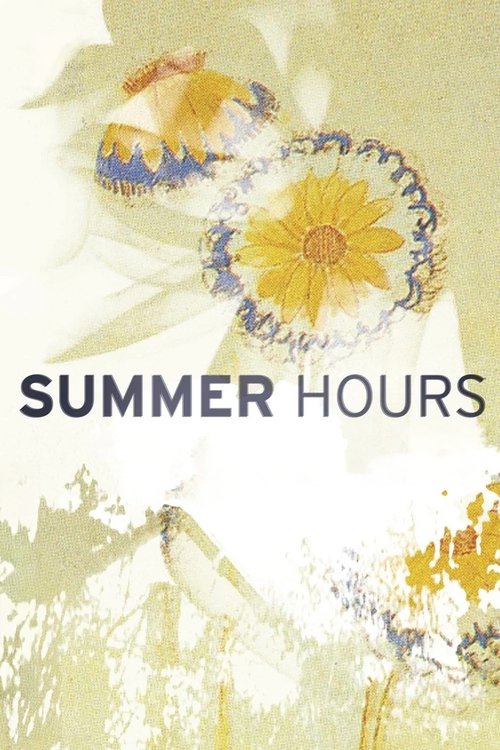
Summer Hours
2008 · Olivier Assayas
For a reflective evening when you want a film to chew on for days — especially if you've ever cleared out a family home or wondered what your parents' things will mean when they're gone. Comforting and sad at once.
What it's about
When their mother dies, three grown siblings — one rooted in France, one in New York, one in China — inherit a country house outside Paris filled with a lifetime of art and beautiful things. The film follows their deliberations over what to keep and what to sell, and watches what happens to objects, and to a family, when the person who held them together is gone.
The experience
Gentle, unhurried, and quietly devastating — nothing melodramatic happens, yet it keeps finding the ache in ordinary decisions. It's the rare film about grief that feels warm, and it sneaks up on you in the last scenes.
Performances
Juliette Binoche, Charles Berling, and Jérémie Renier make the siblings feel like people with thirty years of history — affection, resentment, and geography all legible in how they talk around each other.
The craft
Assayas shoots the house and its objects with a collector's tenderness — sunlit rooms, a vase in use versus a vase in a vitrine — and edits with such lightness that years of feeling pass in a glance. It's writing and direction that trust the audience completely.
Why it matters
Widely regarded as one of the great French films of its decade and a high point of Assayas's career — a touchstone for anyone making films about inheritance, globalization, and what art is for.
Snapshot
Summer Hours (L'Heure d'été) is Olivier Assayas's quiet, devastating chamber drama about what a family does with the things it inherits and cannot keep. Hélène, a woman in her mid-seventies, has spent her life as the keeper of her late uncle's legacy — a painter named Paul Berthier whose house outside Paris is filled with Corots, a Redon panel, Art Nouveau furniture by Majorelle and Louis Majorelle's contemporaries, Bracquemond glass, a Hoffmann desk. When she dies, her three grown children — Frédéric, an economist who has stayed in France; Adrienne, a designer in New York; Jérémie, an executive whose work for a sportswear firm has settled him in China — must decide what to do with the house and its contents. They sell. The film watches objects migrate from a living household into auction rooms and museum vitrines, and watches a family disperse across the globalized world that has made the keeping of such things impossible. Made as one of two completed films from a commission by the Musée d'Orsay, it is among the most admired French films of its decade: a deceptively gentle work whose true subject is transmission — of art, of memory, of a way of life — and the impossibility of it.
Industry & production
The film originated in a commission. To mark the twentieth anniversary of the Musée d'Orsay, the museum invited several international directors to make films loosely connected to it. The larger project foundered for financing reasons; only two films were ultimately completed — Assayas's Summer Hours and Hou Hsiao-hsien's Flight of the Red Balloon (2007), both of which would have appeared, even in vestigial form, with some link to the museum. In Assayas's case the constraint became generative: the obligation to involve the Orsay pushed the narrative toward the question of how privately loved objects become public, institutional ones, and how that passage drains them of their domestic life.
Production was anchored by MK2, the company built by Marin Karmitz, with Karmitz and his sons among the producing principals and Charles Gillibert involved in production — the same MK2 orbit that supported much of Assayas's work in this period. The Musée d'Orsay's involvement gave the production extraordinary access: real museum pieces, real conservation and curatorial settings, and the moral authority of the institution stand behind the film's later scenes. The cast assembled is unusually strong for so unshowy a picture — Charles Berling, Juliette Binoche, and Jérémie Renier as the three siblings, with the veteran Édith Scob as the mother Hélène and Isabelle Sadoyan as Éloïse, the family's long-serving housekeeper. The film ran roughly an hour and three quarters and was released in France in 2008, reaching the United States through IFC Films in 2009. Precise budget and box-office figures are not something I can state reliably, and I won't invent them; the picture's economy was clearly modest, in keeping with its scale.
Technology
Summer Hours was shot photochemically on 35mm, the standard practice for Assayas and his cinematographer Eric Gautier at the close of the celluloid era, and its grain and natural light belong to that tradition rather than to the digital aesthetics Assayas had explored in his harder-edged thrillers. The more interesting technological dimension is thematic. The film is built around a confrontation between two regimes of value: the handmade object — desk, vase, painting, the things that bear the marks of use and the hands that made them — and the dematerialized, frictionless economy that has scattered the family across continents. Jérémie's career producing branded goods in Asia, Adrienne's design practice, the mobile-phone calls that link a household no longer gathered in one place: these are the quiet signs of a world in which physical inheritance has become a burden rather than a gift. The film does not editorialize. It simply registers, with great precision, the moment at which a culture stops being able to live with its own past, and the technologies of mobility and reproduction that have made that past portable, salable, and finally weightless.
Technique
Cinematography
Eric Gautier — one of the finest French cinematographers of his generation, whose credits include Walter Salles's The Motorcycle Diaries and Into the Wild as well as much of Assayas's filmography — shoots in a supple, mobile, available-light register. The camera moves with the characters through the rooms and the overgrown garden of the country house, favoring a warm, summery palette of greens and golds in the early scenes that gives the title its full charge. Gautier's handheld work is restless without being nervous; it keeps the objects and the people in continuous relation, so that furniture and paintings are never merely production design but participants in the action. As the film moves from the lived-in house to the cool, denatured spaces of the auction house and the museum, the light flattens and chills, and the contrast does much of the film's emotional argument without a word.
Editing
The editing, by Luc Barnier — Assayas's longtime collaborator until Barnier's death in 2012 — is fluid and elliptical in the director's characteristic manner. Scenes begin and end on motion; conversations are entered mid-stream; time is compressed across the months of settling an estate with an unfussy economy. The film's rhythm is conversational and accretive rather than dramatically pointed: it builds meaning through the accumulation of small domestic exchanges and the recurrence of objects, so that a vase or a desk acquires weight through repetition. The famous closing movement — a teenage party that floods the soon-to-be-sold house with young bodies and music — is cut with a loosening, liberating energy that releases the tension the rest of the film has held.
Mise-en-scène / staging
This is, more than anything, a film of things. The house and its contents are the central character, and Assayas stages his actors in constant negotiation with the physical world — touching, moving, appraising, packing, and finally surrendering objects. The production design honors the specificity of the Berthier collection: the objects are presented with the texture and authority of real artworks, and their later appearance behind museum glass is staged to register as a small death. The blocking favors groups in rooms, families clustered and then fragmenting, with characters drifting to windows and doorways — visual rhymes for the centrifugal force pulling the family apart. The garden, lush and slightly wild, frames the film at both ends, an Edenic space that the final party briefly repopulates before it passes out of the family's hands.
Sound
Assayas, who came to filmmaking partly through a love of rock music, eschews a conventional orchestral score. Summer Hours relies instead on a sparing use of pre-existing songs and on a richly observed naturalistic soundscape — birdsong and garden ambience, the rooms' quiet, the clatter of a family meal, the murmur of telephone calls bridging continents. The needle-drops, drawn from the folk-rock idiom Assayas favors, arrive chiefly at the film's hinges and in its closing party, where contemporary music against the old house dramatizes the collision of generations. The restraint is purposeful: silence and ambient sound carry the film's elegiac weight, and the absence of an emotive score keeps the sentiment honest.
Performance
The ensemble playing is exceptionally fine and unforced. Charles Berling, as Frédéric — the son who wants to keep the house and is outvoted — carries the film's grief most directly, with a contained ache that surfaces only in glances and small concessions. Juliette Binoche, against type, plays Adrienne with a brittle, modern restlessness, a woman already half-departed into another life. Jérémie Renier gives Jérémie a pragmatic gentleness, the sibling for whom the past is simply, regretfully, no longer affordable. Édith Scob's Hélène, present mostly in the first act and in memory, sets the film's moral key with a clear-eyed acceptance of her own dispersal. And Isabelle Sadoyan, as the housekeeper Éloïse, delivers the film's most quietly heartbreaking grace note when, offered a keepsake, she chooses an object she takes to be ordinary — a piece the family knows to be precious — and means to fill it with flowers.
Narrative & dramatic mode
The film's dramatic mode is the family chronicle in a minor, Chekhovian key: low-stakes on the surface, seismic underneath. There is no villain and no crisis larger than the practical question of an estate. Assayas structures the film in movements — the mother's birthday gathering and her premonitory instructions; her death and the siblings' deliberations; the dismantling and sale; the museum coda; the final party — each calmer in incident and deeper in implication than melodrama would allow. The dialogue is naturalistic and often administrative, concerned with valuations, taxes, and logistics, and it is precisely through this prosaic surface that the emotion seeps. The mode is elegiac and essayistic at once: a fiction that thinks, openly, about value, inheritance, and loss without ever pausing the lives it depicts.
Genre & cycle
Nominally a domestic drama, Summer Hours belongs to a venerable European art-cinema lineage of the family-estate film — works in which a house and its objects become the ledger on which a family's, and a culture's, fate is read. Within Assayas's own career it represents a deliberate turn toward classicism and restraint, a counterweight to the cool, globalized thrillers (demonlover, Boarding Gate) and the rock-inflected youth films that surround it. It can be read alongside Flight of the Red Balloon as a companion piece in the Orsay commission, and within a broader cycle of 2000s art films preoccupied with globalization's erosion of place and inheritance.
Authorship & method
Summer Hours is wholly Assayas's: he wrote and directed it, and it bears the marks of a former Cahiers du Cinéma critic who has thought hard about cinema's relation to art history, memory, and the contemporary world. His method here is observational and trusting — long takes, mobile camera, naturalistic performance, an openness to the contingency of real spaces and real objects. The key collaborators are the cinematographer Eric Gautier, whose warm, fluid images give the film its sensuous texture; the editor Luc Barnier, whose elliptical cutting sets its conversational rhythm; and an ensemble cast directed toward understatement. In place of a composer, Assayas curates a selection of songs, exercising authorship through music supervision as much as through staging. The result is one of the purest expressions of his sensibility: intellectually rigorous about its themes, emotionally generous toward its characters.
Movement / national cinema
Assayas is a central figure of post–New Wave French cinema — a generation that inherited the Cahiers tradition and the auteurist faith of Truffaut and Godard while absorbing a thoroughly globalized, cinephilic, and music-saturated culture. Summer Hours is in one sense his most "French" film, steeped in questions of patrimoine — national heritage, the museum, the country house — that resonate deeply within French cultural debate. Yet it is also pointedly transnational, its family scattered to New York and Asia, its argument about how a specifically French inheritance dissolves into a borderless economy. The Musée d'Orsay framing places it explicitly within a French institutional reflection on its own cultural memory, even as the film questions what that memory can mean once it is sealed behind glass.
Era / period
The film is a document of the late 2000s, the moment just before the digital and financial transformations of the following decade fully arrived, when a European bourgeois family could still plausibly possess such a house and such a collection and still feel them slipping away. Its preoccupation with globalization, outsourcing, and the dispersal of families maps precisely onto its historical instant. Set in a recognizable contemporary France, it nonetheless looks backward to a vanishing nineteenth- and early-twentieth-century artistic culture — the world of Berthier the painter — and forward to a future in which the granddaughter's generation will inherit a different, lighter relation to the past.
Themes
At its center is transmission and its failure: the question of whether the love embedded in objects can be passed down, or whether inheritance in a mobile, monetized world can only mean liquidation. The film draws a sustained contrast between use-value and exhibition-value — the desk one writes at versus the desk roped off in a gallery, the vase one fills with garden flowers versus the vase cataloged as a Bracquemond. It meditates on globalization's solvent effect on family and place; on memory and the way objects hold it; on art's strange afterlife once it passes from private affection into public custody. And it closes on renewal as much as loss: the final party, with the young taking brief, careless possession of the house, suggests that life simply moves on, indifferent and irrepressible, into hands that will value entirely different things.
Reception, canon & influence
Summer Hours was met with broad critical admiration and is widely regarded as one of Assayas's finest achievements and one of the best French films of its decade; it featured on numerous critics' year-end lists following its American release and has since been enshrined in the canon, including a Criterion Collection edition that confirmed its arthouse standing. (Specific awards tallies and grosses I won't quote, as I can't verify them precisely.)
Its influences flow backward to the Chekhovian family drama and to a French tradition of films about houses, heritage, and patrimoine, as well as to Assayas's own grounding in art history and the Cahiers lineage; the commission's terms gave it, uniquely, the Musée d'Orsay itself as both setting and conceptual frame. Looking forward, the film helped consolidate the more humane, classical register that Assayas would carry into later work — its concern with how the global present consumes the cultural past anticipating the explicitly autobiographical and historical reckonings of films like Something in the Air and Non-Fiction. More broadly, it has become a touchstone for filmmakers and critics interested in the cinema of objects and inheritance — a model for how a small domestic story, told with restraint and intelligence, can hold an entire civilization's anxieties about what it can no longer keep.
A Deleuzian reading
A housekeeper of forty years is told to take something from the house to remember it by.
The full Deleuzian reading of Summer Hours →
Reception
A quiet family drama that France received warmly but America adored — it swept onto US year-end top-ten lists in 2009 and has only climbed since, landing on the BBC's 2016 critics' poll of the 21st century's greatest films.
How Summer Hours was received, from release to now →
Influences: the films it descends from and the films it influenced
- The Rules of the Game (1939) — Establishes the country-estate-as-social-organism, with a restlessly mobile deep-focus camera drifting between groups of guests and servants — the choreography Assayas adapts to make the house itself the protagonist.
- Partie de campagne (1936) — Treats a French rural property with Impressionist available light and painterly landscape framing, the sensuous garden register Eric Gautier echoes in the family's outdoor scenes.
- Tokyo Story (1953) — Dramatizes generational dispersal and inheritance through understated performance and the quiet weight of domestic routine rather than plot, the model for Summer Hours' undramatic Chekhovian chronicle.
- Late Spring (1949) — Makes rooms, vases, and kept household objects carry the emotional charge of a family unit dissolving — the direct precedent for Assayas's objects-as-character grammar.
- Voyage to Italy (1954) — Uses museum artifacts and artworks as live emotional agents pressing on contemporary lives, prefiguring the Musée d'Orsay's use-value-vs-exhibition-value frame around the family's heirlooms.
- The Mother and the Whore (1973) — Post-New-Wave naturalism built on conversation-driven rhythm and trust in real duration and contingent space, the talk-and-time aesthetic Assayas inherits from the Cahiers tradition.
- The Green Ray (1986) — Semi-improvised understatement under available light in a summer-vacation setting, performance directed toward naturalistic ordinariness rather than dramatic peaks.
- Yi Yi (2000) — A family drama bracketed by a matriarch's death and generational dispersal, using rooms and objects as vessels of memory — the wedding-to-funeral frame recast around inheritance.
- Something in the Air (2012) — Carries forward the classical, humane register and Gautier's fluid naturalism of Summer Hours into explicitly autobiographical historical reckoning.
- Non-Fiction (2018) — A Binoche-led, talk-driven film extending Summer Hours' anxiety about cultural obsolescence and the changing value of art into the digital-publishing present.
- Clouds of Sils Maria (2014) — Reprises Binoche-against-type within a naturalistic ensemble to interrogate transmission, aging, and the survival value of art across generations.
- The Souvenir (2019) — Renders memory and milieu through extreme restraint, real rooms and objects, and understated performance, descending from the same observational-trust method.
- A Christmas Tale (2008) — A French family reunion at the ancestral home shot by the same DP, Éric Gautier, in the same mobile, warm available-light handheld register — the contemporaneous estate-ensemble counterpart.
- 35 Shots of Rum (2008) — Elliptical, handheld available-light naturalism in which a single domestic object (the rice cooker) silently carries inheritance and transmission between generations.
- Still Walking (2008) — An Ozu-descended family-gathering film where the house, the cooking, and the dead's kept possessions measure generational loss through restraint and dailiness.
- Things to Come (2016) — A naturalistic, elliptical chronicle of an intellectual's life measured through her books and inherited possessions, sharing the Chekhovian undramatic-movements structure.
- Eden (2014) — Builds an elliptical life-chronicle scored entirely by curated needle-drops rather than a composer, exercising authorship through music supervision exactly as Assayas does.
- Our Little Sister (2015) — Siblings dividing an inherited house and its objects, using props and rooms as the vessels of family memory — the prop-inheritance and estate-of-the-parents craft Our Little Sister shares in a Western register.
Similar films
- Tokyo Story (1953) — influence & lineage
- Late Spring (1949) — influence & lineage
- After Life (1999) — shared sensibility
- Amour (2012) — shared sensibility
- Yi Yi (2000) — shared sensibility
- Departures (2008) — shared sensibility
- So Long, My Son (2019) — shared sensibility
- Certified Copy (2010) — shared sensibility