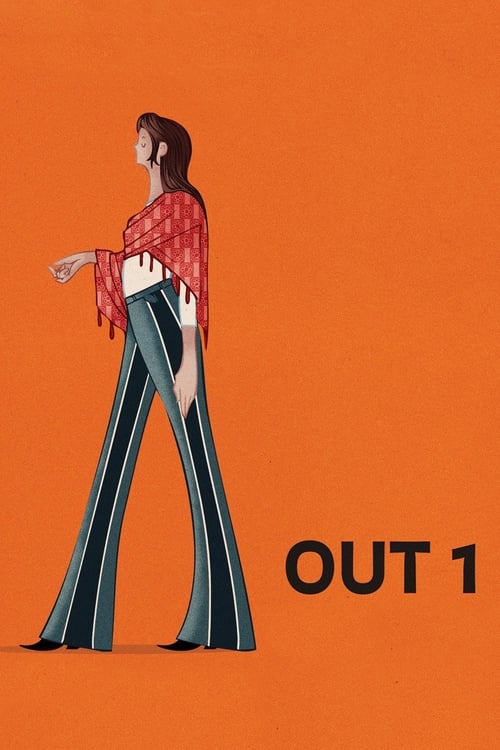
Out 1
1990 · Jacques Rivette
For when you want a pilgrimage, not a movie night — a project to live inside over days, best approached like a great novel or a long walk. Maximum challenge, singular reward.
What it's about
In post-1968 Paris, two theater collectives rehearse Aeschylus at exhaustive, real-time length while, out on the streets, a deaf-mute panhandler and a small-time hustler work their separate cons. Stray messages begin to hint at a secret society — the Thirteen — that may bind all of them together. Or may not. It runs nearly thirteen hours, told as a serial.
The experience
Unlike anything else: long stretches of raw, improvised duration out of which a conspiracy slowly condenses like weather. It asks for surrender — hours of it — and repays you with the eerie sensation of watching fiction assemble itself in real time.
Performances
Jean-Pierre Léaud, as the deaf-mute panhandler decoding messages nobody else can see, gives a performance of obsessive, wordless intensity — one of the strangest and most committed of his career.
The craft
Jacques Rivette shot it in six weeks, largely improvised, letting documentary-length rehearsal footage and street scenes gradually knot into mystery. The construction is the achievement: a serial in which paranoia is built from patience, where meaning arrives not through plot mechanics but through accumulation.
Why it matters
Screened publicly just once in the 1970s before vanishing into legend, it became the French New Wave's great secret monument — a holy grail for decades and a byword for cinema's outer limits of scale and ambition.
Jacques Rivette's thirteen-hour serial is the Nouvelle Vague's great secret monument — shot in six weeks in the spring of 1970, largely improvised, and screened publicly just once, as a work print in Le Havre in 1971, before vanishing into legend. Two theater collectives rehearse Aeschylus at exhaustive, real-time length; on the streets, a deaf-mute panhandler (Jean-Pierre Léaud) and a small-time hustler (Juliet Berto) work their separate cons — until stray messages suggest a secret society, the Thirteen, lifted from Balzac and possibly binding everyone together. Or possibly not: the film is about the conspiracy-shaped hole May '68 left in Paris, the way a scattered generation kept groping for a hidden design that would make its defeat legible. Rivette lets fiction condense slowly out of documentary duration, like weather forming. For decades it circulated only in rumor and a shortened cut, cinema's most storied white whale, until restoration finally made the full Noli Me Tangere visible in 2015.
A Deleuzian reading
A man is working the café tables on a Paris afternoon in the spring of 1970, taking coins from people who look away as they give.
The full Deleuzian reading of Out 1 →
Reception
For decades it was cinema's great unseeable legend — screened in full basically once in 1971, then circulating only as rumour and a shortened cut (Spectre) — until the 2015 restoration finally let people watch the thing everyone had only read about. It went almost straight from 'holy grail' to canonized masterpiece the moment it became viewable.
How Out 1 was received, from release to now →
Influences: the films it descends from and the films it influenced
- Les Vampires (1915) — Out 1's serial episodic form and its Balzacian secret society 'The Thirteen' descend from Feuillade's crime serials, which treat conspiracy as an urban texture unspooling episodically through real, unadorned Parisian streets.
- Dr. Mabuse, the Gambler (1922) — The omnipresent hidden master-design that may or may not actually exist echoes Lang's conspiratorial architecture of a single criminal intelligence saturating the whole city.
- The Rules of the Game (1939) — Rivette's ensemble-troupe staging and long-take blocking of overlapping actors derives directly from Renoir's deep-staged group choreography, the master Rivette repeatedly named as his own.
- Chronicle of a Summer (1961) — The documentary-fiction blend and the provoked, camera-aware improvisation of real people performing versions of themselves come straight from Rouchian cinéma-vérité method.
- Shadows (1959) — The actor-generated scenes built from behavioral truth rather than a fixed script model the improvised performance engine that drives Out 1's eight-part structure.
- Empire (1964) — The durational aesthetic in which real elapsed time, repetition, and even boredom become the film's actual subject licenses Out 1's twelve-and-a-half-hour scale.
- Paris Belongs to Us (1961) — Rivette's own debut already fused a theatrical rehearsal (Shakespeare's Pericles) with a paranoid conspiracy plot; Out 1 is its maximalist expansion of that exact template.
- L'Amour fou (1969) — The immediate predecessor: a four-hour film built by shooting a theatrical rehearsal in real duration, mixing 16mm and 35mm and letting improvisation dictate length.
- Céline and Julie Go Boating (1974) — Extends the improvised-performance and play-within-the-film 'game' method into a lighter register, with actresses co-authoring the fiction they inhabit.
- Jeanne Dielman (1975) — Applies the real-time durational method to domestic labor, letting the accumulation of unremarkable minutes itself carry the film's meaning.
- Berlin Alexanderplatz (1980) — A fifteen-hour serial long-form adaptation of a sprawling urban novel, extending the idea that a fiction can only be honored at exhaustive, episodic length.
- Sátántangó (1994) — Seven hours of long-take durational accretion around a collapsed utopian collective and a con-man's hidden design — real-time patience as the primary formal device.
- La Commune (Paris 1871) (2000) — A near-six-hour documentary-fiction blend performed by improvising non-actors, staging failed-utopia politics as a durational, self-reflexive theatrical event.
- Mysteries of Lisbon (2010) — A serial, proliferating novelistic narrative of interlocking secret histories and hidden designs, sustaining the Balzacian architecture of concealed connection at feuilleton length.
- Twin Peaks: The Return (2017) — Long-form serial storytelling that withholds and defers its hidden design across many hours, trusting durational patience to make conspiracy a felt structure rather than a delivered reveal.
- Out 1: Spectre (1972) — The same footage re-cut to four hours through associative, elliptical, disjunctive montage — durational accretion deliberately inverted into fragmentation and enigma.
- The Mother and the Whore (1973) — Casts Léaud again and delivers post-May-68 disillusion through real-time, near-unbroken talk scenes of extreme duration, prizing accretion over dramatic compression.
- La Belle Noiseuse (1991) — Four hours of real-time observation of artistic creation — the painter's hand actually working — making durational process, not plot, the film's true subject.
Similar films
- L'Amour fou (1969) — influence & lineage
- Céline and Julie Go Boating (1974) — influence & lineage
- The Mother and the Whore (1973) — influence & lineage
- La Belle Noiseuse (1991) — influence & lineage
- Chronicle of a Summer (1961) — influence & lineage
- Le Trou (1960) — shared sensibility
- A Man Escaped (1956) — shared sensibility
- Irreversible (2002) — shared sensibility