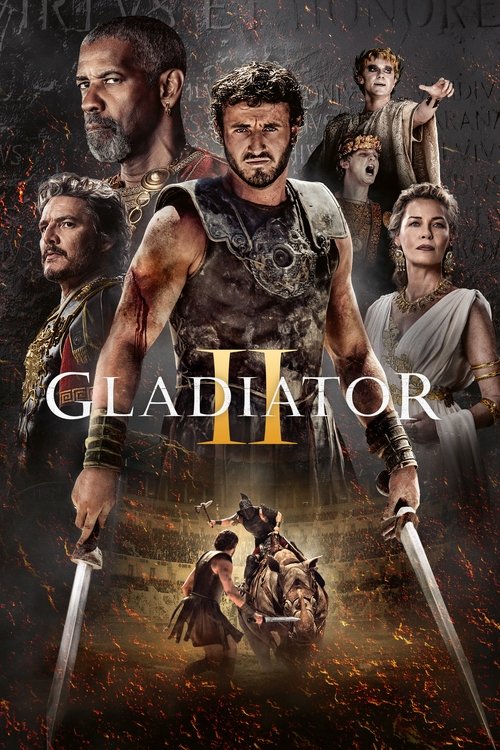
Gladiator II
2024 · Ridley Scott
For when you want a full-throated old-school epic — sand, swords, roaring crowds, revenge — on the biggest screen you have. Comfort viewing at maximum volume, not a film that asks much of you beyond surrender.
What it's about
Rome, a generation after the fall of the hero Maximus. Lucius — the boy who once watched him die in the arena — has grown up in exile, and when Roman legions conquer his adopted North African home, he's dragged back in chains and sold as a gladiator. Under the eye of Macrinus, a former slave turned power-broker who sees the young fighter as a tool for his own ascent, Lucius fights for survival in a Colosseum ruled by two decadent co-emperors, while the general who destroyed his life sits within reach.
The experience
Big, bloody, and propulsive — arena spectacle stacked with palace scheming, moving at the confident pace of a director who has been staging battles for fifty years. It's fueled less by mystery than by momentum: you're waiting for collisions you can see coming and enjoying the size of the impact when they land.
Performances
Denzel Washington runs away with it as Macrinus, playing the schemer with a sly, purring relish that cuts through all the marble and blood — he's clearly having more fun than anyone else in the Colosseum. Paul Mescal grounds the spectacle with a wounded, simmering intensity, and Joseph Quinn and Fred Hechinger make the co-emperors memorably unstable.
The craft
Ridley Scott remains one of the few directors who can marshal spectacle at this scale, and the arena set pieces are staged with escalating, gleeful excess — this is filmmaking built for a giant screen and speakers that can carry a crowd's roar. The production design rebuilds imperial Rome as both grandeur and rot, gilded surfaces over a decaying state.
Why it matters
A twenty-four-years-later sequel to a Best Picture winner, it became a test case for whether the swords-and-sandals epic could still command a global theatrical audience — and proof that Scott, well into his eighties, was still working at blockbuster scale.
Snapshot
Gladiator II is Ridley Scott's long-gestated return to the world of his Best Picture winner Gladiator (2000), arriving twenty-four years after the original and set roughly a decade and a half later within the fiction. The film follows Lucius (Paul Mescal) — the boy who in the first film was the young son of Lucilla and heir-adjacent to the throne — now grown, exiled, and remade into a captive fighter after Roman forces led by General Marcus Acacius (Pedro Pascal) conquer his adopted North African home. Denzel Washington plays Macrinus, a former slave turned arms-dealer and power-broker who purchases and cultivates Lucius as an instrument of his own ascent, while Joseph Quinn and Fred Hechinger play the co-emperors Geta and Caracalla, a decadent fraternal pair ruling a Rome in decline. Connie Nielsen and Derek Jacobi reprise Lucilla and Senator Gracchus, threading the sequel directly back into the original's dynastic politics. Written by David Scarpa (from a story developed with Peter Craig), the film restates the first Gladiator's central fantasy — Rome as a "dream" of republican virtue betrayed by tyranny — while pushing its spectacle toward the operatic and the frankly ahistorical. It is at once a legacy sequel, a star vehicle for a scene-stealing Washington, and a summation of Scott's late-career mode of large-scale, multi-camera historical action.
Industry & production
Gladiator II is a Paramount Pictures production, reuniting the studio (through its earlier Universal/DreamWorks partnership on the original, now consolidated in the sequel's rights arrangement) with Scott's Scott Free banner and producers including Douglas Wick, Lucy Fisher, Michael Pruss and Scott himself. A sequel had been discussed in various forms almost since the original's release — including a famously unrealized supernatural treatment once floated by musician Nick Cave — but only cohered into production in the 2020s once Scott, then in his eighties and coming off a run of ambitious historical projects, committed to it. The film was a major studio tentpole with a reported budget among the largest of Scott's career, reflecting extensive location shooting, large practical sets, crowd work and a marquee cast. Principal photography took place across Malta — including the water-tank and fort facilities near Valletta that had also served the original — and Morocco, particularly the Ouarzazate desert-studio region long used for Roman and biblical epics. Production was interrupted by the 2023 SAG-AFTRA actors' strike, which paused shooting and contributed to the film's late-2024 release window. Marketed as event cinema for the awards-season corridor, it was positioned both as a crowd-pleasing spectacle and as a prestige vehicle, with Washington's performance in particular driving its awards conversation.
Technology
The film's production technology is characteristic of Scott's contemporary method: digitally captured, heavily multi-camera coverage combined with large practical builds and substantial but "invisible" visual effects. Scott's long-standing practice of running many cameras simultaneously — allowing continuous performance and enormous flexibility in the edit — governs the shoot's technical shape. The Colosseum interiors and much of Rome are realized through a blend of partial physical sets and digital extension, a now-standard hybrid that lets crowds, upper tiers and cityscape be completed in post. The film's most conspicuous technical set pieces are the arena spectacles: a flooded Colosseum staging a mock naval battle (a naumachia), populated with sharks in the water, and land combats featuring a charging rhinoceros and a pack of baboons. These animals are digital creations integrated with practical staging and stunt work. Critics and historians noted that these sequences prioritize spectacle over strict plausibility — the sharks especially became a talking point — but they also exemplify the current state of creature and water simulation deployed at blockbuster scale. Beyond the marquee effects, the film leans on the by-now conventional toolkit of digital crowd replication, set extension and atmospheric compositing rather than on any single novel technology; its ambition is scale and integration rather than a specific technical first.
Technique
Cinematography
Director of photography John Mathieson, who shot the original Gladiator and earned an Oscar nomination for it, returns, lending the sequel a deliberate visual continuity with the 2000 film. His work again favors a burnished, high-contrast palette — golden Roman light against cold interiors and dust-choked exteriors — and a mobile, muscular camera that stays close to the physical action. Scott's multi-camera approach shapes the look as much as any single compositional choice: coverage is dense and varied, enabling combat to be assembled from many simultaneous angles. The film's arena sequences are staged for maximal legibility of scale, with wide establishing geometry of the Colosseum alternating with tight, visceral fighting coverage. Where the original leaned on a certain grain and desaturation fashionable in early-2000s epics, the sequel is cleaner and more saturated in keeping with contemporary large-format digital imaging, while consciously echoing the earlier film's iconography.
Editing
Editing is credited to Claire Simpson — an Oscar winner for Platoon — working with Sam Restivo. Scott's films are traditionally cut with speed and density owing to the sheer volume of multi-camera material, and Gladiator II follows that pattern: action is built through rapid intercutting of angles while dramatic scenes are given more measured rhythm. The edit also carries a structural burden particular to a legacy sequel, weaving in flashback and callback material — including imagery evoking Maximus and the first film — to bind the two works. The pacing is brisk for a film of its length, moving between political intrigue in Rome and combat in the arena, though some critics felt the accumulation of set pieces came at the expense of the tighter tragic arc that anchored the original.
Mise-en-scène / staging
Production design by Arthur Max, another key returning collaborator from Gladiator (and a frequent Scott partner), governs the film's dense, layered Rome — a city of marble grandeur curdling into decadence. The staging insists on physical scale wherever possible: real arena floors, crowds, animals and water, augmented digitally rather than replaced. Costume design, overseen by Janty Yates — who won an Academy Award for the original Gladiator — with Dave Crossman, extends the visual language of armor, imperial finery and slave-fighter roughness established in 2000, while distinguishing the twin emperors through a heightened, almost theatrical decadence. The mise-en-scène throughout foregrounds spectacle-as-politics: the arena is explicitly framed as the instrument by which Rome's rulers pacify and manipulate the mob, a staging idea inherited directly from the first film's "bread and circuses" thesis.
Sound
The score is by Harry Gregson-Williams, a longtime Scott collaborator (Kingdom of Heaven, The Martian), taking over the sonic identity forged by Hans Zimmer and Lisa Gerrard on the original. Gregson-Williams both honors and adapts that earlier musical language — the yearning, vocal-inflected elegy of the first film — while scoring new material for the sequel's characters and set pieces. Sound design emphasizes the physical impact of arena combat and the roar of crowds, using the acoustic scale of the Colosseum as a dramatic space. As with the visuals, the soundtrack works partly through memory: cues and textures reminiscent of the 2000 film function as emotional callbacks for returning audiences.
Performance
Performance is where the film's critical energy concentrated. Denzel Washington as Macrinus drew the strongest notices and much of the awards attention — a sly, imperious, self-amused turn as a former slave weaponizing Rome's own appetites against it, and the film's most quoted element. Paul Mescal, an actor associated with intimate drama (Normal People, Aftersun), takes on the physically demanding lead of Lucius, tasked with carrying the Maximus-shaped hole at the film's center. Pedro Pascal brings gravitas to General Acacius, a soldier weary of conquest, while Joseph Quinn and Fred Hechinger play the co-emperors as a grotesque, unstable double act. Connie Nielsen's returning Lucilla supplies the direct emotional bridge to the original, and Derek Jacobi's Gracchus reprises the senatorial conscience of Rome.
Narrative & dramatic mode
The film operates in the register of the revenge tragedy folded into the dynastic epic — the same essential mode as its predecessor, in which a wronged man is stripped of family and status, reduced to a fighter, and rises through the arena toward a reckoning with those who ruled his fate. Lucius's arc consciously rhymes with Maximus's: loss of home and wife, enslavement, the discovery of an identity that ties him to Rome's rightful lineage, and the gladiator's paradoxical power to move the mob. The "dream of Rome" — the idea of a restored republic betrayed by tyranny — returns as the film's animating ideal. Where the sequel differs is in its dispersion of agency: Macrinus is a genuine third force, a schemer whose ambitions cut across the hero's revenge, giving the narrative a more Machiavellian, political texture than the cleaner tragic line of the first film. The story leans heavily on legacy-sequel machinery — parentage revelations, callbacks, inherited symbols — which some reviewers found moving and others found mechanical.
Genre & cycle
Gladiator II belongs to the historical epic and, more specifically, to the Roman "sword-and-sandal" tradition that stretches from silent spectacles through the mid-century Hollywood epics (Ben-Hur, Spartacus, Cleopatra) to the genre's turn-of-the-millennium revival. That revival was substantially triggered by the original Gladiator itself, which in 2000 reanimated a moribund form and licensed a wave of ancient-world screen storytelling (including television's Rome and Spartacus, and films like Troy and 300). The sequel arrives as both an heir to and a commentary on that cycle: it is a legacy sequel, part of the broader 2010s–2020s studio strategy of reviving established properties, and it self-consciously reprises the arena-spectacle grammar its own predecessor codified. Its embrace of frank anachronism — sharks, staged sea battles, heightened cruelty — places it toward the more fantastical, 300-adjacent end of the genre rather than the ostensibly sober historicism the original claimed.
Authorship & method
The film is a near-total expression of Ridley Scott's late authorship. Scott, one of the defining visual stylists of modern Hollywood (Alien, Blade Runner, Gladiator), has in his later years worked at remarkable pace on large historical canvases, and Gladiator II consolidates his signature methods: shooting with many cameras at once, prioritizing physical production and scale, cutting fast and dense, and staging history as a machine of power and spectacle. His return is amplified by the reassembly of key original collaborators — cinematographer John Mathieson, production designer Arthur Max, and costume designer Janty Yates — which makes the sequel unusually continuous with its predecessor at the level of craft. New to the core team are screenwriter David Scarpa (who had recently written Scott's Napoleon and All the Money in the World), composer Harry Gregson-Williams, and editor Claire Simpson. Scarpa's script pursues Scott's recurring preoccupations — the corrupting theater of power, the individual crushed or elevated by empire — while Gregson-Williams and Simpson translate the original film's emotional and rhythmic identity into a contemporary idiom.
Movement / national cinema
The film sits within mainstream Anglo-American commercial cinema, produced through a Hollywood studio but directed by a British filmmaker and shot on European and North African locations — a transnational production model typical of the modern epic. It does not belong to any art-cinema movement; rather, it is an instance of global blockbuster filmmaking, drawing labor, locations and finance across national lines while addressing a worldwide popular audience. Scott's own career — rooted in British advertising and television before Hollywood — situates the film in a lineage of British directors (Scott, his late brother Tony, and others) who shaped the visual grammar of the American blockbuster.
Era / period
Fictionally, the film is set in the early third century, in the Rome of the co-emperors Geta and Caracalla — historical figures, sons of Septimius Severus, though the film treats them and the surrounding events with considerable dramatic license. Its portrait of an empire in florid decline, ruled by unstable youths and manipulated by opportunists, is a heightened invention rather than a reconstruction. As a piece of filmmaking, it belongs firmly to the mid-2020s: a post-pandemic, post-strike theatrical landscape in which studios leaned on established franchises and legacy sequels to justify large budgets, and in which the theatrical "event film" was increasingly defined against streaming. Its production was directly marked by this era, having been paused by the 2023 industry labor actions.
Themes
The film's dominant theme is the same "dream of Rome" that governed its predecessor: the ideal of a just republic set against the reality of tyranny, and the question of whether that ideal can be restored or is merely a story the powerful tell. Around this it develops the theme of spectacle as political control — the arena as an engine of distraction and legitimacy, "bread and circuses" made literal. Washington's Macrinus sharpens a further theme: the subaltern's revenge, a former slave who has learned the empire's machinery well enough to seize it, complicating the film's inheritance-and-bloodline mythos with a story of self-made ambition. Legacy and lineage — who is the rightful heir, and what one owes to the memory of the dead — run throughout, appropriate to a film that is itself a meditation on succession, both Roman and cinematic. Finally, the film treats violence itself as ambivalent: the source of both Lucius's degradation and his agency, staged for our pleasure even as the story indicts the crowd that craves it.
Reception, canon & influence
Critical reception was broadly positive but more divided than the original's, which remains a canonical modern epic and Best Picture winner. Reviewers widely singled out Denzel Washington as the film's standout, and his performance anchored its awards presence; he was among the more prominent supporting-performance contenders of the season, though I would flag that the precise slate of his nominations and any wins should be checked against the awards record rather than asserted here. Praise generally centered on Scott's undiminished command of scale and on the star performances; criticism focused on the sense that the sequel replays the first film's structure without matching its emotional clarity, and on its self-aware indulgence in anachronistic spectacle. Commercially it performed as a substantial global release and a significant theatrical event of late 2024; I am avoiding specific gross figures, which should be sourced from box-office records rather than stated from memory.
Influences on the film (backward): the most immediate is the original Gladiator (2000), whose plot architecture, iconography, music and craft team it deliberately reprises; behind that stand the mid-century Hollywood Roman epics — Spartacus, Ben-Hur, Quo Vadis — and the ancient historical record (however freely adapted) of the Severan dynasty. Scott's own Kingdom of Heaven, Napoleon and broader body of historical work also inform its method.
Legacy (forward): as a very recent film, its downstream influence is still emerging and should not be overstated. Its clearest significance is as a case study in the 2020s legacy-sequel strategy and in the enduring theatrical viability of the large-scale historical epic — proof that the genre the first Gladiator revived retains commercial life a quarter-century on. Its lasting cultural footprint, particularly around Washington's performance, will be clarified with time; any claim of specific influence on later films would, at this date, be speculation.
A Deleuzian reading
They flood the Colosseum.
The full Deleuzian reading of Gladiator II →
Reception
Landed in late 2024 as a solid-but-divisive legacy sequel — big box office, decent reviews, but the instant consensus was that it lived in the original's shadow, with Denzel Washington's scene-stealing Macrinus as the one thing everyone agreed was great. Too young for a reappraisal yet; the 'Denzel was robbed of an Oscar nomination' grievance is already its defining afterlife.
How Gladiator II was received, from release to now →
How to watch Gladiator II: what to notice on a first viewing
- Watch the Colosseum crowd react as a single mass, not persons. Scott's camera treats the arena crowd as one enormous, roaring body throughout, never isolating individual faces within it. The crowd doesn't get persuaded, it gets tuned; that is how Rome's rulers hold power.
- Notice the golden light against cold interiors and dusty exteriors. Mathieson's palette swings between burnished gold in ceremony and cold gray in political interiors, echoing the 2000 film's look. The visual continuity ties this Rome directly to Scott's original, memory built into the color itself.
- Listen for musical phrases that echo the original film's vocal elegy. Gregson-Williams threads Zimmer and Gerrard's earlier themes into new cues written for Lucius and the arena. The score works as memory, cueing feeling for anyone who already knows the first film.
- Count how many angles cover a single arena fight. Scott shoots with many simultaneous cameras, so combat is assembled from dense, rapid intercutting rather than held shots. The fights favor legibility of scale and impact over any single authored composition.
- Watch Macrinus's face when he speaks to different people. Washington shifts tone and posture depending on who he is manipulating, staying amused throughout. His self-amusement signals a man constantly building his own story rather than following one.
The whole guide to watching Gladiator II, with the keys for a rewatch →
Influences: the films it descends from and the films it influenced
- Gladiator (2000) — Direct progenitor whose craft team is literally reassembled — DP John Mathieson, designer Arthur Max, costumer Janty Yates — and whose plot architecture, arena-oratory blocking and Zimmer-derived thematic cues are reprised as legacy-callback structure.
- The Fall of the Roman Empire (1964) — Supplied the decadent-heir template (its dissolute Commodus) that Gladiator borrowed and II doubles into the twin boy-emperors Geta and Caracalla, staging imperial succession as court theater of corruption.
- Spartacus (1960) — Model for the enslaved-gladiator-rises-to-rebel arc and for treating the training ludus and arena as a political crucible rather than mere action setting.
- Ben-Hur (1959) — Established the single-spectacle-as-narrative-climax logic and naval-galley set piece that II reworks into its flooded-Colosseum naumachia.
- Quo Vadis (1951) — Codified the mad-emperor-and-decadent-court iconography and the massed-crowd arena tableau that Scott renders as spectacle-as-politics.
- Cabiria (1914) — Origin of the ancient-world monumental epic and the moving-camera crowd shot across colossal architecture — the foundational grammar of scale Scott's digital set extensions now inherit.
- Black Hawk Down (2001) — Where Scott hardened his multi-camera-saturation combat method — many simultaneous cameras cut fast and dense into disorienting immediacy — the same coverage strategy applied to the arena melees.
- Kingdom of Heaven (2005) — Prior Scott/Mathieson/Max/Gregson-Williams-adjacent collaboration on digitally extended ancient cities and siege staging, prototyping II's high-contrast golden palette over reconstructed antiquity.
- Napoleon (2023) — Immediate late-career precursor: David Scarpa's screenplay method and Scott's rapid many-camera battle staging carry directly into II's production.
- 300 (2006) — Pushes Gladiator's revived arena spectacle into pure stylization — high-contrast bronze palette and near-total digital set extension — the aesthetic II half-consciously answers with its anachronistic showmanship.
- Troy (2004) — Part of the ancient-epic cycle Gladiator revived, extending the same digitally-multiplied army and marquee-star spectacle model.
- Alexander (2004) — Post-Gladiator sword-and-sandal revival that likewise stages empire-building through large physical battle sets augmented by CG crowds.
- Exodus: Gods and Kings (2014) — Scott's other ancient-world canvas leaning on creature/crowd simulation and digital reconstruction of a vanished city, the same VFX pipeline behind II's baboons, sharks and rebuilt Rome.
- Logan (2017) — John Mathieson's cinematography signature — hard, high-contrast light modeling faces against desaturated grandeur — carried by the DP into another elegiac genre climax, evidencing the collaborator's method independent of Scott.
- Dune (2021) — Contemporary large-canvas epic that stages dynastic power as architecture and ritual through monumental digital set extension, the theatrical-scale spectacle-as-politics idiom II operates within.
- The Last Duel (2021) — Same-era Scott historical film using dense multi-camera coverage of physical combat and a Scarpa-circle scripting of institutional power crushing the individual.
Similar films
- Gladiator (2000) — influence & lineage
- Spartacus (1960) — influence & lineage
- The Last Duel (2021) — influence & lineage
- Napoleon (2023) — influence & lineage
- Kingdom of Heaven (2005) — influence & lineage
- Dune (2021) — influence & lineage
- Dune: Part Two (2024) — shared sensibility
- Alien: Romulus (2024) — shared sensibility