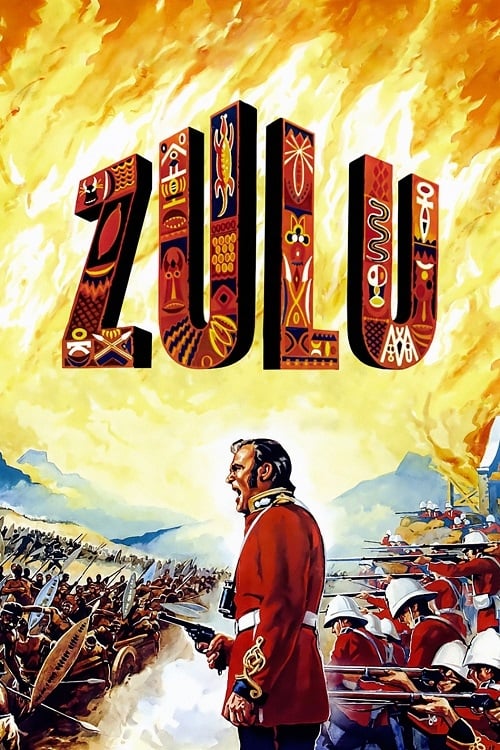
Zulu
1964 · Cy Endfield
For a Sunday-afternoon epic mood — when you want old-fashioned widescreen spectacle and against-the-odds tension you can sink into without irony.
What it's about
Natal, 1879, in the middle of the Anglo-Zulu War: hours after the British army suffers a catastrophic defeat nearby, roughly 150 soldiers at the small mission outpost of Rorke's Drift learn that thousands of Zulu warriors are coming for them. Two mismatched lieutenants — a practical engineer and a languid aristocrat — must improvise a defense out of biscuit boxes, mealie bags, and discipline, with no possibility of retreat.
The experience
A slow-burn siege that tightens for an hour before erupting into wave after wave of massed combat — tense, rousing, and staged with a scale that CGI-era battles rarely match. It honors courage on both sides more than it flag-waves, and the Zulu war chants against the soldiers' singing produce one of the great spine-tingling passages in war cinema.
Performances
A young Michael Caine, in his star-making debut, plays brilliantly against his working-class image as the drawling aristocrat Bromhead, sparring with Stanley Baker's flinty, pragmatic Chard.
The craft
Cy Endfield stages the battle with real masses of extras in Technicolor widescreen, turning a single compound into a legible, escalating chess problem, while John Barry's brass-and-percussion score gives the whole thing a thunderous pulse. It's a film built for the biggest screen you can find.
Why it matters
A perennial of British cinema that launched Michael Caine and became the template for the against-all-odds siege picture, still studied for how it choreographs large-scale battle with total spatial clarity.
Snapshot
Zulu is a British widescreen war epic that reconstructs the defense of Rorke's Drift on 22–23 January 1879, when roughly 150 soldiers of the 24th Regiment of Foot held a mission-station outpost in Natal against several thousand Zulu warriors of King Cetshwayo's army. Directed by the blacklisted American émigré Cy Endfield and produced by (and starring) Stanley Baker, it arrived as a handsome Technicolor spectacle at the tail end of the great-battle cycle and is now best remembered for two things: John Barry's brass-and-percussion score, and the screen debut of a young Michael Caine, cast against his own working-class grain as the languid aristocrat Lieutenant Gonville Bromhead. The film opens on the aftermath of the catastrophe at Isandlwana and narrows to a single fortified compound — a siege picture whose real subject is disciplined labor under terror. It has endured as one of the most-watched British films of its era while also becoming a standing case study in how popular cinema mythologizes empire.
Industry & production
Zulu was an independent production mounted by Diamond Films, the company Baker and Endfield formed to control their own material, released through Paramount. Its existence owes something to the economics of the early 1960s, when British and American money underwrote large, location-shot spectacles that could exploit widescreen and color against the flat monochrome of television. Baker, a Welsh actor of genuine star wattage, was the engine: he took the producing role and the lead part of Lieutenant John Chard, and he pushed the project through on the strength of an article about Rorke's Drift by the historian and writer John Prebble, who then co-wrote the screenplay with Endfield.
Principal photography took place in South Africa, chiefly in the Natal region beneath the Drakensberg escarpment, using the dramatic natural amphitheatre of the mountains as a backdrop and a constructed replica of the mission station for the siege. Shooting an imperial battle epic inside apartheid-era South Africa carried obvious frictions: the production employed large numbers of Zulu people as warriors and extras, and accounts of the shoot — including Caine's own later recollections — describe the constraints of working under apartheid labor arrangements and the awkwardness of paying and directing a mass African cast within that legal regime. Among the Zulu performers was Mangosuthu Buthelezi, then a chief and later a major South African political figure, who played King Cetshwayo — his own ancestor. The record on some production specifics is anecdotal and colored by later memoir, so precise figures on extras and budget should be treated with caution rather than stated as fact.
Technology
The film was shot in Super Technirama 70 and printed in Technicolor — a large-format, high-resolution widescreen system. Technirama used a horizontally-running 35mm negative (the film traveling sideways through the camera, VistaVision-style, exposing a frame twice the normal area) combined with a modest anamorphic squeeze, yielding a very sharp, fine-grained image that could be blown up to 70mm for premium presentation in an approximately 2.35:1 scope ratio. That format choice is inseparable from the film's aesthetic ambition: the process was built to render vast landscapes and massed figures with clarity, and Zulu spends much of its length holding wide, deep views of a valley filling with warriors. The color photography — saturated red tunics against ochre veld and green mountain — is likewise a deliberate exploitation of Technicolor's palette in the service of legibility on a very wide canvas.
Technique
Cinematography
Photographed by Stephen Dade, Zulu organizes itself around a fundamental spatial contrast: the enormous, open exteriors of the surrounding hills and the cramped, barricaded interior of the compound. Dade's exteriors use extreme long shots and high angles to make the Zulu advance readable as a moving mass — lines of shields and plumes cresting a ridge — so that the audience shares the defenders' dread of scale before any blow lands. Inside the perimeter the camera tightens to eyelines and hands: loading, aiming, the mealie-bag barricades. The widescreen frame is used less for painterly composition than for information — how many are coming, from where, and how thin the red line holding the wall has become.
Editing
Cut by John Jympson, the film's construction is essentially architectural. Long stretches of tense preparation and lull are intercut with concentrated bursts of assault, and the editing repeatedly returns to the geography of the station so the viewer always knows the state of each wall. The famous device of the massed Zulu chant answered by the soldiers' singing is built in the cutting room as much as on set — sound and image alternated to stage a contest of collective voice before the physical clash. The rhythm is deliberately uneven: the picture withholds continuous action, banking tension across quiet passages so that each renewed attack detonates.
Mise-en-scène / staging
The staging is the film's real achievement. Endfield choreographs volley-fire drill as spectacle — ranks firing in disciplined rotation, the mechanics of the Martini-Henry rifle turned into a visual argument about order versus numbers. The mealie-bag redoubt, the burning hospital, the final "square" — each is blocked so that the shrinking defensive space is felt physically. Against this, the Zulu attacks are staged as testing probes: feints to draw fire, flanking rushes, the deliberate reconnaissance of the perimeter. This reciprocity — each side reading the other — gives the battle a tactical intelligibility rare in the genre.
Sound
Sound is central. John Barry's score, discussed below, is one element; the other is the film's use of the human voice as a weapon of morale. The Zulu army's rhythmic chanting and shield-drumming function as sonic intimidation, and the British answer with song — the sequence in which the Welsh voices raise "Men of Harlech" against the chant is the film's signature. It is worth noting that this Welshness is largely a dramatic invention: the 24th Foot became formally associated with Wales only after the 1881 reforms, so the film's insistently Welsh regimental identity is a romantic anachronism rather than documented history. As drama, though, the answered song is a superb piece of sound design.
Performance
Baker plays Chard as a plain, competent Royal Engineer — a working professional with a bridge to build, not a glory to win — and this reticence anchors the film. Caine, in his breakthrough, makes Bromhead an aristocratic drawl that curdles from foppish disdain into genuine command; the performance is a deliberate self-transformation by an actor of Caine's actual background, and it launched his career. Nigel Green's Color-Sergeant Bourne supplies the film's spine of unflappable NCO discipline; James Booth's malingering Private Hook is given a redemptive arc; Jack Hawkins and Ulla Jacobsson, as a missionary and his daughter, carry a strand of moral objection to the whole enterprise that the film both voices and finally sidelines. Richard Burton speaks the framing narration.
Narrative & dramatic mode
Zulu is a siege drama, and it obeys the classical unities more strictly than most epics: a single place, a compressed span of roughly a day and a night, a fixed and dwindling company of characters. Its dramatic mode is procedural and ensemble rather than psychological — it is less interested in interior transformation than in how a group of men perform a task under mortal pressure. The engine is the ticking accumulation of threat: warnings arrive, the missionary pleads for evacuation, the numbers become known, and the first attack lands. Character is revealed through function — who panics, who steadies, who improvises — and the two lieutenants' class-inflected jockeying over seniority (historically grounded, since Chard held precedence by a matter of days) is the film's principal interpersonal thread. The framing narration lends it the tone of a chronicle: this is presented as recovered history, an account of the most Victoria Crosses ever awarded for a single action.
Genre & cycle
The film sits at the intersection of the war film, the historical epic, and the "last stand" siege picture — a lineage that runs through The Alamo and Western fort-defence narratives to Beau Geste. Within British cinema specifically it belongs to a strain of imperial-adventure filmmaking that romanticized the Victorian army, but it arrives late in that cycle, in the same mid-1960s moment when the wider war film was turning toward the large all-star spectacle. Zulu is unusual within the type for the tactical seriousness of its battle staging and for granting its adversary an army with strategy, discipline and dignity rather than treating them as undifferentiated menace — though, as later criticism stresses, that dignity is still framed entirely through the besieged British eye.
Authorship & method
The film is best understood as the joint project of Cy Endfield and Stanley Baker. Endfield was an American director driven out of Hollywood by the HUAC blacklist, who rebuilt a career in Britain (at times working uncredited); Zulu is his most celebrated film, and it channels his taste for men under pressure in confined circumstances. Baker, as star-producer, supplied the drive, the money-raising clout, and the Welsh identification that shapes the film's texture. John Prebble, the historian whose article seeded the film, co-wrote the screenplay with Endfield and lent it a documentary armature. Stephen Dade's Technirama cinematography and John Jympson's editing give the battle its clarity and rhythm. And John Barry — fresh from beginning his association with the Bond series — contributed a score whose martial main theme and use of massed brass and percussion became one of the most recognizable in British film music. The collaboration is genuinely collective: no single "vision" dominates so much as a convergence of a blacklisted director's craft, a star's producing will, and a historian's material.
Movement / national cinema
Zulu is a landmark of commercial British cinema of the 1960s, made in the interval between the social-realist "kitchen sink" wave and the emergence of the mid-decade blockbuster. It belongs to no art movement; its lineage is popular and industrial. Yet it is deeply entangled with the idea of British — and specifically Welsh — national self-image, staging empire as a story of ordinary regional men doing their duty. Its production inside South Africa also makes it, uncomfortably, a document of the apartheid film economy of its moment.
Era / period
The film is doubly period. Its subject is high-Victorian: the Anglo-Zulu War of 1879, the Martini-Henry rifle, the confident and brutal machinery of late-nineteenth-century empire. But it is equally a product of 1964 — a Britain in the middle of decolonisation, its empire dissolving, looking back at a Victorian last stand with a mixture of nostalgia, pride and (in the missionary subplot and the film's evident awe at Zulu military prowess) a flicker of unease. That tension between the period depicted and the period of making is much of what keeps it critically alive.
Themes
The film's dominant themes are professionalism and discipline — survival as the product of drill, order and role rather than heroic individualism; class, in the friction between the tradesman-engineer Chard and the aristocrat Bromhead, resolved into mutual respect earned through competence; courage and its cost, culminating in the exhaustion and revulsion that shadow the closing victory rather than any simple triumphalism; and, more problematically, empire and race. Zulu is more generous to its African adversary than many contemporaries — it credits the Zulu with tactics, valor and organization — but it remains an imperial narrative that centers the colonizer, gives the Zulu no interior voice, and stages African warriors largely as a sublime and terrifying force of nature. The final gesture, in which the Zulu appear to salute the defenders' bravery, is a dramatic invention that has drawn particular scrutiny as a piece of comforting myth.
Reception, canon & influence
On release Zulu was a major popular success, especially in Britain, and it launched Michael Caine into stardom; it has since become a fixture of British television and a widely revered example of the war film, its score and its "Men of Harlech" sequence lodged firmly in popular memory. I'd flag that precise box-office figures vary between sources and I won't assign a number I can't verify.
Looking backward, the film draws on the "last stand" tradition of the Western and imperial-adventure genres, on the real historiography of Rorke's Drift (via Prebble), and on the widescreen-epic aesthetic of its moment. Looking forward, its influence runs along two tracks. As spectacle, it set a durable template for the outnumbered-siege film and remains a touchstone for the disciplined-defence set piece. It generated a direct companion in Zulu Dawn (1979), a prequel dramatizing the preceding disaster at Isandlwana. And it has become a central text in the critical reassessment of imperial cinema: postcolonial scholarship regularly returns to Zulu precisely because it is so accomplished and so affectionately remembered, using it to examine how a superbly made film can naturalize the imperial gaze even while appearing to honor the colonized. Its afterlife in British culture — invoked in politics, comedy and sport, sometimes in ways its makers could not have intended — is itself part of the legacy, evidence of how thoroughly the film's images of the thin red line entered the national imagination.
A Deleuzian reading
First there is the sound.
The full Deleuzian reading of Zulu →
Reception
A solid hit in Britain in 1964 that became a perennial TV fixture — the archetypal bank-holiday film — Zulu is now watched through a postcolonial lens, with modern viewers debating whether it's imperial nostalgia or one of the more even-handed films of its era.
How Zulu was received, from release to now →
How to watch Zulu: what to notice on a first viewing
- Notice the shift from wide hills to the cramped compound. Stephen Dade shoots the surrounding hills in extreme long shots and high angles, then tightens inside the perimeter to eyelines and hands loading rifles at the barricades. You feel the same shrinking of space the defenders feel, long before any attack lands.
- Watch the ranks fire in disciplined rotation, not chaos. Endfield stages the volley-fire drill as a visual argument, rank after rank loading and firing in strict sequence, turning military procedure into the film's real spectacle. Order itself, not individual heroics, is what the film is showing you as the thing worth watching.
- Listen for the chanting answered by British singing. The Zulu army's rhythmic chanting and shield-drumming work as sonic intimidation, and the defenders answer with song, staging a contest of collective voice before any physical clash. The battle is being fought with voices before a single shot decides anything.
- Watch how the two lieutenants argue over rank. Baker's plain, competent Chard and Caine's aristocratic, drawling Bromhead needle each other over seniority and class before the siege forces them into working respect. Their friction is doing the character work most war films would hand to a big speech instead.
- Notice how often the film shows you the whole wall. John Jympson's editing keeps returning to the station's geography between attacks, so you always know exactly how thin the defensive line has become. The cutting keeps you oriented in space, which is exactly what lets each new attack land as a shock.
The whole guide to watching Zulu, with the keys for a rewatch →
Influences: the films it descends from and the films it influenced
- Beau Geste (1939) — Codified the outnumbered-imperial-outpost siege — a walled desert fort defended by a dwindling handful, complete with the propped-dead-men-at-the-parapets ruse — the fixed-fortification defensive choreography Zulu transplants onto Rorke's Drift.
- The Four Feathers (1939) — Established the location-shot Technicolor British-imperial spectacle, staging Anglo colonial warfare against a massed African force in the real landscape rather than the backlot — the epic-scale empire canvas Zulu inherits.
- Gunga Din (1939) — Built the small-garrison-holds-a-strongpoint set piece — British regulars defending a fixed structure against a swarming native attack — supplying the besieged-few adventure grammar.
- Sahara (1943) — The archetype of the procedural-ensemble defense of a single scarce resource (a desert well) by a multinational squad against overwhelming numbers — the 'ration the water, count the enemy, hold the position' procedural spine.
- They Died with Their Boots On (1941) — Fixed the visual grammar of the encircled last stand as heroic tableau — the doomed unit ringed by a closing enemy — the shrinking-defensive-space iconography Zulu's cutting exploits.
- Fort Apache (1948) — Modeled the regimental procedural — drill, roll-call, ritual and command friction of professional soldiers on the imperial frontier facing an indigenous nation — the professionalism-and-discipline texture and the imperial gaze Zulu carries.
- The Alamo (1960) — The immediate large-format precedent: a Todd-AO widescreen last-stand epic of outnumbered defenders inside a walled mission, defining the 70mm outnumbered-siege spectacle Zulu scales down to a single compound.
- Spartacus (1960) — Pioneered Super Technirama 70 deep-focus staging of massed disciplined ranks against a horde across a wide field — the very format and army-in-depth choreography Endfield and Dade adopt for the volley-fire lines.
- Khartoum (1966) — Extends the empire-under-siege epic into Ultra Panavision — Gordon's garrison encircled by the Mahdi's host — continuing the imperial-outpost-besieged spectacle two years on.
- Zulu Dawn (1979) — The direct companion prequel dramatizing the Isandlwana disaster, co-written by Cy Endfield himself and sharing the film's staging of massed impi assault and Anglo-Zulu battle procedure.
- The Wild Geese (1978) — Transposes the men-under-pressure ensemble into a disciplined mercenary fighting-withdrawal against overwhelming African numbers, continuing the British professional-unit-besieged film into the modern setting.
- Assault on Precinct 13 (1976) — Strips the siege to its architecture — a small crew in a besieged building, the defensible space steadily shrinking under a faceless numberless assault — inheriting Zulu's shrinking-perimeter cutting logic.
- Aliens (1986) — Transposes the Rorke's Drift set piece to sci-fi: a squad welds and fortifies a perimeter that collapses inward as a countless horde overruns fixed positions — the procedural last-stand with a shrinking defensive line intact.
- Starship Troopers (1997) — Stages an explicit outnumbered-outpost siege — troopers firing in ranks from parapets as an insect horde swarms the walls — a direct Rorke's-Drift-style volley-fire-vs-horde last stand.
- Black Hawk Down (2001) — A small Western force pinned and besieged inside a hostile city by overwhelming local numbers, told through procedural-ensemble combat and architectural, street-by-street siege cutting descended from Zulu's spatial method.
- Glory (1989) — Makes disciplined line-infantry drill and the doomed frontal last stand its formal spine — professionalism-and-discipline as the subject, echoing Zulu's staging of soldiery as trained collective ritual.
- 300 (2006) — Abstracts the disciplined-few-against-a-horde chokepoint stand into graphic tableau, pushing Zulu's spatial contrast between a tight ordered line and an overwhelming mass to stylized extreme.
- The Lord of the Rings: The Two Towers (2002) — Rorke's Drift — a tiny garrison holding a walled compound against successive waves — is the direct dramaturgical blueprint for Helm's Deep's outnumbered defenders and breach-and-fallback structure.
- Lion of the Desert (1981) — Codifies the staging of a disciplined colonial firing-line as geometric grid set against the open-space human wave, the exact spatial dialectic Akkad uses for Mukhtar's ambushes.
- The Breath (2009) — Supplies the besieged-outpost last-stand blueprint The Breath runs on — a tiny fixed garrison, a long dread-filled wait, then escalating human waves against a perimeter that cannot be reinforced.
- The 300 Spartans (1962) — A near-contemporary outnumbered-few-hold-the-chokepoint film in which disciplined heavy infantry stem an endless Eastern army — the phalanx-holds-the-pass staging that parallels Zulu's rotating volley-fire ranks.
Similar films
- Black Hawk Down (2001) — influence & lineage
- Spartacus (1960) — influence & lineage
- Glory (1989) — influence & lineage
- The Longest Day (1962) — shared sensibility
- Waterloo (1970) — shared sensibility
- Gladiator (2000) — shared sensibility
- Sergeant Rutledge (1960) — shared sensibility
- Lawrence of Arabia (1962) — shared sensibility