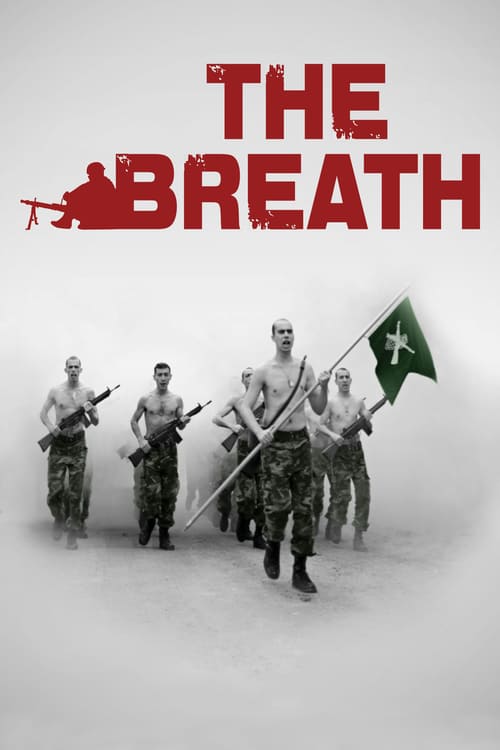
The Breath
2009 · Levent Semerci
For when you want a war film that emphasizes soldiers as people, and you're braced for grief rather than heroics. It's an intense watch — pick it when you want to feel something heavy.
What it's about
A small Turkish army commando unit mans a remote mountaintop relay station in the country's southeast in the early 1990s, at the height of the conflict with the PKK. Most of the film lives in the waiting — the boredom, the homesick phone calls, the rituals and dark jokes of young soldiers — before intelligence of a coming raid turns the outpost into a place that must be defended at all costs.
The experience
Tense and mournful in equal measure: long stretches of intimate, talky calm under a constant hum of dread, then combat that is chaotic, loud, and frightening. It's less about victory than about what waiting for violence does to young men.
The craft
The film wrings maximum tension from a single confined location, using radio chatter, silence, and the vast hostile landscape to build siege pressure before a single shot is fired. The battle sequences are staged with a disorienting, immersive ferocity that rewards good speakers.
Why it matters
A massive commercial phenomenon in Turkey and one of the defining Turkish films of its decade, it reshaped how the national cinema depicted the PKK conflict and the private grief behind the phrase 'long live the homeland.'
Snapshot
The Breath — Turkish title Nefes: Vatan Sağolsun ("Breath: Long Live the Homeland") — is a war drama that compresses the long, grinding trauma of Turkey's conflict with the Kurdistan Workers' Party (PKK) into a single besieged night. A small commando unit mans an isolated mountaintop relay station in the southeast during the early 1990s; the film follows the tedium, dread, and homesickness of the garrison until a coordinated PKK assault forces a last-stand defense in which the commander is killed but the position holds. Released on 16 October 2009 as the debut feature of director Levent Semerci, it became one of the defining Turkish commercial phenomena of its decade — a film that fused the classical "beleaguered outpost" war picture with a distinctly national grammar of grief and sacrifice. Its enormous popularity and the sharp critical argument it provoked (patriotic elegy or militarist spectacle?) make it a key document of Turkish popular cinema's nationalist turn in the late 2000s.
Industry & production
The Breath belongs to a moment when Turkish cinema had regained commercial confidence in its own market. After decades in which Hollywood dominated domestic screens, the mid-2000s saw locally made films — comedies, melodramas, and militarist action pictures — routinely top the Turkish box office, and The Breath arrived squarely inside that wave. Produced on a reported budget of roughly two million dollars, it was distributed by Medyavizyon and opened wide, reportedly on more than six hundred screens. It became the year's second highest-grossing Turkish release (behind the comedy sequel Recep İvedik 2), held the domestic number-one position for several consecutive weeks, and earned in the vicinity of thirteen to fifteen million dollars — a return of many multiples on its cost. A 2010 re-release extended its theatrical life.
The production was, by design, a physically demanding shoot. Principal photography took place in and around Antalya — including the heights of Tahtalı Mountain near Kemer — with additional work in Istanbul, standing in for a remote southeastern garrison. Semerci came out of the advertising industry, and The Breath was framed as the ambitious feature debut of a commercials director bringing a polished, image-driven sensibility to a national subject. The screenplay was credited to Semerci together with Hakan Evrensel and Mehmet İlker Altınay, adapted from Evrensel's collection of stories drawn from the southeast (Güneydoğu'dan Öyküler). The film thus carries a claim of experiential authenticity — rooted in first-hand narratives of the conflict — without being the dramatization of one specific documented engagement; it is a composite, not a chronicle.
Technology
The Breath is a product of the transitional period just before digital acquisition fully colonized mid-budget cinema, and the granular technical record (camera systems, stocks, laboratory pipeline) is not well documented in accessible English-language sources — a point worth stating plainly rather than filling with invention. What is clear is that the film pursued a heightened, textured, near-monochrome image built around cold blues, dust, and darkness, consistent with the international "combat realism" look of the 2000s. Much of the film unfolds at night and in low light, which places heavy demands on exposure and on the control of muzzle flash, tracer fire, and explosive effects. The night battle is staged with substantial practical pyrotechnics and squib/atmospheric work, integrated with the location terrain rather than composited into it, which gives the climactic assault its weight. Any account of extensive digital augmentation would be speculative; the film reads as predominantly practical, location-based filmmaking in the tradition of the physically produced war picture.
Technique
Cinematography
The cinematography is credited to Vedat Özdemir, and it is the film's most conspicuous authorial signature — unsurprisingly, given Semerci's commercials background and the emphasis on a designed, immersive image. The palette is drained and cold, the frame frequently handheld and close to the soldiers' bodies, and the mountaintop geography is used both for grandeur (long establishing views of an indifferent, beautiful landscape) and for claustrophobia (the station as a trap ringed by dark ridgelines). The film alternates registers deliberately: the daylight and interior scenes of waiting are relatively still and observational, establishing faces and hierarchies, while the night battle shifts to a kinetic, fragmentary, over-the-shoulder immediacy indebted to the post-Saving Private Ryan combat idiom. Light sources within the action — flares, tracer, explosions — do much of the dramatic modeling, so that the assault becomes a chaos of momentary illumination.
Editing
The specific editor's credit is not something the available record makes reliable, and I will not guess at a name. Structurally, however, the film's cutting logic is legible. It follows a two-movement design common to siege narratives: a long, deliberately paced first movement that accumulates character, routine, and dread through relatively sustained scenes; and a compressed, rapidly cut second movement in which the battle collapses spatial and temporal continuity into sensory shock. The escalation is engineered — the patient rhythm of the garrison exists precisely so that the tempo of the final assault registers as rupture. Cross-cutting to the home front (the commander's wife, family life left behind) is used to sharpen the pathos of the ending.
Mise-en-scène / staging
The controlling spatial idea is the outpost as a closed world. The relay station — a functional cluster of bunkers, sandbags, watchtowers, and radio equipment perched on exposed high ground — is the film's entire universe, and staging repeatedly emphasizes sightlines, perimeters, and the vulnerable geometry of a small force holding a large darkness. Production design leans on grounded military texture: worn uniforms, improvised comforts, the mundane objects of confinement. The staging of the assault exploits verticality and encirclement, with the defenders fighting downward and outward against an enemy that materializes from the terrain. The film's meaning is built into this space: the station is simultaneously a symbol of the state's reach and an image of isolation and expendability.
Sound
Sound is central to the film's affective strategy. The long quiet stretches foreground ambient detail — wind on the mountain, radio static, the small sounds of men at rest — against which the battle's percussive violence lands with maximal contrast. The title itself, Nefes ("breath"), points to an aural and bodily motif: breathing as the sign of life under threat, and its cessation as the film's ultimate stake. The score, composed by Fırat Yükselir, works in the elegiac-national register typical of the cycle, swelling around sacrifice and loss; critics who found the film overpowering often located that quality precisely in the fusion of music and montage at the close.
Performance
Semerci cast largely unknown actors, many drawn from acting schools, a choice that supports the film's ensemble-of-ordinary-soldiers realism. Mete Horozoğlu anchors the film as the captain, the moral and emotional center whose death consecrates the defense; Birce Akalay appears as his wife on the home front; İlker Kızmaz and Barış Bağcı feature among the unit as sergeant and lieutenant. The performances aim for unforced naturalism in the waiting scenes — banter, fear, boredom, small kindnesses — reserving heightened emotion for the crisis. The strategy of unfamiliar faces is deliberate: it discourages star identification and encourages the audience to read the soldiers as representative rather than exceptional, which is essential to the film's collective, mournful address.
Narrative & dramatic mode
Dramatically, The Breath is a siege tragedy. It adopts the classic "last stand" architecture — a small, sympathetic force in a fixed position, an encroaching enemy, an assault that cannot be fully repelled without loss — and inflects it toward elegy rather than triumph. The first act is essentially a character mosaic in the mode of the platoon film: individual soldiers are introduced through routine and memory so that their later peril has weight. The turn to combat converts this accumulated intimacy into grief. Crucially, the film's resolution is bittersweet and sacrificial: the position is held, but at the cost of the commander's life, and the emotional payload is loss, not victory. This is the dramatic engine of its reception controversy — the same structure can be read as anti-war lament (war destroys these ordinary, knowable men) or as consecration of martyrdom in the service of the state. The film largely withholds interiority from the PKK attackers, which is central to both its efficacy as a genre machine and the critique that it flattens the conflict's politics into a one-sided passion play.
Genre & cycle
The Breath sits at the intersection of two lineages. Internationally, it is a "beleaguered outpost" war film, kin to a long tradition running from Beau Geste and Zulu through Fort Apache's frontier stand to modern siege-of-realism pictures like Black Hawk Down and, later, Beau Travail-adjacent studies of soldiers in remote deployment. Nationally, it belongs to the cycle of Turkish military-nationalist cinema that surged after the mid-2000s, most conspicuously Kurtlar Vadisi: Irak (Valley of the Wolves: Iraq, 2006). Where that film trafficked in geopolitical revenge fantasy and conspiratorial spectacle, The Breath pursues a more sober, ground-level, casualty-focused mode — closer to the soldier's-eye war drama than to the action-thriller. Within Turkish cinema it helped consolidate a commercially potent subgenre: the emotionally intense, sacrifice-centered film about the security forces' war in the southeast, aimed at a mass domestic audience and calibrated to national feeling.
Authorship & method
The film is best understood as a director-driven debut in which a formation in advertising is turned toward national subject matter. Levent Semerci brought a designed, image-first, emotionally maximal aesthetic — the polish and affective efficiency of commercials scaled to the war film — and co-authored the screenplay, which signals a strong authorial control over both look and story. The writing partnership with Hakan Evrensel, whose southeastern stories supplied the source material, grounds the film's claim to lived authenticity, while Mehmet İlker Altınay shares the screenplay credit. Cinematographer Vedat Özdemir is the key visual collaborator, executing the film's cold, immersive, largely nocturnal style. Composer Fırat Yükselir supplies the elegiac scoring that critics identified as central to the film's emotional force. The editor and several other department heads are not reliably documented in accessible sources, and I flag that gap rather than fabricate attributions. Semerci's method — nonstar ensemble, demanding location shoot, adaptation of testimonial stories, and a two-movement structure that weaponizes patience — defines the film's character.
Movement / national cinema
The Breath is a Turkish national-cinema artifact in the fullest sense: not an art-cinema export in the mold of Nuri Bilge Ceylan or Zeki Demirkubuz, but a mass-market film addressed to a domestic public and engaged directly with the state's most sensitive contemporary conflict. It exemplifies the post-2004 recovery of Turkish popular cinema's box-office dominance and, more specifically, the emergence of the security-forces war film as a commercially reliable and ideologically charged genre. Its subtitle, Vatan Sağolsun ("Long Live the Homeland" / roughly "the homeland is safe/thanks to the homeland"), is itself a phrase from the vocabulary of military martyrdom, situating the film explicitly within a national discourse of sacrifice.
Era / period
The film is doubly period-marked. Diegetically, it is set in the early 1990s, the most intense phase of the PKK insurgency in the southeast, and it invokes that era's landscape of remote garrisons and asymmetric ambush. Industrially and culturally, it is a product of 2009 — a Turkey of rising domestic box office, an assertive popular nationalism, and a public appetite for films that dramatized the ongoing conflict. Its aesthetic likewise belongs to its production moment: the handheld, desaturated, sensory-overload combat style that global war cinema had standardized in the decade after Saving Private Ryan and Black Hawk Down.
Themes
The film's governing themes are sacrifice, brotherhood, and the ordinary body caught in national violence. Breath itself — respiration as the fragile evidence of life — is the organizing metaphor: the film is about who keeps breathing and who stops, and about the state's demand for that breath. Camaraderie among a small, mixed unit is idealized as the human core worth mourning, while the home front (wife, family, the life deferred) supplies the measure of what is lost. Duty and martyrdom are treated with reverence, and this is where the film's politics become contested: it can be read as an anti-war meditation on waste and grief, or as an affirmation of state sacrifice that declines to grant the enemy interiority or the conflict its full political complexity. Isolation — geographic, existential, national — pervades every level of the film, from the mountaintop station to the soldiers' emotional solitude.
Reception, canon & influence
Commercially, The Breath was a landmark: a debut feature that became one of the biggest Turkish releases of its year, held the top of the domestic chart for weeks, and earned many times its budget. It was recognized on the awards circuit as well, with honors including recognition at the Yeşilçam Awards and prizes at the Adana Golden Boll Festival, and notice as a first-film achievement. Critically, response was genuinely divided in a way that has made the film a recurring reference point in discussions of Turkish popular cinema. Admirers praised its technical accomplishment, its immersive battle staging, and its emotional directness; skeptics faulted it as emotionally manipulative and, more pointedly, criticized its nationalism, its one-sided framing of the conflict, and its limited representation of women. Scholars have since used it as a case study in exactly this tension — whether the film functions as pro-military spectacle or as anti-war lament — which is arguably the most durable form of influence a popular war film can have.
Looking backward, its lineage is clear: the international siege/last-stand war film and the post-1998 realist-combat aesthetic on one side, and the domestic military-nationalist cycle epitomized by Valley of the Wolves: Iraq on the other, with Evrensel's testimonial southeastern stories as its documentary anchor. Looking forward, The Breath helped establish a template and a proven market for emotionally intense, sacrifice-centered Turkish films about the state's war in the southeast — a mode that subsequent domestic productions and television would continue to work in. Its precise, film-to-film chain of influence within later Turkish cinema is not something the accessible scholarly record maps in detail, and I will not overstate it; but as a commercial proof of concept and as a lightning rod for the debate over how popular cinema should represent a living national conflict, its significance is well established.
Reception
A box-office phenomenon in Turkey in 2009 — one of the year's most-watched local films — it has since settled into a strange dual life: a modern classic at home, almost invisible internationally.
How The Breath was received, from release to now →
Influences: the films it descends from and the films it influenced
- Zulu (1964) — Supplies the besieged-outpost last-stand blueprint The Breath runs on — a tiny fixed garrison, a long dread-filled wait, then escalating human waves against a perimeter that cannot be reinforced.
- Saving Private Ryan (1998) — Establishes the post-1998 combat grammar Semerci and DP Vedat Özdemir adopt: stripped-shutter handheld immediacy, desaturated cold color timing, and mud-level soldier-POV that treats battle as chaotic bodily assault rather than choreographed spectacle.
- Black Hawk Down (2001) — The explicitly cited idiom — a surrounded small unit under relentless fire, rendered in cold desaturated palette, embedded roving handheld, and rupture-tempo cutting that dissolves geography into pure attritional siege.
- Platoon (1986) — Models the platoon-film mosaic of nonstar grunts individuated in a closed world, plus the elegiac-strings scoring template (Barber's Adagio) that Fırat Yükselir's national lament reprises to frame combat as mourning.
- Come and See (1985) — Origin of the sensory sound-subjectivity The Breath's breath-motif descends from — muffled ringing, amplified respiration, and aural point-of-view that make the soldier's body, not the wide shot, the site of war.
- We Were Soldiers (2002) — Provides the surrounded-unit-holds-the-line structure fused with sacrificial-martyr framing and home-front cross-cutting, the sentimental last-stand mode The Breath localizes to a Turkish border post.
- Valley of the Wolves: Iraq (2006) — The domestic proof-of-concept: a Turkish military-nationalist blockbuster that established the market, the affective-maximal register, and the state's-eye framing The Breath inherits and refines.
- Restrepo (2010) — Distills the remote-outpost closed world into documentary form — war as endurance in a fixed, exposed position under intermittent contact — the nonfiction counterpart to The Breath's staged siege.
- Lone Survivor (2013) — Carries forward the small-unit doomed last stand in bone-crunching handheld realism organized around escalating rupture-tempo and sacrifice, the Hollywood extension of the outpost-overrun template.
- Dağ / The Mountain (2012) — The direct Turkish heir — a special-forces unit in the mountainous southeast rendered in the same desaturated nocturnal realism and nonstar ensemble, inheriting the exact realist-nationalist template and audience The Breath proved.
- 13 Hours (2016) — Reworks the compound-under-siege in night-vision desaturation and wave-assault escalation — a small team defending a fixed perimeter through the night — the later-cycle spectacle of the beleaguered-outpost mode.
- Dağ II (2016) — Continues the Turkish military-nationalist combat cycle The Breath seeded, extending its sacrifice-centered, handheld-realist, brotherhood-under-fire idiom into a franchise built on the same domestic market.
- Beaufort (2007) — Same closed-world outpost dramaturgy — conscripts enduring incoming fire in a fixed hilltop position, patience weaponized into dread — treating the besieged post itself as the film's protagonist and prison.
- Lebanon (2009) — Extends the same-year confined-position aesthetic: war experienced entirely from inside a claustrophobic military enclosure, staging the outpost as a sealed sensory box of sound and waiting.
- Taegukgi (2004) — Parallel national war spectacle built on brotherhood-and-isolation and handheld visceral combat, scaling a living homeland conflict into emotionally maximal blockbuster form the way The Breath does for the southeast.
- Assembly (2007) — Imports the Black Hawk Down realist-combat idiom into a national-sacrifice narrative of a doomed company ordered to hold a position to the last man — the same siege-tragedy-plus-martyrdom fusion.
Similar films
- Lone Survivor (2013) — influence & lineage
- The Hurt Locker (2008) — shared sensibility
- Uri: The Surgical Strike (2019) — shared sensibility
- Warfare (2025) — shared sensibility
- Yellow Letters (2026) — shared sensibility
- The Thin Red Line (1998) — shared sensibility
- September 5 (2024) — shared sensibility
- The Outpost (2020) — shared sensibility