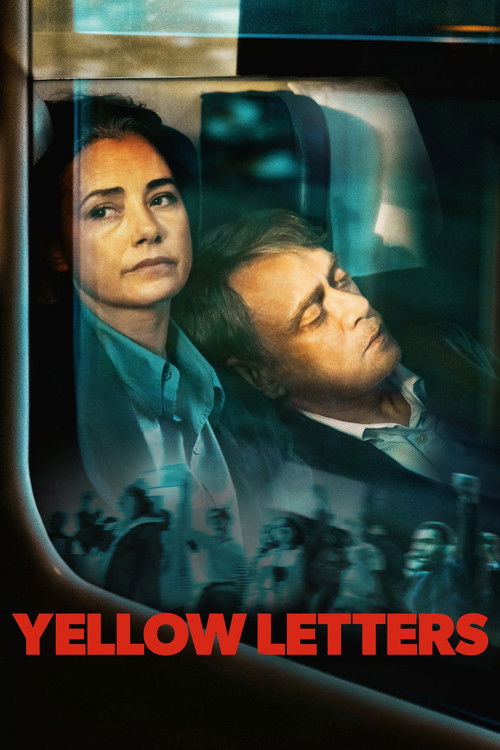
Yellow Letters
2026 · İlker Çatak
For a night when you want a serious, humane drama about ordinary people under pressure — something to sit with and talk about after, not comfort viewing.
What it's about
Derya and Aziz lose their jobs to a government decree they can neither contest nor appeal, and the loss forces them out of the life they built. With their thirteen-year-old daughter Ezgi, they move into Aziz's parents' apartment in Istanbul — three generations under one roof, a marriage under new strain, and a family that has to work out from scratch how to live. It follows what happens to love and dignity when the ground is pulled out by forces too large to argue with.
The experience
Quiet, close, and slowly tightening — the tension lives in kitchens and hallways rather than confrontations, and it builds through the small humiliations of dependence. It's the kind of drama that makes you feel the weight of every unspoken thing at a family dinner.
The craft
Çatak comes to this after The Teachers' Lounge, a film famous for its pressure-cooker control, and he brings that same precision to a domestic canvas: the drama is built from proximity, framing, and what characters don't say. It's intimate filmmaking that rewards close attention more than a big screen.
Why it matters
This is the film Çatak made after The Teachers' Lounge won Germany's top film prizes and an Oscar nomination — the follow-up that shows where one of Europe's most watched directors goes next, turning from institutional pressure to family and state power in Turkey.
Snapshot
Yellow Letters is the feature İlker Çatak makes after The Teachers' Lounge (Das Lehrerzimmer, 2023) — the small, ferociously controlled school thriller that won the German Film Award's top prizes and carried Germany to a Best International Feature nomination at the 96th Academy Awards. Where that film compressed an entire civic order into one staffroom, the premise here opens outward: Derya and Aziz lose their jobs to what the synopsis calls state arbitrariness, leave whatever life they had, and move into Aziz's parents' apartment in Istanbul with their thirteen-year-old daughter Ezgi. Three generations, one household, and a marriage asked to survive a loss it did not cause and cannot appeal.
A caution that governs this entire dossier: the verifiable public record for Yellow Letters is thin in the account available to me. Cast, crew of record, festival premiere, financing partners, running time, and the film's own gloss on its title are not established here, and I will not manufacture them. What follows grounds the film in what is established — Çatak's documented working method across four features, the Turkish German film tradition he writes from inside of, and the specific political and industrial history that the phrase "state arbitrariness" points to in a Turkish context. Where I am extrapolating from pattern rather than reporting fact, I say so.
Industry & production
Çatak works from a German production base with Turkish subject matter, which in practice means the European co-production apparatus: regional funds (Medienboard Berlin-Brandenburg, Filmförderung Hamburg Schleswig-Holstein, and their peers), the federal FFA and DFFF incentives, the BKM, and — for films with a partner country — Eurimages. The Teachers' Lounge was produced by Ingo Fliess's Munich company if... Productions, released in Germany by Alamode and picked up for North America by Sony Pictures Classics, an arthouse distribution path that converted a modestly budgeted German film into an Oscar nominee. Whether Yellow Letters repeats that exact configuration is not confirmed in the record here.
The material fact worth stating is structural rather than anecdotal. A film set substantially in Istanbul, about citizens stripped of their livelihoods by state action, occupies a genuinely difficult industrial position. Turkey's own funding and exhibition regime has been openly constrained: the 2019 amendments to the cinema law tightened the Culture Ministry's registration and certification power over films seeking theatrical release, and in 2023 the Antalya Golden Orange festival withdrew the documentary Kanun Hükmünde (The Decree) — about public employees dismissed by emergency decree — which triggered a jury resignation and the collapse of the documentary competition that year. That episode is a matter of record and it establishes the operating temperature around this subject. A German-financed production shooting in Istanbul is not immune to that temperature; it is simply differently exposed to it. This is the practical meaning of the diaspora director's position in 2026: access to European money, ambiguous access to the country the film is about.
There is also the post-nomination problem, which is an industrial fact of German auteur careers. An Academy nomination generates English-language offers and international agency interest; the alternative is to make the smaller, harder, more local film. On the evidence of the premise, Yellow Letters is the second choice.
Technology
The technical specifications of Yellow Letters are not documented in the record available here — camera, format, aspect ratio, and post pipeline are all unconfirmed, and I decline to guess at a sensor.
What can be said with confidence is what the technology enabled in Çatak's previous work and why it mattered. The Teachers' Lounge was shot and shown in the near-square Academy ratio, 1.37:1 — a choice that is trivial to execute in a digital acquisition and DCP-mastering workflow and that would have been a costly, deliberate anachronism in the photochemical era. The format did specific work there: it cropped the world to the width of a body, made doorways into vices, and kept the frame from ever offering the relief of surrounding context. The broader point is that contemporary formal severity in European art cinema is downstream of digital flexibility. Directors reach for constraint precisely because the default is abundance.
A second technological condition is relevant to a film like this one: distributed post-production. Co-produced European films now routinely cut, mix, and grade across borders with remote review, which is what makes a Munich-or-Berlin-edited, Istanbul-shot film ordinary rather than exceptional. And a third, thematic rather than industrial: a story about bureaucratic dismissal in the 2020s is a story about documents, databases, and notification — the administrative technologies by which a state removes a person from a payroll without ever meeting them.
Technique
Cinematography
Çatak's established visual grammar, as developed with cinematographer Judith Kaufmann on The Teachers' Lounge, is proximate, handheld or handheld-adjacent, and built on shallow focus that isolates a face from a room full of people who are about to turn on it. The camera stays with one consciousness and refuses the reverse angle that would let us verify what that consciousness believes. Kaufmann is one of German cinema's major cinematographers — her credits include Vier Minuten and Die Fremde — and her contribution to Çatak's breakthrough was the conversion of institutional space into thriller space through lens length and distance alone, with almost no overt stylization.
Whether Kaufmann shot Yellow Letters is not confirmed here. If the method carries over, the interesting adaptation is spatial: a multi-generational apartment offers the same enclosure as a school, with an additional resource the school lacked — the balcony, the light well, the street below. An Istanbul apartment is a container with a view of everything the characters have lost access to.
Editing
Gesa Jäger cut The Teachers' Lounge, and the editing there was the film's engine: scenes ended a beat before resolution, cuts arrived on the rising action of a misunderstanding, and the cumulative effect was of a situation accelerating past anyone's ability to correct it. Her work on that film was recognized at the German Film Awards. A domestic drama across three generations invites a different rhythm — longer holds, overlapping household activity, the slow-motion of cohabitation — and the productive question for Yellow Letters is whether Çatak's escalation instinct survives contact with material that has no single inciting incident to escalate from. Editor of record on the new film is not established here.
Mise-en-scène / staging
The apartment is the form. A household of three generations in one flat produces a specific staging problem: every private conversation is overheard, every argument has an audience, and intimacy has to be negotiated in corridors and kitchens. This is the same compositional logic as the staffroom — a space where people who must remain civil are forced into permanent proximity — transposed from institution to family. Çatak's documented preference is for blocking that keeps secondary characters visible at the edges of the frame, so that the viewer registers the social cost of a line before the speaker does.
The daughter's position is structurally central. Ezgi at thirteen is the family's translator of downward mobility: she is old enough to understand the humiliation and young enough to be told nothing directly.
Sound
Marvin Miller has scored Çatak's features, and his work on The Teachers' Lounge is unusually aggressive for a school drama — percussive, string-driven, closer to a procedural thriller's pulse than to naturalist underscore. It was one of the film's most argued-about elements, precisely because it told the audience how frightened to be. The sound design there also weaponized the ordinary: a photocopier, a hallway, the compression of a crowded room.
An Istanbul household offers a richer ambient field than a German school — the call to prayer, street noise, ferry horns, neighbors, television — and the obvious risk is postcard sonics. The score and sound credits for Yellow Letters are not confirmed here.
Performance
Çatak's reputation as a director of actors rests on sustained, close observation of a single performer under pressure: Leonie Benesch in The Teachers' Lounge, Anne Ratte-Polle in Es gilt das gesprochene Wort (2019). His method, as visible on screen, favors performers who can play the gap between what a person says in a room and what their face has already conceded. The cast of Yellow Letters is not established in the record available to me, and a premise resting on a marriage plus a grandparental generation plus a child requires an ensemble balance his previous work has not yet had to solve.
Narrative & dramatic mode
The mode is domestic realist drama with a political cause held offscreen. Crucially, the dismissal appears to precede the film — the characters arrive already stripped. That is a significant dramaturgical choice, because it removes the courtroom, the appeal, the confrontation with an official. What remains is consequence without antagonist: the state acts once, invisibly, and the rest of the runtime is two adults discovering what the act did to their marriage.
This connects Yellow Letters to a durable European tradition — the Dardennes' Two Days, One Night (2014), Ken Loach's I, Daniel Blake (2016), Cristian Mungiu's studies of institutional pressure — in which bureaucracy is dramatized not as a villain but as weather. It also inverts The Teachers' Lounge, where the institution was fully present and every escalation had a named author.
Genre & cycle
Three cycles intersect. The first is the European social-realist drama of precarity, which has been the continent's dominant serious-film register since the 2008 crisis. The second is the Turkish drama of state pressure on ordinary life — Emin Alper's Burning Days (2022) is the most pointed recent instance, and Nuri Bilge Ceylan's About Dry Grasses (2023) turns on a teacher's professional destruction by accusation. The third is the return narrative in Turkish German cinema, where a journey to Istanbul reorganizes a family's understanding of itself.
What distinguishes the premise is the direction of travel. In the classical Turkish German film the move is outward to Germany or a temporary return; here the relocation to Istanbul is a retreat into the family and into the country, a downward move made because there is nowhere else.
Authorship & method
Çatak was born in Berlin in 1984 to Turkish parents, spent part of his childhood in Istanbul, and trained at the Hamburg Media School. His short Sadakat (Fidelity, 2014), set against the Gezi Park protests, won a Student Academy Award — his first film was already about a private moral bind produced by a public crackdown, which makes Yellow Letters a return to his founding subject rather than a departure.
His features: Es gilt das gesprochene Wort (2019), about a marriage of convenience between a German flight attendant and a young Turkish man; Räuberhände (2021), adapted from Finn-Ole Heinrich's novel, which sends two friends to Istanbul; and The Teachers' Lounge (2023). The through-line is a person of decent intentions who makes one defensible choice and watches a social system convert it into catastrophe.
The key collaborator is co-writer Johannes Duncker, Çatak's writing partner across multiple features including The Teachers' Lounge, whose screenplay was honored at the German Film Awards. Duncker's structural signature is the airtight premise: a situation defined so tightly that every subsequent scene is forced. Whether he co-wrote Yellow Letters is not confirmed here, but the premise has the shape of their joint work — a single irreversible condition, then pressure.
Movement / national cinema
Yellow Letters belongs to Turkish German cinema, a body of work with a documented lineage: Tevfik Başer's 40 m² Deutschland (1986) and its confinement dramas of the guest-worker generation; Thomas Arslan's Berlin School films of the late 1990s, which replaced sociology with duration and observation; Fatih Akın's Head-On (2004), which won the Golden Bear and broke the subject into international visibility, and The Edge of Heaven (2007), which shuttled between Germany and Turkey on a structure of missed encounters; Yasemin Şamdereli's Almanya (2011), which found comedy in the same history.
Scholarship on this tradition is well developed. Deniz Göktürk's critique applied the phrase "cinema of duty" — borrowed from Black British film criticism — to the earlier, obligation-bound mode of migrant filmmaking, arguing for work that escapes both victimhood and parody. Thomas Elsaesser's "double occupancy" named the condition of European subjects who belong to more than one national frame without being fully claimed by either. Çatak's generation inherits that argument as settled and proceeds accordingly: the family in Yellow Letters is not explained to a German audience, it is simply observed.
The film also sits inside Turkish national cinema proper, alongside Ceylan, Zeki Demirkubuz, Semih Kaplanoğlu, Reha Erdem, and the younger Selman Nacar — a tradition that has long specialized in moral pressure applied slowly in confined domestic and provincial space.
Era / period
The referent behind "state arbitrariness" is legible without being invented. Following the July 2016 coup attempt, Turkey governed under a state of emergency in which emergency decrees dismissed well over a hundred thousand public employees — teachers, academics, judges, civil servants — frequently without individual hearings, often with passports annulled and public-sector re-employment foreclosed. The Academics for Peace prosecutions began even earlier, in 2016. These are documented facts of the period, and they produced exactly the social type the synopsis describes: an educated couple, formerly salaried, suddenly unemployable and dependent.
Layered on top is Turkey's economic crisis of the 2020s — sustained high inflation, currency depreciation, and an Istanbul housing market that pushed multi-generational cohabitation from cultural tradition into economic necessity. The film's household is therefore overdetermined: they move in with Aziz's parents because of politics and because of rent. Whether the film names the decrees explicitly is not established here; the synopsis's careful phrase may be deliberate.
Themes
Downward mobility and its erosion of a marriage. Work as identity — what remains of two people when the thing they were is administratively deleted. The household as political space, where a grandparents' generation that survived earlier Turkish ruptures meets a middle generation that thought the ruptures were over. Shame, which is the private form political repression takes when there is no one to accuse. And the child as witness: Ezgi at thirteen is the film's future tense, learning what the country costs at exactly the age when a person decides what they will become.
The title is the open question. The record available here does not establish what the yellow letters are, and I will not supply a meaning; note only that dismissal in a bureaucratic state arrives as a document, and that films about purges have repeatedly made the physical letter the object where abstraction becomes touchable.
Reception, canon & influence
Critical reception of Yellow Letters is not documented in the record available to me, and I will not characterize reviews, festival awards, or commercial performance that I cannot verify. That is a real gap and the reader should treat every forward-looking claim below as structural expectation, not reporting.
Backward — what shapes it. Most directly, Çatak's own Sadakat and the authorial preoccupation it announced. Beyond that: the Turkish German return narrative as Akın codified it; the confinement dramas of Başer; the Dardenne-derived European precarity film; and, on the Turkish side, the Ceylan-Alper mode of political pressure rendered as domestic and interpersonal weather. Formally, The Teachers' Lounge is its own most important precursor and its most dangerous one — a director who has proven he can generate dread from enclosure has to decide whether dread is the right instrument for grief.
Forward — what it might shape. Two possibilities are worth naming honestly as possibilities. The first is a maturation of Turkish German cinema's second generation into political filmmaking that is neither the "cinema of duty" nor Akın's genre exuberance, but something quieter and more legally specific — films about administrative violence rather than cultural collision. The second is narrower and more institutional: a German-financed film about the post-2016 purges, made by a director with an Academy nomination behind him, expands the space in which that history can be treated on screen at scale, at a moment when doing so from inside Turkey has demonstrably carried cost. Whether Yellow Letters actually occupies that space is a question this dossier cannot yet answer.
Reception
Premiered in competition at Berlinale 2026 to strong reviews, then took the Golden Bear at a closing ceremony thick with political speeches — going from festival buzz-title to prize-winner in a single week.
How Yellow Letters was received, from release to now →
Influences: the films it descends from and the films it influenced
- The Teachers' Lounge (2023) — The template Çatak is reworking: Judith Kaufmann's 1.37 Academy frame with a long lens pinned to one protagonist so colleagues and pupils blur into edge-of-frame threat, cut against Marvin Miller's percussive, pulse-based score that converts an institutional corridor into a thriller space.
- Sadakat (2014) — His founding structure — a state crackdown (Gezi) kept entirely offscreen while the camera stays on a private actor forced into one irreversible moral choice, the public event registering only as sound and as consequence arriving through a door.
- 40 m² Deutschland (1986) — Establishes the Turkish-German apartment-as-enclosure grammar: an entire feature shot inside one flat, where the outside world exists only as window light, stairwell sound and things pushed through the entryway, and where blocking measures a character's shrinking permissible floor space.
- Yol (1982) — The originating Turkish film in which a state document — a furlough paper stamped and revocable — is the actual engine of the drama, so that the antagonist is a bureaucratic instrument rather than a person who can be confronted in a reverse shot.
- Three Monkeys (2008) — Ceylan's method of withholding the inciting event (the hit-and-run, the political bargain) and filming only its domestic weather — a three-person household re-blocked around a silence, with low-frequency ambient drone and offscreen train/sea sound carrying the pressure the dialogue refuses.
- Beyond the Hill (2012) — The systematic denial of the reverse angle: the threat 'over the hill' is looked at, pointed at and fired upon but never granted its own shot, so that paranoia is produced by an editing rule rather than by a performance.
- Rosetta (1999) — The Dardenne adherence shot — handheld, shallow, held at the nape of a single protagonist's neck so the social field stays out of focus behind her — plus the practice of cutting to black before the situation resolves, leaving the consequence rather than the outcome.
- Two Days, One Night (2014) — The airtight-premise architecture Duncker's screenwriting shares: one irreversible administrative condition stated in the first minutes, then a serial structure of doorstep encounters in which every scene is forced by the premise and no scene requires a villain.
- Caché (2005) — The canonical withheld reverse angle — a held frame whose watcher is never revealed — bound to a buried state atrocity that erupts into a bourgeois apartment, and the recurring composition of a child placed at the edge of an adult argument he is not addressed by.
- A Separation (2011) — The three-generation household as pressure chamber — a dependent grandparent physically constraining where the adults can go — combined with escalation through offices, forms and depositions in which each party is legible and no one can be cast as the antagonist.
- Head-On (2004) — Codifies the Turkish-German return structure as a formal break: the film changes register when it crosses to Istanbul, shifting to location direct sound and street-level field recording so the city is heard as an acoustic environment rather than scored as exotic backdrop.
- Son of Saul (2015) — The extreme instance of shallow-focus isolation in Academy ratio: a 40mm lens locked to one face with the surrounding catastrophe deliberately defocused at the frame's edge, so that the atrocity is delivered by sound design and peripheral blur rather than by coverage.
- In the Fade (2017) — The other major Turkish-German film built on an offscreen inciting atrocity and a single actor carried through administrative aftermath, using courtroom and waiting-room staging where bystanders crowd the frame edge and the camera declines to cut away to the event itself.
- Frenzy (2015) — Renders a Turkish state emergency as interior paranoia between brothers in a single apartment, with percussive, arrhythmic scoring and curfew sound (sirens, shutters, distant detonations) doing the work that an on-screen security apparatus would otherwise do.
- About Dry Grasses (2023) — A teacher's life dismantled by an accusation that arrives as a filed complaint rather than a confrontation — pressure applied through hearings and hallway glances, with Ceylan holding on the accused's face and refusing the reverse to the pupils who wrote it.
- Anatomy of a Fall (2023) — Builds an entire film on an event the camera never shows and a child positioned as the frame's ethical witness, sustaining a lead performance under juridical pressure while systematically withholding the verifying shot that would settle it.
- The Zone of Interest (2023) — Administrative violence staged as domestic routine: the horror exists only in Johnnie Burn's offscreen sound field and in paperwork read aloud at a kitchen table, with Mica Levi's low percussive drones supplying the dread the static, unemphatic framing refuses to.
Similar films
- Head-On (2004) — influence & lineage
- Nobody Knows (2004) — same viewing thread
- After the Storm (2016) — same viewing thread
- Shoplifters (2018) — same viewing thread
- Love Letters (2025) — shared sensibility
- All That's Left of You (2025) — shared sensibility
- No Other Choice (2025) — shared sensibility
- Destiny (2006) — shared sensibility
All the films related to Yellow Letters →
Watch it with: curated runs of related films
- The Weight of the Unspoken — A run of quietly shattering films where the largest feelings never get said aloud — love that outlasts reason, grief that gathers over a single family dinner, a long marriage cracked open by one old letter.