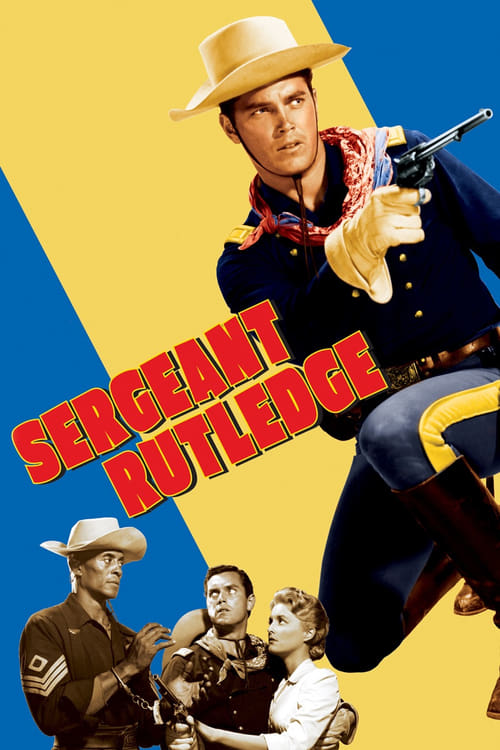
Sergeant Rutledge
1960 · John Ford
For when you want a classic Western with a conscience — something handsome and old-fashioned in its craft but with a moral fury that feels anything but quaint. A film to argue about afterward, not just admire.
What it's about
A respected Black cavalry sergeant of the all-Black 9th U.S. Cavalry — a Buffalo Soldier — stands court-martial, accused of raping and murdering a white woman and killing her father, his own commanding officer. The story unfolds almost entirely as testimony, with the events on the frontier reconstructed in flashback from the witness stand, so you watch the truth being pieced together, contested, and warped by prejudice in real time.
The experience
Half tense courtroom drama, half sweeping cavalry Western, and the two halves charge each other: every stretch of open desert plays under the shadow of the verdict waiting back in the courtroom. It's gripping and angry beneath its classical surface, and the injustice at its center still stings.
Performances
Woody Strode is monumental as Rutledge — a former athlete turned actor given a rare leading role, he plays the sergeant with a dignity and physical grandeur that carries the whole film; John Ford frames him like a statue the country hasn't earned yet.
The craft
John Ford folds the iconography of his cavalry pictures inside the machinery of a legal thriller, cutting between the cramped, sweaty courtroom and vast frontier landscapes so the flashbacks land like gulps of air. The widescreen location photography rewards a big screen, and the structure — the West narrated and adjudicated rather than simply lived — was daring for a 1960 studio Western.
Why it matters
One of the earliest studio Westerns to put a Black soldier at its dramatic and moral center and to make American racism, not the frontier, the true antagonist — a late-career reckoning from the genre's defining director.
Snapshot
Sergeant Rutledge is John Ford's courtroom Western, a film that folds the iconography of the cavalry picture inside the machinery of a legal drama. Its subject is Braxton Rutledge (Woody Strode), a First Sergeant of the all-Black 9th U.S. Cavalry — a "Buffalo Soldier" — arraigned before a court-martial for the rape and murder of a white woman and the killing of her father, his commanding officer. The film unfolds almost entirely as testimony, the events of the frontier reconstructed in flashback from the witness stand, so that the audience watches the West being narrated and adjudicated rather than simply lived. Made for Warner Bros. late in Ford's career, it is one of the earliest studio Westerns to place a Black soldier at its dramatic and moral center and to make American racial prejudice — rather than the frontier's usual antagonists — the true thing on trial. It is a transitional, somewhat divided work: visually a Ford Western of the first rank, structurally an experiment, and thematically the most explicit statement on race in his filmography to that point.
Industry & production
The picture was produced through Ford's own production arrangement and released by Warner Bros., a studio outside Ford's more habitual homes at RKO, Fox, and Republic. It was written by James Warner Bellah and Willis Goldbeck, the pairing that also furnished Ford with The Man Who Shot Liberty Valance two years later. Bellah's short fiction had supplied the raw material for Ford's earlier "Cavalry Trilogy" (Fort Apache, She Wore a Yellow Ribbon, Rio Grande), so the collaboration extended a long working relationship with the cavalry milieu; here, however, the writers built an original courtroom framework rather than adapting a discrete published story.
The film belongs to a late phase in which Ford, then in his mid-sixties, was working with somewhat reduced industry leverage relative to his 1940s peak, and it was made economically. Its most consequential production decision was the casting of Woody Strode — a former UCLA athlete and one of the first Black players in the modern NFL — in the title role. Ford, who had used Strode in smaller parts, elevated him to a lead, an unusual and deliberate act at a studio and in a genre that had almost never centered a Black performer. Precise budget and box-office figures for the film are not well documented in the popular record, and it is generally described as a modest commercial performer rather than a hit; I won't assign numbers the sources don't reliably support.
Technology
Sergeant Rutledge was photographed in Technicolor and released as a widescreen picture in the flat, spherical format standard for Warner Bros. features of 1960. It is not a large-format spectacle in the CinemaScope or VistaVision mold; Ford largely avoided anamorphic widescreen throughout his career, preferring compositions that retained vertical weight, and the film's framing reflects that temperament. The production combined location exteriors — most famously in Monument Valley, the sandstone landscape Ford had made synonymous with his own name across two decades — with studio-built interiors for the courtroom that anchors the narrative. The result is a technological register split between the open-air realism of Technicolor location work and the theatrical, artificially lit space of the trial, a contrast the film exploits deliberately.
Technique
Cinematography
The film was shot by Bert Glennon, one of Ford's most important and long-standing collaborators, whose credits with the director reached back to Stagecoach (1939) and included Young Mr. Lincoln, Wagon Master, and Rio Grande. Glennon's Monument Valley exteriors give the flashback sequences the monumental scale of classic Ford: horizon-dominated compositions, riders diminished against buttes, and the low horizon lines that turn human figures into upright presences against sky. The courtroom, by contrast, is handled in a more enclosed, shadowed manner, with pooled light and dramatic contrasts that push toward the expressionistic — a visual code that separates the theater of judgment from the remembered clarity of the frontier. The film's most celebrated images isolate Strode's physique against landscape, using his stillness and stature compositionally so that the camera confers a dignity the narrative's accusers deny him.
Editing
The film was cut by Jack Murray, Ford's regular editor of the period. The central editorial challenge is the flashback architecture: the picture must repeatedly move from the present-tense courtroom into reconstructed past events and back, and the credibility of the whole design depends on those transitions reading cleanly as testimony rather than omniscient narration. Murray's cutting keeps the trial as the organizing spine, returning to it as a recurring anchor, and stages the revelation of information according to who is speaking and what they claim to have seen. The rhythm alternates the confined, dialogue-driven tempo of the court with the more expansive movement of the action flashbacks.
Mise-en-scène / staging
The staging embodies a structural doubling — the theatrical box of the courtroom set against the vast openness of Monument Valley. Ford treats the court as a stage, with the officers of the panel, the spectators, and the lawyers arranged frontally, and he mines it for a characteristic mixture of solemnity and comic byplay (the gallery of onlookers, the fussy social types) that leavens the gravity. Against this, the flashbacks restore Ford's deep-space frontier compositions. The film's staging insists throughout on Rutledge's bearing: he is repeatedly positioned to stand tall, framed as a soldier of unimpeachable military dignity even while accused, so that the visual grammar quietly rebuts the charge before the plot resolves it.
Sound
Howard Jackson supplied the score, which draws on the film's original marching song "Captain Buffalo," a number tied to the pride and identity of the Buffalo Soldier regiments. The song functions less as background than as a thematic emblem, associating the regiment with an anthem of collective honor. Beyond the music, the film's soundscape sets the hushed, procedural quiet of the courtroom — where testimony is the entire event — against the ambient openness of the location work. The record on the film's specific sound-mixing craft is thin, and I won't overstate it.
Performance
Woody Strode's performance is the film's foundation and its most discussed element. Working largely through restraint — physical stillness, controlled voice, an almost sculptural composure — Strode plays Rutledge as a man whose dignity is itself the argument, refusing to plead in the register of victimhood. It remains one of the landmark leading performances by a Black actor in a mainstream Hollywood Western. Around him, Jeffrey Hunter plays Lieutenant Tom Cantrell, the officer conducting Rutledge's defense; Constance Towers plays Mary Beecher, a key witness whose frontier encounter with Rutledge frames much of the flashback material. The supporting ensemble draws on Ford's stock company and character players — Billie Burke, Willis Bouchey, Carleton Young among the court's officials and gallery, and Juano Hernández as a fellow Black sergeant whose presence deepens the film's portrait of the regiment. The prosecutorial and social types are drawn broadly, sometimes to satirical effect.
Narrative & dramatic mode
The film's boldest choice is formal: it is a Western told as a courtroom drama, with the frontier action delivered as sworn testimony. This structure makes the film explicitly about narration and belief — about who is permitted to testify, whose account is credited, and how a jury of white officers reads the actions of a Black man. Because we access the events through competing witnesses, the "truth" of the West arrives filtered through prejudice, memory, and cross-examination. The mode is fundamentally forensic and rhetorical: guilt and innocence are established through argument and revelation rather than through the open-field showdown of the conventional Western. This gives the film a mystery-plot engine — the identity of the real killer functions as a withheld solution — grafted onto a social-problem drama. The design is ambitious and not without strain: some critics have found the eventual resolution and the tonal swings between courtroom comedy and racial tragedy uneasy, and that unevenness is part of the film's honest record.
Genre & cycle
Sergeant Rutledge sits at the intersection of three cycles. It is a cavalry Western, extending the regimental world Ford built in the 1940s, complete with Monument Valley, bugle calls, and the rituals of frontier military life. It is a courtroom drama, participating in the strong late-1950s/early-1960s Hollywood current of trial films that used the legal setting to stage arguments about justice and prejudice. And it belongs to the social-problem picture, the cycle of postwar films that confronted American racism directly. Its distinctive contribution is to fuse the mythic Western with the problem film, turning the frontier from a site of national self-flattery into a courtroom where that self-image is interrogated. Within Ford's own output it is best read alongside his other late reckonings — a body of work in which the director began to examine the costs and exclusions embedded in the frontier legend he had done so much to create.
Authorship & method
As author, Ford brings the film his lifelong vocabulary — Monument Valley, the regimental ensemble, the mixture of ceremony and comic relief, the reverence for military duty — and turns it toward a subject his earlier cavalry films had left at the margins: the Black soldiers who served in the historical West. The film is frequently understood as part of Ford's late-career effort to confront race, a strand that runs forward to Cheyenne Autumn (1964) and its sympathetic reframing of Native American experience. The collaborative method is that of a director working with trusted long-term partners: cinematographer Bert Glennon, whose association with Ford dated to Stagecoach; editor Jack Murray; and writers James Warner Bellah and Willis Goldbeck, who supplied both the cavalry expertise and the courtroom architecture. Composer Howard Jackson provided the score and the "Captain Buffalo" theme. The decisive authorial act, though, was casting: Ford's insistence on Woody Strode as a leading man is the film's signature gesture and the clearest expression of its intent.
Movement / national cinema
The film is a work of classical Hollywood, made near the end of the studio era by one of that system's defining figures. It is not affiliated with any avant-garde or new-wave movement; its idiom is the mature American studio Western. Yet it appears at a hinge moment in American national cinema — the years when the postwar consensus was fracturing and Hollywood was beginning, haltingly, to address civil-rights-era questions of race on screen. As such it can be read as classical Hollywood turning its own most nationalist genre, the Western, toward self-critique, using the machinery of the studio film to question the racial exclusions of the American frontier myth.
Era / period
Released in 1960, Sergeant Rutledge stands at the threshold of the American civil rights movement's most intense phase and at the tail end of the Hollywood studio system's classical period. Its release coincides with a moment when the Western itself was entering a reflective, revisionist mood — the genre would grow increasingly self-critical across the 1960s — and when problem films about race were becoming more prominent in mainstream production. The film's fictional setting is the post–Civil War frontier of the Buffalo Soldier regiments, but its urgent address is contemporary: the courtroom's white judgment of a Black man spoke directly to 1960 audiences living through desegregation struggles. It is a period piece pointed unmistakably at its own present.
Themes
The film's governing theme is racial justice and the presumption of guilt: Rutledge is convicted in the minds of many before evidence is heard, and the drama exposes how prejudice pre-writes the verdict. Closely bound to this is dignity under accusation — the film locates Rutledge's heroism not in violence but in his refusal to be degraded, in his choice to return to and stand by his regiment. A third theme is belonging and the claim on the nation: the Buffalo Soldiers' service, and the "Captain Buffalo" anthem, assert a Black stake in the American story that the frontier myth had suppressed, even as the film registers the bitter irony of men serving a country that denies them equal standing. Finally, the film thematizes testimony and truth — the fragility of justice when it depends on whose word is believed. Ford's treatment is sincere and, for its moment, unusually direct, though critics have noted that the film still routes its Black protagonist's vindication partly through white advocacy, a limitation of its era that the film does not fully escape.
Reception, canon & influence
Contemporary reception was mixed. Reviewers respected the film's seriousness and Strode's performance while finding fault with its structural strain — the oscillation between grave racial drama and broad courtroom comedy — and with a resolution some judged contrived. It was not among Ford's celebrated commercial or critical triumphs on release, and it spent decades as one of his lesser-discussed late works.
Reading backward, the film draws on Ford's own cavalry cycle for its world and iconography, on the postwar social-problem film for its confrontation with prejudice, and on the vogue for courtroom dramas for its form; Bellah and Goldbeck's screenplay supplies the cavalry lore and the legal scaffolding, and Glennon's camera reaches back to the visual language of Stagecoach and the trilogy.
Reading forward, its legacy has grown considerably in reappraisal. It is now widely cited as a pioneering mainstream Western centered on a Black protagonist and as a key text in the study of race in Ford's work and in the Western generally — a film that anticipated the genre's later revisionism and its willingness to interrogate the frontier myth's exclusions. It gave Woody Strode a defining leading role and helped establish him as a significant figure in the Western canon, feeding into his subsequent international work. Within Ford scholarship it is treated as an essential companion to The Man Who Shot Liberty Valance and Cheyenne Autumn in charting the director's late turn toward the human costs and injustices underwriting the legend he helped build. Its critical standing today is markedly higher than its original reception, valued precisely for the ambition and moral seriousness that its first audiences found uneven.
A Deleuzian reading
Ford keeps putting Woody Strode's head above the horizon line.
The full Deleuzian reading of Sergeant Rutledge →
Reception
Barely a blip in 1960 — Warner Bros. didn't know how to sell a courtroom Western with a Black hero, and it underperformed. Now it's regularly cited as one of Ford's most fascinating late films and a key text in the reassessment of his handling of race after The Searchers.
How Sergeant Rutledge was received, from release to now →
How to watch Sergeant Rutledge: what to notice on a first viewing
- Watch where Rutledge's head sits against the horizon. In the valley flashbacks the camera sits low so his shoulders finish the composition where the sky starts, unlike the pooled lamplight of the courtroom. The camera keeps giving him a dignity the room he's standing in refuses to grant.
- Notice how shadowed and enclosed the courtroom looks. Glennon lights the trial with pooled lamps and hard contrast that pushes toward the expressionistic, a sharp break from the open daylight of the valley. The shift in light alone tells you judgment is a darker place than the frontier ever was.
- Watch how the courtroom gallery is arranged, and who speaks. Ford treats the court as a stage, panel, spectators, and lawyers arranged frontally, mixing solemn procedure with comic byplay among the onlookers. The seating plan alone tells you who counts as a participant and who is only there to watch.
- Listen for the regiment's marching song returning. 'Captain Buffalo' never settles into mere background, it keeps declaring what the 9th Cavalry means to itself, tied to pride and collective honor. The song asserts a claim on belonging that the courtroom itself never says out loud.
- Watch Strode stand rather than plead. He plays Rutledge almost entirely through stillness and stature, refusing the register of victimhood even while formally accused of a capital crime. His bearing works as its own defense, before a single argument is made in the room.
The whole guide to watching Sergeant Rutledge, with the keys for a rewatch →
Influences: the films it descends from and the films it influenced
- Stagecoach (1939) — Bert Glennon's low-horizon Monument Valley photography and gliding cavalry-column compositions are the exact visual grammar he reprises for Rutledge's valley flashbacks.
- Young Mr. Lincoln (1939) — Ford's own template for the folksy-defender courtroom drama — comic trial byplay swerving into gravity and a climactic exposure of the true culprit — is the structural skeleton reused here.
- Fort Apache (1948) — James Warner Bellah's cavalry stories and the regimental ensemble-and-ceremony world are lifted wholesale, with Bellah and Goldbeck supplying the same military lore for the screenplay.
- She Wore a Yellow Ribbon (1949) — Establishes the Technicolor Monument Valley cavalry iconography — dust, sunset skies, mounted patrols — that Rutledge deploys as the visual counterweight to the courtroom.
- Rio Grande (1950) — Cements the trilogy's tonal signature of reverent military duty braided with broad comic relief, the very oscillation Rutledge extends into a race drama.
- The Ox-Bow Incident (1943) — Pioneers the social-problem Western that indicts frontier mob justice and the rush to convict an innocent, prefiguring Rutledge's accusation-and-prejudice engine.
- Rashomon (1950) — Supplies the flashback-testimony architecture in which competing courtroom accounts dramatize and withhold the truth until a final reveal reorders everything.
- Pinky (1949) — A postwar studio social-problem film built entirely on racial passing and prejudice — and one Ford himself began directing before Kazan replaced him, tying him directly to the cycle Rutledge draws on.
- Intruder in the Dust (1949) — Mainstream studio melodrama of a dignified Black man wrongly accused of murder and exonerated against community prejudice — the precise moral situation Rutledge transposes to the cavalry.
- Home of the Brave (1949) — Puts a Black soldier at the protagonist's center confronting military racism in the social-problem mode, the template for foregrounding a uniformed Black lead.
- To Kill a Mockingbird (1962) — Builds a racial-injustice courtroom drama on a Black man falsely accused and a lone defender's summation, carrying forward Rutledge's fusion of trial form and race protest.
- The Man Who Shot Liberty Valance (1962) — Reuses the flashback-testimony framing device and Woody Strode's loyal-retainer presence to interrogate the frontier legend, the companion piece in Ford's late self-revision.
- Cheyenne Autumn (1964) — Completes Ford's late-career reckoning with frontier racial injustice, turning the sympathetic gaze Rutledge extended to Black soldiers onto Native American experience.
- Once Upon a Time in the West (1968) — Opens with Woody Strode as an iconic waiting gunman, exporting the Western stature Ford's leading role built for him into European genre cinema.
- A Soldier's Story (1984) — Investigates the murder of a Black soldier through flashback testimony inside the segregated army, directly inheriting Rutledge's marriage of racial mystery and military-tribunal structure.
- Glory (1989) — Restores Black soldiers to the dignified center of an American military-history frame, extending Rutledge's recovery of the Buffalo Soldier as a subject worthy of the epic.
- Anatomy of a Murder (1959) — A near-contemporary courtroom drama sustaining tension through withheld verdict and stark procedural staging, sharing Rutledge's expressionist trial-chamber theatricality.
- Spartacus (1960) — Casts Woody Strode the same year as Draba, extending the noble, monumentalized physical presence Ford forged into Strode's emerging leading-man iconography.
Similar films
- The Man Who Shot Liberty Valance (1962) — influence & lineage · same viewing thread
- Fort Apache (1948) — influence & lineage
- Stagecoach (1939) — influence & lineage
- The Ox-Bow Incident (1943) — influence & lineage
- To Kill a Mockingbird (1962) — influence & lineage
- Spartacus (1960) — influence & lineage
- Anatomy of a Murder (1959) — influence & lineage
- The Wild Bunch (1969) — same viewing thread
All the films related to Sergeant Rutledge →
Watch it with: curated runs of related films
- Print the Legend — A run of frontier myths and their unmaking — town-taming marshals, aging gunfighters, and the stories the newspapers chose to print instead of the truth.