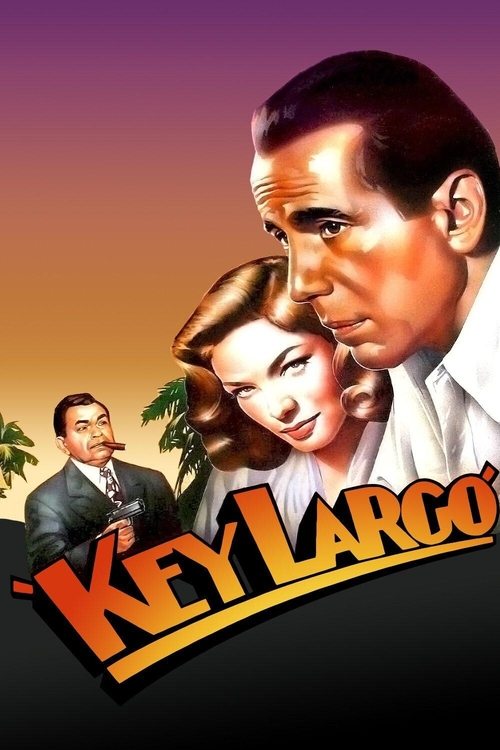
Key Largo
1948 · John Huston
For a stormy night when you want crackling old-Hollywood tension, star power, and moral stakes you can chew on — comfort viewing with real teeth. Perfect when you're in a black-and-white classics mood but want it mean.
What it's about
A war veteran arrives at a run-down hotel in the Florida Keys to pay respects to the family of a fallen comrade — the man's father, who owns the place, and his widow. He walks into a hostage situation: a notorious gangster and his crew have taken over the hotel, and as a hurricane bears down outside, everyone is trapped inside with a man who enjoys watching people break. The question the film keeps tightening is whether a soldier who's done fighting will pick one more fight.
The experience
A pressure-cooker two-step of menace and nerve, almost all of it in one sweltering building while the storm howls. It's talky in the best way — every exchange is a small duel — and the tension climbs steadily rather than in jolts.
Performances
Claire Trevor won an Oscar as the gangster's humiliated, drink-ruined moll, and one scene of hers is among the most painful things in 1940s Hollywood. Edward G. Robinson's Rocco is pure reptilian appetite, while Humphrey Bogart and Lauren Bacall — in their final film together — generate heat through restraint.
The craft
John Huston converts a stage play into cinema by making confinement the point: the hotel becomes a moral arena, and the offscreen hurricane does the work of an entire action budget. The dialogue is razor-cut, the shadows do half the storytelling, and the ensemble staging in cramped rooms is a masterclass in blocking.
Why it matters
It stands as a defining late entry in Hollywood's classic gangster cycle, fusing the genre with post-war disillusionment, and it sealed the Bogart-Bacall screen legend. Its trapped-in-one-place blueprint has echoed through thrillers ever since.
Snapshot
A masterwork of claustrophobic tension, Key Largo confines its moral drama almost entirely to a single hotel on Florida's southernmost tip, letting the geography do the work that the ideology cannot yet speak aloud. John Huston's adaptation of Maxwell Anderson's 1939 stage play transforms a verse drama about post-war disillusionment into the definitive late entry of Hollywood's gangster cycle — a film in which the returning soldier's existential paralysis meets the persistence of criminal power, and the hurricane outside functions as the externalized conscience of the man who refuses to act. Claire Trevor's Oscar-winning portrayal of a humiliated moll, Edward G. Robinson's reptilian Rocco, and the fourth and final teaming of Humphrey Bogart and Lauren Bacall make it a film dense with star mythology even as it reaches, imperfectly but with genuine ambition, toward political allegory.
Industry & production
Key Largo was produced by Jerry Wald for Warner Bros. and released in July 1948, arriving during one of the most politically charged moments in Hollywood's history. The HUAC investigations into alleged Communist infiltration of the film industry were well underway; the Hollywood Ten had already refused to cooperate the previous October, and Huston himself had been among the founders of the Committee for the First Amendment, which lobbied against the witch-hunts. There is a charged historical irony in the fact that Edward G. Robinson — whose portrayal of crime lord Johnny Rocco anchors the film — was himself, at this very moment, under suspicion and in the process of being graylisted, a fate he would spend years trying to reverse. The film's implicit equation of organized crime with fascist strongman politics took on uncomfortable contemporary resonances that studio publicity did not foreground.
The screenplay was developed by Huston in collaboration with Richard Brooks, who was then in the early stages of what would become a major directorial career. Together they substantially refashioned Anderson's source material. Anderson had written Key Largo as a philosophical verse play — consistent with his wider practice in works like Winterset — in which a veteran of the Spanish Civil War confronts questions of political commitment and moral courage. Huston and Brooks stripped the elevated diction, relocated the historical reference from the Spanish conflict to the Second World War, and concentrated the action into the confines of the Hotel Largo, sharpening Anderson's diffuse political meditation into a genre mechanism. The gangster replaces the fascist as symbolic antagonist, though the substitution is transparent enough to read as allegory.
The production was primarily a studio affair, shot on Warner Bros. soundstages with controlled efficiency. The use of a pre-existing stage property allowed for a relatively contained production footprint — the script's inherent confinement translated naturally to the studio environment. Jerry Wald, a prolific and commercially shrewd producer, had been instrumental in several key Warner noirs of the decade and understood the commercial viability of the Bogart star vehicle.
Technology
Key Largo is, by the standards of its day, a film that uses its technology in the service of atmosphere rather than novelty. Karl Freund's cinematographic approach relied on the full toolkit of late 1940s Hollywood studio craft: arc lighting, deep-focus composition in the wider hotel interiors, and carefully controlled chiaroscuro for closer quarters. The hurricane sequences required substantial practical effects work — driving water, wind machines, and the structural trembling of the set — achieved through on-lot effects that were sophisticated enough for the period without approaching the spectacle ambitions of a larger production.
The monochrome stock was handled with considerable sensitivity; Freund was working in the tradition he had helped establish, and the visual texture of the film has a density appropriate to its moral weight. No innovations of record attach to the film's technical execution; its distinction lies in the deployment of established means with disciplined intention.
Technique
Cinematography
Karl Freund's involvement elevates Key Largo cinematographically beyond what its stage origins might have produced in lesser hands. Freund had been one of the defining cameramen of German Expressionist cinema — he shot Murnau's The Last Laugh (1924) and shared credit on Metropolis (1927) — before emigrating to Hollywood, where he directed Dracula (1931) and The Mummy (1932) and then returned to cinematography for the next decade. By 1948 he brought to Warner Bros. a visual literacy rooted in the manipulation of shadow and spatial anxiety that German Expressionism had developed and American noir had absorbed.
The hotel's interior is shot in a way that emphasizes its topological traps: corridors narrow, stairwells loom, and the bar where much of the drama plays out becomes an arena whose sightlines Freund orchestrates to keep the power dynamics legible at a glance. Rocco commands visual space; McCloud retreats from it. When McCloud is finally provoked to action, the frame acknowledges his reclaimed agency through a shift in compositional weight. The deep-focus rendering of the hotel's main room — with its multiple planes of action — allows staging that preserves the theatrical heritage of the material while activating the specifically cinematic grammar of depth.
Editing
Rudi Fehr's editing respects the film's theatrical cadences while maintaining functional pacing. Key Largo is not a film that foregrounds its editing; the rhythms are essentially those of the stage, with the cutter's job being to distribute attention across a large ensemble during extended dramatic confrontations. Where the editing becomes most active is in the hurricane sequences and the film's climax aboard Rocco's boat, where accelerating cuts manufacture the kinetic urgency the claustrophobic interior has deliberately withheld. The contrast is calculated: the confinement is edited long, the release edited short.
Mise-en-scène / staging
The film's deepest craft lies in its staging — the physical disposition of characters within the hotel's hierarchically charged spaces. Huston had developed, through The Maltese Falcon (1941) and The Treasure of the Sierra Madre (1948, released the same year), a refined understanding of how power relations are enacted through spatial positioning and eyeline. In Key Largo, Lionel Barrymore's wheelchair-bound Temple is persistently placed at spatial disadvantage, emphasizing his vulnerability; Robinson's Rocco consistently occupies the room's dominant positions until his cowardice begins to drain that dominance; Bogart's McCloud operates in the negative space of potential action, physically present but morally retreated, until the film demands his re-engagement.
The hotel itself is coded with meticulous attention. The bar — with its counter, its mirror, its stools — functions as a kind of stage within a stage, and it is here that Claire Trevor's Gaye Dawn performs her devastating song for a promised drink. The spatial geometry of that scene — Rocco seated, Gaye standing, the assembled company watching — makes the humiliation geometrically exact.
Sound
Max Steiner's score operates within Warner Bros. house conventions — full orchestration, leitmotif assignment to principal characters, emotional underlining that modern ears may find emphatic. Steiner had scored some of the studio's most celebrated productions (Casablanca, Now, Voyager) and understood the studio's appetites. His work on Key Largo is competent rather than distinguished; the hurricane sequences give him genuine dramatic latitude that his scoring fills ably.
The sound design of the storm itself — continuous throughout the film's middle section — functions as an almost purely dramatic element. Its presence provides a sonic correlate to the psychological pressure building within the hotel, and its eventual cessation signals the shift in moral atmosphere as clearly as any plot development.
Performance
The film belongs, finally, to its performers. Edward G. Robinson's Rocco is a study in how the gangster archetype had evolved since his definitive Little Caesar (1931): where Rico Bandello was vital and forward-driving, Rocco is retrograde, self-pitying, addicted to his own past dominance. Robinson modulates the character's self-aggrandisement against visible flickers of cowardice, arriving at a portrait of corruption that is explicitly political in implication — the bully who depends on others' acquiescence for his power.
Claire Trevor's Gaye Dawn won the Academy Award for Best Supporting Actress, a recognition of a performance that operates against all glamour conventions for its central moment. The sequence in which Rocco demands she sing — badly, humiliatingly — for the drink he withholds is one of the cruelest scenes in classical Hollywood, made to work entirely through Trevor's calibration of degraded need.
Bogart's McCloud inhabits the familiar Bogart register of hard-won cynicism, though the film asks him to spend more time than usual in a state of apparently moral failure — choosing not to act, not to draw the gun, not to intervene. This prolonged inaction runs against Bogart's screen persona's grain, which makes the eventual reckoning dramatically earned. Bacall, in a role less demanding than her earlier Huston-adjacent work, anchors the film's romantic moral pole without reducing to mere function.
Narrative & dramatic mode
The film operates in what might be called the theatrical siege mode: a group of people confined by external circumstances (the hurricane) to a space dominated by an internal threat (Rocco and his associates). This structure — derived directly from Anderson's play, which was itself influenced by the hostage-drama conventions of 1930s theatrical naturalism — generates its tension not through plot complications but through the slow pressure of confined time. The hurricane's duration is the drama's duration; resolution and atmospheric clearing coincide.
The narrative's moral argument concerns McCloud's recovery of conviction. He has returned from the Pacific war emptied of belief — in causes, in action, in the possibility that individual courage can alter anything. Rocco's presence forces the question: at what point does the refusal to act become moral abdication? The film's answer is schematic but honest about its schematism, and it earns its resolution by making the cost of McCloud's earlier passivity visible and specific (in Gaye's suffering, in Temple's helplessness).
Genre & cycle
Key Largo occupies a late and perhaps terminal position in the Hollywood gangster film cycle that Warner Bros. had essentially inaugurated with Little Caesar and The Public Enemy in 1931. By 1948 the gangster had been transformed by two decades of code compliance, wartime allegory, and the absorption of noir into the studio system. Rocco is explicitly a figure from the past — characters say as much — whose return represents not dynamism but atavism. The film is thus internally elegiac about the genre it concludes; it frames the gangster as a survived archaism who only persists because no one has summoned the will to confront him.
The film also participates in the cycle of postwar "returning veteran" dramas — The Best Years of Our Lives (1946) being the paradigm — though it inflects that cycle through the noir lens rather than the domestic-realist one.
Authorship & method
John Huston had established himself, with The Maltese Falcon (1941) and The Treasure of the Sierra Madre (1948), as a director with a pronounced gift for literary adaptation — specifically for translating existing narrative materials into films that feel definitively cinematic. His method was collaborative and actor-centred; he worked through extensive rehearsal and trusted his performers to develop character physicality during production. His co-writers were invariably active partners rather than hired functionaries, and his scripts with Richard Brooks on Key Largo show the structural intelligence Brooks would deploy throughout his own directorial career.
Karl Freund's cinematographic authorship is significant and underacknowledged. His visual sensibility, formed in a tradition that understood light as psychological instrument, gives the film more visual character than its stage origins might have produced under a less distinguished collaborator.
Movement / national cinema
Key Largo is solidly a product of the Hollywood studio system at its classical apogee: Warner Bros. genre filmmaking, star vehicle construction, and the conventions of the Production Code all shaped its final form. It exists within the broad formation of American film noir — though it is more theatrical in its staging than the location-shot, shadow-fractured films that define the cycle's visual paradigm. Its debts to German Expressionism run through Freund's camera rather than through any direct stylistic citation.
Era / period
The film belongs to the immediate postwar period — culturally defined by demobilisation, atomic anxiety, the onset of the Cold War, and the specific American crisis of HUAC — and it carries those pressures in its subtext even when it cannot articulate them directly. The gangster-as-fascist substitution was not incidental; for audiences in 1948, it was transparent. The film's critique of acquiescence — its insistence that not confronting evil is itself a moral choice — spoke to an historical moment when the question of appeasement had just been settled, catastrophically, in one arena of European history.
Themes
Moral courage and its recovery is the film's primary concern. McCloud's arc — from paralysis to action — is rendered as a question of whether individual agency retains meaning in a world where organized power operates at a structural level. The film answers yes, provisionally, at the scale of personal intervention.
Alongside this runs the theme of masculine performance: what it means to be a man after the war, when the coordinates of heroism have been scrambled by industrial violence. Rocco's masculinity is performative and hollowed; McCloud's is suspended and eventually reclaimed; Temple's is preserved in dignity despite physical incapacity.
The film is also, without quite knowing how to fully argue it, about the persistence of fascism in peacetime — not as European politics but as an American social structure, in the form of organized crime that legitimate society has been unwilling to eradicate because it has been, in various ways, complicit in its existence.
Reception, canon & influence
Backward influences. Key Largo draws most directly on the hostage-drama tradition that Warners itself had established with The Petrified Forest (1936) — in which Bogart's Duke Mantee holds a desert roadhouse to ransom — a structural precedent so clear that the later film might almost be read as a conscious reprise. Maxwell Anderson's theatrical framework arrives with its own influences: the American theatrical naturalism of the 1930s, O'Neill's enclosed-space dramas, and the European tradition of dramatic unities that Anderson's verse plays deliberately invoked. Huston's formal inheritance from The Maltese Falcon — particularly the ensemble management and the moral anatomy of corruption — runs through the film's narrative structure.
Reception. The film was a commercial success on release and received broadly positive critical notices, though reviews tended to acknowledge its stage-bound limitations alongside its virtues. The critical consensus identified it as a lesser Huston than The Treasure of the Sierra Madre, released the same year, and that ranking has largely persisted. Claire Trevor's Academy Award recognition fixed one element of the film's reputation permanently; Robinson's performance has been reassessed more generously over time as the political ironies surrounding his career have become better understood.
Forward influence. Key Largo's most durable legacy may be structural rather than stylistic: it established or confirmed a template for the single-location moral confrontation thriller that recurs throughout subsequent decades. The formula of a confined space, a threatening captor, and a protagonist whose redemption requires the discovery of active courage runs through an enormous range of later films, from the siege dramas of the 1950s through the hostage thrillers of the 1980s and beyond. Whether any specific instance consciously cites Key Largo is often difficult to determine; the pattern had become generic convention by the time later filmmakers reached it.
Within the noir canon, the film occupies a position of respected secondary stature — cited regularly in surveys of the cycle but not ranked among the genre's supreme achievements (those positions tend to go to Double Indemnity, Out of the Past, Sunset Boulevard, and a handful of others). Its slightly anomalous status — too theatrical for the mobility characteristic of late noir, too genre-bound for the art cinema — has, paradoxically, protected it from the revisionism that has shifted opinion on more central texts. It remains what it always was: a flawed, adult, politically aware entertainment that rewards the patience of those willing to meet it on its own terms.
A Deleuzian reading
The gun is right there.
The full Deleuzian reading of Key Largo →
Reception
A hit in 1948 and respectable ever since, it's settled into a curious middle rank: never reappraised because it never fell — the Huston/Bogart film everyone likes but ranks below The Maltese Falcon and Treasure of the Sierra Madre from the same era.
How Key Largo was received, from release to now →
Influences: the films it descends from and the films it influenced
- The Petrified Forest (1936) — Bogart's Duke Mantee holding a desert roadside café hostage is Key Largo's direct formal template — the same single-location gangster siege, the same morally paralyzed male protagonist whose belated action redeems the trapped ensemble.
- The Last Laugh (1924) — Karl Freund developed his mobile camera and shadow-laden interior compositions here — corridors that narrow into humiliation, rooms that express hierarchy through depth — and transported this visual grammar directly into Key Largo's hotel staging.
- Little Caesar (1930) — Robinson's Rico established the specific performance idiom of reptilian criminal stillness and spatial command that Rocco deliberately echoes — Key Largo places the two Robinson performances in explicit intertextual dialogue, counting on audience memory of the archetype.
- Scarface (1932) — Hawks's film inaugurated the gangster-as-fascist-analogue coding by explicitly comparing Tony Camonte's organization to Mussolini's apparatus; Key Largo systematizes this allegorical register, converting Rocco's criminal authority into a legible figure for postwar authoritarian persistence.
- M (1931) — Lang's criminal underworld staging a grotesque tribunal introduces the formal device of organized crime as a distorted mirror of legitimate governance — the structural precedent for Key Largo's Rocco theatrically commanding a space while exposing the corruption of every power structure around him.
- The Maltese Falcon (1941) — Huston's debut established his ensemble staging method: precise eyeline matches and actor positioning within confined rooms make dominance hierarchies legible without expository dialogue — the same spatial grammar he imports into Key Largo's hotel bar confrontations.
- Casablanca (1942) — Rick's arc of cynical disengagement surrendering to political commitment under wartime pressure is the structural prototype for McCloud's paralysis-to-action moral recovery — both films using genre confinement to externalize a postwar allegory of civic obligation.
- To Have and Have Not (1944) — The inaugural Bogart-Bacall pairing calibrated their specific star dynamic — the morally hazed, immobile hero challenged by a sexually assured, actively pushing woman — that Key Largo inherits as its fourth iteration and complicates by making Bogart's passivity more genuinely vulnerable than Hawks permitted.
- White Heat (1949) — Cagney's Cody Jarrett is the terminal convulsive figure of the classic gangster cycle that Key Largo's Rocco anticipates closing; Walsh pushes the archetype into explicit psychopathology as the genre exhausts the criminal-strongman model Key Largo had already marked as historically obsolescent.
- The Asphalt Jungle (1950) — Huston extends his Key Largo ensemble-in-criminal-spaces method across multiple locations while retaining its core practice: actor positioning and blocking as the primary tool for mapping shifting moral authority among men under criminal duress.
- The Desperate Hours (1955) — Wyler inherits Key Largo's one-location siege structure directly — escaped convicts holding a family hostage inside a domestic space — using deep-focus interiors to distribute power dynamics across multiple spatial planes in the same staged-but-cinematic register.
- Night of the Hunter (1955) — Stanley Cortez channels the German Expressionist chiaroscuro lineage (Murnau → Freund → American noir) into its most radical Hollywood application; Mitchum's silhouette against the window is the visual grammar of Key Largo's shadow-as-moral-pressure pushed to its expressive limit.
- Twelve Angry Men (1957) — Lumet inherits Key Largo's core formal method — a single enclosed room, ensemble staging, actor positioning to make shifting moral authority visible without action — transposing the technique from the Warner gangster film to the courtroom procedural without altering the spatial logic.
- Touch of Evil (1958) — Welles extends Key Largo's Expressionist chiaroscuro into baroque excess, pushing shadow and deep-focus depth as moral architecture toward the noir's extreme — where Freund used darkness to contain, Welles uses it to implicate the camera itself in Quinlan's corruption.
- Dog Day Afternoon (1975) — Lumet's one-location hostage drama is the New Hollywood endpoint of the Key Largo siege model — criminal and hostages trapped together in a spatial crucible that strips character to its moral core — now executing the same formal logic in documentary realism rather than expressionist shadow.
- 3:10 to Yuma (1957) — A reluctant ordinary man is morally tested against a charismatic captor inside a single weather-besieged interior — the hostage-chamber standoff Yuma restages as the hotel-room vigil.
- The Young One (1960) — A single-location siege built entirely on classical découpage of trapped antagonists in confined interiors — the staging grammar of the chamber-under-pressure that The Young One inherits.
- Die Hard (1988) — Prototype of the confined-siege hostage drama — everyman trapped in one building with a witty, articulate criminal ringleader — anticipating the McClane/Gruber dynamic of talk-as-combat within enclosed space.
- Cul-de-sac (1966) — The hostage-picture chassis Cul-de-sac strips for parts: gunmen pinned in an isolated building by weather, waiting on a boat that governs the plot from offscreen, with siege action displaced almost entirely into talk.
- The Breaking Point (1950) — The immediate model for shipboard-confinement staging: gunmen commandeer a working boat and its captain, and the climax is blocked entirely within the few feet of cockpit and cabin, using sightlines around the wheel and hatch rather than cutting to open water for relief.
- Rope (1948) — Released the same year, Rope independently adapts a stage play into a real-time theatrical siege using deep-focus staging to track moral authority across a single confined space — an independent parallel solution to the same formal problem of translating theatrical power dynamics into cinematic grammar.
Similar films
- The Maltese Falcon (1941) — influence & lineage
- Touch of Evil (1958) — influence & lineage
- The Asphalt Jungle (1950) — influence & lineage
- To Have and Have Not (1945) — shared sensibility
- The Big Sleep (1946) — shared sensibility
- Casablanca (1943) — shared sensibility
- The Treasure of the Sierra Madre (1948) — shared sensibility
- Rear Window (1954) — shared sensibility
All the films related to Key Largo →