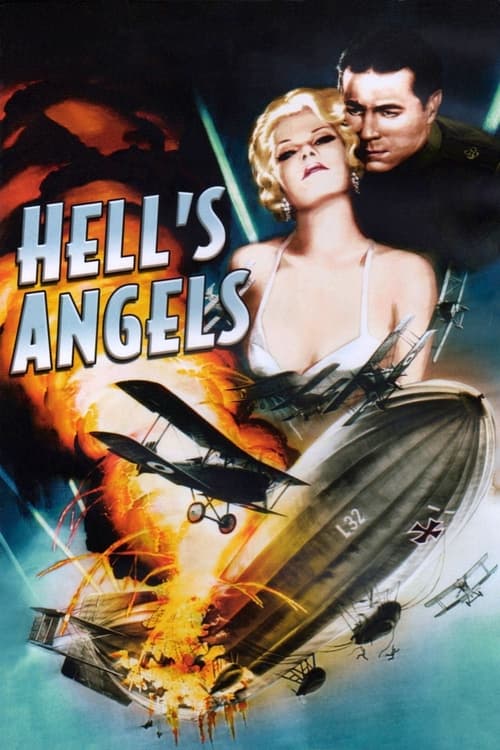
Hell's Angels
1930 · Howard Hughes
For when you're curious about Hollywood's wild early days and want spectacle with a story attached — the kind of film you watch for its legendary sequences and its legend. A time-capsule challenge with jaw-dropping rewards, not a cozy sit.
What it's about
Two brothers — one earnest, one a charming cad — leave Oxford to fly for Britain's Royal Flying Corps when the First World War breaks out, and a woman between them tests their loyalty as the war tests their nerve. The drama on the ground frames the film's real subject: combat in the air, from a night zeppelin raid over London to massed dogfights of dozens of real biplanes.
The experience
The love-triangle melodrama creaks with early-talkie stiffness, but when the film takes to the sky it still astonishes — real planes, real stunts, real danger, staged at a scale that feels reckless because it was. You watch half in suspense, half in disbelief that any of it was actually filmed.
Performances
Jean Harlow, an unknown teenager cast when sound reshoots demanded a new leading lady, burns through her scenes with a bluntness about desire that predates Hollywood's censorship era — the role made her a star.
The craft
Howard Hughes spent three years and a then-unheard-of fortune on it, shooting silent, then reshooting for sound, adding two-strip Technicolor passages and aerial photography — the zeppelin raid and climactic dogfight — that has arguably never been matched, because no one else was ever so indifferent to cost. See it big if you can; the sky footage is the whole point.
Why it matters
The most extravagant production of its era, it set the template for the aviation epic, launched Jean Harlow, and made Howard Hughes a Hollywood legend before he became a recluse.
Snapshot
Hell's Angels is the most expensive silent film ever made — and it is not a silent film. That paradox is the whole story. Howard Hughes, a twenty-two-year-old Texas heir with a drill-bit fortune and no filmmaking credentials, began shooting an aerial war picture in 1927, spent roughly three years and a sum widely reported in the neighborhood of $4 million on it, scrapped most of the dramatic footage when sound arrived, replaced his Norwegian leading lady with an unknown named Jean Harlow, and released the result in 1930 as a part-talkie with two-strip Technicolor sequences and aerial photography that no subsequent production ever quite matched, because no subsequent production was ever quite so indifferent to money.
The film that emerged is structurally lopsided and dramatically crude, and it contains perhaps twenty minutes of flying footage that remains, ninety-odd years on, among the most astonishing physical spectacle in American cinema. Roy and Monte Rutledge, brothers at Oxford — one earnest, one a cad — enlist with the Royal Flying Corps; a Zeppelin raid on London and a suicidal bombing mission over a German munitions depot supply the two great set pieces; Harlow, as Helen, supplies the sexual cynicism that made the picture notorious. The dialogue scenes creak. The Zeppelin sequence does not.
Hell's Angels matters less as a coherent work than as a hinge: the last monument of the silent aerial cycle inaugurated by Wings, the launch pad of a major star, an early feature-length demonstration of what Technicolor and multi-plane aerial coverage could do, and the founding legend of Hughes as an American type — the obsessive amateur whose money outlasted everyone's patience.
Industry & production
The production history is inseparable from the film's meaning, and it is one of the best-documented debacles of the studio era, though the numbers attached to it should be treated with the caution any 1930 publicity figure deserves.
Hughes had come to Hollywood in the mid-1920s with money from the Hughes Tool Company's rock bit patent — the drilling technology that made the family fortune. He produced several pictures in quick succession, including Two Arabian Knights (1927), directed by Lewis Milestone, which won the first and only Academy Award for Best Comedy Direction. That success gave him credibility he had not earned as a filmmaker, and he immediately spent it. Hell's Angels began production in late 1927, in the wake of Wings (1927), Paramount's aerial war picture that would win the first Best Picture Oscar. Hughes intended to outdo it, and his method for doing so was simply to buy more airplanes than a studio would consider rational.
He assembled what was, by contemporary accounts, one of the largest privately held air fleets in the world — dozens of vintage and surrogate aircraft, Sopwith Camels, Fokker D.VIIs and converted substitutes, sourced across Europe and America — along with pilots, mechanics, and multiple camera crews spread across several California airfields. The scale created its own problems: Hughes waited for the specific cloud conditions his aerial photography required, and Southern California's clear skies meant weeks of paid idleness. Crews were relocated to find weather. The shoot stretched across years rather than months.
The directorial chair turned over repeatedly. Marshall Neilan began the picture; Luther Reed followed; Hughes ultimately took the director's credit himself, with James Whale — brought from the London stage, fresh from Journey's End — directing the dialogue sequences after the conversion to sound. Whale's involvement is the film's most consequential piece of hidden authorship, and it launched a Hollywood career that produced Frankenstein the following year. Multiple aerial second-unit directors and stunt pilots did the actual flying work.
Then sound arrived. By the time Hughes had a silent cut, The Jazz Singer had reordered the industry and audiences had begun to reject silent features outright. Hughes reshot the dramatic material with sound — retaining the aerial footage, which had been shot silent and was post-scored and post-dubbed — and in the process removed his leading lady. Greta Nissen, a Norwegian actress whose accent was implausible for an English girl in a talking picture, was replaced by Jean Harlow, then eighteen or nineteen, a Hughes contract player with almost no experience. The reshoots and the re-editing consumed further months and money.
Fatalities occurred during production. Accounts of the number vary in the popular literature, and the precise toll and circumstances are reported inconsistently enough that no specific figure should be asserted here; what is not in dispute is that men died flying for the picture, and that this was a known feature of the aerial-film cycle in the late 1920s generally.
The film premiered at Grauman's Chinese Theatre in Hollywood in May 1930 and was released through United Artists. It drew enormous audiences. It did not recoup its cost on first release — the expenditure was simply too large for any 1930 gross to absorb — and the shortfall did not much concern Hughes, whose oil-tool revenue was unaffected by whether anyone bought a ticket. That independence from studio financing is the structural fact that makes Hell's Angels possible: no production chief would have permitted it, and none had to.
Technology
Hell's Angels sits precisely at the intersection of three technological transitions and shows the seams of all three.
Sound. The picture straddles the conversion. Aerial material shot 1927–29 was captured silent, at whatever camera speeds the operators chose, and later fitted with music, engine effects, and dubbed dialogue. The ground drama was reshot with direct sound recording under early-talkie constraints — fixed microphone positions, actors playing toward the pickup, a camera whose movement was limited by blimping. The disparity is audible and visible: the flying sequences move with the freedom of silent cinema, and the drawing-room scenes have the stiffness of 1930 sound stages. This is not a flaw peculiar to Hughes; it is the signature condition of transitional pictures.
Color. The film includes a sequence photographed in two-strip Technicolor (Process 3), the red-green subtractive system in wide use around 1929–30 before three-strip arrived in the mid-1930s. Two-strip renders flesh tones and reds and greens with reasonable fidelity and cannot render blue — skies go pale, blues read as gray — which is precisely why the color material is a ballroom scene rather than an aerial one. Some prints and presentations also employed tinting and toning on monochrome passages, and the Zeppelin sequence has circulated in versions with blue tinting. The 2004 restoration undertaken by the film's rights holders reconstructed the color sequence and the film's original release form; the restoration history is itself part of why the picture is visible today in something like its intended state.
Widescreen and exhibition. Portions of the film were exhibited in some venues using a widescreen process (variously associated with the short-lived Magnascope-style enlargement practices and the wide-gauge experiments of 1929–30), though these presentations were limited and the standard release was in the conventional aspect ratio. Claims about the extent of widescreen exhibition vary in the literature and should be held loosely.
Aerial cinematography as a technology. The most important technical achievement is the least glamorous to describe: Hughes and his crews solved the problem of photographing airplanes from airplanes at scale. This meant camera ships flying in formation with the action, gyroscopic and hand-held mounts, multiple simultaneous camera positions to permit editorial coverage of a single pass, and — crucially — smoke, cloud, and ground reference in frame so that the eye could read speed and altitude. Aerial footage without visual reference reads as static; Hughes understood, or his cameramen did, that the sky must contain something for the plane to move against.
Technique
Cinematography
Credited cinematography is shared across a large group — Tony Gaudio, Harry Perry, E. Burton Steene, Elmer Dyer and others contributed, with Perry and Dyer central to the aerial work; Dyer in particular became the era's specialist in flying photography and would work the aerial cycle for decades. The multiplicity of credits reflects the multiplicity of units.
Two visual registers coexist. The ground photography is competent studio work of its moment — proscenium-ish framings, high-key interiors, the flattened depth typical of early sound stages, enlivened occasionally by Whale's instinct for a composition that isolates a face against dark space.
The aerial photography is something else entirely. It is characterized by an extraordinary sense of air as a medium: aircraft entering frame from unexpected quadrants, planes silhouetted against sculpted cumulus, dive angles that put the horizon on the diagonal or lose it altogether. The Zeppelin sequence — the airship descending through cloud, its enormous bulk revealed gradually, gondola lowered below the cloud deck as a spotter — is a masterclass in scale, staged so that the human figures are legible against a mass whose size the eye must keep re-estimating. Hughes's cameramen habitually placed the camera where a documentary operator would have to be: in the slipstream, behind the pilot, looking down the length of a diving fuselage.
Editing
Frank Lawrence and Douglass Biggs are credited; the editorial history is complicated by the silent-to-sound reconstruction. The dogfight material is cut with a rhythmic aggression that anticipates later action editing — short durations, hard graphic matches on direction of travel, cutaways to pilots' faces to anchor geography. Where the sequence works, it works because the coverage is genuinely multi-camera: the same event exists from three or four vantages, so the cut can be motivated rather than merely energetic.
The dramatic scenes, by contrast, are cut with the plodding literalism of early sound — long masters, few angles, the camera waiting for lines to finish. The two editorial styles belong to different decades, and in a sense they are.
Mise-en-scène / staging
Staging in the air is the film's real mise-en-scène: formations, altitudes, the choreography of a bombing run. The Zeppelin raid organizes vertical space with unusual clarity — cloud layer, airship, observation gondola on its cable, London below — and the munitions-dump raid organizes horizontal space, a run in and a run out with escalating attrition.
On the ground, staging is conventional. The Oxford scenes and the London interiors are drawn broadly. Harlow's key scene — the seduction in her apartment, the "shall we go into my bedroom and get more comfortable" register — is staged simply and works entirely on performance and on the shock of its frankness.
Sound
Post-synchronized engine noise, machine-gun fire, and explosion effects give the aerial material an aggressive sonic texture that was itself a selling point in 1930. Hugo Riesenfeld's score functions in the transitional manner — near-continuous under action, receding under dialogue. The mixing of dubbed voices over silent-shot footage produces the characteristic detachment of early post-sync, voices sitting slightly outside the image. Sound in Hell's Angels is additive rather than integral; it was applied to a film conceived without it.
Performance
Ben Lyon (Monte) and James Hall (Roy) give serviceable early-talkie performances in the declamatory manner, Lyon with more ease. The film belongs to Jean Harlow, and not because she is good in it in any conventional sense — her line readings are flat, her timing unformed, and she reportedly struggled under Whale's direction. What she has is presence: platinum hair, an unembarrassed sexual directness, and a delivery that treats seduction as a transaction rather than a swoon. In a 1930 dominated by either virgins or vamps, Harlow is neither; she is casual about wanting what she wants. That casualness, not technique, made her a star, and the film's most famous line ("Would you be shocked if I changed into something more comfortable?") is inseparable from her.
Narrative & dramatic mode
The screenplay — credited to Howard Estabrook and Harry Behn, with dialogue by Joseph Moncure March — organizes itself as a moral triangle: the honorable brother, the reckless brother, the faithless woman. Roy loves Helen and idealizes her; Monte sleeps with her; Helen is indifferent to both in any durable way. The war supplies the arena in which the brothers' characters are tested and the film's disillusioned conclusion arrives.
The dramatic mode is melodrama in the strict sense: character externalized as moral position, conflict resolved through sacrifice. What complicates it is the film's genuine bleakness. The final movement — capture, the demand that they inform, the brothers' resolution — does not offer the consolation the surrounding romance would predict. There is no redemptive uplift. In this the film belongs to the late-silent anti-war current running from The Big Parade (1925) through Wings to All Quiet on the Western Front (1930), the last released the same year.
The structural problem is that the aerial spectacle and the melodrama occupy different films. The dogfights do not dramatize the triangle; they interrupt it. Audiences in 1930 did not mind — the spectacle was the point — but the disjunction is why Hell's Angels has never been treated as a dramatic achievement, only a photographic one.
Genre & cycle
Hell's Angels is the apex and effectively the terminus of the first aviation-war cycle. That cycle begins with Wings (1927), continues through Lilac Time (1928), The Dawn Patrol (1930, Hawks), Young Eagles (1930), The Flying Fleet, and others, and is defined by a set of shared conventions: the flying-corps squadron as a closed male society, the rivalry-into-brotherhood arc, the fatal mission, the empty chair at mess.
Hughes's contribution to the cycle was not conventional but material: he raised the cost of entry beyond what the genre could bear. After Hell's Angels, no studio could plausibly compete on aerial spectacle, and the cycle turned inward — Hawks's The Dawn Patrol is a chamber piece about command and attrition, its flying sequences functional rather than exhibitionist, and it is the better film. The genre survived by abandoning the arms race Hughes had won.
The film also sits inside the pre-Code moment. Released in 1930, before the Production Code's enforcement machinery took hold in 1934, its sexual frankness — Helen's promiscuity presented without punitive framing, the seduction scene, the dialogue's innuendo — is characteristic of the window. Later reissues encountered censorship difficulty, which is itself evidence of what the film got away with.
Authorship & method
Attributing Hell's Angels to an author is genuinely difficult, and honest accounts say so.
Howard Hughes takes the directing credit and is unquestionably the film's originating and controlling intelligence, but his method was accumulation rather than design: shoot enormously, wait for conditions, discard, reshoot, hire and fire. He was reportedly present in the air himself, and was injured in a crash during production. What he supplied was not craft but an unwillingness to accept limits that no salaried director could have sustained. His subsequent career — The Front Page (1931, produced), Scarface (1932, produced), The Outlaw (1943), and later control of RKO — confirms the pattern: a producer's obsessions imposed through capital.
James Whale directed the dialogue sequences. Whale's own films — Frankenstein, The Old Dark House, The Bride of Frankenstein — are stylistically nothing like this material, and Hell's Angels is not a Whale film in any authorial sense. It is, however, the credit that brought him to Hollywood's attention.
Cinematographers Harry Perry, Elmer Dyer, E. Burton Steene, and Tony Gaudio (among others) are, collectively, the film's actual visual authors. Dyer's subsequent career photographing aviation pictures through the 1940s makes the case that the aerial idiom developed here was a craft tradition, transmitted by operators rather than directors.
Joseph Moncure March, poet and author of The Wild Party, wrote the dialogue, and the sexual candor of Helen's scenes plausibly reflects his sensibility more than Hughes's.
Hugo Riesenfeld scored the picture; he was among the most experienced composer-arrangers of the transitional period, having come from the great silent-era theater orchestras.
Editors Frank Lawrence and Douglass Biggs assembled the surviving structure across two production regimes.
The method, then, is industrial in scale and artisanal in execution — a film made by specialists under a patron rather than by an artist under a studio.
Movement / national cinema
Hell's Angels is Hollywood cinema in its most characteristic and least typical mode simultaneously: characteristic in its spectacle-first logic and star manufacture, atypical in being made outside the studio system's financial discipline.
It has no relationship to the European avant-gardes contemporary with it, and only a distant one to the German war films or to the Soviet montage tradition whose editing principles the dogfights occasionally seem to rediscover independently. Its subject is British — the Royal Flying Corps, Oxford, London under Zeppelin attack — and it belongs to a small group of American productions that adopt a British wartime perspective, made in a period when the Great War's Anglo-American memory was still fused.
The relevant "movement," if there is one, is the independent-producer tradition running through United Artists: films financed outside the majors and distributed by them, from Chaplin and Griffith through to Hughes. Hell's Angels represents the moment when that tradition's freedom was used not for artistic autonomy but for spectacle beyond any studio's risk tolerance.
Era / period
The film's era is doubly inscribed. It depicts 1914–18 and it was made across 1927–30, and the second span is the more legible one on screen.
Those three years contain the sound conversion, the arrival of two-strip Technicolor as a viable feature process, the peak and collapse of the aerial cycle, the beginning of the Depression (the market crashed in October 1929, mid-production), and the last full breath of pre-Code permissiveness. Hell's Angels records all of it involuntarily. The film is a stratigraphic section through the American film industry's most turbulent three-year period.
Its depiction of the Great War is, by 1930 standards, disenchanted — the war as waste, heroism as futility — consistent with the broad Anglo-American cultural turn against the war that produced Remarque's novel, Sherriff's Journey's End, and Graves's Goodbye to All That in the same few years.
Themes
Brotherhood and moral opposition. Roy and Monte are a thesis and antithesis — duty and appetite — and the film's arc forces them into a single moral position at the end. The resolution grants Monte a dignity the narrative has denied him throughout, which is the melodrama's characteristic move.
Sexual candor and the ungovernable woman. Helen is not punished, not reformed, and not made tragic. She simply is what she is. This is the film's most modern element and the reason its pre-Code status matters.
The machine and the body. The aerial sequences are fundamentally about human bodies inside fragile machines at altitude. The Zeppelin sequence's most disturbing beat — the crew jettisoning men to gain altitude — states the theme baldly: the machine's survival supersedes the crew's.
Futility. The bombing raid succeeds; nothing follows from it. The brothers' final choice is meaningful only to them. There is no strategic payoff, which is precisely the anti-war argument the era's literature was making.
Spectacle as its own justification. Unintentionally, the film argues that scale is a value in itself — an argument American cinema has been making ever since, and one Hughes made more literally than anyone.
Reception, canon & influence
Critical reception. Contemporary notices were divided along a line that has never moved: awe at the flying, impatience with the drama. Reviewers in 1930 registered the aerial photography as unprecedented and the dialogue scenes as ordinary; Harlow drew attention immediately, though several critics of the day were unimpressed by her acting while conceding her impact. Harry Perry received an Academy Award nomination for cinematography. The film was an enormous popular draw without being a financial success in the ordinary sense.
Modern criticism has largely sustained the split verdict. The film appears in histories as a production legend and a technical landmark rather than as a work of dramatic art, and it is more often excerpted than watched whole.
Influences on the film (backward). Wings (1927) is the direct model and the target — Hughes's project was explicitly to exceed it. Behind that stand The Big Parade (1925) for the war-as-disillusionment register, and the wartime literature of the late 1920s for the tone. The aerial-photography practice draws on newsreel and barnstorming traditions and on the stunt-flying culture of 1920s California, where a population of ex-military pilots made this kind of shooting possible at all.
Legacy (forward).
Jean Harlow. The film's most durable consequence. Harlow's contract passed to MGM, and within two years she was a major star (Red-Headed Woman, Red Dust), the template for the wisecracking blonde that runs through Hollywood for decades. Hell's Angels is her origin point.
James Whale. The dialogue credit brought him into the studio system; Frankenstein followed in 1931.
Aerial filmmaking. The techniques, crews, and equipment developed here became the aviation-picture craft tradition. Elmer Dyer and his cohort carried the idiom into The Dawn Patrol reuse, Test Pilot, Air Force, and beyond. Practically, footage from Hell's Angels was recycled into later aviation productions for decades — the most literal form of influence a film can have.
The Hughes myth. The picture is the founding text of Howard Hughes as American figure — the obsessive, the perfectionist, the man whose fortune let him refuse compromise. That myth reached its widest audience through Martin Scorsese's The Aviator (2004), which stages the Hell's Angels production and its premiere as its first act, and which introduced the film to viewers who will never see it.
The blockbuster logic. More diffusely, Hell's Angels prefigures a recurring American production pattern: the runaway budget justified retroactively by spectacle, the film whose making becomes a larger story than the film. Cleopatra, Apocalypse Now, Heaven's Gate, Waterworld, Titanic — the lineage is real, and Hughes is at its head.
The final assessment is stable and unglamorous: Hell's Angels is a bad film containing great cinema, and the greatness is entirely in the air.
A Deleuzian reading
A man rides in a wicker car at the end of a cable, hanging a few hundred feet below the cloud deck with London underneath him.
The full Deleuzian reading of Hell's Angels →
Reception
In 1930 it was the most expensive movie ever made — a scandalously over-budget spectacle that critics sniffed at for its creaky drama while gasping at the dogfights. Today the drama still creaks, but the aerial sequences are considered some of the greatest ever shot with real planes, and it's remembered as the film that launched Jean Harlow.
How Hell's Angels was received, from release to now →
How to watch Hell's Angels: what to notice on a first viewing
- Watch for clouds kept in frame during every flying shot. Hughes's cameramen waited weeks for cumulus because a plane against empty sky reads as motionless. Cloud gives your eye something to measure speed and altitude against. A simple choice about what's visible in the background is what makes the flying look real.
- Watch the Zeppelin's size grow as it drops through the clouds. The airship's bulk is revealed gradually against cloud and city, staged so your eye keeps having to re-estimate how big the thing actually is. Scale itself is the spectacle here, not what the ship eventually does.
- Notice the cutaways to a pilot's face during a dogfight. The same pass was filmed from three or four cameras at once, and the editors cut between them and back to a face to keep you oriented in the sky. No single shot contains the dogfight. It only exists once the pieces are cut together.
- Notice how differently the ground scenes and flying scenes are shot. The drawing rooms are static and posed, the camera waiting for each line to finish. In the air the camera sits in the slipstream, catching angles nobody composed. The film is really two different ideas of movement spliced into one reel.
The whole guide to watching Hell's Angels, with the keys for a rewatch →
Influences: the films it descends from and the films it influenced
- Wings (1927) — Established the grammar Hughes set out to beat — cameras bolted to fuselage and wing struts with the actor-pilot triggering them mid-maneuver, and dogfights staged against open sky rather than process plates, which forced Hughes's discovery that clouds are required to register speed and depth.
- The Big Parade (1925) — Supplied the structural template of the American war picture as descent — extended comic/romantic first movement, then a metrically slowed advance into fire — that Hell's Angels reproduces as its melodrama-to-spectacle break.
- What Price Glory (1926) — Codified the two-comrades-one-woman triangle inside a service unit as the load-bearing dramatic armature of the war film, the exact scaffold on which the Monte/Roy/Helen scenes are built.
- Ben-Hur: A Tale of the Christ (1925) — Pioneered blanket multi-camera coverage of an unrepeatable action event (dozens of simultaneous cameras on the chariot race) plus the runaway-budget-redeemed-by-one-set-piece production model that Hughes scaled up to squadron size.
- The Black Pirate (1926) — Worked out the design discipline of two-strip Technicolor — restricting sets, costume and makeup to what the red/green record can hold — which governs the ballroom sequence and the specific rendering of Harlow's gown and skin.
- Sunrise (1927) — Demonstrated the Movietone method of laying a post-synchronized effects-and-music track over footage shot silent and freely mobile — precisely the procedure that lets the Hell's Angels aerial reels keep camera freedom while the dialogue scenes sit nailed down.
- Frankenstein (1931) — Direct career transmission — Whale's uncredited dialogue direction here (static long masters, proscenium-scale two-shots in decorated interiors) is his studio entry credit, and the same chamber-staging instinct organizes the Frankenstein laboratory and tower scenes.
- Sky Devils (1932) — The most literal debt possible: a Hughes-produced service comedy built around recycled Hell's Angels aerial and zeppelin negative, establishing the aviation-picture economy in which one film's flying footage amortizes across a decade of others.
- Red Dust (1932) — Consolidates the Harlow persona that Hell's Angels invented — platinum hair lit from behind to blow out as a light source, and a flat, unactressy line delivery played against declamatory co-stars — into a repeatable star system.
- Test Pilot (1938) — Elmer Dyer's aerial unit, formed in the Hell's Angels crews, carries the mounted-camera and camera-ship idiom into the studio A-picture, including the practice of shooting for cloud conditions rather than schedule.
- Air Force (1943) — Dyer again — the air-to-air lens package and the convention of cutting mounted cockpit POV against wide camera-ship masters becomes the standard combat-aviation coverage pattern for the war years.
- The Blue Max (1966) — Rebuilds the Hughes doctrine at scale for widescreen — flyable WWI replicas, low-altitude camera ships, and dogfights choreographed against cloud and terrain for parallax — the first film to genuinely exceed the 1930 aerial footage on its own terms.
- Apocalypse Now (1979) — Inherits Hughes's production method rather than his images: real aircraft flown in formation, multi-camera coverage of unrepeatable events, shooting held hostage to weather and personal fortune, and a legend of the making that outgrows the film.
- The Aviator (2004) — Reconstructs Hell's Angels as its first act and reproduces its optics by digitally emulating the two-strip Technicolor response curve for pre-1935 scenes, so that the color of the past is rendered as a film stock rather than as production design.
- Dunkirk (2017) — Hoyte van Hoytema's IMAX bodies mounted on flying Spitfires and a converted camera ship revive Hughes's rule literally — no aerial shot reads as motion without a reference plane, so cloud and sea are composed into frame as the speed indicator.
- Top Gun: Maverick (2022) — The purest modern statement of the Hughes premise — six IMAX-certified bodies fixed inside real F/A-18 cockpits with the cast actually pulling G, refusing simulation for the same reason Hughes refused miniatures: the audience can see the difference in the air.
- Porco Rosso (1992) — Hughes's multi-camera aerial photography set the convention Miyazaki animates by hand — dogfights staged in continuously legible airspace where cloud banks, sun position and horizon line act as spatial landmarks, so the viewer always knows which plane is behind which.
- The Dawn Patrol (1930) — Same WWI squadron subject shot the same season, but answering Hughes's accumulation with compression — Hawks keeps the camera in the cockpit and the drama in the mess hut, and its aerial negative was treated as a reusable capital asset, recut into the 1938 remake exactly as Hughes's footage was recycled.
- All Quiet on the Western Front (1930) — The other 1930 answer to the problem of sound-era spectacle: Arthur Edeson's crane-borne lateral tracking shots across the trench line restore mobility to a blimped camera on the ground, the terrestrial counterpart to Hughes's camera ships.
Similar films
- All Quiet on the Western Front (1930) — influence & lineage
- The Aviator (2004) — influence & lineage
- Only Angels Have Wings (1939) — shared sensibility
- Heaven's Gate (1980) — shared sensibility
- The Big Sleep (1946) — shared sensibility
- Twelve O'Clock High (1949) — shared sensibility
- Pearl Harbor (2001) — shared sensibility
- Gone with the Wind (1939) — shared sensibility