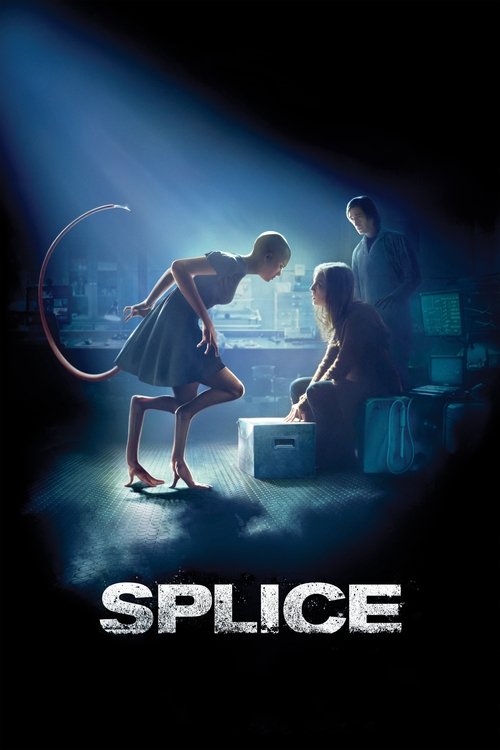
Splice
2010 · Vincenzo Natali
For when you want smart, boundary-pushing sci-fi horror that will genuinely disturb you and fuel an argument afterward. Firmly a challenge watch — provocative, not cozy.
What it's about
Two hotshot genetic engineers — partners in work and in love — defy their employer and splice human DNA into a new organism. The result is Dren, a fast-maturing creature they hide and raise: first a specimen, then a surrogate daughter, then something neither can control or name. It's a mad-science story told as a domestic drama about two people disastrously unready to be parents.
The experience
Queasy and fascinating in equal measure — it keeps shifting from lab thriller to uncomfortable family drama to full creature feature, and it goes places mainstream science fiction almost never dares. Expect to squirm; it's designed to transgress, and it does.
Performances
Adrien Brody and Sarah Polley ground the madness by playing it as a failing relationship rather than a monster movie, and Delphine Chanéac gives Dren an eerie, wordless expressiveness that keeps the creature sympathetic even at her most alien.
The craft
Vincenzo Natali's creature design is the star: Dren evolves through stages blending practical effects, performance, and digital work into something genuinely novel — beautiful and wrong at once. The script knowingly rewrites the Frankenstein story as a parable about parenthood and scientific ambition, naming its leads after classic horror stars as a tip of the hat.
Why it matters
A Sundance premiere that improbably got a wide studio release, it became a touchstone for 2010s bio-horror and is still cited whenever films dare to mix creature design with taboo-breaking intimacy.
Snapshot
Splice is a Canadian–French bio-horror film. Its story follows two married-in-all-but-name genetic engineers, Clive Nicoli (Adrien Brody) and Elsa Kast (Sarah Polley). Without permission they splice human DNA into an animal hybrid, and the result is Dren, a fast-maturing chimera. They raise her in secret, first as a lab specimen, then as a surrogate daughter, and finally as something neither of them can name. The film rewrites Frankenstein as a domestic drama about parenthood, and it is pointedly explicit about this: the leads are named after Colin Clive and Elsa Lanchester, stars of Bride of Frankenstein (1935). It moves from laboratory procedural to dysfunctional family comedy to sexual transgression and then to a creature-feature ending. It premiered at Sundance in 2010 and went on to a wide American studio release. The film is known for the nerve of its third act. Critics broadly admired it and mainstream audiences were often hostile to it. It remains Natali's best-known film after Cube (1997), and it is one of the defining English-language "body horror" films of its decade.
Industry & production
Natali developed Splice for about a decade before it was made. He has said in interviews that he co-wrote the first drafts in the late 1990s, after Cube. He also said the project stalled for years because the creature seemed impossible to realise convincingly on an independent budget. The screenplay is credited to Natali, Antoinette Terry Bryant and Doug Taylor.
The film was produced by Steve Hoban's Toronto company Copperheart Entertainment as a Canadian–French co-production with Gaumont. Guillermo del Toro was an executive producer, and his name was prominent in the marketing. It was shot in and around Toronto. Like much Canadian genre production of the period, the financing relied on the country's co-production treaties and public funding structures.
The film played in Sundance's midnight section in January 2010. Warner Bros. then acquired American distribution, with Joel Silver's horror label Dark Castle Entertainment involved, and opened it wide in early June 2010. That was an unusual route for a film this strange: an auteur-driven Canadian co-production sold through a festival into a summer studio slot. The marketing presented it largely as a creature thriller. Commentators widely noted a mismatch between that campaign and the film's psychological, sexually transgressive content, and its theatrical performance was generally considered disappointing. This dossier does not give specific budget and gross figures, because the reported numbers vary.
Technology
Dren is a hybrid in production terms as well as in the story. As an adult she is played by the French actress Delphine Chanéac, whose performance was digitally altered. The changes included digitigrade, backward-jointed legs, a prehensile tail with a stinger, later a pair of wings, and modifications to the face and head that make her subtly inhuman. Her earlier, more animal stages combined practical creature work with CGI. The child stage is played by Abigail Chu, also with digital alteration.
The design strategy matters to the film's effect. Dren's appeal and her horror both depend on her being almost human. The digital work is mostly subtractive and deformative: it pushes a real performer's body slightly out of true rather than replacing it outright. This uncanny-valley approach is the film's main technical bet. Natali had argued that it only became affordable in the late 2000s. The proto-Dren hybrids Fred and Ginger are slug-like masses of flesh and were achieved mainly through CG. The precise division of labour between effects houses is not consistently documented in accessible sources, so it is not itemised here.
Technique
Cinematography
The cinematographer was Tetsuo Nagata, the French-Japanese director of photography whose recent credits included La Vie en Rose (2007). His work is cool and clinical in the laboratory sections, with steely blues, sterile whites and hard practical light. It warms noticeably when the story moves to Elsa's derelict family farmhouse, which becomes the setting for the film's middle and final acts. The colour move from lab to barn tracks the story's shift from science to family, and from institutional control to private, unsupervised obsession. Nagata generally shoots Dren with restraint. The camera often frames her in partial view, half-lit or in medium shots that let the viewer grow used to her rather than presenting her as a spectacle. This calm style helps the film's more lurid turns land with greater force.
Editing
The editor was Michele Conroy, a regular collaborator of Cronenberg-adjacent Canadian productions. She cuts the film as a compressed developmental chronicle. Dren's accelerated growth requires repeated time jumps, and the editing handles them through short montage passages and scene-to-scene ellipsis rather than title cards. The overall rhythm is deliberately uneven. Long, observational domestic scenes give way abruptly to violent set pieces. The most notorious example is the corporate presentation sequence, where Fred and Ginger tear each other apart in front of an audience. Its sudden escalation shows the film's habit of puncturing composure with carnage.
Mise-en-scène / staging
Todd Cherniawsky's production design builds three spaces that structure the film. The first is the N.E.R.D. lab (Nucleic Exchange Research and Development), a corporate space full of incubators and screens, decorated by the young scientists with pop ephemera that marks them as hip and irreverent. The second is Clive and Elsa's apartment, cluttered and childless. The third is the farmhouse, Elsa's childhood home, still holding the traces of an abusive mother. Elsa's preserved childhood room becomes Dren's nursery and later her prison. This makes literal the film's central idea that Elsa is restaging her own upbringing. Natali stages many of the key exchanges as family tableaux: a dinner, a dress-up session, a dance. These are domestic set pieces made grotesque by the creature in their midst.
Sound
Cyrille Aufort's orchestral score leans toward the lyrical and even the tender, especially in the themes associated with Dren. It invites sympathy rather than dread for much of the running time. The sound design gives Dren a vocabulary of chirps, clicks and trills in place of speech. She communicates through these sounds and, famously, through Scrabble tiles, spelling out "TREND", from which Elsa derives her name ("NERD" reversed). Withholding language from Dren sets the terms of the drama. Her inner life has to be inferred from vocalisation, gesture and eyes, and it is never stated.
Performance
Chanéac's performance is the centre of the film. She plays Dren almost entirely without dialogue, through bird-like head movements, a tilted and curious gaze, and abrupt shifts between infantile need and predatory menace. Critics often singled out the performance for creating a coherent, sympathetic character inside heavy digital modification.
Polley plays Elsa as brilliant, controlling and emotionally damaged. The character's maternal impulse curdles into cruelty, peaking in the scene where she surgically removes Dren's stinger while Dren is restrained. Brody's Clive is the ostensibly cautious partner who at first wants to destroy the specimen. He then commits the film's most transgressive act and has sex with the adult Dren. The two actors play the couple's banter naturalistically, which keeps the film anchored in recognisable relationship drama. Supporting roles include David Hewlett, a frequent Natali collaborator, as Clive's brother Gavin's boss Barlow; Brandon McGibbon as Gavin; and Simona Maicanescu as the corporate executive Joan Chorot.
Narrative & dramatic mode
The film is built as an accelerated life cycle: gestation, birth, infancy, childhood, adolescence, sexual maturity and metamorphosis. Each stage brings new parental crises in compressed form. The tone is deliberately mixed. Early scenes have a wry, almost comic energy as the scientists bicker and improvise. The middle section works as dark family melodrama. The final act turns sharply into horror. Dren, having undergone a sex change triggered by her life cycle, becomes male, kills Gavin and Barlow, and rapes Elsa before he is killed.
The coda shows Elsa pregnant and agreeing to carry the child for the corporation, which closes the loop of exploitation. These swerves were the most contested aspect of the film's reception. Some viewers took them as audacious escalation and others as tonal incoherence. The dramatic logic is consistent, though: each act of transgression by the parents comes back on them in amplified form. The film refuses a stable moral position. Clive and Elsa are both sympathetic and culpable. Dren is both victim and threat. The corporation, the film's most straightforwardly bad actor, ends up with what it wanted.
Genre & cycle
Splice belongs to the line of "mad scientist" and creature horror that runs from Frankenstein (1931) and Bride of Frankenstein through H. G. Wells's The Island of Doctor Moreau and its adaptations. It belongs most directly to Canadian body horror as defined by David Cronenberg. Its closest model is The Fly (1986), which also fuses a love story, scientific hubris and physical transformation. Its sexual hybridity also recalls the reproductive anxieties of the Alien series. Species (1995) is another reference point, since its sexually mature female hybrid was a commercial template. Splice largely inverts that film's exploitation framing by putting the creators' psychology at the centre rather than the creature's threat.
Within its own moment, Splice sits among late-2000s and early-2010s genre films that returned to biotech anxiety at a time when found-footage and supernatural horror dominated the market. It is better read as a "prestige" or festival-bred genre film than as part of a commercial cycle.
Authorship & method
Vincenzo Natali, born in the United States and raised in Canada, worked as a storyboard artist before directing. He made his name with Cube (1997), a low-budget, high-concept puzzle film that became an international cult success. Cypher (2002) and Nothing (2003) followed. Across his career he works with confined spaces, conceptual premises, and pitch-black humour that sits alongside genuine horror. Splice is his most emotionally intimate film and his largest-scale production. His later work includes Haunter (2013), television directing on Hannibal and Westworld, and the Stephen King–Joe Hill adaptation In the Tall Grass (2019).
Key collaborators:
- Writers: Natali, Antoinette Terry Bryant and Doug Taylor.
- Cinematographer: Tetsuo Nagata.
- Editor: Michele Conroy.
- Composer: Cyrille Aufort.
- Production designer: Todd Cherniawsky.
- Producer: Steve Hoban, Natali's long-time producing partner at Copperheart.
- Executive producer: Guillermo del Toro, whose sensibility of sympathetic monsters and grotesque tenderness clearly fits the film's, although Natali is its author.
- Actor: David Hewlett has appeared in several Natali films, including Cube, Cypher and Nothing.
Natali's method for Splice puts the conceptual premise in service of character. The science is plausible enough to pass, and the real subject is the couple.
Movement / national cinema
Splice sits squarely in the tradition of English-Canadian genre cinema, which runs from the tax-shelter horror of the 1970s and early 1980s through Cronenberg to the Toronto-based genre filmmakers of the 1990s and 2000s. Natali is one of the figures most often named as Cronenberg's successor in the "Canadian body horror" lineage. Splice is the film that most explicitly earns him that label. Its Gaumont co-production also places it within the Canada–France co-production framework, which shows in its partly European creative team (Nagata, Aufort, Chanéac). Its route to market, a Canadian independent production sold to a Hollywood studio, is typical of how ambitious Canadian genre films reached wide audiences in that period.
Era / period
The film appeared at the end of a decade of public debate about cloning, stem cells and transgenics. The cloning of Dolly the sheep (1996) was a background reference point, along with recurring controversies over human embryonic stem-cell research. The so-called Vacanti mouse, a lab mouse with a cartilage structure shaped like a human ear growing on its back, was widely circulated in the late 1990s, and Natali has cited such images as part of the film's genesis. The film's corporate setting reflects the 2000s turn of biotechnology toward private, patent-driven pharmaceutical research. Clive and Elsa want pure science, but their employer wants a marketable protein, and their transgression is partly a revolt against commercial constraints. Industrially, 2010 was a period when mid-budget original horror was being squeezed out of studio slates, which partly explains the awkward fit between the film and its summer release.
Themes
- Creation as parenthood. The film's central move is to read the Frankenstein story as a parenting story. Clive and Elsa disagree about whether to have children, and Dren becomes their displaced, unplanned child. Each stage of her development tests a parental failure: over-control, neglect, jealousy, punishment.
- Inherited trauma. Elsa's abusive mother is mostly invoked rather than shown, through the preserved farmhouse and Elsa's own account. Elsa reproduces that mother's cruelty. The film suggests that what we pass on is behavioural as well as genetic, and Elsa has secretly used her own DNA in Dren.
- Sexuality and taboo. The film deliberately confronts incest-adjacent and cross-species desire through Clive's sexual relationship with Dren, framed as both a betrayal of Elsa and an abuse of parental power. Dren's later rape of Elsa reverses those power relations violently. Critics debated whether these scenes are an intelligent exploration of taboo or provocation, and that debate is itself part of the film's identity.
- Gender and the body. Dren's sex change, the stinger's removal (read by many critics as a form of mutilation or castration) and Elsa's final pregnancy make the female body a site of control, modification and exploitation.
- Scientific hubris and corporate capture. The scientists' ambition is framed as rebellious and creative, but the system absorbs it. The ending, in which the corporation monetises the catastrophe, is the film's bleakest statement.
- The monster's subjectivity. In the del Toro mould, Dren is sympathetic for most of the film. She is curious, lonely, playful and hurt. Her turn to violence is presented as at least partly the result of how she was raised.
Reception, canon & influence
Critical reception. Splice was received well by many critics at Sundance and on release. Reviewers praised its ambition, Chanéac's performance and its refusal to soften its themes. Many compared it favourably with Cronenberg's work of the 1980s, particularly The Fly. Its third act drew the main objections, with some reviewers finding the escalation absurd or gratuitous. Mainstream audience response was markedly less favourable: exit polling was reportedly poor, and word of mouth widely described the film as disturbing or ridiculous. The film's box-office run was considered a disappointment for a wide summer release. The film has since acquired a solid cult and critical standing as one of the most daring studio-distributed horror films of its era. It regularly appears in retrospectives of body horror and twenty-first-century creature cinema.
Influences on the film (backward).
- Frankenstein (1931) and especially Bride of Frankenstein (1935), signalled by the protagonists' names.
- Mary Shelley's novel, with its focus on the creator's abandonment of the creature.
- H. G. Wells's The Island of Doctor Moreau and its hybrid humans.
- David Cronenberg's films, especially The Fly (1986), Dead Ringers (1988) and The Brood (1979). The Brood shares Splice's link between monstrous offspring and maternal trauma.
- The Alien series' reproductive horror.
- Species (1995), as the commercial precedent the film complicates.
- Guillermo del Toro's sympathetic-monster sensibility.
- Real-world biotech imagery of the late 1990s and 2000s.
Legacy (forward). It is hard to trace Splice's direct influence on specific later films, and the documentary record of filmmakers citing it is thin. What can be said is that it anticipates several currents in 2010s and 2020s genre cinema. These include the creator–creation dramas of artificial-life films, where the line between nurture, desire and control becomes the subject, as in Ex Machina (2014). They also include the revival of literary-scientific body horror and a wider cycle of "elevated" horror that treats family trauma as the true monster. Later works such as Cronenberg's Crimes of the Future (2022) and Yorgos Lanthimos's Poor Things (2023) share its fusion of bio-engineering, sexuality and the Frankenstein inheritance. These are best described as affinities, not established lines of descent. Within Natali's career, Splice is his most fully realised statement of themes he returned to in later work. Within Canadian genre cinema, it marks the clearest early-twenty-first-century continuation of the body-horror tradition Cronenberg established.
Influences: the films it descends from and the films it influenced
- Frankenstein (1931) — Its birth-in-the-lab set piece, where machinery, the creator's mania and the creature's first awkward movements are staged as a single event, is the template for Splice's incubator delivery of Dren.
- Bride of Frankenstein (1935) — Whale's mix of tender pathos and arch black comedy around a manufactured female creature, played by Elsa Lanchester through bird-like gesture and hisses with no dialogue, gives Splice both its tonal register and Chanéac's nonverbal performance method; the leads' names Clive and Elsa signal the debt.
- Island of Lost Souls (1932) — Lota the Panther Woman is an engineered human-animal hybrid whose maker steers her toward sex with a human. Splice turns this Moreau premise into Clive's transgression with Dren.
- It's Alive (1974) — Cohen keeps his monstrous infant mostly off-screen or in fragments and plays the parents' horror and protectiveness as the drama. Splice frames the newborn Dren in partial glimpses in the same way, putting the creature as child at the centre of a family crisis.
- Eraserhead (1977) — Lynch's practical baby, a mewling, reptilian thing the parents can neither love nor give up, shows how a single uncanny creature-infant in a cramped domestic space can carry the whole horror of reluctant parenthood.
- The Brood (1979) — Cronenberg makes monstrous offspring the literal outgrowth of a mother's trauma and staging, and Splice ties Dren to Elsa's abusive childhood in the same way, using the farmhouse as the place where repressed maternal history comes back.
- Alien (1979) — The chestburster's fast growth from small parasite to adult between scenes is the model for Splice's accelerated life cycle. Giger's biomechanical sexual design also sets the precedent for a creature whose anatomy codes as both phallic and vaginal.
- The Fly (1986) — Splice copies its structure: a scientific breakthrough becomes an intimate romantic and sexual tragedy between two or three people in a private lab, and the body-transformation horror builds in stages out of a relationship drama.
- Dead Ringers (1988) — Cronenberg's cold, clinical design, with gynaecological tools and sterile surfaces standing for sexual pathology, sets the visual language of Splice's lab, where reproductive science looks intimate and violating at once.
- Species (1995) — The studio precedent for an engineered hybrid female who grows from child to adult in days and turns her sexuality into a weapon. Splice takes the same accelerated-maturation premise and treats it as tragedy rather than chase thriller.
- Mimic (1997) — Del Toro's engineered 'Judas breed' evolves past its designers' control in a few generations. This bioengineering-gone-feral plot, from the man who became Splice's executive producer, prefigures Dren's change of sex and her third-act escape from her makers' design.
- Alien Resurrection (1997) — The human-alien Newborn, with its partly human face, attaches to Ripley as its mother and kills its alien parent. It anticipates Splice's hybrid whose half-human features make the creature's attachment and violence painfully familiar.
- Ex Machina (2014) — Vikander's Ava is made by digitally removing parts of a live actor's body rather than adding CG over it, the same subtractive uncanny-valley method used on Chanéac's proportions in Splice. Both films use it for a confined creator–creation drama that is also erotic.
- Lamb (2021) — A childless couple on a remote farm raise a human-animal hybrid as their daughter. The film keeps her partly out of frame for its first act, combines a child actor, puppetry and CG for her body, and stages calm, grotesque family scenes that match Splice's farmhouse section.
- Poor Things (2023) — Bella Baxter is a Bride-of-Frankenstein figure who grows from infant to adult over a few elliptical stages. Her development unfolds in leaps between scenes, the same chronicle structure Splice uses for Dren, and in both films the creator's possessiveness becomes sexual.
- The Shape of Water (2017) — Through a performer in prosthetics who never speaks and expresses everything through gesture, del Toro takes the sympathetic, sexualised lab creature held by scientists, the sensibility he brought to Splice, and plays it as romance instead of horror.
- Crimes of the Future (2022) — Cronenberg's return to surgery and organ engineering as erotic art follows the line Splice carried through the 2000s: Canadian body horror in which laboratory change to the body is a source of sexual and creative intimacy.
Similar films
- The Fly (1986) — influence & lineage
- Frankenstein (1931) — influence & lineage
- The Brood (1979) — influence & lineage
- Eraserhead (1977) — influence & lineage
- Dead Ringers (1988) — influence & lineage
- Bride of Frankenstein (1935) — influence & lineage
- Frankenstein (2025) — shared sensibility
- Annihilation (2018) — shared sensibility