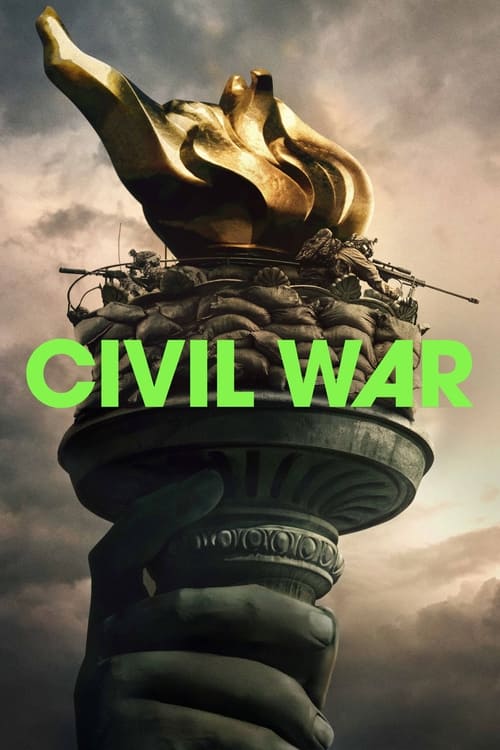
Civil War
2024 · Alex Garland
A24's biggest budget spent on refusing to name its politics — the "both-sides map" (California-Texas alliance) became the argument, making it 2024's designated discourse machine.
For when you want to be shaken, not entertained — a tense, immersive watch to argue about afterward. Absolutely not a comfort pick; reach for it when you're ready for a film that gets under your skin.
What it's about
In a near-future America torn apart by civil war, a team of war journalists drives from New York toward Washington, D.C., hoping to photograph and interview a besieged president before the capital falls. Along the way they pass through a country turned unrecognizable — checkpoints, militias, pockets of eerie normalcy — as a veteran photojournalist reluctantly takes a young aspirant under her wing.
The experience
Dread on a slow drip, punctured by combat sequences of shocking force. It's less a war movie than a road trip through a nightmare, deliberately cool and observational, and it leaves you rattled — asking what it costs to keep looking through a lens while the world burns.
Performances
Kirsten Dunst anchors the film as a hollowed-out veteran photographer, doing career-best work almost entirely through stillness and thousand-yard weariness — you read her whole history in how little she reacts.
The craft
Garland withholds the war's politics and puts everything into texture: sudden silences, freeze-frame still photographs interrupting the chaos, and a sound design that makes gunfire feel physically dangerous. This one genuinely demands the biggest screen and loudest speakers you can find.
Why it matters
A lightning-rod release that became a cultural argument about American division the moment it landed, and the biggest swing of Garland's directing career.
Snapshot
Civil War is Alex Garland's fourth feature as director and his most ambitious in scale, a road movie disguised as a war film in which a quartet of journalists drive from New York toward a besieged Washington, D.C., to photograph and interview a president in his final days. The premise—a fractured United States in which a secessionist alliance of Texas and California, the "Western Forces," advances on a federal government led by an authoritarian third-term president—was widely read as provocation, but the film is conspicuously incurious about the politics that produced the war. Its subject is instead the labor and psychology of war reportage: what it costs to look, to frame, to keep shooting. Built around Kirsten Dunst's performance as a depleted veteran photojournalist, the film advances a deliberately affectless, observational mode that divided critics between those who found it a bracing study of moral exhaustion and those who found its refusal to assign blame a failure of nerve. Released by A24 in April 2024 and reported to be the studio's most expensive production to that point, it functioned as a test case for whether a mid-budget, hard-R, formally austere spectacle could command a wide theatrical audience.
Industry & production
Civil War was produced by A24 in association with DNA Films (the company of longtime Garland collaborators Andrew Macdonald and Allon Reich) and distributed theatrically by A24 in North America, with the UK and other territories handled through Entertainment Film Distributors and other partners. The film is significant in industrial terms chiefly as a marker of A24's evolution from a boutique distributor of low-budget auteur cinema into a studio willing to finance large-scale productions; it was widely reported as the company's costliest film, with budget estimates circulating around the $50 million mark. I treat that figure as a reported estimate rather than a confirmed accounting, as studios of A24's kind do not publish precise budgets.
Principal photography took place largely in and around Atlanta, Georgia, exploiting Georgia's production incentives and its capacity to double for multiple American regions, with additional location work standing in for the Eastern Seaboard and the approach to Washington. The marketing campaign became a minor industrial event in itself: A24 mounted an unusually aggressive promotional push, including IMAX previews and a provocative poster and trailer strategy that foregrounded images of armed conflict on American soil. The film was given a wide release across formats including IMAX, a deliberate bid to position an art-cinema sensibility as four-quadrant spectacle.
Technology
Civil War was shot digitally and finished for large-format presentation, with IMAX exhibition treated as a primary rather than ancillary format—the expansive aspect ratio reserved for the film's set-piece battle sequences gives the combat a documentary grandeur that contrasts with the more intimate framing of the journalists' downtime. The film's most distinctive technological gesture is diegetic rather than infrastructural: Garland punctuates the action with still photographs, rendered in high-contrast black-and-white and color, that freeze the moving image into the kind of frame a press photographer would file. These inserts are the film's signature device, and they depend on the seamless integration of motion capture of violence with the still image, a reminder that the film is constantly converting its own spectacle into the artifact of journalism.
Sound and effects technology serve a hyperrealist agenda: weapons fire, helicopter rotors, and the concussive percussion of ordnance are rendered with a dynamic range that, in a properly calibrated theater, becomes physically assaultive, a calculated use of theatrical sound systems to collapse the distance between spectator and combat.
Technique
Cinematography
Rob Hardy, Garland's regular director of photography since Ex Machina, shot the film, and his work here marks a shift from the controlled, hermetic interiors of their earlier collaborations toward a more mobile, reactive idiom. The camera frequently behaves like a fifth member of the press team—handheld, searching, sometimes caught flat-footed by violence that erupts at the edge of frame. Hardy alternates this reportorial restlessness with passages of eerie stillness: depopulated highways, a burning forest, a gas station in the grip of casual cruelty, all photographed with a clarity that estranges the familiar American landscape. The film's lighting tends toward an overcast naturalism punctuated by the high-key glare of muzzle flash and the artificial color of flares, and the climactic assault on Washington is staged in part under cover of darkness lit by tracer fire and explosions, a deliberately disorienting palette. Throughout, Hardy's framing is organized around the act of looking—characters raising cameras, the audience's view repeatedly aligned with and then severed from the viewfinder.
Editing
Jake Roberts, who also cut Garland's Men, edits with a rhythm that mirrors the journalists' experience of war as long stretches of waiting interrupted by sudden, unsurvivable intensity. The film's most discussed editorial strategy is its interpolation of still frames: at moments of violence the motion picture drops into a sequence of photographic stills, sometimes accompanied by the mechanical click of a shutter, sometimes by silence, arresting the flow and forcing the viewer to contemplate the image as composed object. This device performs several functions at once—it dramatizes the photographer's craft, it implicates the viewer in the aestheticization of suffering, and it withholds the conventional catharsis of continuous action. Elsewhere the cutting is patient, lingering on faces and dead time, building dread through duration rather than acceleration.
Mise-en-scène / staging
The film's production design renders a recognizable America rendered uncanny: refugee camps in sports stadiums, abandoned vehicles, hand-painted slogans, the detritus of collapsed infrastructure. Garland and his designers resist the temptation to mark the war with clear partisan iconography; the warring factions are defined by tactical patches and improvised insignia rather than recognizable contemporary political symbols, a choice consistent with the film's refusal to allegorize current party politics directly. Staging emphasizes spatial confusion—who is shooting at whom, and why, is frequently unknowable to the characters and the audience alike—which is itself the point. The single most concentrated set piece is the assault on Washington and the storming of the White House, staged with the granular logic of an infantry operation rather than the iconography of insurrection.
Sound
The score is by Geoff Barrow and Ben Salisbury, Garland's standing musical collaborators, whose synthetic, often abrasive textures shaped Ex Machina, Annihilation, and Devs. Against expectation, the film also deploys an ironic counterpoint of licensed songs—upbeat, incongruously cheerful tracks laid over scenes of violence and aftermath—a Kubrickian estrangement device that drains the imagery of conventional moral framing. The sound design is the film's most visceral tool: gunfire is rendered without romanticism, percussive and shockingly loud, and the contrast between near-silence and sudden detonation is used repeatedly to ambush the viewer, reproducing the journalists' own vulnerability to the unannounced.
Performance
Kirsten Dunst anchors the film as Lee, a celebrated war photographer hollowed out by what she has witnessed; the role's surname, Smith, and the character's evident lineage gesture toward the tradition of combat photojournalism, and the performance is built on suppression—flat affect, economy of gesture, a face that has trained itself not to react. Wagner Moura plays Joel, a reporter whose adrenalized appetite for the story masks his own fraying, and Cailee Spaeny plays Jessie, the young aspirant whose arc inverts Lee's: where Lee numbs, Jessie awakens to the seductions of the work. Stephen McKinley Henderson lends warmth and gravity as the aging journalist Sammy. The film's most cited single scene is a sustained encounter with a militiaman played by Jesse Plemons, whose genial, sunglassed interrogation—"What kind of American are you?"—compresses the film's terror into a few minutes of conversational menace.
Narrative & dramatic mode
Civil War is structured as a quest-shaped road movie: a journey with a fixed destination (Washington), episodic encounters along the way, and a generational hand-off at its core. Its dramatic mode is deliberately observational and withholding. Garland declines to supply the expository backstory a conventional political thriller would provide—we never learn the precise causes of the war, the ideologies of the factions, or the policies of the president—and this evacuation of context is the film's central formal wager. The drama is displaced from geopolitics onto craft and succession: the real plot is the transmission of a vocation, and its costs, from the burnt-out master to the eager apprentice. This makes the film a character study wearing the clothes of an action spectacle, and the friction between those two registers—the contemplative and the kinetic—is the source of both its admirers' praise and its detractors' frustration.
Genre & cycle
The film sits at the intersection of the war film, the road movie, and the journalism procedural. Its closest generic ancestors are the combat-correspondent dramas of the late twentieth century—films concerned less with battle than with the people who photograph it. By transposing that tradition onto American soil, Civil War also enters the lineage of the dystopian near-future film and the long American tradition of imagining national collapse. It belongs, too, to a mid-2020s cycle of films and series preoccupied with internal fracture and the fragility of the American polity, though it distinguishes itself from more overtly partisan entries by its studied refusal of allegory. Within Garland's own filmography it represents a movement outward from chamber-piece science fiction toward a more expansive, materialist register, while retaining his characteristic interest in cognition, perception, and the limits of empathy.
Authorship & method
Alex Garland came to directing from screenwriting (28 Days Later, Sunshine, Dredd) and novels (The Beach), and his directorial work—Ex Machina, Annihilation, the series Devs, and Men—is marked by formal control, conceptual provocation, and an interest in systems that exceed human understanding. Civil War extends his method's signature ambiguity into political territory, applying to the nation the same withholding, unresolved treatment he had applied to artificial intelligence and the unconscious. His authorial practice is notably collaborative and consistent: cinematographer Rob Hardy, composers Geoff Barrow and Ben Salisbury, and producers Andrew Macdonald, Allon Reich, and DNA Films constitute a repertory company whose continuity gives Garland's films a recognizable house style—cool, precise, sonically aggressive, intellectually cold. Editor Jake Roberts, carried over from Men, sustains that sensibility. Garland wrote the screenplay himself, as he has for all his features, and his decision to strip the script of political specificity was both the film's organizing principle and its most contested authorial choice. Around this period Garland publicly signaled ambivalence about continuing to direct, which lends the film a valedictory air for some readers, though his subsequent work complicates any clean narrative of withdrawal.
Movement / national cinema
Garland is a British filmmaker working within the orbit of a British production company, DNA Films, but financed and distributed through the American independent studio A24, and Civil War is best understood as a transatlantic production turning an outsider's eye on the United States. That perspectival distance is arguably central to the film: it imagines American catastrophe with the detachment of a foreign correspondent, and its refusal to take a domestic political side may owe something to the director's position as an observer rather than a partisan. The film thus belongs less to any national movement than to the contemporary phenomenon of globally financed, internationally authored cinema that treats America as both setting and subject.
Era / period
The film is set in a deliberately unspecified near future, close enough to the present to be unsettling but vague enough to avoid literal prediction. Its production and release in 2024 placed it squarely within a period of acute anxiety about American political stability, and the film's reception was inseparable from that climate; audiences inevitably read its imagery of domestic armed conflict against the headlines of the moment. Garland's strategy of temporal and political vagueness was a means of insulating the film against being reduced to a forecast of any single election or faction, aiming instead for a more durable parable about how societies normalize atrocity and how those who document it are changed.
Themes
The film's governing theme is the ethics and psychology of witness: what it means to make images of suffering, whether the act of documentation is a form of moral seriousness or a sublimated thrill, and how repeated exposure to violence both numbs and addicts. Lee's deadened affect and Jessie's dawning exhilaration map the two poles of this question. A second major theme is desensitization—the film argues, through its detached form as much as its content, that horror becomes routine, that people adapt to the unthinkable with terrifying speed. The deliberate withholding of political cause foregrounds a third concern: the failure of comprehension, the way participants in catastrophe cannot see its shape from within. Finally, the film meditates on succession and the transmission of vocation across generations, and on the complicity of the spectator, who is made—through the still-frame device—to share in the aestheticizing gaze.
Reception, canon & influence
Critical reception was substantial and divided. Many reviewers praised the film's craft—Hardy's cinematography, the sound design's visceral force, Dunst's controlled central performance, and the Plemons sequence singled out almost universally as its peak—and admired its refusal of easy partisanship as a mark of integrity and ambiguity. Others judged that same refusal evasive, arguing that a film invoking American civil war while declining to engage the actual fault lines of American politics had abdicated its responsibility, or had it both ways: trading on incendiary imagery while disclaiming any argument. The debate over whether the film's political agnosticism was principled or cowardly became the defining feature of its discourse.
The influences flowing into the film are legible. Backward, it draws on the tradition of war-correspondent cinema and on the documentary and photojournalistic record of twentieth-century conflict—the iconography of the embedded photographer, the famous combat images that the film's still-frame inserts evoke. Garland has cited the conventions of war reportage as a model, and the character of Lee resonates with the lineage of women combat photographers. Formally, the ironic use of incongruous pop music over violence and the cool, affectless register recall the Kubrickian and the broader tradition of estranging war cinema. Within Garland's own work it extends the perceptual and ethical preoccupations of Ex Machina and Annihilation into the political field.
Its forward influence is, at the time of writing, still emerging and should be stated with appropriate caution. The film's most immediate legacy was industrial—as a demonstration that A24 could mount and market a large-scale, formally uncompromising spectacle—and discursive, as a touchstone in arguments about whether and how popular cinema should represent the possibility of American disintegration. Whether its specific techniques, especially the photographic-still device, will be widely emulated remains to be seen; the historical record on its lasting influence is genuinely thin this close to release, and any claim to canonical status would be premature.
A Deleuzian reading
Watch your own body the first time the film does it.
The full Deleuzian reading of Civil War →
Reception
It opened huge for A24 in April 2024 amid a firestorm over its refusal to explain the war's politics — accused of both cowardice and genius. Time has cooled the hot takes, and it's increasingly read as a film about war journalism rather than the American-politics prophecy people wanted or feared.
How Civil War was received, from release to now →
Influences: the films it descends from and the films it influenced
- Under Fire (1983) — A war-photographer protagonist whose ethical crisis over staging and withholding a single image models Lee's combat-correspondent dilemma of when to shoot and when to intervene.
- The Killing Fields (1984) — Builds its drama as a journalism-procedural in which embedded reporters navigate a collapsing nation, the same witness-as-protagonist structure Garland adopts.
- Salvador (1986) — A gonzo photojournalist road-trip through a disintegrating state foregrounds the ethics of capturing the death-image, anticipating the film's desensitization theme.
- Apocalypse Now (1979) — A road/river journey deeper into war scored with ironic licensed rock, plus Dennis Hopper's manic photojournalist as forebear of the embedded-witness figure.
- Full Metal Jacket (1987) — The affectless register and incongruous pop songs laid over combat ('Surfin' Bird') are the direct template for Garland's ironic licensed-song scoring of violence.
- The Battle of Algiers (1966) — Handheld, newsreel-grain staging that makes wholly fictional combat read as captured documentary reportage.
- Medium Cool (1969) — A cameraman's complicity in recording rather than intervening dramatizes the ethics-of-witness that is the film's moral core.
- Come and See (1985) — Relentless subjective immersion charts a witness's progressive desensitization through escalating atrocity, the perceptual arc Garland gives his junior photographer.
- La Jetée (1962) — A narrative built almost entirely from photographic stills establishes the freeze-frame as the privileged unit of memory, source-DNA for the still-frame interpolation device.
- Children of Men (2006) — Handheld long-take immersion in a near-future societal collapse staged on uncanny-familiar domestic ground, the visual grammar of 'uncanny-America' here.
- The Hurt Locker (2008) — Embedded handheld vérité combat with hyperreal sound that privileges procedural tension and bodily immediacy over stated politics.
- Saving Private Ryan (1998) — Desaturated handheld combat and concussive, hyperreal gunfire set the visceral battle-realism template the film's firefights inherit.
- Warfare (2025) — Garland's immediate follow-up pushes the embedded-reportage handheld camera and hyperreal-gunfire sound aesthetic to unbroken real-time combat immersion.
- Ex Machina (2014) — Same authorial withholding of context and cool, sonically aggressive register from the recurring Hardy/Barrow-Salisbury repertory company.
- Annihilation (2018) — Extends the identical uncanny-Americana staging and perceptual unease into a continuous, recognizable house style applied across genres.
- Sicario (2015) — A cool procedural descent into a war zone driven by aggressive low-frequency sound design and a watchful female protagonist deliberately withheld from full agency.
- 28 Years Later: The Bone Temple (2026) — Garland's embedded-photojournalist handheld treatment of national collapse, a sibling in war-reportage immediacy and the ethics-of-witnessing that braids through the series.
- Eddington (2025) — Widescreen-landscape-isolation framing of a fracturing United States, using composed emptiness and sudden eruptions to render present-tense national breakdown as genre cinema.
- 28 Years Later (2025) — Garland's allegory of a fractured nation supplies the conceptual architecture of post-Brexit dread he brings to this screenplay.
Similar films
- Warfare (2025) — influence & lineage
- The Hurt Locker (2008) — influence & lineage
- One Battle After Another (2025) — shared sensibility
- The Post (2017) — shared sensibility
- Platoon (1986) — shared sensibility
- American Sniper (2014) — shared sensibility
- The Birth of a Nation (1915) — shared sensibility
- Punishment Park (1971) — shared sensibility