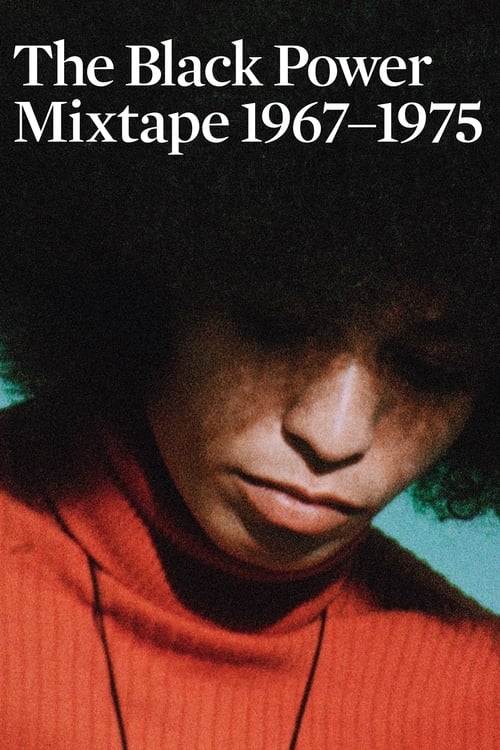
The Black Power Mixtape 1967-1975
2011 · Göran Olsson
When you want a documentary with real substance — to learn something, feel the texture of a historical moment, and come away with things to talk about. Engaged-brain viewing, not background noise.
What it's about
Swedish television journalists spent nearly a decade filming the American Black Power movement, and their 16mm footage sat in a Stockholm vault for thirty years. This documentary assembles it chronologically, 1967 to 1975: Stokely Carmichael's speeches, the Black Panther Party's breakfast programs, Angela Davis in prison, and the movement's slow fracturing under government pressure and the arrival of hard drugs. It's American history seen through outsiders' eyes, with contemporary voices reflecting over the images.
The experience
Absorbing and quietly electric — the footage has an intimacy American news cameras rarely got, catching leaders in kitchens and classrooms rather than just at podiums. It builds from exhilaration to something heavier, and it leaves you thinking about how movements are remembered and who gets to film them.
The craft
The craft here is curation: director Göran Olsson resists the urge to explain, organizing the material year by year and letting the archival images carry the argument, with audio commentary laid over rather than talking heads cut in. The 16mm footage itself is gorgeous — grainy, close, human — and the mixtape structure gives history the momentum of an album.
Why it matters
Its rediscovered-archive approach helped fuel a wave of documentaries built from dormant footage, and it reintroduced the Black Power era to a new generation as living people rather than iconography.
Snapshot
The Black Power Mixtape 1967–1975 is a Swedish-produced archival documentary that reconstructs nearly a decade of the American Black Power movement out of 16mm footage shot by Swedish television journalists who traveled to the United States between 1967 and 1975. Director Göran Hugo Olsson found the material dormant in the vaults of Sveriges Television (SVT), the Swedish public broadcaster, and organized it chronologically, year by year, into a portrait of the movement's arc — from the rhetorical militancy of Stokely Carmichael, through the Black Panther Party's community programs and the persecution of Huey P. Newton, Bobby Seale, Eldridge Cleaver, and Angela Davis, into the disillusionment and drug economies of the mid-1970s. Rather than narrate over the footage in the conventional expository voice, Olsson layered contemporary audio commentary from later-generation artists, scholars, and surviving participants — among them Angela Davis herself, Kathleen Cleaver, Harry Belafonte, Sonia Sanchez, Abiodun Oyewole, Erykah Badu, Talib Kweli, and Ahmir "Questlove" Thompson — producing what the title frankly announces: a "mixtape," a curated remix of found sound and image. It premiered at the 2011 Sundance Film Festival and became one of the most widely discussed archival documentaries of its year, prized less for original reporting than for the act of recovery and re-framing.
Industry & production
The film is a European production about an American subject, and that transatlantic origin is central to both its material and its politics. The core footage belonged to SVT, having been shot by Swedish reporters and crews for Swedish broadcast during the movement's active years; the outsider vantage of Scandinavian journalists — sympathetic, curious, and largely free of the domestic anxieties that shaped U.S. network coverage — is one of the film's recurring themes. Olsson assembled the project through the Swedish production company Story AB, with co-production involvement from SVT and from Louverture Films, the New York company founded by actor-activist Danny Glover and producer Joslyn Barnes, which specializes in politically engaged international cinema. Additional support came from Nordic and public-broadcasting funding structures typical of Swedish documentary. The involvement of Louverture provided an American bridge — access to contemporary commentators and to U.S. distribution. The film was released theatrically in the United States by Sundance Selects / IFC, reaching art-house and specialty audiences rather than a wide commercial run; precise box-office figures are not something I can cite reliably, and the film's economic profile is that of a modestly budgeted archival documentary rather than a theatrical event.
Technology
The project's technological identity is doubled: it is a digital film built almost entirely from analog materials. The original images are 16mm film and early videotape captured by 1960s and 1970s television crews, with the grain, color shifts, and optical texture of that era's news and documentary stock. Olsson's production digitized and restored this footage, and the finished film's aesthetic depends on preserving — rather than sanitizing — its archival surface: the scratches, the period color, the handheld immediacy of equipment carried into rallies, prisons, and apartments. Layered against this is a contemporary digital soundtrack, recorded decades later, so that the film's technology is essentially a marriage of archival 16mm imagery to a modern multitrack audio commentary and score. This is not a film of technical innovation in the apparatus sense; its "technology" is archival and curatorial — the machinery of the broadcast vault, telecine transfer, and digital editing turned toward recovery.
Technique
Cinematography
Because the images were shot by many different Swedish crews across nearly a decade, there is no single authored camera style; the cinematography is found rather than composed. What unifies it is the sensibility of foreign television journalism of the period: direct, observational, willing to sit with a subject. The footage ranges from formal sit-down interviews — most famously Angela Davis speaking from jail — to handheld coverage of street demonstrations, Panther offices, and community breakfast programs. The recurring visual grammar is the frontal interview and the roving reportage shot, and Olsson trusts these images to carry weight without stylization. The outsider camera repeatedly finds intimacy: Stokely Carmichael, in one celebrated sequence, effectively takes over the interview to question his own mother, and the camera's willingness to hold on that exchange is characteristic of the material's patient, unhurried framing.
Editing
Editing is the film's authorial center and its most decorated element — the picture won the World Cinema Documentary Editing Award at Sundance 2011, and the citation is apt because the film is, in essence, an act of editing. The organizing device is chronological: the film advances year by year through title cards from 1967 to 1975, giving a sprawling archive a clear temporal spine. Within that structure, editors Hanna Lejonqvist and Olsson interleave archival image with newly recorded voice-over so that a present-day speaker often comments over footage they are watching for the first time, creating a dialogue across decades. The "mixtape" logic governs the cutting: fragments are juxtaposed for rhythm and resonance rather than seamless continuity, and the film openly foregrounds its own construction as assemblage.
Mise-en-scène / staging
As a compilation documentary, the film has no staged mise-en-scène of its own; its "staging" is the historical reality the Swedish crews recorded and the curatorial arrangement Olsson imposes. What the film does control is the framing of the archive — the choice of which interview, which rally, which domestic interior to present, and in what order. The contemporary commentary is presented as pure audio, without cutting away to talking-head shots of the present-day speakers, a deliberate staging decision that keeps the viewer's eye inside the past while the present speaks from off-screen. This refusal to show the commentators is one of the film's defining formal gestures.
Sound
Sound is where the film most clearly becomes a 2011 work rather than a 1970s one. The contemporary voice-over — Davis, Belafonte, Sanchez, Kathleen Cleaver, Oyewole, Badu, Kweli, and others — forms an audio essay that runs beneath and between the images. The musical score is credited to Ahmir "Questlove" Thompson of The Roots together with Om'Mas Keith, and it grounds the film's sonic identity in hip-hop and soul, drawing an explicit line from the movement to the Black popular music that inherited its politics. The mixtape conceit is thus literalized in the sound design: archival speech, present-day reflection, and original score are layered like tracks.
Performance
There is no acting; the "performances" are the historical presences captured on film. What the footage preserves is a gallery of the movement's rhetorical styles — Carmichael's oratorical fire, Newton's and Seale's leadership, Cleaver's provocations from exile, and above all Angela Davis, whose composed, incisive prison interview is the film's most-cited passage. The archival Davis is answered by the present-day Davis on the soundtrack, a doubling that gives the film an unusual reflexive charge: a historical figure narrating her own image across forty years.
Narrative & dramatic mode
The film's mode is the essayistic compilation documentary rather than dramatized or fully expository history. It does not supply an omniscient narrator marshaling facts toward a thesis; instead it proceeds associatively, letting the chronological structure imply a narrative of rise, repression, and dissolution while the layered commentary supplies interpretation. The dramatic arc emerges from history itself — the movement's early confidence giving way to state repression (COINTELPRO, imprisonment, exile, assassination) and, by the mid-1970s, to the social wreckage of poverty and heroin that the closing sections document. The film's stance is participatory and reflective rather than neutral; it is candidly sympathetic to its subjects, and it treats the archive as evidence to be felt as much as analyzed.
Genre & cycle
It sits squarely within the archival/compilation documentary — the tradition of films built from found footage and re-contextualization rather than original shooting. More specifically it belongs to a 2000s–2010s cycle of documentaries revisiting the civil rights and Black Power eras through recovered media and a contemporary lens, works interested in memory, in who controls the historical image, and in connecting the movement to present-day Black culture. Olsson himself extended this vein with a companion project, Concerning Violence (2014), which applied a similar archival-essay method to African liberation struggles using Frantz Fanon's text. Within Swedish documentary, the film is part of a strong public-service tradition of archive-based nonfiction.
Authorship & method
Göran Hugo Olsson is the film's author in the curatorial sense: the directorial act here is discovery, selection, structuring, and the invention of the contemporary-commentary layer. His method — treating a broadcast archive as raw material and re-editing it into a first-person essay — defines his body of work and reaches its fullest expression in the Mixtape/Concerning Violence pair. The key collaborators reflect this compilation method: editor Hanna Lejonqvist, who shares the editing credit and the film's central creative burden with Olsson; the anonymous Swedish television cinematographers whose original footage constitutes the film's image track; and the musical authorship of Questlove and Om'Mas Keith, whose score situates the film in a Black-music continuum. Producers Danny Glover and Joslyn Barnes of Louverture Films were instrumental in shaping the American dimension and securing the contemporary voices. The "screenplay," in a compilation film, is effectively the edit and the assembled commentary rather than a written script.
Movement / national cinema
The film is a Swedish film about America, and that hybrid identity is inseparable from its meaning. It grows from the Scandinavian public-broadcasting documentary tradition — well-funded, socially engaged, internationalist — and from the specific fact that Swedish left-leaning journalism of the 1960s and 70s took an active, sympathetic interest in American racial politics and the Vietnam-era ferment. The movie makes that outsider gaze part of its subject: it even includes a period fragment in which American commentary dismisses the Swedish coverage as biased, turning the question of who is authorized to document Black America into an explicit theme. As American cinema, it participates in the ongoing project of Black historical documentary; as Swedish cinema, it exemplifies the archive-essay film.
Era / period
The film covers 1967–1975 and was made and released in 2010–2011, and it is legible only through both dates. The depicted era is the high and late Black Power period — post–civil-rights radicalization, the Panthers' ascendancy and destruction, the trials of Newton, Seale, and Davis, and the movement's fraying under state pressure and economic collapse. The moment of production, by contrast, is the early Obama years, when questions of Black political memory and its relationship to the present were freshly urgent; the contemporary commentary implicitly reads the past against that later horizon. The film is thus a period piece twice over — about the years in its title and about the sensibility of the moment that recovered them.
Themes
Its central themes are the mechanics and morality of political violence and self-defense; the systematic repression of Black radicalism by the state; the tension between revolutionary rhetoric and community survival programs; and the movement's collision with poverty, addiction, and disillusionment by the mid-1970s. Running beneath these is a meta-theme about the archive itself: who records history, from what vantage, and how images made by foreign outsiders can preserve what domestic media might have flattened or ignored. The film is finally about memory and inheritance — the way the politics of 1967–1975 flow into the Black music and thought of the twenty-first century, a continuity its hip-hop-rooted score and its choice of contemporary narrators make explicit.
Reception, canon & influence
Critical reception was broadly strong. Reviewers praised the extraordinary quality and freshness of the recovered footage, the elegance of the year-by-year structure, and the intelligence of the contemporary-commentary device, while some noted the limits of the format — that the film gestures at the movement's sweep without offering the depth of a comprehensive history, and that the mixtape approach favors evocation over analysis. Its most concrete institutional recognition was the World Cinema Documentary Editing Award at the 2011 Sundance Film Festival, a fitting honor for a film whose art is the edit.
The influences on the film run backward to the compilation-documentary and film-essay traditions — the practice of authoring meaning through found footage — and to the specific archive of Swedish television journalism that supplied its raw material; the framing owes something to the essay-film lineage that treats archive as text to be read. The influence it exerted forward is clearest in Olsson's own subsequent Concerning Violence (2014), which systematized the Mixtape's method, and in the broader turn among 2010s documentaries toward archival recovery of Black political history and toward foregrounding the question of who owns the historical image. Its pairing of movement footage with a hip-hop-generation soundtrack and narration also helped model a way of connecting archival Black radicalism to contemporary Black culture that later documentaries and multimedia projects have echoed. Precise measures of its long-term canonical standing are hard to fix, but within the niche of archival civil-rights and Black Power documentary it is durably cited as a landmark of the recovered-footage form.
Reception
A Sundance 2011 hit that won the World Cinema Documentary Editing award, it's only grown in stature since — its profile spiked again around 2020, when it landed on seemingly every 'essential films on Black liberation' list.
How The Black Power Mixtape 1967-1975 was received, from release to now →
Influences: the films it descends from and the films it influenced
- The Fall of the Romanov Dynasty (1927) — Founded the compilation-documentary method the Mixtape lives by — authoring a historical argument entirely by selecting, ordering, and juxtaposing pre-existing newsreel footage rather than shooting anything new.
- Now! (1965) — Cut found photographs and newsreels of American racial violence to a single pop song (Lena Horne), inventing the archive-set-to-Black-music montage that the Mixtape's Questlove-scored sequences directly extend.
- In the Year of the Pig (1968) — Built a polemical feature purely from broadcast and archival material with no on-camera host, proving argument could be constructed through the edit alone — the 'no-narrator, meaning-in-the-cut' template the Mixtape adopts.
- Night and Fog (1955) — Pioneered layering a reflective, present-tense voiceover over historical archive so the commentary reads the images from a later vantage — the same past-footage/present-voice structure as the Mixtape's contemporary-commentator layer.
- A Grin Without a Cat (1977) — Assembled a first-person essay-film from the global New Left's own footage of 1967–77, treating movement archive as a text to be authored and interrogated — the essayistic compilation mode the Mixtape inherits.
- Sans Soleil (1983) — Established the associative essay-film in which a spoken commentary treats each recovered image as something to be read and questioned, modeling the Mixtape's 'who controls the archive' reflexivity.
- The Atomic Cafe (1982) — Composed an entire feature from government and TV archive with meaning generated by ironic juxtaposition and no editorial narration, an all-found-footage assembly the Mixtape's edit-as-authorship approach descends from.
- The Sorrow and the Pity (1969) — Interwove period archive with retrospective testimony to reconstruct a contested political era over long form, a template for combining recovered footage with belated voices to re-litigate history.
- Concerning Violence (2014) — Olsson's own sequel systematizes the Mixtape's exact method — re-editing the Swedish broadcast archive into a first-person essay — this time scoring the images to a recited Fanon text instead of contemporary commentators.
- I Am Not Your Negro (2016) — Drives an archival montage of Black political history with a single authored text (Baldwin's words) that reads the footage across past and present — the Mixtape's authored-voice-over-archive structure carried forward.
- 13th (2016) — Constructs its argument about the repression of Black radicalism through dense archival montage and, like the Mixtape, bridges that archive to the present with hip-hop and contemporary Black voices.
- MLK/FBI (2020) — Built from surveillance-era archive, it foregrounds the Mixtape's central question of who owns and controls the historical image of Black radicalism, mining the state's own footage against it.
- Summer of Soul (2021) — Resurrects long-buried festival footage of Black cultural life and frames it through present-day commentary and a musician's ear — the recovered-footage-plus-Black-music continuum the Mixtape's own Questlove score helped model.
- The Black Panthers: Vanguard of the Revolution (2015) — Recovers and re-edits period 16mm footage of Black Power organizing into a structured chronicle, part of the same 2010s archival-recovery turn toward reclaiming the movement's self-image.
- Free Angela and All Political Prisoners (2012) — Reconstructs Angela Davis's trial almost entirely from period news archive, sharing the Mixtape's reliance on recovered broadcast footage of the same figure and moment.
- HyperNormalisation (2016) — Mines a national public-service broadcast archive (the BBC's) to build an associative, essayistic montage authored through juxtaposition, the same practice of turning a television archive into a first-person essay.
- Soundtrack to a Coup d'Etat (2024) — Reactivates dormant archival footage of Black liberation with a contemporary sonic and vocal layer, the same strategy of letting period image and present-day audio commentary interrogate each other.
Similar films
- HyperNormalisation (2016) — influence & lineage
- Soundtrack to a Coup d'Etat (2024) — shared sensibility
- The Story of Lovers Rock (2011) — shared sensibility
- Judas and the Black Messiah (2021) — shared sensibility
- Paris Is Burning (1991) — shared sensibility
- Sankofa (1993) — shared sensibility
- La Commune (Paris, 1871) (2003) — shared sensibility
- Bad Black (2016) — shared sensibility
All the films related to The Black Power Mixtape 1967-1975 →