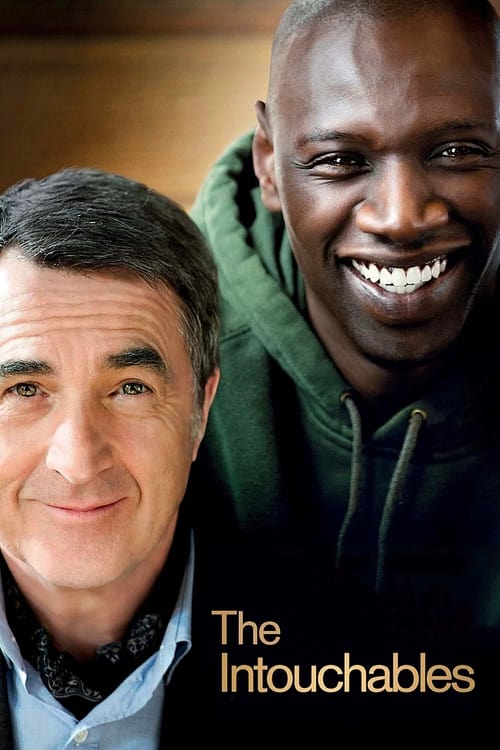
The Intouchables
2011 · Éric Toledano
The definitive pick for when you need your faith in people restored — a crowd-pleaser for date nights, family viewing, or a rough week. Pure comfort, zero homework.
What it's about
A Parisian aristocrat, paralyzed from the neck down after a paragliding accident, interviews candidates for a live-in caregiver and hires the least qualified one: Driss, a young man from the housing projects who only showed up to get a form signed. Drawn from a true story, it follows the unlikely, irreverent friendship that grows between two men separated by class, race, and circumstance — and united by a shared refusal to be pitied.
The experience
Warm, brisk, and genuinely funny, with a comic rhythm built on Driss puncturing every polite fiction around disability and wealth. It's a feel-good machine that mostly earns the feeling, sliding into real tenderness without wallowing.
Performances
Omar Sy is a supernova here — his charm, timing, and physical exuberance made him a star and won him the César for Best Actor — and François Cluzet does subtle, difficult work conveying a whole inner life using only his face and voice.
The craft
Nakache and Toledano direct with unfussy polish, letting the two leads' chemistry carry long dialogue scenes, and the soundtrack does heavy lifting — Ludovico Einaudi's delicate piano themes against blasts of Earth, Wind & Fire that turn a few scenes into pure joy.
Why it matters
One of the most commercially successful French-language films ever made and a global phenomenon, it launched Omar Sy internationally and spawned remakes abroad — while also sparking lasting debate about how it handles race and caregiving.
Snapshot
The Intouchables (French: Intouchables) is a 2011 French comedy-drama co-written and co-directed by the long-standing partnership of Olivier Nakache and Éric Toledano — a point worth establishing at the outset, since the film is the work of a directing duo rather than a single author. Built from the true relationship between Philippe Pozzo di Borgo, a wealthy quadriplegic left paralyzed by a paragliding accident, and Abdel Sellou, the young man from the margins who became his live-in caregiver, the film reimagines that bond as the friendship between the aristocrat Philippe (François Cluzet) and Driss (Omar Sy), a Senegalese-French man from the Paris housing projects fresh out of prison. It became one of the most commercially successful French-language films ever made and a global phenomenon, while also becoming a lightning rod for debate about race, disability, and the politics of the feel-good crowd-pleaser. Its cultural footprint is disproportionate to its modest formal ambitions: this is a mainstream entertainment whose reach — and whose critique — has outlasted most of the auteur cinema released alongside it.
Industry & production
The film was produced by Quad Productions (Nakache and Toledano's home base, run with producer Nicolas Duval-Adassovsky) together with Gaumont, Ten Films, and TF1 Films Production, with Gaumont handling distribution — a firmly mainstream French industrial configuration rather than an art-house or subsidy-driven one. The project originated not in a screenplay pitch but in a documentary: the directors have repeatedly credited À la vie, à la mort (a television documentary portrait of Pozzo di Borgo and Sellou) as the seed, and Pozzo di Borgo's memoir Le Second Souffle (A Second Wind) as the underlying text. The filmmakers reportedly spent years cultivating the relationship with Pozzo di Borgo before shooting, and he remained associated with the production's development.
Commercially, the outcome exceeded any reasonable projection. Widely reported figures place French admissions at roughly 19 million — among the highest of any film in French box-office history — and worldwide gross at somewhere over $400 million, which made it, for a time, one of the highest-grossing non-English-language films ever released. That success arrived on the heels of Bienvenue chez les Ch'tis (2008), the previous French box-office earthquake, and confirmed that a homegrown popular comedy could out-perform imported blockbusters domestically and travel internationally in a way French cinema rarely manages. Exact grosses vary across sources and currency conversions, so specific dollar figures should be treated as approximate.
Technology
On the technical front the record is comparatively thin, and this is not a film that foregrounds its apparatus. It was a conventionally resourced 35mm-era production made at the transitional moment when French features were moving between photochemical and digital acquisition; I will not assert a specific capture format, as I cannot confirm it with certainty. What matters is that nothing in the technology package is deployed for spectacle. There are no elaborate visual-effects set pieces, no stylized digital grading calling attention to itself. The one arena where technology is thematically present is within the story — the assistive apparatus of quadriplegic life (the powered wheelchair, the specialized van, the medical routines) — which the film treats matter-of-factly rather than as a subject of wonder or pathos.
Technique
Cinematography
Mathieu Vadepied's photography is warm, classical, and legible. The palette leans into the honeyed golds and burnished woods of Philippe's hôtel particulier, contrasted against the cooler, harder light of the banlieue apartment blocks where Driss's family lives — a straightforward visual coding of the two social worlds the film brackets together. The camera favors clean coverage, medium two-shots, and unfussy framing that keeps both actors in play; the style serves performance and rapport rather than asserting itself. Vadepied's later move into directing — including Tirailleurs (Father & Soldier, 2022), again with Omar Sy — suggests an authorial sensibility, but on The Intouchables his work is in service of accessibility and emotional clarity.
Editing
Dorian Rigal-Ansous cut the film to a brisk, comedic rhythm built around the interplay of the two leads. The most conspicuous structural gesture is the framing device: the film opens in medias res with a night-time drive through Paris — Driss at the wheel of Philippe's Maserati, a police pursuit, and the pair's improvised ruse of feigning a medical emergency — before doubling back to the story's beginning. The cutting elsewhere is transparent, prioritizing timing and the landing of comic beats over any modernist play with duration or ellipsis.
Mise-en-scène / staging
Staging is organized around a single governing contrast: the ordered opulence of Philippe's residence versus the crowded vitality of Driss's origins. Within Philippe's world, the production design (grand rooms, fine art, high ceilings) both establishes wealth and sets up the film's running comedy of Driss puncturing bourgeois solemnity — the famous scene mocking abstract modern art, the intrusion of Earth, Wind & Fire into a chamber-music birthday recital. The staging repeatedly places Driss's physical exuberance against Philippe's necessary stillness, using bodies in space to dramatize the exchange each man offers the other.
Sound
Sound is one of the film's genuine strengths, and its musical strategy is central to its appeal. The score is by the Italian composer-pianist Ludovico Einaudi, whose spare, arpeggiated minimalism ("Fly," "Una Mattina," "Writing Poems," "Cache-cache") supplies the film's emotional register and became internationally recognizable through it. Against Einaudi's introspection, the soundtrack sets exuberant soul and funk — Earth, Wind & Fire's "Boogie Wonderland" and "September" anchor the film's most joyous sequences. This dialectic between contemplative piano and dancing groove is essentially the film's thesis in sound: the two idioms belong to the two men, and the pleasure of the movie is hearing them mingle.
Performance
The film lives or dies on its central pairing, and the performances are its engine. Omar Sy's Driss is a star-making turn of physical charisma, comic timing, and unforced warmth; the role vaulted him from television sketch comedy (his partnership with Fred Testot) to leading-man status. François Cluzet, an established and respected actor, performs almost entirely with face and voice — Philippe is immobile from the neck down — and finds a full range of wit, hauteur, longing, and grief within that constraint. The chemistry between them is the whole point, and it is real enough to have carried the film across every language barrier it crossed.
Narrative & dramatic mode
Structurally the film is a two-hander in the "odd couple" tradition, and dramatically it operates in the mode of the transformational friendship: each man is emotionally stuck, and their unlikely bond frees them both. The narrative eschews conventional obstacle-driven plotting for a picaresque accretion of episodes — the job interview, the first bath, the night drive, the birthday party, the paragliding flight, the tentative romance-by-correspondence Driss engineers for Philippe. Its dramatic engine is comic incongruity resolving into sincerity: the film mines laughs from the collision of Driss's irreverence with Philippe's world, then converts that friction into feeling. It is, unabashedly, a feel-good film that arcs toward reconciliation and release rather than tragedy, softening the harder edges of both men's real biographies in the service of uplift.
Genre & cycle
The Intouchables sits at the intersection of the buddy comedy, the comédie dramatique, and the "based on a true story" inspirational drama. Within French cinema it belongs to the commercial comédie populaire — the strain of broad, warm-hearted crowd-pleasers that periodically breaks out to enormous domestic audiences (the Ch'tis phenomenon being its immediate predecessor). It also participates in the international cycle of disability-and-caregiver narratives, and in the older tradition of stories that pair a privileged white protagonist with a Black companion whose vitality restores him — a lineage that would later draw the film's sharpest criticism. Its own commercial success helped define a subsequent cycle: the globally remake-able feel-good property.
Authorship & method
Although the assignment lists Éric Toledano alone, authorship of The Intouchables is inseparable from his creative partnership with Olivier Nakache; the two write and direct jointly and should be credited as a unit. Their filmography before Intouchables — Nos jours heureux (2006), Tellement proches (2009) — established their ensemble comic sensibility and their recurring collaboration with Omar Sy, whom they would reunite with in Samba (2014). Their later films Le Sens de la fête (C'est la vie!, 2017) and Hors normes (The Specials, 2019) — the latter again drawn from a real-world story, this time of caregivers for autistic young people — confirm a consistent authorial preoccupation: comedy of social difference, human dignity at the margins, and warmth extracted from institutions and hardship.
The key collaborators are integral to the result: cinematographer Mathieu Vadepied, composer Ludovico Einaudi (whose score is arguably the film's most durable artistic contribution), and editor Dorian Rigal-Ansous. The screenplay is Nakache and Toledano's own, adapted from Pozzo di Borgo's memoir and the documentary source. The directors' method — long immersion with real subjects, then a shift into broadly comic register — is the through-line of their body of work.
Movement / national cinema
The film is a definitional example of contemporary French popular cinema as distinct from the auteurist art cinema that typically represents France abroad. It stands apart from the festival-circuit tradition of Dardenne-adjacent social realism or the Cahiers-descended auteur film; its ambitions are those of mainstream entertainment. At the same time, by centering a banlieue protagonist of African descent and making him a national box-office hero, it intersects — however gently — with the French cinema of immigration and the quartiers, a body of work more often associated with harder-edged films like La Haine (1995). The Intouchables domesticated that milieu for a mass audience, which is both the source of its unifying appeal and of the charge that it sands down real social friction.
Era / period
Released in late 2011, the film is a product of Sarkozy-era France, made in the shadow of the 2008 financial crisis and amid intense national debate over integration, immigration, laïcité, and the place of the banlieues in the Republic. Its fantasy of reconciliation across class and racial lines — the aristocrat and the project kid healing each other — landed at a moment of acute anxiety about exactly those divisions, which helps explain both its runaway domestic embrace and the suspicion it drew from critics attentive to what the fantasy elides. Contemporaneously, it shared 2011–12 award seasons with The Artist, the other great French success of the moment, against which Omar Sy's César win was measured.
Themes
The film's central theme is friendship as mutual liberation across the barriers of class, race, and physical ability. Around it cluster several others: dignity versus pity — Driss treats Philippe as a person rather than a patient, and the film argues that irreverence is a form of respect; the gaze and disability — the refusal of the caregiver's condescension is the film's ethical core; freedom and the body — literalized in the paragliding motif that both caused Philippe's injury and, at the film's climax, returns to him as release; social mobility and belonging; and music as a universal solvent, the medium through which two incompatible worlds find common feeling. Beneath the comedy runs an insistent optimism about human connection as the answer to isolation.
Reception, canon & influence
Critically and popularly, the film was a massive success in France and across much of Europe and Asia. Omar Sy won the César Award for Best Actor in 2012 — a landmark, as one of the first Black actors so honored — beating Jean Dujardin of The Artist; the film also drew a Golden Globe nomination and a BAFTA nomination in the foreign-language categories, and the two leads were recognized together at the Tokyo International Film Festival. (It should be noted that the film was not France's official submission to the Academy Awards that year, a point sometimes misremembered given its prominence.)
Anglophone reception was more divided. While many critics found it charming and the performances irresistible, a strain of serious criticism accused it of trafficking in the "magical" Black companion trope — the vital, instinctual Black man who exists to enliven and redeem a paralyzed white aristocrat. A widely cited Variety review by Jay Weissberg used notoriously charged language to make this charge, and the ensuing controversy became part of the film's permanent critical record; the debate it crystallized about race, disability, and feel-good uplift is now inseparable from the film's reputation.
Influences on the film run backward to its documentary and memoir sources, to the odd-couple buddy-comedy tradition, and to the directors' own prior comedies. Its legacy forward is substantial. It turned Omar Sy into an international star — leading to Hollywood roles (X-Men: Days of Future Past, Jurassic World), the François Cluzet-esque prestige of Chocolat (2016), and above all the global Netflix hit Lupin. It confirmed Nakache and Toledano as major figures in French popular cinema. And it became a template property remade around the world, most visibly in the American The Upside (Neil Burger, with Kevin Hart and Bryan Cranston), alongside Argentine, Indian, and other adaptations. Few French films of its era have combined such commercial ubiquity with so pointed a critical afterlife; The Intouchables endures as both a beloved crowd-pleaser and a case study in the ideological work that crowd-pleasers perform.
A Deleuzian reading
A Maserati is going too fast through Paris at night, and there are police behind it.
The full Deleuzian reading of The Intouchables →
Reception
A colossal phenomenon in France — for years the second-most-watched French film ever at home and briefly the highest-grossing non-English-language film worldwide — but American critics were far cooler, with Variety infamously accusing it of recycling racial stereotypes. Audiences never blinked: it's since settled in as one of the most beloved crowd-pleasers on Letterboxd, critics be damned.
How The Intouchables was received, from release to now →
How to watch The Intouchables: what to notice on a first viewing
- Watch Cluzet's face in the opening car ride. Philippe is immobile from the neck down, so Cluzet acts with face and voice alone. The hauteur sits still. The grief and longing move in the jaw and around the eyes. Once you see that his face is the whole instrument, every reaction shot becomes the scene.
- Listen for the switch between solo piano and soul records. Einaudi's circling piano figures belong to Philippe. Earth, Wind & Fire's funk belongs to Driss. Nakache and Toledano keep the two idioms apart, then let them share scenes. The soundtrack states the friendship before the dialogue does: one music repeats, the other dances.
- Notice the honeyed golds in Philippe's mansion. Vadepied lights the hôtel particulier in warm woods and gold, then shoots the banlieue apartment blocks in cooler, harder light. The film shuttles between the two. The color tells you which social world you are in before anyone speaks.
- Count how often both men share one medium two-shot. Vadepied favors clean coverage and unfussy framing that keeps Sy and Cluzet in play together. The camera never asserts itself over the pair. The style hands everything to the rapport, which is what you came for.
- Watch Sy move while Cluzet stays put. Driss lifts, washes, carries, dances, and fills rooms. Philippe permits it. The staging repeatedly puts exuberance next to necessary stillness, especially in the caregiving scenes. Two bodies in one arrangement show you employment, embarrassment, and intimacy without a word naming them.
The whole guide to watching The Intouchables, with the keys for a rewatch →
Influences: the films it descends from and the films it influenced
- The Defiant Ones (1958) — Establishes the forced Black-white two-hander whose antagonism-into-intimacy arc, staged as a chain of picaresque episodes, The Intouchables domesticates into comedy.
- Midnight Cowboy (1969) — The picaresque episodic two-hander of a class-mismatched male pair drifting through a city, alternating comic hustle and pathos, is the narrative shape Nakache and Toledano inherit.
- Rain Man (1988) — Codifies the odd-couple caregiving road picture that mines both comedy and dignity from a disability/difference pairing, using the trip as engine for grudging affection.
- Driving Miss Daisy (1989) — A memoir-sourced, chamber two-hander of employer and cross-race servant built on warm classical two-shots, whose 'affection across the service relation' template Intouchables directly extends.
- My Left Foot (1989) — The based-on-true-story performance in which acting is constrained to a near-immobile body prefigures Cluzet's quadriplegic turn played almost entirely through face and voice.
- The Fisher King (1991) — A privileged man redeemed by an 'unrespectable' companion from the social margins, blending broad comedy with wound and pathos in the same tonal register Intouchables adopts.
- Scent of a Woman (1992) — The irascible disabled man plus young able-bodied caretaker who trade vitality for guidance — dignity-versus-pity worked out inside a two-hander — is Intouchables' direct dramatic model.
- Le Dîner de cons (1998) — Mainstream French comédie populaire that engineers laughs from a rigidly class-divided two-hander via precision comic timing, the national box-office idiom Intouchables perfects.
- Nos jours heureux (2006) — The duo's own institution-set ensemble comedy that established their method of extracting warmth from confinement and their working collaboration with Omar Sy.
- Tellement proches (2009) — Their immediate pre-Intouchables comedy of social and class difference, rehearsing the tonal shift from observed hardship into broadly comic register.
- Elling (2001) — The odd-couple care two-hander of maximally contrasting physicality and temperament, where comedy and mutual rehabilitation arise from the daily intimacy of one tending to the other.
- Samba (2014) — The duo reunite with Omar Sy for another comedy of marginal dignity — undocumented labor rather than disability — reusing the star's charismatic-outsider register and social-color coding.
- Chocolat (2016) — A based-on-true-story prestige lead built expressly on Sy's post-Intouchables stardom, converting his crowd-pleasing charisma into dramatic period weight.
- The Upside (2019) — The direct Hollywood remake, transposing the quadriplegic-patron/streetwise-carer two-hander onto Cranston and Hart while preserving the opulence-versus-vitality staging.
- Hors normes (The Specials) (2019) — Nakache and Toledano return to a real-world caregiving subject — carers of autistic youth — reprising their true-story-into-comedy method and dignity-at-the-margins theme.
- Lupin (2021) — The global Omar Sy vehicle enabled by his Intouchables breakout, engineering its whole appeal around the same disarming, class-crossing charm that won him the César.
- Just an Illusion (2026) — Codifies the pair's two signature tools that the seed turns inward: the asymmetrical duo whose difference in mobility and class generates every scene, and Vadepied's cité-to-interior contrast scored by a contemporary composer (Einaudi) instead of period pastiche — the seed's licensed-composer facet.
- Le Sens de la fête (C'est la vie!) (2017) — Extends the duo's signature editing of overlapping comic-timing rhythm across a service/labor institution (a wedding crew), the same warmth-from-work engine.
- Green Book (2018) — A true-story interracial road two-hander whose feel-good uplift inherited the identical 'magical companion' / class-inversion critique that trailed Intouchables.
- Nomadland (2020) — The most direct heir to the film's scoring signature: Ludovico Einaudi's minimalist solo-piano pieces deployed as emotional needle-drops rather than bespoke underscore.
- Big World (2024) — Turned a caregiver-and-disabled-man bond into mass-audience feeling — the crowd-pleasing 'blockbuster disability drama' register Big World deliberately courts.
- The Sea Inside (2004) — Extends the comic-counter-mode within disability drama — mining dry humor from the caregiver/quadriplegic relationship so warmth undercuts pathos, exactly Amenábar's tonal safeguard against melodrama.
Similar films
- Green Book (2018) — influence & lineage · same viewing thread · often watched together
- Il Sorpasso (1962) — same viewing thread
- Talk to Her (2002) — same viewing thread
- La Haine (1995) — often watched together
- The Umbrellas of Cherbourg (1964) — often watched together
- Cinema Paradiso (1988) — often watched together
- Ocean's Twelve (2004) — often watched together
- Amélie (2001) — shared sensibility
All the films related to The Intouchables →
Watch it with: curated runs of related films
- Strangers Who Change Each Other — Watch these back-to-back when you want the warmth of two people who shouldn't have met becoming each other's whole world — a ladder from the multiplex hit down to its arthouse ancestors.