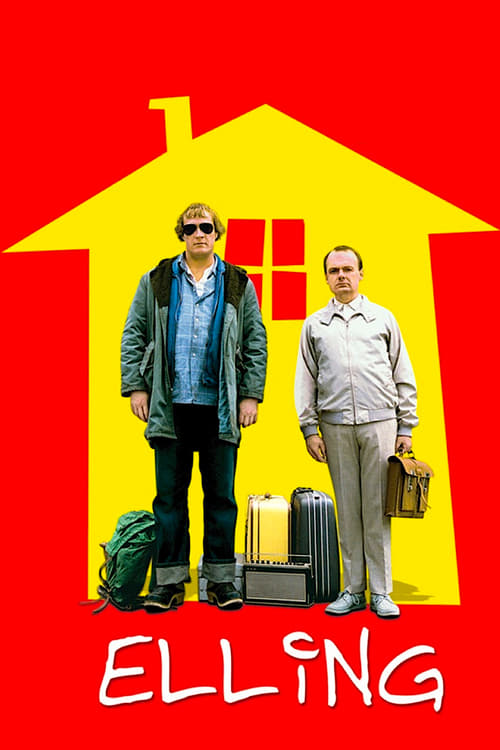
Elling
2001 · Petter Næss
For a cozy night when you want to laugh gently and end up rooting hard for someone — comfort viewing about courage at the smallest scale. Good medicine when the world feels like too much.
What it's about
When his sheltering mother dies, Elling — a fastidious, anxious, forty-year-old would-be poet who has never lived on his own — is placed in a state institution, where he's paired with Kjell Bjarne, a gentle giant obsessed with women and equally untested by the world. Discharged into a shared Oslo apartment, the two must prove to a patient social worker that they can manage ordinary life: answering the phone, ordering in a restaurant, stepping outside the front door.
The experience
Warm, droll, and quietly triumphant — the comedy comes from how enormous small things can feel, and the film treats its two heroes with affection rather than pity. It's the rare feel-good movie that earns the feeling.
Performances
Per Christian Ellefsen and Sven Nordin, who played these roles on stage, are a perfectly tuned odd couple — Ellefsen all prissy terror and secret poetry, Nordin a lumbering sweetheart — and their friendship feels lived-in from the first scene.
The craft
Adapted from Ingvar Ambjørnsen's beloved novels via a hit stage production, the film keeps its scale intentionally small — an apartment, a phone, a grocery run — and mines each ordinary terror for both comedy and real stakes. The writing walks a delicate line, funny about its characters' quirks without ever mocking them.
Why it matters
It became one of Norwegian cinema's biggest international successes, the film that carried this odd-couple story from Oslo to audiences worldwide.
Snapshot
Elling is a Norwegian tragicomedy about two middle-aged men, recently discharged from a state psychiatric institution, learning to live in a shared Oslo apartment under the watch of a social-services system that expects them to become functioning citizens. Elling (Per Christian Ellefsen) is a fastidious, anxious, mother-fixated would-be poet who has never lived independently; Kjell Bjarne (Sven Nordin) is a hulking, sexually frustrated innocent. The film is built almost entirely from the friction and tenderness between these two temperaments as they negotiate ordinary terrors — answering the telephone, eating in a restaurant, speaking to a woman, leaving the flat at all. Adapted from Ingvar Ambjørnsen's popular novels and from a stage production the same creative team had already mounted, the film became the most internationally visible Norwegian feature of its moment, earning a nomination for the Academy Award for Best Foreign Language Film. It is a small, humane, deliberately unspectacular picture whose reputation rests on performance, tone, and the precision of its comic observation rather than on formal innovation.
Industry & production
Elling was produced within the modestly scaled Norwegian film industry of the late 1990s and early 2000s, an industry heavily dependent on public subsidy through the Norwegian Film Fund and on the small domestic market. The film was produced by Maipo (Maipo Film), one of the country's significant production houses, and the project carried an unusual pedigree: it reached the screen by way of the theater rather than directly from the page. Petter Næss had directed a stage adaptation of Ambjørnsen's material — scripted by Axel Hellstenius — and the stage version's success, with Per Christian Ellefsen already established in the title role, effectively de-risked and shaped the film. This theater-to-film pathway is central to understanding the production: the casting, the two-hander structure, and much of the dialogue's rhythm were tested before a live audience first.
The screenplay is credited to Axel Hellstenius in collaboration with Næss, working from Ambjørnsen's quartet of Elling novels — the film draws principally on Brødre i blodet (Blood Brothers). The picture was made on a scale appropriate to its intimate scope: largely interior, Oslo-set, dependent on actors and apartments rather than on locations or effects. Its commercial and critical performance — strong domestic reception followed by the Oscar nomination announced for the 2001 awards cycle — made it a landmark for Norwegian cinema's international profile, and it spawned a small franchise. A prequel, Mors Elling (Mother's Elling, 2003), was directed by Eva Isaksen, and further Elling screen and stage iterations followed, confirming the character as a durable national property. Precise budget and box-office figures are not something I can state reliably here, and I will not invent them; the salient industrial fact is that Elling succeeded disproportionately to its scale.
Technology
Elling is, technologically, an unremarkable film by design, and that is worth stating plainly rather than dressing up. It was produced as a conventional theatrical feature of its period, and the available record does not support claims about specific camera systems or laboratory processes that I can verify; I will not manufacture them. What matters is the absence of technological ambition. The film makes no use of visual effects, no conspicuous digital intervention, no formal apparatus that calls attention to itself. Its "technology" is the technology of classical narrative cinema — a camera, available and built interiors, naturalistic lighting — deployed to keep the actors legible and the comic timing intact. In an era when Scandinavian cinema was being reshaped by the Dogme 95 movement's handheld, on-location, digital-video asceticism, Elling is notable for declining that vocabulary entirely; it is a smoothly conventional film, and its restraint is an aesthetic choice rather than a technical limitation.
Technique
Cinematography
The cinematography, by Svein Krøvel, is functional and self-effacing in the best sense: it serves the performances and the claustrophobic comedy of the apartment without imposing a signature. The dominant register is interior and close, organized around the cramped shared flat that is both refuge and prison for the two men. The camera tends to hold on faces and on the small spatial negotiations between Elling and Kjell Bjarne — who occupies the doorway, who retreats to which room — because the drama is almost entirely a matter of proximity and avoidance. When the film ventures outdoors, the framing registers the city as something vast and threatening from Elling's agoraphobic point of view; Oslo is photographed less as a place than as an ordeal to be survived. The visual approach is warm and legible rather than expressive, a deliberate match to the film's humane comic tone.
Editing
The editing prioritizes performance and timing. Elling is a comedy of behavior, and its cutting is paced to let reactions land — the held beat before Elling answers the phone, the gathering dread before a social encounter. Because the film originated partly in the theater, scenes are often allowed to play in relatively sustained units, trusting the actors rather than fragmenting the action. The structure is episodic, a string of graduated challenges (the telephone, the restaurant, the street, the public reading) that mark the men's incremental progress toward autonomy, and the editing organizes these as discrete comic-dramatic set pieces with clear emotional arcs.
Mise-en-scène / staging
Mise-en-scène is where the film's theatrical DNA is most visible and most productive. The shared apartment is the central stage, and the production design renders it as a closed world — ordinary, slightly shabby Norwegian domesticity that becomes the arena for every fear and small triumph. The blocking is essentially two-character choreography: the contrast between Ellefsen's compact, contained, fussy physicality and Nordin's looming, ungainly bulk is staged again and again for both comedy and pathos. Doorways, thresholds, windows and the telephone recur as charged objects, because the entire drama concerns the boundary between inside and outside, safety and exposure. The institution, the social worker's visits, the encounter with the upstairs neighbor Reidun and with the aging poet Alfons are all staged to test how far the men can extend themselves beyond the controlled space of the flat.
Sound
Sound design is naturalistic and unobtrusive, keyed to the intimacy of the performances. The film leans heavily on dialogue and on Elling's first-person voice-over narration, which is one of its defining devices: we hear Elling's anxious, self-dramatizing inner commentary, and the gap between his grandiose interior monologue and his timid exterior behavior is a primary source of both comedy and sympathy. The musical score is by Lars Lillo-Stenberg — known as a songwriter and member of the Norwegian band deLillos — and it supplies a gentle, melodic, faintly melancholic accompaniment that reinforces the film's tenderness without sentimentalizing it.
Performance
Performance is the film's reason for being. Per Christian Ellefsen's Elling is a finely calibrated study in repression, vanity, and fragile courage — a man whose pomposity is inseparable from his terror, and whose small acts of bravery (mailing a poem, speaking to a stranger) carry genuine weight precisely because the actor has made the stakes felt. Having originated the role on stage, Ellefsen brings a lived-in completeness to it. Sven Nordin's Kjell Bjarne is the essential counterweight: physically enormous, emotionally transparent, governed by appetite and longing, and capable of a sweetness that prevents the character from becoming a crude joke. The two performances function as a single mechanism, each defining the other by contrast. The supporting playing — Jørgen Langhelle as the pragmatic social worker Frank Åsli, Marit Pia Jacobsen as the pregnant neighbor Reidun Nordsletten, and Per Christensen as the elderly poet Alfons Jørgensen — is pitched to the same naturalistic, warmly comic key.
Narrative & dramatic mode
The dramatic mode is the comedy of rehabilitation, structured as a sequence of escalating ordeals that double as milestones. The narrative engine is simple and effective: two men must learn to perform the basic functions of independent life, and each mundane task — using the phone, going to a café, forming a relationship, appearing in public — becomes a small heroic quest. This episodic, incremental structure gives the film a satisfying shape of gradual emergence without ever resorting to melodrama. Elling's voice-over narration frames the story as his own self-aware account, lending it the texture of a comic confession and allowing the film to mine the discrepancy between how Elling sees himself (as a sensitive poet and man of the world) and how he behaves (as a frightened man-child). The tone is sustained tragicomedy: the laughter is never cruel, and the pathos never tips into bathos, because the film keeps faith with the dignity of its characters even at their most ridiculous.
Genre & cycle
Elling sits at the intersection of the gentle character comedy and the social-realist drama of mental illness and care. It belongs recognizably to a strand of European cinema that finds humane comedy in marginal, "abnormal" protagonists negotiating ordinary society — a tradition that prizes warmth, eccentric specificity, and the rehabilitation of the outsider. Within Norwegian and broader Scandinavian cinema it stands somewhat apart from the grittier or more ironic registers of the period; it is unashamedly feel-good without being dishonest. As a property, it generated its own small cycle: the Ambjørnsen source novels, the stage production, the feature, the prequel Mors Elling, and subsequent adaptations, making "Elling" less a single film than a recurring national franchise centered on a beloved character type.
Authorship & method
The authorship of Elling is genuinely collaborative and rooted in a theater ensemble's method. Petter Næss, an actor-turned-director, is the organizing creative intelligence, and his background is decisive: he had directed the stage version with the same leads, and his approach is that of a director of actors, prioritizing performance, timing, and tonal control over visual authorship. Elling launched his international career; he subsequently worked in English-language film, including Mozart and the Whale (2005) and the wartime drama Into the White (2012), though Elling remains his signature achievement. Axel Hellstenius, the screenwriter, is the second indispensable author, having shaped Ambjørnsen's episodic novels into both the stage and screen versions; the literate, character-driven dialogue is his contribution as much as anyone's. The ultimate source author, Ingvar Ambjørnsen, created Elling and Kjell Bjarne across a quartet of novels, and the film's richness of character owes much to that literary foundation. Among technical collaborators, cinematographer Svein Krøvel and composer Lars Lillo-Stenberg supply the film's unobtrusive visual warmth and gentle musical melancholy respectively. The method, in short, was theatrical incubation followed by faithful, performance-led screen translation — an authorship distributed across novelist, playwright-screenwriter, director, and a pair of actors who had already inhabited their roles on stage.
Movement / national cinema
The film is a key document of Norwegian cinema's turn-of-the-millennium emergence onto the international stage. Norwegian film had long been overshadowed by its Danish and Swedish neighbors, and the late 1990s and 2000s saw a concerted, subsidy-supported push toward films that could travel. Elling's Oscar nomination was a milestone in that effort, demonstrating that a small, intimate, distinctly Norwegian comedy could find an international audience. Notably, it achieved this while standing outside the most internationally famous Scandinavian "movement" of the moment — the Danish Dogme 95 collective, whose stripped-down, rule-bound realism dominated discussion of Nordic cinema. Elling offers a contrasting model: conventionally crafted, warm, accessible, and rooted in popular literature and theater rather than in avant-garde manifesto. It belongs to the tradition of Norwegian humanist comedy-drama and helped define a commercially viable, exportable national cinema.
Era / period
Released in 2001, Elling is a product of its specific cultural moment: a prosperous, social-democratic Norway with a robust welfare state, which is not merely the setting but effectively a character in the film. The drama is unimaginable outside the context of a comprehensive care system — the institution, the social worker, the state-provided apartment, the expectation of reintegration are all features of the Norwegian welfare model, and the film both gently satirizes and ultimately affirms that system's faith in rehabilitation. The period's broader European appetite for humane, character-driven comedies about outsiders and the mentally fragile provided a receptive climate. The film does not engage with the dominant geopolitical anxieties of the early 2000s; it is resolutely domestic and interior, a portrait of private life under a benevolent state.
Themes
The film's central theme is fear and its conquest — specifically the fear of ordinary social existence, dramatized through Elling's agoraphobia and acute anxiety. Around this it organizes several others: friendship as a form of mutual rehabilitation, with Elling and Kjell Bjarne each supplying what the other lacks; masculinity and arrested development, two middle-aged virgins and innocents learning belatedly to be adult men; and the tension between dependence and autonomy, embodied first in Elling's smothering bond with his late mother and then in his graduated separation from every protective structure. Art and self-expression recur as Elling's secret vocation — his clandestine poetry, distributed anonymously, becomes the vehicle of his emergence into the world and the film's emblem of how the marginal can speak to the mainstream. Underlying all of it is a generous thematic conviction: that "normality" is a performance everyone struggles to sustain, and that dignity is available even to the most ridiculous and frightened among us. The welfare state hovers as a thematic frame — caring, bureaucratic, and faintly absurd, but ultimately trusted.
Reception, canon & influence
Critically and popularly, Elling was a success that exceeded the usual reach of Norwegian cinema. Its nomination for the Academy Award for Best Foreign Language Film — the central, verifiable fact of its reception — gave it an international visibility rare for a film of its scale and made it, for a time, the public face of Norwegian cinema abroad. Reviewers internationally responded to its warmth, its comic precision, and above all the performances of Ellefsen and Nordin; the prevailing critical line treated it as a modest but genuinely charming and well-acted humanist comedy, with some dissent that found it slight or sentimental. I am wary of attaching specific quotations or aggregate figures I cannot verify, and will not; the durable record is the awards recognition and the broad affection the film earned.
The influences on the film are clear and traceable: Ingvar Ambjørnsen's novels supplied the characters and incidents; the team's own prior stage production supplied the structure, tone, and cast; and the broader tradition of European outsider-comedy supplied the genre template. Its influence forward is twofold. Domestically, it consolidated "Elling" as a national franchise and character — generating the prequel Mors Elling (2003) and further adaptations — and it demonstrated a replicable model for exportable Norwegian cinema: intimate, performance-driven, accessible, literature- and theater-rooted. Internationally, it became a touchstone reference for the humane mental-illness comedy and was widely cited in discussions of Norway's cinematic emergence. Its legacy is less a matter of stylistic imitation — the film is too self-effacing in form to have founded a visual school — than of proof of concept: evidence that a small, kind, well-observed film from a minor film nation could win the world's attention on the strength of two unforgettable characters.
A Deleuzian reading
The telephone rings in the little Oslo flat, and Elling does not answer it.
The full Deleuzian reading of Elling →
Reception
A phenomenon at home — one of the biggest Norwegian box-office hits ever, capped by a Best Foreign Language Film Oscar nomination — Elling has settled internationally into 'quiet gem you recommend to people' status while remaining a stone-cold classic in Norway.
How Elling was received, from release to now →
Influences: the films it descends from and the films it influenced
- Of Mice and Men (1992) — Establishes the foundational template Elling rebuilds — the male dyad of a small, verbal, anxious caretaker bound to a large, gentle, childlike companion, with the smaller man narrating and protecting the larger.
- The Odd Couple (1968) — The stage-to-screen apartment two-hander whose entire comic engine is two mismatched temperaments confined to one domestic set — the single-apartment staging and contrasting-physicality blocking Elling inherits directly.
- Marty (1955) — The teleplay-incubated, performance-led humanist portrait of an ordinary lonely man venturing toward connection — the social-realist care drama mode translated faithfully from script to screen, as Hellstenius/Næss did from stage.
- One Flew Over the Cuckoo's Nest (1975) — Sources its institutional ensemble from a stage play and builds comedy from rehabilitation and contrasting physicality (verbal instigator vs. large silent companion), the McMurphy/Chief dyad prefiguring Elling/Kjell Bjarne.
- Midnight Cowboy (1969) — The odd-couple survival two-hander built on contrasting bodies and a shared squalid flat, where two social incompetents must navigate a city that overwhelms them — Elling's agoraphobic-POV version of the same.
- Rain Man (1988) — Defines the neurodivergent/neurotypical pairing as a performance-led acting showcase, where a precisely interiorized portrayal of mental difference anchors the dyad rather than plot.
- Withnail and I (1987) — The flatmate two-hander of sharply contrasting physicality, organized as episodic set-pieces and filtered through a literary first-person sensibility — the prose-to-screen voice Elling's narration echoes.
- Mors Elling (2003) — The direct prequel that extended Elling into a national franchise character, reprising the literary source and the performance-anchored portrait of the same protagonist's earlier life.
- Mozart and the Whale (2005) — Næss's own English-language reprise of the formula — a romance between two neurodivergent characters carried by performance and tonal control, transplanting Elling's method to Hollywood.
- Lars and the Real Girl (2007) — Treats a mentally fragile man's delusion with collective tenderness, the whole community enlisted as therapeutic care — the comedy-of-rehabilitation played, like Elling, for warmth rather than mockery.
- Silver Linings Playbook (2012) — The mainstream mental-illness comedy of recovery, performance-driven and built on two damaged people rehabilitating each other — Elling's humane-mental-illness-comedy template at commercial scale.
- The Intouchables (2011) — The odd-couple care two-hander of maximally contrasting physicality and temperament, where comedy and mutual rehabilitation arise from the daily intimacy of one tending to the other.
- Amélie (2001) — Released the same year, it uses warm omniscient voice-over to frame a pathologically shy protagonist's small ventures into the world as quiet triumphs — the identical narrated-introvert device.
- Kitchen Stories (2003) — The defining Norwegian deadpan-humanist two-hander, staging a delicate male bond within a single domestic space and threshold objects, sharing Elling's anti-Dogme warmth and welfare-state setting.
- Italian for Beginners (2000) — A contemporaneous Scandinavian gentle ensemble comedy of lonely misfits tentatively forming bonds — the same accessible, warm character-comedy register, here from inside Dogme rather than against it.
- The Station Agent (2003) — A character-led comedy of social isolates who form an improbable family, built on contrasting physicality and the slow accretion of small episodic encounters rather than incident.
- The King's Speech (2010) — A therapeutic two-hander where rehabilitation proceeds through rehearsed practice between two contrasting men in confined rooms — the comedy-of-rehabilitation structure given a stage-rooted, dialogue-driven form.
Similar films
- Kitchen Stories (2003) — influence & lineage
- The Station Agent (2003) — influence & lineage
- A Man Called Ove (2015) — shared sensibility
- Noi the Albino (2003) — shared sensibility
- My Life as a Dog (1985) — shared sensibility
- Mary and Max (2009) — shared sensibility
- Fanny and Alexander (1982) — shared sensibility
- Young Hearts (2024) — shared sensibility