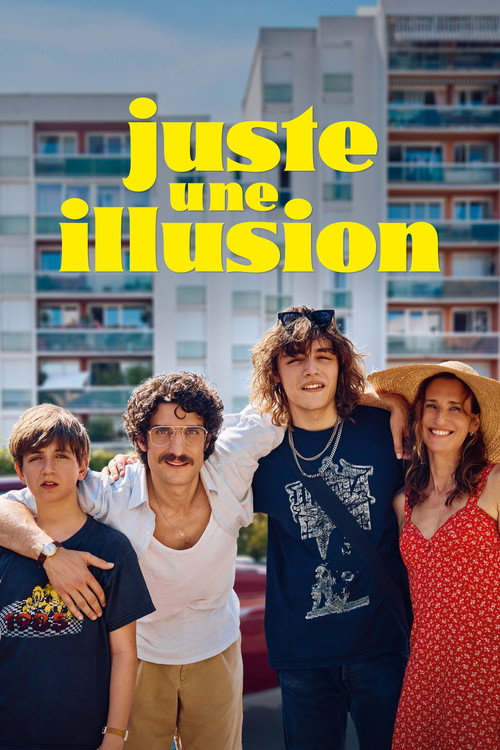
Just an Illusion
2026 · Olivier Nakache
For a tender night when you want to revisit being twelve — the crushes, the cassettes, the eavesdropping on your parents through the wall. A warm watch that will still put a lump in your throat.
What it's about
Suburban Paris, 1985. Vincent is twelve, with an older brother who's already drifted out of reach and parents whose quarrelling is the permanent weather of the apartment. Across one year he navigates friendship, a first love, and the dawning realization that the adults around him are improvising too.
The experience
Bittersweet in the true sense — genuinely funny scenes of kid logic and 80s texture sit right next to the quiet unease of a home coming apart. It's gentle, nostalgic, and more piercing than it first lets on.
The craft
This is Olivier Nakache directing solo for the first time after a two-decade partnership with Éric Toledano that produced some of French cinema's biggest crowd-pleasers, and he brings that duo's signature blend — comedy played close enough to life that it turns into drama without you noticing. The 1985 period detail is affectionate rather than museum-piece.
Why it matters
A solo feature from one half of French cinema's most commercially durable directing team is an event in itself — and the fact that he chose intimate, autobiographical-feeling material for it says a lot about what the partnership's crowd-pleasers were hiding.
Snapshot
A comedy-drama of childhood set in the Paris suburbs in 1985, following a twelve-year-old, Vincent, through a year of friendship, first love, a brother who has already left him behind emotionally, and parents whose quarrelling is the weather of the house. The structural fact that matters most for an atlas of influence is the credit line itself: Olivier Nakache has directed every previous feature of his career jointly with Éric Toledano, a partnership running from Je préfère qu'on reste amis (2005) through Intouchables (2011), Samba (2014), Le Sens de la fête (2017), Hors normes (2019), the Arte series En thérapie (2021–22) and Une année difficile (2023). A solo feature from one half of French cinema's most commercially durable directing duo is, on its face, an authorship event — and the material chosen for it is the most exposed kind available: a boyhood in the mid-1980s suburbs, which is to say almost exactly Nakache's own. He was born in Suresnes in 1973; in 1985 he was twelve.
One caution belongs at the top rather than buried. The verifiable primary record for this film — festival placement, full credits, cast, technical package, critical response, admissions — is not something this dossier can confirm, and nothing below should be read as reporting it. What follows is a scholarly reading of the film's position: the established career and working method behind it, the traditions it enters, and the industrial and technological conditions under which a French period-set mid-budget comedy-drama is made in 2026. Where a specific claim about this film would require the primary record, the dossier says so and stops.
Industry & production
Nakache and Toledano occupy an unusual industrial position. Intouchables drew roughly nineteen million admissions in France — the second-largest domestic audience ever recorded for a French film, behind Bienvenue chez les Ch'tis — and travelled internationally to a degree almost no French-language comedy manages, generating remakes and a long tail of imitation. That single result converted the pair from working comedy directors into bankable ones, and the subsequent features were financed on that strength: produced with Quad Productions (Yann Zenou, Laurent Zeitoun, Nicolas Duval Adassovsky) alongside their own Ten Cinéma, and distributed in France by Gaumont, a partnership that has held across most of their output.
That is the machinery a solo Nakache film inherits, and the precise configuration used here is not something this dossier can verify. What can be said is that the standard French financing stack for a project of this shape has narrowed since Intouchables: pre-sales to Canal+ and to free-to-air groups (TF1, M6) have contracted in real terms, the CNC's automatic support and avance sur recettes carry proportionally more weight, regional funds increasingly attach to period shoots that can be located outside Paris proper, and the 2022 revision of the chronologie des médias reshaped how streaming rights are valued against a theatrical window. A 1985 period reconstruction is also materially more expensive than a contemporary comedy at the same page count — costume, vehicles, signage, cleared music, and the constant cost of keeping a modern street out of frame. The commercial bet implied is that the duo's audience will follow one of them into a quieter, more personal register, which is a genuinely different proposition from Le Sens de la fête's ensemble farce.
Technology
The film's acquisition format, lenses, and post pipeline are not in the record available here, so this section describes the conditions rather than the choices. By 2026 French production at this budget level is digitally acquired as a default — the Arri Alexa 35 and large-format bodies dominate — with photochemical origination a deliberate, budgeted exception rather than a norm. The relevant technological question for a 1985 film is therefore emulation: grain structure, halation, and gate-weave are now routinely applied in the DI, and the aesthetic decision has migrated from the camera department to the grade. This has a real critical consequence, which is that period texture in the 2020s is cheap and available, and the interesting films in the memory cycle are the ones that resist it.
Two further technological facts structure a film like this. First, music: a 1985 setting invites the era's pop, and clearance is a budget line that shapes the soundtrack more than taste does — the title itself coincides with Imagination's 1982 Brit-funk single "Just an Illusion," a substantial hit on French radio in the early eighties, though whether the film licenses it or merely borrows the phrase is not something this dossier can confirm. Second, absence: 1985 is the last period in which adolescent social life can be staged with no screens in it. Waiting, boredom, the landline, the unanswered doorbell, and physical proximity become the only available mechanisms of suspense and intimacy, which is a formal gift and a discipline at once. Period cinema of the pre-mobile era is now partly a technology of dramaturgy, not only of design.
Technique
Cinematography
The mode carries a small set of solved problems. A child protagonist forces a decision about eye level: whether the camera adopts the boy's height and sightlines throughout — the Truffaut solution in L'Argent de poche, where adults are frequently cropped or held at a distance — or whether it observes him from an adult's remove, which converts the film from immersion into recollection. Nakache and Toledano's photographic history is on the immersive side: Mathieu Vadepied's handheld, close, available-light work on Intouchables and Samba, and the more composed but still proximate look of the later features shot by Antoine Sanier. Their default is a camera that stays inside the social group rather than surveying it. Applied to suburban 1985, that implies interiors shot for volume and clutter rather than for design display, and exteriors — the pavillon street, the school yard, the shopping-centre car park — treated as lived rather than curated. Whether this film adopts that inheritance or breaks from it toward a more formal memory-film grammar is precisely the question its images would answer.
Editing
Dorian Rigal-Ansous has cut most of the Nakache-Toledano features, and the house style is legible: comedy assembled for reaction rather than for punchline, scenes allowed to run a beat past the joke so that discomfort can arrive, and tonal pivots handled inside a continuous scene rather than across a cut. That last habit is the structural key to their dramaturgy, and it is what a synopsis describing "laughter and unease" would require. The memory film additionally tempts the editor toward ellipsis — the year passing in fragments, the season changing between shots — and the risk is a montage-of-childhood that substitutes accumulation for consequence. The durable examples of the form (Les Quatre Cents Coups, Au revoir les enfants) are ruthlessly causal underneath their apparent looseness.
Mise-en-scène / staging
The synopsis names a four-cornered household — boy, older brother, two quarrelling parents — which is a staging problem before it is a thematic one: a child's drama in which the child is mostly an audience to adults. The classical French solution is architectural. Doorways, corridors, the top of a staircase, the kitchen heard from a bedroom: the apartment or house becomes a listening device, and the boy's knowledge is built from partial access. The Nakache-Toledano ensemble manner — overlapping talk, groups held in one frame, characters cutting across each other — is well suited to this, since a family row is their native register scaled down from the workplace comedies. The period setting supplies its own iconography, and the discipline is to let the suburb be specific: the 1980s Paris banlieue is not one place but a gradient from bourgeois western commune to grand ensemble, and a film that blurs it loses the class reading that makes the year meaningful.
Sound
Two registers are in play. Diegetic period sound — radio, television news, a cassette deck, a moped — does the dating work that production design cannot do alone, and in the best period childhood films the sound track is where the era is least sentimental. Against that, the family argument as an offscreen acoustic event is one of the oldest and most reliable devices in the form: overheard rather than witnessed conflict is how children actually experience marital breakdown, and it is cheaper, crueller, and more precise than a staged confrontation. The duo's previous films have generally licensed contemporary composers rather than employing a single house composer — Ludovico Einaudi's pieces in Intouchables and Samba, Avishai Cohen on Le Sens de la fête, Grandbrothers on Hors normes — so a scored-versus-sourced strategy for this film cannot be assumed from precedent, and the actual credits are not available here.
Performance
Their casting method is well established and doubled: professional leads drawn from a loose repertory that has included Omar Sy, Jean-Pierre Bacri, Reda Kateb, Vincent Cassel, Benjamin Lavernhe and Hélène Vincent, set against non-professionals and first-timers used for texture — most conspicuously the disabled and neuro-atypical performers integrated into Hors normes. A film resting on a twelve-year-old lead sits in the French tradition of open-call child casting and performance built in the room rather than from the page, the practice behind Truffaut's Jean-Pierre Léaud and, in a different key, Doillon's and Sciamma's children. The cast of this film is not something this dossier can confirm, and any account of the lead's performance would be invention.
Narrative & dramatic mode
The synopsis describes the classic one-year initiation structure: a stable but unhappy household, an intrusion (friendship, first love), and a threshold — "beginning to confront the adult world" — which in this tradition is almost always the child's discovery that the parents are not a fixed condition but two people who may fail. The mode is retrospective realism with a comic surface: episodic rather than goal-driven, organised by season and by school calendar, with the dramatic pressure held in the gap between what the boy understands and what the audience understands. That gap is the engine, and it is also the ethical test of the form — whether the film grants the child a real interiority or uses him as a lens through which adults are observed with adult irony. Nakache and Toledano's dramaturgy has always been built on a paired asymmetry (carer and cared-for, host and guest, insider and outsider) in which laughter is the sign of a relationship working and silence the sign of it failing; a boy and an unreachable older brother is that structure at its most intimate.
Genre & cycle
The film lands squarely inside an international cycle of late-career autobiographical childhood films that consolidated between 2018 and 2023: Cuarón's Roma, Sorrentino's È stata la mano di Dio, Branagh's Belfast, Spielberg's The Fabelmans, James Gray's Armageddon Time, Linklater's Apollo 10½, with Charlotte Wells' Aftersun as the cycle's formally sharpest outlier. The pattern is consistent enough to be a genre condition: an established director, secure funding, a specific year, a household in trouble, and a child who is not yet the artist he will become. A 2026 French entry by a director of Intouchables' commercial standing is an unsurprising and legible move within that cycle.
Its domestic lineage is older and deeper. French cinema has an unbroken line of childhood and adolescence films that this one necessarily reads against: Truffaut's Les Quatre Cents Coups (1959) and L'Argent de poche (1976); Claude Berri's Le Vieil Homme et l'enfant (1967); Louis Malle's Le Souffle au cœur (1971) and Au revoir les enfants (1987); Diane Kurys's Diabolo menthe (1977) and La Baule-les-Pins (1990), which established the French autobiographical-childhood film as a form with a female author at its centre; Yves Robert's Pagnol adaptations (1990); Téchiné's Les Roseaux sauvages (1994) and Klapisch's Le Péril jeune (1994), both period adolescences made by directors looking back roughly thirty years — the same interval this film observes. For the specific pleasure of 1985 as a French cultural object, Noémie Lvovsky's Camille redouble (2012) is the nearest precedent. And the duo's own Nos jours heureux (2006), built from their years as summer-camp counsellors, already established that their comedy draws directly on remembered adolescence.
Authorship & method
The working method is the most documented thing about Nakache and Toledano and the most relevant to a solo film. They met as teenagers, came up through short films, and have written and directed jointly throughout — a genuine co-authorship rather than a division of labour, with scripts developed in dialogue and performance shaped on set. Their recurring collaborators form a stable unit: Rigal-Ansous editing, Vadepied and later Sanier on camera, the Quad producers, Gaumont distributing, and a repertory of actors used across films. En thérapie (2021–22), their adaptation of the Israeli series BeTipul for Arte — the first season set in the weeks after the November 2015 Paris attacks, with Frédéric Pierrot as the analyst — is the pivot worth marking: a two-hander chamber form, dialogue-driven, almost entirely without comic release, and evidence that the pair had appetite for scale reduction well before a solo project.
What the solo credit means in practice — whether Toledano is involved in writing or production, how the crew was constituted — is not in the record available here, and it is the first question a reviewer should answer. The authorship claim this dossier can support is narrower and firmer: the material's coincidence with Nakache's own age and place in 1985 makes this the most plausibly first-person film of his career, and first-person is the one register a fifty-year co-authorship cannot easily accommodate. That alone is a sufficient artistic reason to direct alone.
Movement / national cinema
No movement affiliation. The film sits in the mainstream French centre — the cinéma du milieu that Pascale Ferran named in 2007 and whose squeeze between blockbuster comedy and micro-budget auteur work has been the standing anxiety of French production ever since. Nakache and Toledano have always been read as commercial rather than auteurist, and their critical treatment in France has been correspondingly uneven: Intouchables provoked a substantial argument about race, paternalism and the comedy of the banlieue, most sharply in Anglophone criticism, while Hors normes' advocacy for autism care was received more warmly. A period childhood film is, among other things, a bid for a different critical frame — the memory film is the genre in which commercial directors are most readily granted seriousness.
Era / period
1985 is a precise and loaded choice in France. It falls in the middle of Mitterrand's first term after the 1983 austerity turn, at the high point of Touche pas à mon pote and SOS Racisme, the year of the Rainbow Warrior affair, with Canal+ a year old and private television about to arrive; the suburbs themselves were entering the decade in which "la banlieue" hardened into a political category. Culturally it is the moment of La Boum's afterlife, of imported Anglo-American pop and the first generation of French children raised with a remote control. Filmed in 2026, that is a forty-year interval — the standard distance at which a childhood becomes period rather than recent. The dossier notes without asserting that a film can occupy this year either as nostalgia or as diagnosis; the synopsis's "laughter and unease" suggests the intention is both, and which one dominates is a question for the finished work.
Reception, canon & influence
Critical reception cannot be reported here. Assessing it would require the primary record — festival coverage, French daily and monthly reviews, admissions — and this dossier does not have it. The honest statement is that the film's reception is unestablished at the time of writing, and that the interesting axis when it is established will be whether French critics who have historically read Nakache and Toledano as commercial operators extend the memory film's usual credit to a solo Nakache.
The backward influences are clear and multiple: Truffaut's Doinel films as the founding grammar of the French child's-eye narrative; Kurys and Malle for the autobiographical family in a dated year; Téchiné and Klapisch for the thirty-years-back period adolescence; the international 2018–23 memory-film cycle as the immediate permission structure; and, internally, Nos jours heureux and En thérapie as the two prior points where this filmmaking has drawn on remembered youth and on chamber-scale intimacy respectively. Riad Sattouf's comics and films sit adjacent as the other major recent French account of an eighties childhood in tonal proximity to comedy.
Forward influence cannot yet be assessed; a 2026 release has no legacy. What can be said is where any influence would register. If the film succeeds commercially, it would supply a domestic proof that France's biggest comedy names can carry audiences into the personal-memory register, which is the kind of demonstration that moves financing — the Intouchables precedent showed how quickly French production copies a validated shape. If it succeeds critically, its more interesting consequence would be on the reading of the earlier work: a first-person film tends to retroactively reframe a co-authored filmography, and the pairs and asymmetries that structure Intouchables, Samba and Hors normes would invite rereading against whatever this film says about a brother who will not look back.
Reception
How Just an Illusion was received, from release to now →
Influences: the films it descends from and the films it influenced
- Les Quatre Cents Coups (1959) — Supplies the founding grammar the seed reuses wholesale: a child lead found by open call and then written toward (Léaud), a camera pegged to his height so adult authority enters frame as torso and voice, and narration strictly bounded by what the boy can see — the film never cuts away to explain the parents to us.
- L'Argent de poche (1976) — The school-year armature with seasonal ellipsis between blocks, an ensemble of non-professional children directed for overlapping chatter, and the specific Truffaut move the seed's editing facet names — a gag scene that pivots tonally inside its own duration when the camera holds on the one child for whom it is not funny.
- Diabolo menthe (1977) — The template for the dated autobiographical year in France: a titled period (1963), two sisters as asymmetrical pair whose unequal knowledge carries the plot, and period pop used only as diegetic source — records, radio, a dance — rather than as nostalgic underscore.
- Au revoir les enfants (1987) — Perfects child-limited knowledge as a withholding device: the boy overhears and half-sees what the adults transact, and Malle refuses the reverse angle that would complete it, so comprehension arrives only in the last shot — the structural bet the seed's overheard-domestic-conflict staging makes.
- Le Thé au harem d'Archimède (1985) — Establishes the cité as a staging apparatus rather than a backdrop — stairwells, walkways and window grids that grant partial access, letting a scene be heard through a wall or watched from a landing; shot on location in available light in the seed's exact year and housing typology.
- Les Roseaux sauvages (1994) — The thirty-years-back adolescence shot as present tense: handheld coverage in available light with young unknowns, and a quartet arranged as interlocking unequal pairs so each duo's imbalance exposes the other — the paired-asymmetry architecture the seed inherits.
- Le Péril jeune (1994) — Shows how to stage a remembered cohort as continuous overlapping talk — long takes with several voices competing and no one line privileged — and licenses period songs as the memory's timestamp rather than scoring the emotion.
- L'Esquive (2003) — The modern French method for banlieue ensemble speech: open-call non-professional teenagers, multi-camera handheld held long past the point of comfort, and dialogue scenes built from simultaneous talk and interruption so exposition survives only as overheard fragment.
- Nos jours heureux (2006) — The directors' own first draw on remembered youth: a fixed-duration institutional stay (the camp session) as a one-season initiation structure, and a large child ensemble worked for overlapping improvisation around adults who are themselves barely competent.
- Intouchables (2011) — Codifies the pair's two signature tools that the seed turns inward: the asymmetrical duo whose difference in mobility and class generates every scene, and Vadepied's cité-to-interior contrast scored by a contemporary composer (Einaudi) instead of period pastiche — the seed's licensed-composer facet.
- Hors normes (2019) — The pair's documentary-adjacent shooting practice, direct precursor to the seed's handheld available-light look: Sanier's reactive camera following non-professional performers cast for their real situations, with Rigal-Ansous cutting comedy and crisis inside a single scene rather than segregating them into sequences.
- En thérapie (2021) — The scale-reduction rehearsal: a two-hander chamber form built almost entirely from dialogue, withholding comic release, proving the pair could sustain a room and two voices — the intimacy discipline a first-person memory film requires.
- Roma (2018) — The immediate permission structure for the dated autobiographical year, and the purest case of architecture controlling access: adult catastrophe reaches the frame through doorways, courtyards and rooms the observer cannot enter, with sound design placing off-screen domestic rupture at the edge of audibility.
- Belfast (2021) — Same-cycle sibling that solves the seed's problem of period sound the same way — a licensed catalogue of one songwriter set against diegetic radio and television — while keeping the camera at the boy's height so a street of adults reads as legs, thresholds and overheard argument.
- Armageddon Time (2022) — The closest structural twin: one school year, two boys whose friendship is built as an asymmetry of social fate, and a narration that lets the child misread his family's calculations in real time so the audience sees the injustice he cannot yet name.
- The Fabelmans (2022) — Builds its central turn out of exactly the seed's overheard-domestic-conflict staging — the child acquires knowledge of the parents' rupture by accident and through a mediating surface, and the film then tracks the cost of holding information the adults think is hidden.
- Un monde (2021) — The most rigorous contemporary execution of child eye-level as a whole-film rule: the lens never leaves the girl's height and never cuts to an adult's vantage, so playground violence arrives as partial, badly-lit, handheld fragments — the formal extreme of the seed's cinematography facets.
- Les Beaux Gosses (2009) — The adjacent French account of an adolescence played for comedy without protecting its subject: open-call non-actor leads whose flat non-performance is the joke, and scenes that pivot from crude laughter to humiliation without changing shot or tempo.
Similar films
- Au Revoir les Enfants (1987) — influence & lineage · same viewing thread
- The 400 Blows (1959) — influence & lineage
- The Intouchables (2011) — influence & lineage
- Little Amélie or the Character of Rain (2025) — shared sensibility
- Young Hearts (2024) — shared sensibility
- Mon Oncle (1958) — shared sensibility
- Summer of 85 (2020) — shared sensibility
- The Little Sister (2025) — shared sensibility
All the films related to Just an Illusion →
Watch it with: curated runs of related films
- The Past Is a Foreign Country — A run of films that reach back through memory — lost summers, vanished friends, the golden light of a place you can never return to — best watched in a row when you're in the mood to ache a little.