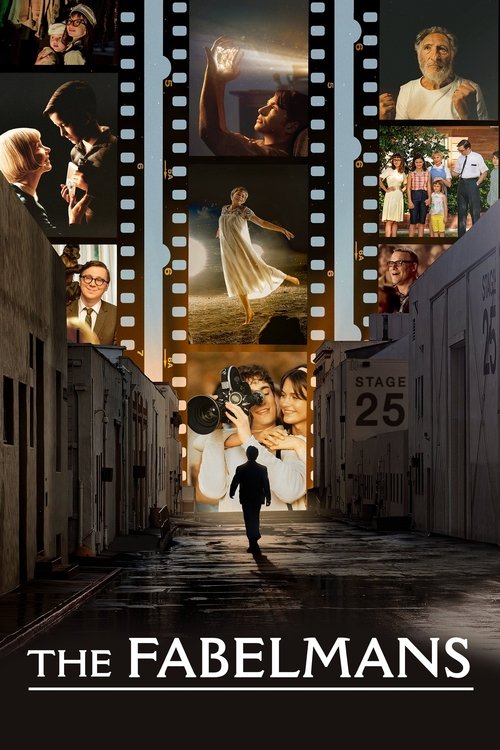
The Fabelmans
2022 · Steven Spielberg
For a reflective night when you want to feel something true about family — the kind of film to watch when you're ready for a lump in the throat rather than a thrill. Comforting on the surface, quietly devastating underneath.
What it's about
Sammy Fabelman, a Jewish kid growing up in postwar Arizona, falls in love with making movies — first as play, then as obsession. As he films his family and classmates, his camera catches something about his parents' marriage he was never meant to see, and the story becomes about a boy learning that art can reveal truths the people around you can't say out loud. It's Spielberg telling his own childhood, barely disguised.
The experience
Warm but not soft — it has the golden glow of memory and the sting of it too. It moves gently, lands hard in a few scenes, and leaves you thinking about your own parents as much as about the movies.
Performances
Michelle Williams gives a high-wire performance as Sammy's mercurial, artistic mother — luminous and heartbreaking at once — while Judd Hirsch storms through a handful of scenes as a great-uncle who delivers the film's thesis about art and family like a thunderclap. Paul Dano's quiet, decent father and Gabriel LaBelle's watchful Sammy hold the middle.
The craft
Spielberg and co-writer Tony Kushner shape a lifetime of memory into scenes that keep paying off the film's central idea: the camera as a machine for seeing what the eye avoids. The sequences where young Sammy edits his footage and discovers what it contains are little masterclasses in how movies make meaning, shot with the fluid confidence of someone who's been doing this for fifty years.
Why it matters
The most personal film of Spielberg's career, a Toronto People's Choice winner and seven-time Oscar nominee that reframed his entire body of work as autobiography in disguise.
Snapshot
The Fabelmans is Steven Spielberg's most nakedly autobiographical film, a coming-of-age drama that reconstructs his childhood and adolescence through the fictional surrogate of Sammy Fabelman, a Jewish boy in postwar Arizona and California whose passion for filmmaking becomes both a refuge and an instrument for uncovering an unbearable family truth. Co-written with playwright Tony Kushner, it braids together two subjects that had recurred obliquely across Spielberg's career—the disintegration of a family and the birth of an artist—and treats them, for once, without the mediating armature of genre spectacle. The film premiered at the Toronto International Film Festival in September 2022, where it won the People's Choice Award, and went on to seven Academy Award nominations, including Best Picture and Best Director. Widely received as a summation and a self-portrait, it is best understood as Spielberg, in his mid-seventies, turning the apparatus that made him famous back onto his own origins.
Industry & production
The film was produced by Spielberg's Amblin Entertainment and released by Universal Pictures, the studio with which Amblin has a long-standing distribution relationship. Reported production budgets place it in the neighborhood of $40 million—modest for a director of Spielberg's stature but substantial for an intimate period drama with no genre hook. Spielberg has described in interviews the decades of hesitation that preceded the project: the story required the emotional distance afforded by the deaths of his parents, Arnold and Leah Spielberg, and the encouragement of Kushner and his family to proceed. Principal photography took place in 2021, largely in and around Los Angeles, with locations standing in for the family's moves from New Jersey to Phoenix, Arizona, and finally to Northern California.
Commercially, the film underperformed relative to its acclaim. Despite a prestige awards campaign and near-unanimous critical praise, it drew modest audiences and ranks among the lower-grossing releases of Spielberg's career—a fact widely noted at the time as evidence of the difficulty of marketing a personal, star-restrained adult drama in a theatrical marketplace increasingly organized around franchise spectacle. Its awards profile was strong but not dominant: it won the Golden Globes for Best Motion Picture (Drama) and Best Director, yet converted none of its seven Oscar nominations into wins.
Technology
The Fabelmans was shot digitally, continuing the practice Spielberg and cinematographer Janusz Kamiński adopted in the 2010s after decades of celluloid work. The choice is thematically pointed in a film so preoccupied with the physical medium of film itself: the diegetic movie-making that Sammy undertakes is emphatically photochemical—8mm and 16mm reversal stock, hand-wound cameras, splicing and editing on a viewer, projection in darkened rooms. The film thus stages the analog origins of cinema through digital capture, a doubling that runs beneath its surface. The recreated home movies, war films, and the climactic "Ditch Day" beach short that Sammy assembles are period-faithful in gauge, grain, and mechanics, and the film treats the tactile business of loading, cutting, and projecting film as a subject in its own right rather than a decorative texture.
Technique
Cinematography
Kamiński, Spielberg's cinematographer since Schindler's List (1993), shoots the film in his characteristic register: warm, memory-soft light, with strong sourcing from windows that blooms and diffuses at the edges of the frame. The palette leans nostalgic without tipping into pastiche. Kamiński's approach here favors a certain clarity and restraint appropriate to a drama of interiors and faces, but retains the halated backlight and lens flares that have become his signature. A recurring cinematographic motif is the film-within-the-film: sequences shift in texture when we are inside Sammy's amateur footage, and Kamiński distinguishes the "real" of the family drama from the mediated image Sammy captures and later scrutinizes.
Editing
The film was cut by Michael Kahn and Sarah Broshar. Kahn, Spielberg's editor since Close Encounters of the Third Kind (1977) and one of the most decorated editors in Hollywood history, brings the pair's long-honed sense of pacing to a film whose editing is also, self-reflexively, its subject. The pivotal dramatic turn—Sammy discovering his mother's secret while cutting together camping footage—makes editing itself the mechanism of revelation: it is only by slowing, isolating, and re-viewing frames that the boy sees what was invisible to him in life. The film's structure is episodic and elliptical, moving in chapters across the family's relocations, and its rhythm is patient, giving scenes room to breathe rather than compressing them toward incident.
Mise-en-scène / staging
Staging is where Spielberg's mastery is most legible. He is a director of blocking and camera movement, and The Fabelmans is built on his familiar vocabulary of gliding tracking shots, choreographed movement through domestic space, and figures arranged in depth. The recurring image of the mother, Mitzi, illuminated by car headlights as she dances—a scene of dangerous, exposed emotion—shows Spielberg's instinct for making psychology visible through light and staging. Period production design renders the family's successive homes with precise, unsentimental detail, and the film uses spatial arrangement to dramatize the family's fractures: the physical distances that open between parents, the placement of the interloping "Uncle" Bennie within the family unit.
Sound
Sound is used with characteristic economy. The mechanical clatter of projectors and cameras, the specific acoustics of a suburban living room screening, and the ambient textures of period locations ground the film in sensory reality. John Williams's score is spare relative to his blockbuster work with Spielberg, foregrounding piano and restrained orchestration suited to an intimate drama.
Performance
The ensemble is central to the film's effect. Gabriel LaBelle carries the adolescent Sammy with watchful reserve. Michelle Williams plays Mitzi—based on Spielberg's mother, Leah—as a frustrated artist of volatile warmth, a performance that earned a Best Actress nomination; the film's decision to campaign her in the lead category rather than supporting drew some industry commentary. Paul Dano plays the father, Burt, an engineer of gentle, contained rationality, modeled on Spielberg's father, Arnold. Seth Rogen plays Bennie, the family friend whose closeness becomes the film's fault line. Judd Hirsch, in a single galvanic scene as the great-uncle Boris, earned a Best Supporting Actor nomination for a monologue about the irreconcilable pull between art and family that functions as the film's thesis delivered aloud.
Narrative & dramatic mode
The film operates in the mode of the Künstlerroman—the coming-of-age story of an artist—crossed with domestic melodrama. Its dramatic engine is not external threat but the slow disclosure of an emotional truth: that Sammy's parents' marriage is failing, and that his camera has recorded the evidence before he consciously understood it. This makes seeing—and the ambiguous ethics of the recorded image—the film's true subject. The camera is both a shield that lets Sammy manage overwhelming feeling and a weapon that can expose and wound. The narrative resists neat catharsis; it is structured as a series of relocations and losses, and it ends not with resolution but with a threshold, as Sammy enters the professional film world.
Genre & cycle
The Fabelmans belongs to a distinct cycle of late-career autobiographical films by major auteurs—works in which established directors turn to their own formation as a subject. It sits alongside Alfonso Cuarón's Roma (2018), Kenneth Branagh's Belfast (2021), Paolo Sorrentino's The Hand of God (2021), and James Gray's Armageddon Time (2022), a striking clustering of memory-films released in close proximity. Within Spielberg's own filmography it is anomalous: a small, personal drama from the director most associated with the modern blockbuster, though its concerns—fractured families, childhood wonder, the yearning gaze—have suffused his work from the start.
Authorship & method
The film is the product of Spielberg's most important creative partnerships, several of them decades long. His screenwriting collaboration with Tony Kushner—following Munich (2005), Lincoln (2012), and West Side Story (2021)—was essential here; Spielberg has said Kushner drew the personal material out of him and gave it dramatic shape, and the two share the screenplay credit. Janusz Kamiński (cinematography), Michael Kahn (editing, here with Sarah Broshar), and John Williams (score) constitute the core artistic team Spielberg has relied on for most of his mature career; Williams's involvement carried particular weight given his own late-career reflections about slowing his output. The film's method is one of transposition rather than documentary fidelity: names and details are changed—Spielberg becomes Fabelman—precisely to license emotional truth over literal accuracy, a distinction the film itself thematizes.
Movement / national cinema
The film is a product of American studio cinema and of the New Hollywood generation that Spielberg helped define in the 1970s. It is also, importantly, a work of American Jewish cinema: the Fabelmans' Jewishness is not incidental but structural, informing the family's culture, the antisemitism Sammy encounters at his California high school, and Uncle Boris's Old World warning about the cost of the artistic life. In this dimension the film joins a lineage of American films concerned with Jewish assimilation and identity in the postwar suburbs, and it renders that experience with unusual specificity for a mainstream release of its scale.
Era / period
Set primarily across the 1950s and 1960s, the film moves from the postwar prosperity of the DeMille-era moviegoing childhood through the suburban migrations of Cold War America to the countercultural threshold of the 1960s. Its recreated films—an opening encounter with Cecil B. DeMille's The Greatest Show on Earth (1952), backyard war and western shorts, a high-school beach movie—chart the popular film culture of the period from the inside. The setting is also the world of postwar American engineering and early computing: the father's work, based on Arnold Spielberg's career as a pioneering computer engineer, situates the family within the technological optimism of the era, a quiet counterpoint to the son's turn toward art.
Themes
The film's governing theme is the conflict between art and family—crystallized in Boris's monologue, which frames the artist's calling as a kind of beautiful affliction that will always compete with love. Closely bound to this is the ethics and power of the image: the camera as an instrument that can reveal truths the eye misses, comfort by giving control over reality, and manipulate how others are seen. A late sequence in which Sammy edits the school beach film to flatter a bully who has tormented him distills this ambivalence—cinema's capacity to remake a person into an ideal, and the disquiet that follows. Other threads include Jewish identity and outsiderhood, the pain of divorce seen through a child's eyes, artistic vocation as both inheritance and rebellion, and the redemptive-yet-costly act of transforming private wound into public art.
Reception, canon & influence
Critical reception was warm and widespread, with reviewers treating the film as a career summation and a rare instance of a blockbuster architect writing his own origin story with candor. Praise centered on the performances—particularly Williams and Hirsch—and on the film's self-reflexive intelligence about cinema itself; where reservations arose, they tended to concern a perceived softness or sentimentality in the memory-film form. Its Toronto People's Choice Award, historically a reliable Oscar bellwether, and its seven Academy Award nominations confirmed its standing, even as its commercial disappointment became part of its story.
The influences on the film run in two directions. Autobiographically, it draws on Spielberg's actual formation: the childhood trauma of The Greatest Show on Earth's train crash, which he famously recreated with a toy train set; his amateur 8mm filmmaking; and the real dissolution of his parents' marriage. Cinematically, it is steeped in the classical Hollywood the young Sammy consumes—DeMille, the western, the war film—and it culminates in a celebrated cameo by David Lynch as director John Ford, dramatizing a formative encounter the real Spielberg has recounted, in which Ford's terse lesson about the horizon line becomes the film's parting gift. The scene functions as an explicit statement of lineage, placing Spielberg in a line of descent from the studio masters.
Its forward legacy is still forming, given its recency. As a document, The Fabelmans has become an indispensable key to reading Spielberg's entire body of work, offering direct autobiographical sources for the fatherless boys, imperiled families, and awestruck gazes that recur across his films. Within the broader culture it stands as a prominent entry in the early-2020s wave of auteur memory-films, and as a case study—cited in industry discussion—of the widening gap between critical prestige and theatrical viability for adult dramas. Whether it will be canonized among Spielberg's major works or regarded as a late, personal coda is a judgment the historical record is still too close to render, and it would be premature to claim otherwise.
A Deleuzian reading
A boy sits alone with a viewer and a splicer, running the same few feet of camping footage back and forth.
The full Deleuzian reading of The Fabelmans →
Reception
It premiered as the anointed Oscar frontrunner — TIFF People's Choice winner, Spielberg's 'most personal film' — then bombed at the box office and lost Best Picture to Everything Everywhere All at Once. A few years on, it's settling in as beloved late-Spielberg, the one fans predict will age into a classic while the awards-season noise fades.
How The Fabelmans was received, from release to now →
How to watch The Fabelmans: what to notice on a first viewing
- Notice when the picture's texture changes into Sammy's own footage. Janusz Kaminski shoots the family in warm window light and shoots Sammy's reels in a thinner, coarser texture. The film keeps announcing which order of image you are inside. You are never simply looking here. You are watching a boy look, and the image carries that looking inside it.
- Watch where the light in each scene is coming from. Kaminski sources light hard from windows and car headlamps, so it blooms and flares at the edges of the frame. Faces are lit by something inside the scene rather than by an invisible crew. Sourced light makes the past look gentle while the scenes inside it stay sharp, so the two never quite agree.
- Watch Spielberg's camera glide while the family stays arranged in depth. He blocks rooms so the Fabelmans sit at different distances from the lens, then moves the camera through them. Where each person stands, and how far from the others, reports on the marriage. Spielberg puts the family's condition into floor plan and distance, so you can read the trouble long before dialogue names it.
- Listen for projectors, shutters and film winding through a camera. The mechanical noise of the equipment stays loud and present. Living-room screenings get their own acoustics. John Williams keeps the piano thin so the machines can be heard working. The apparatus is audible throughout, which keeps you aware that somebody is making the pictures you are watching.
- Watch Michelle Williams's hands when a room goes quiet. Williams plays Mitzi as a trained pianist whose feeling comes out through her body before it reaches her speech. She moves toward warmth and then past it. Paul Dano's Burt watches without moving. The imbalance in the marriage is on screen continuously, so you feel it well before the story gets around to saying it.
The whole guide to watching The Fabelmans, with the keys for a rewatch →
Influences: the films it descends from and the films it influenced
- How Green Was My Valley (1941) — The film literally invokes Ford's horizon-line doctrine (dramatized in the Lynch cameo)—interesting is 'the horizon at the bottom or the top,' the compositional discipline of pinning the horizon high or low to charge the frame, which becomes Sammy's parting inheritance.
- The Searchers (1956) — Ford's doorway-and-landscape framing—the human figure dwarfed against a decisively placed horizon—is the exact compositional grammar the John Ford cameo hands down as the film's closing lesson.
- The Greatest Show on Earth (1952) — Its train-crash spectacle is the primal cinematic wound the film restages: young Sammy reenacts the collision with a toy train set to master the terror of the moving image, making DeMille's set-piece the origin of Spielberg's whole compulsion to reconstruct.
- The 400 Blows (1959) — The template for the semi-autobiographical Künstlerroman: a boy processing a mother's infidelity and a fracturing home by fleeing into image-making, the director transposing his own childhood into a fictional surrogate.
- Fanny and Alexander (1982) — The child's-eye memory film in which a magic lantern / projected image is the boy's refuge, and adult secrets are apprehended through what the child watches—the same fusion of cinephilia and domestic revelation staged from a low, watching vantage.
- Amarcord (1973) — The episodic auteur-memory mode—hometown and family reconstructed as affectionate, exaggerated tableaux prioritizing emotional truth over literal accuracy, the exact 'transposition not documentary' method Spielberg names.
- Blow-Up (1966) — The founding instance of revelation-through-examining-one's-own-footage: a hidden truth surfaces only when the maker scrutinizes and enlarges his own images—precisely how Sammy discovers his mother's affair inside his edited home movie.
- The Conversation (1974) — The ethics-of-the-image thriller built on obsessively replaying a recording to extract a secret, and the maker's guilt at what his craft exposes—mirrored in Sammy's editing-bench discovery and its moral cost.
- Cinema Paradiso (1988) — Cinephilia-as-formation narrated through a mentor in the projection booth; the boy's love of the apparatus itself as the engine of the Künstlerroman, a direct forerunner to the Boris/Uncle-Boris art-versus-family axis.
- Radio Days (1987) — The nostalgic auteur memory film that reconstructs an extended family as personal mythology—warm, anecdotal, filtered through a specifically American-Jewish domestic milieu of the postwar period.
- The Hand of God (2021) — Extends the same directors-memoir genre — the origin story of a filmmaker whose family rupture becomes the engine of his art — following Hand of God's model of an established auteur turning the camera on his own formation.
- Close Encounters of the Third Kind (1977) — Establishes the awestruck-gaze staging the seed reprises—upturned faces raked by a single offscreen light source and choreographed beams, the 'headlight dance' vocabulary Kamiński would later refine into backlit silhouette.
- E.T. the Extra-Terrestrial (1982) — The suburban-divorce, fatherless-boy scenario shot at child's-eye height with adults cropped or withheld—the autobiographical wound of The Fabelmans dramatized earlier through genre displacement.
- Munich (2005) — The first Spielberg–Kushner screenplay, inaugurating Kushner's dialogue-forward dramatic shaping and the ethics-of-the-violent-image inquiry that The Fabelmans turns inward onto home-movie footage.
- Lincoln (2012) — Same core team (Kushner script, Kahn edit, Kamiński camera, Williams score) and the same Kushner method of building drama around long, morally weighted monologues—the register of Hirsch's Boris and Hirsch's aria.
- Roma (2018) — The contemporary auteur turning his own childhood into meticulously reconstructed period film, controlling the image directly as his own cinematographer—the same digital-capture-of-an-analog-past project as Kamiński's here.
- Belfast (2021) — An auteur childhood-memory film where the movie palace is the boy's luminous refuge amid family rupture and historical upheaval—cinema-going staged as the formative counterweight to domestic and political fracture.
- Armageddon Time (2022) — The parallel early-2020s American-Jewish autobiographical boyhood, structured around a beloved grandparent who delivers the film's moral-instruction monologue—the Anthony Hopkins figure occupying the exact dramatic slot as Judd Hirsch's Boris.
- Sentimental Value (2025) — Reflexive auto-fiction in which a nascent artist draws his films directly from his family's fractures, posing the same question of art made from those one loves.
- Wildlife (2018) — The same structural device — a boy's camera footage becomes the mechanism by which the mother's affair is discovered, making an imaging apparatus the film's instrument of unbearable knowledge; Dano plays the father, closing the rhyme.
- Just an Illusion (2026) — Builds its central turn out of exactly the seed's overheard-domestic-conflict staging — the child acquires knowledge of the parents' rupture by accident and through a mediating surface, and the film then tracks the cost of holding information the adults think is hidden.
Similar films
- Lincoln (2012) — influence & lineage
- Fanny and Alexander (1982) — influence & lineage · same viewing thread
- Guillermo del Toro's Pinocchio (2022) — shared sensibility
- Mars One (2022) — shared sensibility
- Boyhood (2014) — shared sensibility
- A Real Pain (2024) — shared sensibility
- All That's Left of You (2025) — shared sensibility
- Waltz with Bashir (2008) — shared sensibility
All the films related to The Fabelmans →
Watch it with: curated runs of related films
- When the Family Comes Undone — Watch these when you want intimate, one-household dramas where love and grief are the same thing — a parent fading, a marriage on trial, a child at the center of the wreckage.