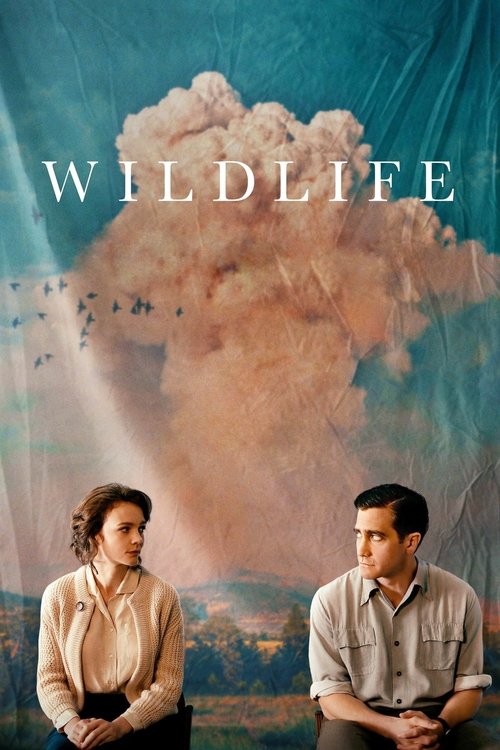
Wildlife
2018 · Paul Dano
For a contemplative night when you want a beautifully made, grown-up drama that trusts you with silence — closer to a good sad novel than an easy watch, and worth the bruise.
What it's about
Great Falls, Montana, 1960. Fourteen-year-old Joe is the only child of Jerry, a golf pro who loses his job and his sense of purpose, and Jeanette, a housewife with no outlet for her restlessness. When Jerry impulsively signs on to fight a wildfire burning near the Canadian border, Joe is left alone to watch his mother improvise a new life — and to witness, up close, a marriage coming apart.
The experience
Hushed, composed, and quietly wrenching — every scene is watched through the boy's eyes, so you feel his helplessness as the adults fail in slow motion. It's the kind of film that builds an ache rather than delivering blows.
Performances
Carey Mulligan is astonishing as Jeanette — brittle, charming, and frightening by turns, a woman reinventing herself in front of her own son. Jake Gyllenhaal brings a wounded pride to Jerry that makes his bad decisions painfully understandable.
The craft
Paul Dano's directorial debut, co-written with Zoe Kazan from Richard Ford's novel, is remarkable for its restraint: no voiceover, no consoling flashbacks, just precise framing that keeps the boy in the doorway of every scene. The muted autumn palette and smoke-hazed Montana landscapes give it the stillness of a period photograph.
Why it matters
One of the most assured actor-turned-director debuts of its decade, it confirmed Dano as a filmmaker of real discipline and gave Mulligan one of her defining roles.
Snapshot
Wildlife is a chamber drama about the collapse of an American marriage, watched from the doorway by the fourteen-year-old son who cannot leave the room. Adapted by Paul Dano and Zoe Kazan from Richard Ford's 1990 novel, it transplants the book's retrospective first-person account into a rigorously present-tense observational cinema: no voiceover, no flash-forward, no adult narrator to console us with the knowledge that the boy survived. Great Falls, Montana, autumn 1960. Jerry Brinson (Jake Gyllenhaal) loses his job at the golf club, refuses the humiliation of being offered it back, and signs on with a crew fighting a wildfire near the Canadian border for a dollar an hour. Jeanette (Carey Mulligan), left with rent and a son and no vocabulary for what has happened to her, begins to improvise a different life — teaching swimming at the Y, taking up with a prosperous, ailing car dealer named Warren Miller (Bill Camp). Joe (Ed Oxenbould) takes an after-school job at a portrait photography studio and learns, at the worst possible moment, how to compose a family into a frame.
It was Dano's directorial debut, premiered at Sundance in January 2018, opened the 57th Semaine de la Critique at Cannes that May, and was released in the U.S. by IFC Films in October. The reviews were strong and the audience was small — a shape that has become typical for the serious American independent drama in the streaming era.
Industry & production
Wildlife is a specimen of the late-2010s American independent ecosystem at close to its final workable scale: a mid-single-digit-millions literary adaptation, financed outside the studios, cast with actors whose theatrical value derives from studio work elsewhere, premiered at Sundance, sold to a specialty distributor, and released into a limited theatrical run designed largely to legitimize a subsequent video-on-demand life.
The project's engine was actorly rather than corporate. Jake Gyllenhaal's Nine Stories Productions was involved alongside June Pictures and other independent financiers; Gyllenhaal's participation as both producer and supporting player is the kind of leverage that gets a first-time director's period drama financed. Dano and Gyllenhaal had worked together as actors on Denis Villeneuve's Prisoners (2013), and the professional trust visible in that history is one of the film's quiet enabling conditions. Dano and Kazan — partners in life, and previously collaborators on Kazan's Ruby Sparks (2012), which she wrote and he starred in — developed the adaptation over a span of years rather than months, a luxury available precisely because nobody was waiting on it.
Principal photography took place in Oklahoma rather than Montana, with Enid and its surroundings standing in for Great Falls — a rebate-driven substitution that is standard practice and that has real aesthetic consequences (see Mise-en-scène). The production was compact, location-based, and built around long working days in practical interiors rather than stage builds.
Commercially, the film performed as such films now do: a respectable specialty release, no crossover, no awards-season propulsion beyond critics' groups and the independent sector. Awards attention gathered almost entirely around Mulligan, who drew nominations from the independent-film awards bodies; the film received no Academy Award nominations. It is worth stating plainly that Wildlife's theatrical numbers are not the interesting fact about it — by 2018 the specialty market had already ceased to be a reliable index of a drama's cultural life.
Technology
The film's technological argument is one of subtraction. Set in 1960 and concerned with a wildfire, it declines almost every affordance that would make the fire a spectacle. There is no digital conflagration, no aerial VFX set-piece. The fire arrives as smoke on the horizon, ash on a windshield, an amber contamination of daylight, and — in the single sequence where Jerry drives Joe out to see it — a glowing seam along a ridge, apprehended from a great and helpless distance. The most advanced imaging technology in the film is diegetic: the large-format portrait camera, the hot lights, and the posing stool of a small-town photo studio, which the script installs as the story's central mechanism.
The image itself reads photochemically — visible grain structure, tungsten interiors with soft halation around practical lamps, gentle highlight rolloff, a desaturated palette that sits closer to faded consumer color stock of the period than to the saturated Technicolor idea of 1960. This is a deliberate historical positioning: 1960 as it survives in family snapshots, not as it survives in movies. Public documentation of the production's specific capture format and lens package is thinner than for a studio release, and I won't assert specifics I can't stand behind; what is legible on screen is a look built to resist the clinical transparency that was the default of digitally-originated 2018 cinema.
Post-production color work is doing quiet structural labor. The Brinson house is graded toward browns, ochres, and a chilly north light; Jeanette's wardrobe and Warren Miller's house introduce reds and golds that are the same temperature as the fire. The film's color logic and its thematic logic are the same logic.
Technique
Cinematography
Diego García, the Mexican cinematographer whose formation is in international art cinema — Apichatpong Weerasethakul's Cemetery of Splendor (2015), Gabriel Mascaro's Neon Bull (2015), Carlos Reygadas's Our Time (2018) — brings to an American domestic drama a patience that American domestic drama rarely gets. The camera is predominantly static or minimally mobile. Compositions are frontal and often near-symmetrical, with doorways, window frames, and car windshields used as pictures-within-the-picture. Joe is repeatedly staged at thresholds: in a doorframe, at the edge of frame, in the back seat, behind glass.
Crucially, the film is about Joe's point of view without ever being in it. There are very few optical POV shots. Instead, the camera occupies a position roughly equivalent to where a watchful, frightened child would stand — near enough to hear, far enough to be forgotten. This is a formal solution to the adaptation's central problem, and it is the reason the film can dispense with narration.
Editing
Matthew Hannam and Louise Ford cut for duration rather than emphasis. Scenes are played in few setups and held past the point where conventional coverage would relieve the pressure; the film consistently declines the reaction-shot reflex that would tell us how to feel. The most consequential editorial decision is structural and negative: when Jerry leaves for the fire line, the film does not go with him. There is no crosscutting to men in yellow gear on a burning ridge. The obviously "cinematic" material is amputated, and the resulting hole in the narrative is precisely the hole in the household. What remains is a boy in rooms with his mother.
The ending is correspondingly abrupt — the film stops rather than resolves, on an image rather than a settlement.
Mise-en-scène / staging
The Brinsons' rented house is the film's principal instrument: thin-walled, provisional, furnished by someone else, with rooms that all look like waiting rooms. Warren Miller's house answers it with wall-to-wall carpet, a bar, a hi-fi, and the specific ugliness of postwar prosperity. Costume tracks Jeanette's trajectory more honestly than dialogue does — from serviceable housewife dress into brighter, tighter, more effortful clothes that are read by the film without contempt and by the town with plenty.
The Oklahoma-for-Montana substitution produces an unexpected benefit: instead of the postcard verticality of the Rockies, we get a flat, horizon-heavy landscape in which the sky occupies most of the frame and the smoke has nowhere to hide. The Brinsons live under weather rather than among mountains, which is the right relation for people with no shelter.
The set piece is the dinner at Miller's house — Jeanette drinking, dancing, performing a version of herself for a man's benefit while her son watches from a chair. Dano stages it in long, unhurried takes and refuses to editorialize.
Sound
David Lang's score is used with real discipline: spare, elegiac string and piano writing, deployed in short passages and withheld across the film's most volatile scenes, which play in room tone. The fire is largely an aural phenomenon — wind, a distant low-frequency presence, radio bulletins reporting containment percentages that never improve. Diegetic period radio and television do the work that a needle-drop soundtrack would do in a lesser version of this film, and the absence of pop-song shorthand is part of why the 1960 setting feels inhabited rather than curated.
Performance
Mulligan's Jeanette is the film's great achievement and the reason it survives. The role is a trap: a woman who behaves badly in front of her child, in a period idiom that invites either condescension or hagiography. Mulligan plays performance-within-performance — Jeanette manufacturing brightness for Joe, and the manufacture visibly costing her — and refuses to manage the audience's sympathy. It is a portrait of a woman discovering, at thirty-four, that she has been improvising a self she never chose.
Gyllenhaal's Jerry is built from wounded charm and a fatal vanity about work; the character's smallness is played without any actorly bid for grandeur. Oxenbould has the hardest assignment — sustained reactive stillness, a performance composed almost entirely of watching — and he holds the film's center by not doing very much. Bill Camp's Warren Miller is the film's shrewdest casting: physically diminished, unglamorous, neither predator nor prize, which denies the story a melodramatic antagonist and forces the audience to reckon with Jeanette's choice as a choice.
Dano's method here is legibly an actor's: rehearsal, long takes, a camera willing to wait, and a director's confidence that the truth of a scene will arrive if nobody hurries it.
Narrative & dramatic mode
The mode is observational realism laid over a melodramatic substrate. The events are melodrama's events — a lost job, an abandonment, an affair, an act of arson, a broken family — but the treatment systematically strips them of melodrama's amplification: no crescendos, no confrontation scenes that clarify motive, no speeches of self-explanation. Interiority is withheld on principle.
The adaptation's key move is the removal of Ford's retrospective first person. In the novel, an older Joe narrates from a position of survival and partial understanding; the prose supplies interpretation. Dano and Kazan delete the interpretive layer entirely and lower Joe's age from the novel's sixteen, which makes him less capable of processing what he sees and therefore a better lens. What we lose in explanation we gain in immediacy: the film is structured as a sequence of things a child was not supposed to witness.
The wildfire functions as objective correlative rather than plot: an uncontrolled burn on the horizon, unfightable, reported nightly in percentages. Jerry's return, and the small futile fire he sets in retaliation, completes the rhyme — the private conflagration is pathetic where the public one is sublime, and both are beyond his competence.
Genre & cycle
Three cycles intersect here. First, the American literary adaptation of postwar domestic fiction — the tradition that runs through the Carver adaptations, Ang Lee's The Ice Storm (1997), and Sam Mendes's Revolutionary Road (2008). Second, the divorce-through-a-child's-eyes drama: Kramer vs. Kramer (1979), Alan Parker's Shoot the Moon (1982), The Ice Storm again, Noah Baumbach's The Squid and the Whale (2005). Third — and this is the 2018-specific context — the actor-turned-director debut, of which that year produced an unusual concentration: Bradley Cooper's A Star Is Born, Jonah Hill's Mid90s, and Wildlife, all arriving within months of one another, all made by performers with the capital and the contacts to direct on their own terms.
Against Robert Redford's Ordinary People (1980) — the canonical actor's-debut family-dissolution drama, and an Oscar winner — Wildlife's refusal of catharsis and of therapeutic explanation reads as a deliberate correction.
Authorship & method
Dano's authorship is best described as curatorial restraint: the film's decisions are consistently about what not to show, not to score, not to explain. Coming from a performance career built with directors of strong formal signature — Paul Thomas Anderson, Steve McQueen, Villeneuve, Bong Joon-ho — he directs like someone who has spent twenty years watching what a patient camera does to an actor.
Zoe Kazan's contribution as co-writer is not incidental, and it carries its own lineage: she is the daughter of screenwriters Nicholas Kazan and Robin Swicord and the granddaughter of Elia Kazan, whose Splendor in the Grass (1961) is very nearly Wildlife's period sibling in its treatment of repression, class, and family damage. The screenplay's most valuable quality is its refusal to adjudicate Jeanette, and it is reasonable to read that as the mark of a writer who is also an actress.
Diego García supplies the film's optical philosophy — art-cinema stillness applied to Eisenhower-era Montana. David Lang, the Pulitzer-winning composer and Bang on a Can co-founder whose film work includes Paolo Sorrentino's Youth (2015), supplies a score that behaves like weather rather than commentary. Matthew Hannam and Louise Ford, editors formed on formally adventurous independent work, supply the film's patience with its own silences. Akin McKenzie's production design carries the period without curating it.
Movement / national cinema
Wildlife belongs to American independent cinema's realist-literary wing, but its crew composition is quietly transnational: a Mexican cinematographer trained on Thai and Brazilian and Mexican art films, a Canadian editor, an Australian actor playing a Montana boy. The film is a good illustration of how "American regional realism" is now made — with an international grammar imported into a domestic subject.
Within the national field, its nearest contemporary neighbor is Kelly Reichardt's Certain Women (2016): Montana, literary adaptation, static camera, ordinary people in economic weather, refusal of dramatic emphasis. Its literary parent, Richard Ford, was a central figure in the "dirty realism" cohort identified by Granta in 1983 alongside Raymond Carver and Tobias Wolff — a lineage of unadorned prose about working people that American cinema has always found difficult to translate without sentimentalizing. Wildlife is one of the more successful translations.
Era / period
The 1960 setting is exact and consequential. It is three years before Betty Friedan's The Feminine Mystique named "the problem that has no name," and the film's most rigorous historical achievement is that Jeanette has no language for her situation. She cannot say what is wrong; she can only act, badly, in a town where a woman acting badly is the only available form of self-assertion. The economic backdrop is equally specific: a service and extractive economy in which a man's identity is fused to a job that can vanish in an afternoon, and in which his wife's options are the Y, the classroom, or a wealthier man.
The 2018 vantage matters too. Released into the first full year after the #MeToo reckoning, the film arrived among a broader reappraisal of the mid-century housewife narrative — and its critical reception was shaped by how completely it declined to moralize about her.
Reception, canon & influence
Critical reception was near-uniformly positive from Sundance onward, with the consensus concentrating on two claims: that Dano had made a startlingly assured and mature debut, and that Mulligan had given the best performance of her career to that point. The Cannes Critics' Week opening slot conferred international art-cinema legitimacy; the IFC release converted very little of it into audience. The film's reputation has since settled as a well-regarded, somewhat under-seen American drama — admired, cited, not canonical.
Backward. The determining influence is Ford's novel and, behind it, the dirty-realist prose tradition. Formally, the film's frontal, static, doorway-framed grammar descends from a European and Asian art-cinema patience routed through García's own filmography rather than from American independent house style. Its handling of period melodrama through restraint invites comparison to Todd Haynes — Far from Heaven (2002) and Carol (2015) — though Wildlife declines Haynes's Sirkian saturation and stylization in favor of documentary muteness. The family-dissolution lineage runs through Ordinary People, Shoot the Moon, and The Ice Storm; the American photographic record of the period, from Robert Frank onward, is the more accurate visual reference than any film.
Forward. Honesty requires saying that the record here is thin: Wildlife is recent enough, and was seen by few enough people, that no documented school of imitators has formed around it, and claims to the contrary would be invention. Its traceable consequences are careerist rather than stylistic. It marked a decisive turn in Mulligan's trajectory toward the harder, less accommodating leading roles that followed — Promising Young Woman (2020), Maestro (2023). It established Dano as a director of consequence on the strength of a single film; as of this writing he has not released a second feature, which leaves the debut standing as an unresolved promise rather than the opening of an authorship.
There is one rhyme worth noting without overclaiming causation: four years later Dano played the father in Steven Spielberg's The Fabelmans (2022) — another autobiographically inflected account of a marriage dissolving under the gaze of a boy with a camera, in which a child's imaging equipment becomes the instrument of unbearable knowledge. That is a coincidence of preoccupation rather than an influence, but it is the kind of coincidence that tells you what a filmmaker is actually about.
A Deleuzian reading
They drive out to look at the fire.
The full Deleuzian reading of Wildlife →
Reception
It premiered at Sundance and opened Cannes Critics' Week in 2018 to warm reviews as a remarkably assured actor-turned-director debut, then barely registered at the box office. Since then it's settled into 'quietly great' status — the film people cite when arguing Paul Dano is as serious behind the camera as in front of it.
How Wildlife was received, from release to now →
How to watch Wildlife: what to notice on a first viewing
- Notice how often Joe stands in doorways, at the edge of frame. Dano keeps placing Joe in doorframes, the back seat, behind glass, watching his parents from just outside the room where the marriage is happening. Joe never gets to be in the room where things are decided; the camera puts you exactly where he stands, watching and powerless.
- Watch how still the camera stays, even in the tensest scenes. Diego García keeps the camera static or barely moving, framing people through doorways and windshields instead of pushing in on their faces. The camera stands near enough to hear and far enough to be forgotten, the way a frightened child would stand in the room.
- Listen for the radio giving containment percentages that never improve. David Lang's score stays spare and drops out entirely in the film's most volatile scenes, leaving radio bulletins and room tone to carry the tension instead. The bulletins report a fire nobody can put out, in numbers nobody can act on, a fact you only hear, never see.
- Look at the furniture in the Brinsons' rented house. The house is thin walled, furnished by someone else, every room shaped like a waiting room. Nothing in it belongs to this family, including, increasingly, the family. A rented house with nobody's furniture in it is what a marriage without a foundation looks like from the outside.
- Watch Carey Mulligan manufacture brightness for her son. Mulligan plays Jeanette performing cheerfulness she does not feel, and lets you see the manufacture cost her something every time she does it. She is not hiding her feelings from Joe. She is improvising a mother in front of him, and you can watch the improvising.
The whole guide to watching Wildlife, with the keys for a rewatch →
Influences: the films it descends from and the films it influenced
- Late Spring (1949) — Supplies the frontal, squared-off domestic grammar Wildlife runs on — figures addressed head-on within doorframes and hallway apertures, the camera holding the room after the actor has left it rather than cutting on the exit.
- The 400 Blows (1959) — Establishes the child-witness structure Wildlife inherits wholesale — the boy who sees the mother with another man and can neither report it nor understand it — and the abrupt arrested ending that refuses to convert that knowledge into resolution.
- Splendor in the Grass (1961) — Zoe Kazan's direct family inheritance: the treatment of Eisenhower-era sexual and class repression as damage transacted inside the house, with an actress permitted to be unsympathetic and unexplained rather than adjudicated by the script.
- The Last Picture Show (1971) — The model for period American flatness as photographic record rather than production design — wide low-horizon exteriors, wind, and an adolescent who learns adult infidelity by proximity, staged without nostalgic scoring.
- A Woman Under the Influence (1974) — The precedent for holding an unmanageable female performance in long takes without cutting away to a reaction shot that would tell you how to read her — the refusal to adjudicate that Kazan and Dano build Jeanette on.
- Jeanne Dielman, 23 quai du Commerce, 1080 Bruxelles (1975) — The rented-house-as-instrument method: fixed frontal setups repeated across the same domestic geography so that duration itself, not dialogue, registers a woman's interior collapse.
- Days of Heaven (1978) — The literal source of the burning-landscape objective correlative — a wildfire on a flat horizon photographed as autonomous weather rather than as a suspense event, with the human crisis kept in the same shot scale as the fire.
- Ordinary People (1980) — The template for the actor's directorial debut as an exercise in withholding: unmoving master shots of a family at table, a mother whose refusal to perform grief is never diagnosed, and no score to soften it.
- Shoot the Moon (1982) — Stages marital rupture as scenes played to their full uncomfortable length with the children physically present in frame, rather than crosscutting between separated spouses to editorialize blame.
- The Ice Storm (1997) — The adaptation model Wildlife follows — a literary novel of family dissolution rendered with an offscreen weather system as the structuring correlative, and adolescent characters used as the film's limited, uncomprehending register.
- Carol (2015) — Ed Lachman's photochemical period palette and habit of shooting characters through glass, doorways, and partial obstructions — the framing vocabulary Wildlife adopts while stripping out the Sirkian saturation and camera movement.
- Cemetery of Splendor (2015) — Diego García's own formation: the locked-off, non-POV observational camera that stays at a fixed civil distance from bodies for the full duration of an event, imported directly into 1960 Montana.
- Aftersun (2022) — Extends the withheld-interiority device to its limit: a first feature that restricts us to a child's partial sightline on a parent's unreadable crisis, uses the child's imaging device as the only evidence, and ends on non-resolution rather than disclosure.
- Certain Women (2016) — Same-decade Montana grammar: 16mm grain, flat horizon lines that dwarf the figures, and an editorial refusal to crosscut between strands so that each woman's withheld interiority stays sealed inside her own duration.
- Loving (2016) — Period American drama built on the same subtraction — no rhetorical speeches, no montage, faces held in static medium shots for beats past the point of comfort so that unspoken pressure reads as blocking rather than dialogue.
- The Souvenir (2019) — Hogg's fixed frontal tableaux and threshold compositions — action observed from an adjoining room through a doorway, scenes ending without a resolving beat — arrive at Wildlife's exact refusal to give the audience a privileged vantage.
- The Fabelmans (2022) — The same structural device — a boy's camera footage becomes the mechanism by which the mother's affair is discovered, making an imaging apparatus the film's instrument of unbearable knowledge; Dano plays the father, closing the rhyme.
Similar films
- Certain Women (2016) — influence & lineage
- Aftersun (2022) — influence & lineage
- Grizzly Man (2005) — shared sensibility
- The Power of the Dog (2021) — shared sensibility
- Blue Heron (2026) — shared sensibility
- Fjord (2026) — shared sensibility
- Beasts of the Southern Wild (2012) — shared sensibility
- Hunt for the Wilderpeople (2016) — shared sensibility