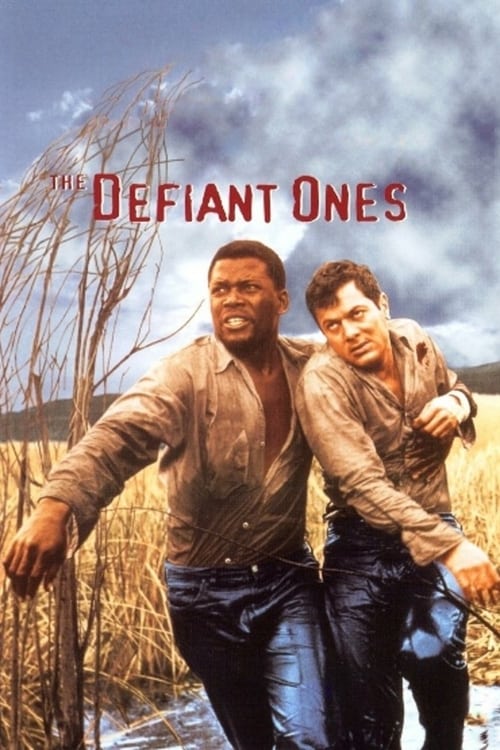
The Defiant Ones
1958 · Stanley Kramer
For when you want a tight, old-school thriller that's actually about something — gripping enough for a Friday night, substantial enough to argue about after.
What it's about
A prison truck overturns on a rainy Southern road and two convicts run — a white Southerner and a Black man, shackled together at the wrist. Neither can ford a river, climb a slope, or hide without the other, and over three days of pursuit through swamp and hostile country, the chain forces two men who despise each other into something neither expected.
The experience
Lean, muddy, and propulsive — a manhunt thriller that keeps physical danger and racial hostility twisted around each other, so the tension never lets up even as the film's heart slowly opens.
Performances
Tony Curtis and Sidney Poitier are electric together, spitting hostility that erodes into hard-won respect; Poitier in particular brings a fury and dignity that made the film a landmark for what a Black leading man could be on screen.
The craft
Stanley Kramer builds the whole film on one brilliant device — the chain as both plot engine and argument — and shoots the pursuit in stark black-and-white that makes the mud, rain, and swamp feel punishing. It's message filmmaking that works because the thriller mechanics are airtight.
Why it matters
Released squarely into the early civil-rights era, it became the defining Hollywood race-relations picture of its moment and a template every chained-together, enemies-forced-to-cooperate story since has drawn on.
Snapshot
The Defiant Ones is a lean, propulsive escape thriller built to carry an argument. Two convicts break loose when a prison-transport truck overturns on a rainy Southern back road — John "Joker" Jackson (Tony Curtis), a white Southerner, and Noah Cullen (Sidney Poitier), a Black man — and they are shackled together at the wrist by a single chain. The manacle is both plot engine and thesis: neither man can run, hide, ford a river, or climb without the other, and the film uses roughly three days of pursuit across mud, brush, and rural hostility to force a bond between men who begin by despising each other. Produced and directed by Stanley Kramer at the height of his reputation as Hollywood's foremost maker of "message" pictures, and released by United Artists in 1958, it arrived squarely inside the early civil-rights era and became one of the decade's most conspicuous liberal statements on race. It earned wide acclaim, multiple Academy Awards, and a durable place in the cultural argument about how mainstream American cinema imagined racial reconciliation — an argument its famous ending has kept alive for decades.
Industry & production
The film is a product of the post-studio independent-producer system that reshaped Hollywood in the 1950s. Kramer had built his name as an independent producer of socially themed dramas (Home of the Brave, The Men, High Noon among the pictures he produced) before moving into direction himself in the middle of the decade. The Defiant Ones was made through his own production operation and distributed by United Artists, the studio that specialized in financing and releasing independent producers rather than keeping them on contract — an arrangement that gave Kramer unusual latitude to make an overtly issue-driven film with two leads chained to a controversial subject.
The best-documented production story concerns the casting and billing. Tony Curtis, then a major box-office star, is widely reported to have used his standing to insist that Poitier receive equal, above-the-title billing — a meaningful gesture in an industry that rarely accorded a Black actor parity with a white star. The screenplay carried its own charged history: it was credited on release in part to "Nathan E. Douglas," a pseudonym for Nedrick Young, who was blacklisted after refusing to cooperate with the House Un-American Activities Committee. Young shared the writing with Harold Jacob Smith. When their script won the Academy Award for writing, it became one of the notable cases in which a blacklisted writer was honored under cover of a false name; the credit was later restored to Young. That the same picture championed racial brotherhood on screen while quietly employing a blacklisted author underscores how tightly Kramer's project sat at the intersection of the era's two great political anxieties — race and the Red Scare.
Technology
Technically the film is conservative by design. It was shot in black and white at a moment when color and the new widescreen formats were being marketed as the industry's answer to television. Kramer's choice of monochrome is consistent with the visual grammar of the serious "problem picture," which associated black and white with documentary sobriety and moral weight rather than spectacle. The photography favors location-style realism — rain, mud, water, night — over studio gloss, and the production leaned on practical hardship (the physical chain, the terrain, the weather) as its principal effect rather than on any technological novelty. The film was made in and around California standing in for the rural South; I would not want to overstate the precise locations without the production record in front of me, but the aesthetic aim is unmistakably naturalistic. There is no reliance on process work or optical showmanship as an end in itself; the "technology" of the film is essentially the chain and the actors' bodies.
Technique
Cinematography
Sam Leavitt's black-and-white photography won the Academy Award for cinematography, and it is the film's most celebrated craft element. Leavitt shoots the fugitives low and hard against sky, water, and undergrowth, keeping the two men and their connecting chain in frame together as a compositional constant — the image itself insists on their inseparability. Wet surfaces, overcast light, and high-contrast night sequences give the chase a grimy tactility that reads as realism rather than glamour, and the camera repeatedly frames the pair in tight two-shots that make the chain a visible third presence between them. The style is functional in the best sense: it subordinates its considerable technical polish to the single idea the film wants the audience never to forget.
Editing
Frederic Knudtson's cutting (Oscar-nominated) sustains the picture's momentum as a thriller while allowing the character scenes room to breathe. The film's architecture alternates between the two fugitives and the posse pursuing them — a sheriff and his men, plus dogs — and the editing manages that cross-cutting to build pressure without letting the chase overwhelm the human drama at its center. Crucially, the final movement depends on precise timing: the cutting between the running man and the departing train in the closing sequence is what gives the ending its emotional charge.
Mise-en-scène / staging
The staging is organized around a physical constraint that most films would never accept: two actors tethered together for nearly the entire running time. Every blocking decision — crossing a river, climbing out of a clay pit, sleeping, fighting, running — must account for the chain, and Kramer exploits this relentlessly. The single most quoted image, of the two men trying to climb out of a slick pit and repeatedly dragging each other back down, is a piece of staging that states the theme without a word: neither ascends unless both do. The rural settings — a turpentine or labor camp, a lonely farmhouse, a small-town store, the railroad line — function as a moral geography of the segregated South through which the pair must pass.
Sound
Ernest Gold's score supports the drama without overwhelming it, and the film integrates a memorable use of song: Poitier's Cullen sings a work-song refrain (associated with the "Long Gone" / "Lost John" tradition) that recurs as a motif of endurance and identity, and the singing returns with devastating effect in the finale. The film's sound world is otherwise spare and naturalistic — dogs, rain, the clank of the chain, footfalls — which keeps the emphasis on physical struggle.
Performance
The performances are the film's beating heart and drew extraordinary recognition: both Curtis and Poitier were nominated for the Academy Award for Best Actor, and the supporting players Theodore Bikel (the reluctant, decent sheriff) and Cara Williams (a lonely farm woman who offers Joker an escape) were both nominated in the supporting categories. Poitier's nomination is historically significant as one of the earliest competitive Best Actor nominations for a Black performer, and his Cullen — proud, wary, quick-tongued, and finally generous — established much of the dignified, controlled register that would define his star persona. Curtis, cast against his matinee-idol type, plays Joker's bigotry and eventual dependence with a rawness that surprised contemporaries who thought of him only as a light leading man. The chemistry of antagonism curdling into loyalty is what sells the film's thesis.
Narrative & dramatic mode
Dramatically the film is a two-hander survival thriller welded to a conversion narrative. Its structure is almost classical in its economy: an inciting accident frees the men; a ticking pursuit gives the story external pressure; and a series of trials — physical obstacles and human encounters — progressively strips away the enmity between them. The chain literalizes the dramatic premise so cleanly that the film hardly needs to editorialize; the audience watches interdependence become mutual regard. The mode is earnest and demonstrative, characteristic of the "problem picture," and it culminates in a moral test in which one man is offered freedom at the price of abandoning the other. The ending — in which the possibility of separate escape is refused in favor of solidarity — is engineered as the payoff of everything the preceding hour has built.
Genre & cycle
The Defiant Ones sits at the crossing of several cycles. As a prison-break-and-manhunt picture it belongs to the chain-gang tradition that runs from I Am a Fugitive from a Chain Gang (1932) forward, and it anticipates later Southern-incarceration dramas such as Cool Hand Luke (1967). As a race-relations drama it belongs to the postwar cycle of Hollywood "social problem films" that took up prejudice directly — a cycle Kramer himself had helped inaugurate with Home of the Brave (1949) and would extend through Judgment at Nuremberg (1961) and Guess Who's Coming to Dinner (1967). And it belongs to the emerging cycle of Sidney Poitier vehicles that, across the late 1950s and 1960s, placed a dignified Black protagonist at the moral center of a mainstream studio film. Its most enduring generic legacy, however, may be the "chained/shackled antagonists forced to cooperate" premise, which became a recognizable narrative template well beyond its original social frame.
Authorship & method
The film is quintessential Stanley Kramer. Kramer's authorial signature is thematic rather than stylistic: he sought out the era's live social controversies — combat trauma, nuclear anxiety, the teaching of evolution, Nazism, interracial marriage — and built accessible, star-driven dramas around them, earning both admiration for his seriousness and, from some critics, the charge that his films were schematic or sermonizing. The Defiant Ones is among his most controlled and least preachy works precisely because its central metaphor does the arguing for him.
His key collaborators shaped the result decisively. Writers Nedrick Young and Harold Jacob Smith supplied a tight, incident-driven screenplay whose award recognition doubled as a quiet rebuke of the blacklist. Cinematographer Sam Leavitt gave the film its award-winning monochrome realism. Editor Frederic Knudtson, a frequent Kramer collaborator, kept the thriller machinery humming. Composer Ernest Gold, another recurring member of Kramer's team, provided a score that served the drama and folded in the film's crucial use of song. Above all, the film is authored jointly by its two stars, whose willingness to play against type — Curtis roughened, Poitier permitted anger as well as nobility — makes the central relationship credible.
Movement / national cinema
This is an American film in the fullest sense: a product of Hollywood's independent-producer era, addressed to a national audience, and engaged with a specifically American wound. It belongs to the liberal, socially conscious strain of postwar Hollywood cinema — a tendency associated with New York-inflected, message-minded filmmaking — rather than to any formal avant-garde. Its realism is a moral posture more than a stylistic movement, and its ambitions are civic: to move a mass audience toward a particular view of racial brotherhood at a moment when the country was being forced to confront segregation.
Era / period
The film is inseparable from its moment. It appeared amid the opening battles of the civil-rights movement — after the Brown v. Board of Education decision (1954), the Montgomery bus boycott (1955–56), and the Little Rock desegregation crisis (1957) — and it addressed a white mainstream audience with a parable about Black and white men learning they cannot survive apart. Simultaneously it bore the marks of the HUAC/blacklist era in its concealed authorship. The picture thus stands at the confluence of the two dominant political currents of late-1950s American life, and its confidence that a popular entertainment could dramatize reconciliation is very much of that hopeful, contested period.
Themes
The governing theme is interdependence across the color line: the chain makes racial separation physically impossible and, the film argues, morally untenable. Around that core cluster several others — the transformation of inherited bigotry through shared suffering; freedom and its price (the recurring question of whether one can be free alone); dignity under a hostile social order, embodied in Cullen's refusal to be diminished; and the pull of solidarity against self-interest. The work-song motif ties the film to a longer history of Black endurance, and the Southern landscape functions as a map of segregation's dangers. The ending crystallizes the thesis: liberation chosen in solidarity is presented as morally superior to liberation seized alone.
Reception, canon & influence
On release the film was widely praised and heavily honored. It won Academy Awards for its screenplay and for Sam Leavitt's cinematography, and it collected a substantial slate of additional nominations, including Best Picture, Best Director, both lead actors, both supporting nominees, and editing — a haul that marked it as one of the most esteemed American films of its year. Poitier's Best Actor nomination in particular is a landmark in the history of Black recognition at the Academy. (I'm confident of the wins and of the breadth of the nominations; I'd verify the exact nomination count against the record rather than state a precise number here.)
Its influences run backward to the 1930s chain-gang film and to Kramer's own prior race dramas, and to the broader tradition of the Hollywood problem picture. Its influence forward is considerable and двойной. Narratively, the "two enemies shackled together and forced to cooperate" premise became a reusable template — echoed in exploitation reworkings (the women-in-prison riff Black Mama White Mama, 1973), in later buddy and mismatched-partner films, and in a 1986 television remake — to the point that the setup reads today as a recognizable genre unit. Culturally, the film became a touchstone in the debate over Hollywood's racial imagination.
That debate centers on the ending. The film's climax — in which the chance of separate escape is refused for the sake of solidarity — was embraced by many contemporary (largely white, liberal) audiences as a moving affirmation of brotherhood. But it also drew pointed criticism, most famously from James Baldwin, who in his book-length reflection on movies, The Devil Finds Work (1976), contrasted white audiences' approval with a very different reaction he reported among Black viewers, for whom the image of the Black man forfeiting his freedom to remain with a white companion read as a reassuring fantasy tailored to white feeling rather than to Black liberation. That critique — the charge that the film asks its Black hero to sacrifice escape to comfort a white audience — has become as much a part of the film's legacy as its awards. The Defiant Ones endures, then, as a double object: a genuinely well-made and historically brave studio film, and a case study in the limits and blind spots of mid-century Hollywood liberalism. Both readings are true, and the film's continued discussion depends on holding them together.
A Deleuzian reading
Two men are trying to climb out of a clay pit.
The full Deleuzian reading of The Defiant Ones →
Reception
A prestige smash in 1958 — nine Oscar nominations and near-universal acclaim as a courageous statement — it's since been filtered through the general cooling on Stanley Kramer, whose earnest 'message pictures' became cinephile shorthand for well-meaning middlebrow, even as this one keeps its landmark status.
How The Defiant Ones was received, from release to now →
Influences: the films it descends from and the films it influenced
- I Am a Fugitive from a Chain Gang (1932) — Establishes the chain-gang manhunt template — the hunted convict fleeing across sweaty, documentary-real Southern terrain as an indictment of the penal system — the exact scaffolding Kramer's escape plot inherits.
- The 39 Steps (1935) — Invents the handcuffed-together two-hander: two antagonistic strangers physically shackled so every movement dramatizes forced intimacy, the tethered-two-shot device Kramer literalizes with the leg iron.
- Odd Man Out (1947) — Renders the wounded fugitive's nocturnal cross-country flight as a passion play in expressive high-contrast monochrome, the manhunt-as-moral-ordeal photography Sam Leavitt echoes.
- Home of the Brave (1949) — Kramer's own prior production established his method — a taut, small-scale race-prejudice problem drama built around a single strained interracial relationship rather than spectacle.
- Intruder in the Dust (1949) — Pioneers location-shot Southern race drama treating a Black man's fate with grave naturalistic realism, the outdoor black-and-white social-problem idiom Kramer extends.
- No Way Out (1950) — Poitier's screen debut as a dignified Black professional under white assault inaugurates the poised-Poitier persona that Kramer casts against type by permitting it anger.
- In the Heat of the Night (1967) — Extends the antagonistic Black/white two-hander forced into partnership, now letting Poitier's dignity carry sharper, unmasked anger — the conversion structure sharpened.
- Guess Who's Coming to Dinner (1967) — Kramer and Poitier reunite on a reassuring interracial resolution that draws the identical Baldwin critique — a brotherhood fantasy tailored to comfort the white liberal viewer.
- Cool Hand Luke (1967) — Inherits the chain-gang penal setting with its sweat-and-dust realism and the diegetic work-song sound motif structuring the prisoners' labor.
- Hell in the Pacific (1968) — Strips the forced-cooperation two-hander to two enemy soldiers stranded in a landscape, extending the shackled-antagonists-must-collaborate premise to bare survival.
- Black Mama White Mama (1973) — A direct exploitation reworking — two women literally chained together escaping — that recycles Kramer's shackled-constraint premise as a self-conscious genre unit.
- 48 Hrs. (1982) — Codifies the mismatched Black/white pair whose mutual antagonism converts to grudging respect, the buddy-film template descending from the two-hander-conversion arc.
- Enemy Mine (1985) — Transposes the 'two enemies must cooperate to survive' structure into science fiction, an explicit restatement of the reluctant-solidarity narrative unit.
- Fled (1996) — An action-movie restatement of the premise at its most literal — two convicts chained together on the run — reprising the shackled-escape two-hander for the buddy-thriller era.
- Toy Story (1995) — Template for the mismatched-pair buddy structure — two antagonists chained by circumstance into reluctant partnership — that Woody and Buzz inherit beat for beat.
- Mississippi Burning (1988) — Founding template of the Hollywood social-problem message picture that stages race relations as a redemptive drama for a white mainstream audience, the very tradition and limitation Parker works within.
- Anbe Sivam (2003) — Establishes the message-movie device of literally yoking two antagonists together on a journey so ideological opposites must cooperate, delivering a social sermon through the road structure itself.
- The Intouchables (2011) — Establishes the forced Black-white two-hander whose antagonism-into-intimacy arc, staged as a chain of picaresque episodes, The Intouchables domesticates into comedy.
- Odds Against Tomorrow (1959) — A near-simultaneous stark-monochrome noir in which interracial hostility between partners must be overcome to survive — the same civil-rights-era interracial two-hander worked in parallel.
- Judgment at Nuremberg (1961) — Kramer's signature method — star-driven, accessible drama built around a live social controversy where the central metaphor does the arguing — is the same authorial DNA.
- To Kill a Mockingbird (1962) — Shares the liberal-Hollywood social-problem film's strategy of dramatizing racial injustice through a morally testing scenario in luminous black-and-white realism.
Similar films
- In the Heat of the Night (1967) — influence & lineage
- I Am a Fugitive from a Chain Gang (1932) — influence & lineage
- Mudbound (2017) — shared sensibility
- Mississippi Burning (1988) — shared sensibility
- 12 Angry Men (1957) — shared sensibility
- The Hateful Eight (2015) — shared sensibility
- Bad Day at Black Rock (1955) — shared sensibility
- The Hill (1965) — shared sensibility