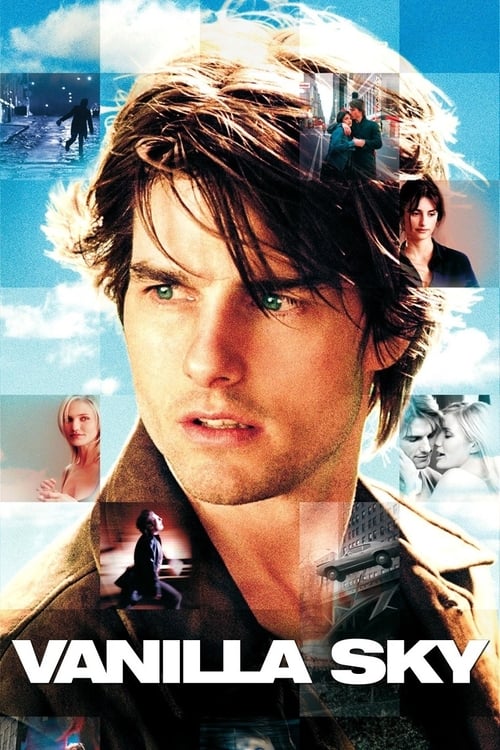
Vanilla Sky
2001 · Cameron Crowe
For when you want a glossy studio movie that messes with your head — a mystery to chew on for days rather than comfort viewing. Best late at night, with your full attention.
What it's about
David Aames is a young Manhattan publishing heir who coasts on money, charm, and a perfect face — until the night he meets Sofia, the first woman who feels real to him, and accepts one last ride from a jealous ex. The car crash that follows wrecks his face and his charmed life, and as he tries to rebuild both, the world around him starts to slip: memories contradict each other, faces change, and he ends up telling his story from a psychiatric cell wearing a prosthetic mask.
The experience
It plays like a lush romantic drama that keeps tilting into nightmare — seductive one scene, disorienting the next, with a mounting sense that you can't trust what you're seeing. It asks you to hang on through the confusion, and it lingers afterward as a puzzle you keep turning over.
Performances
Tom Cruise takes his own stardom apart, playing vanity curdling into desperation from behind a mask; Penélope Cruz is warm and grounding as Sofia, the role she originated in the Spanish film this remakes; Cameron Diaz is genuinely unnerving as the lover who won't be discarded.
The craft
Cameron Crowe remakes the Spanish thriller Open Your Eyes as a fever dream of pop culture, packing the frame with album covers, movie references, and one of his signature wall-to-wall soundtracks. The famous image of a man alone in an empty Times Square announces its ambition in the first minutes. It rewards a rewatch — the film is built so its details read differently once you know where it's going.
Why it matters
One of the most divisive studio films of its era — dismissed by many on release and steadily reclaimed since as the strangest, riskiest thing Crowe ever made, and a key entry in the early-2000s wave of reality-bending mainstream cinema.
Snapshot
Vanilla Sky is Cameron Crowe's English-language remake of Alejandro Amenábar's Spanish thriller Abre los ojos (Open Your Eyes, 1997), and the most formally adventurous and divisive film of Crowe's career. It transposes Amenábar's puzzle-box of love, vanity, disfigurement, and engineered reality onto a glossy Manhattan backdrop, with Tom Cruise as David Aames, a charmed and shallow magazine heir whose face — and life — are shattered in a car crash engineered by a spurned lover. Structured as a fractured confession told from a psychiatric cell by a man in a prosthetic mask, the film withholds the ground of its own reality until a late revelation reframes everything as a contracted lucid dream purchased from a cryonics company. Where Crowe had built his reputation on warm, music-soaked humanist comedies — Say Anything…, Jerry Maguire, Almost Famous — Vanilla Sky turned those instincts toward existential dread, narcissism, and the terror of mortality, while preserving his signature pop-cultural saturation and emotional yearning. Penélope Cruz crossed over from the original to reprise her role as the dream-woman Sofía, an unusual continuity between source and remake. Released in December 2001, weeks after the September 11 attacks, the film's images of an emptied Times Square and a world dissolving into catastrophe acquired an accidental, melancholy timeliness. Critically polarizing on release and a steady commercial performer rather than a runaway hit, it has since accrued a substantial cult following as one of the era's most earnest mainstream experiments with subjective and unreliable narration.
Industry & production
Vanilla Sky was a star-driven studio production, financed and released by Paramount Pictures and produced principally through Cruise/Wagner Productions, the company Tom Cruise ran with his producing partner Paula Wagner, in concert with Crowe's own Vinyl Films. The project originated with Cruise: having admired Amenábar's Abre los ojos, he and Wagner secured remake rights and recruited Crowe — with whom Cruise had triumphed on Jerry Maguire (1996) — to write and direct. The reunion of star and director after that earlier success was a significant part of the film's industrial logic; Cruise was at the height of his commercial power, and the film functioned in part as a vehicle through which he could complicate and even punish his own golden-boy image.
The casting drew on Crowe's established relationships and on the source film's legacy. Penélope Cruz, who had played Sofía in Amenábar's original opposite Eduardo Noriega, was cast in the same role here — a rare instance of an actress reprising a part across a remake in two languages. Cameron Diaz, fresh from There's Something About Mary, took the volatile role of Julie Gianni; Kurt Russell played the psychiatrist Dr. Curtis McCabe; Jason Lee, a Crowe regular, played David's best friend and resentful confidant Brian Shelby. The production unfolded largely in New York and Los Angeles. Its single most logistically famous achievement was the early sequence of Cruise running through a completely deserted Times Square — accomplished by closing the area in the early morning hours, a feat of permitting and coordination that became one of the film's signature production stories. Because Crowe is also a former music journalist, the film's music supervision and soundtrack assembly were treated as a core production activity rather than an afterthought, with the eclectic song selections woven in from the earliest stages of conception.
Technology
Vanilla Sky is a turn-of-the-millennium 35mm production whose technological interest lies less in image-capture innovation than in prosthetic and makeup effects and in the controlled manufacture of unreal environments. The film's narrative hinges on disfigurement and concealment, and a great deal of craft went into the rendering of David's ruined face and, later, the lifelike prosthetic mask he wears to hide it — effects that had to read as both clinically plausible and emotionally devastating, and that thematically literalize the film's concern with surfaces and masks. The dream logic of the later acts also called for set-pieces of constructed unreality — most notably the emptied Times Square, achieved practically rather than digitally — and for the film's recurring use of paintings, photographs, and pop imagery as reality-anchors that subtly destabilize. Beyond these, the record does not support claims of unusual camera or post-production technology; the film's uncanniness is achieved chiefly through staging, performance, sound, and editing rather than through any signal technical novelty, and it would be invention to assert otherwise.
Technique
Cinematography
The cinematography is by John Toll, an Academy Award winner for Legends of the Fall and Braveheart and the cinematographer of Terrence Malick's The Thin Red Line. Toll lends Vanilla Sky a lush, high-gloss surface entirely appropriate to David's privileged world — clean light, saturated color, the glamorous sheen of wealth and beauty — which the film then progressively corrupts as reality comes apart. The visual strategy depends on a contrast between the warm, romantic luminosity of David's "good" life and the colder, more clinical and fractured imagery of his confinement and disfigurement. The title itself — a "vanilla sky," named in the film after the sky in a Claude Monet painting beloved by David's mother — points to the cinematography's painterly ambitions: the dream world is repeatedly keyed to that soft, impossible, art-derived light, so that the very beauty of an image becomes a clue to its falseness. Toll's framing keeps David central and often isolated, the camera complicit in his narcissism early on and in his entrapment later.
Editing
The editing, by Joe Hutshing — a longtime Crowe collaborator who had cut Jerry Maguire and Almost Britain — together with Mark Livolsi, is the film's most demanding technical achievement, because the entire structure depends on the controlled withholding and reshuffling of time. The narrative is built as a confession: David, masked and imprisoned, recounts events to Dr. McCabe, and the film cuts restlessly between this framing present and a past that the audience cannot yet trust. Memories, possible dreams, and "spliced" realities are interleaved so that the viewer, like David, loses the ability to distinguish the lived from the manufactured. The cutting is also, characteristically for Crowe, married to music: songs frequently drive transitions and montage, and the rhythm of the film is as much musical as dramatic. The late-film revelation requires the editing to retroactively re-cohere a deliberately disordered experience, and the picture's success or failure for many viewers rests on whether that final reorganization feels earned.
Mise-en-scène / staging
Crowe's staging saturates the frame with cultural reference — film posters, album covers, paintings, photographs — turning David's environment into a collage of borrowed images, which the film eventually reveals to be precisely the point: the dream he inhabits has been assembled from the detritus of his own pop-cultural consciousness. The contrast of worlds is again central: the airy, design-magazine luxury of David's apartment and social life against the bare institutional spaces of his confinement and the surreal, depopulated cityscapes of the dream. Cameron Diaz's Julie and Penélope Cruz's Sofía are staged as opposing romantic poles — danger and salvation, the woman scorned and the woman idealized — and the mise-en-scène repeatedly frames David's idealization of Sofía in romantic, almost advertising-like imagery that the film's logic will expose as fantasy. Crowe threads recurring motifs — masks, mirrors, the Monet sky, the rooftop — through the design so that the visual world is constantly hinting at its own constructed nature.
Sound
Sound, and specifically music, is the domain in which Crowe's authorship is most legible. The original score was composed by Nancy Wilson — the Heart guitarist and Crowe's wife at the time — and the film is further built around an extensive, eclectic curation of songs spanning rock, electronica, and pop, deployed with the precision of a critic who treats records as emotional and thematic statements. The needle-drops are not decorative; particular tracks are tied to memory, mood, and the slippage between real and dreamed, and the soundtrack functions almost as a parallel narration of David's interior life. The sound design also exploits the uncanny silence of the deserted-city sequences, where the absence of expected urban noise becomes a primary signal that reality has failed. As in all of Crowe's work, the marriage of image to popular song is treated as a fundamental expressive tool rather than as ornament.
Performance
The performances center on Tom Cruise, who uses the role to interrogate and dismantle his own star persona. David Aames begins as a vain, careless golden boy — a knowing exploitation of Cruise's charisma — and is then physically and psychologically broken, the actor playing much of the film behind disfigurement makeup or an immobilizing prosthetic mask that strips him of the very handsomeness on which his appeal depends. It is among Cruise's most exposed and risk-taking performances, and it drew notice as a deliberate complication of his image. Penélope Cruz, reprising Sofía from the Spanish original, plays the idealized beloved with a warmth the film both celebrates and ultimately marks as a projection. Cameron Diaz, against her then-prevailing comic image, is volatile and frightening as Julie, the rejected lover whose anguish detonates the plot; the performance is widely regarded as among the film's strongest. Kurt Russell grounds the framing scenes as the patient, increasingly uncertain psychiatrist, and Jason Lee supplies the rueful, envious friendship that gives the dream its human stakes.
Narrative & dramatic mode
Vanilla Sky's dramatic mode is the unreliable, subjective puzzle-film — a mystery whose true object is not "what happened" but "what is real." Its architecture is a nested confession: a masked, imprisoned David narrates his story to a psychiatrist, and the film's apparent chronology — wealth, the meeting with Sofía, the catastrophic crash, disfigurement, recovery, romance, and a creeping disintegration of reality — is gradually exposed as untrustworthy. The engine is not the thriller mechanics but David's psychology: his vanity, his fear of being unloved for anything but his face and money, and his inability to accept loss. The late revelation — that much of what we have seen is a contracted "Lucid Dream" sold by a cryonics company called Life Extension, with a "splice" point at which David's real life ended and the engineered dream began — recasts the entire film as an externalized study of a single consciousness unable to reconcile itself to death and disfigurement. This is melodrama in the serious sense, a drama of recognition: David must choose between an eternal, curated illusion and the terror of waking into real mortality. The film's closing image — a leap from a rooftop and the command to "open your eyes," translating the Spanish source title — leaves the act of waking as both salvation and abyss.
Genre & cycle
The film sits at the intersection of romance, mystery, and science fiction, and it belongs to a distinct turn-of-the-millennium cycle of "reality is not what it seems" puzzle-films. Around 1999–2001, mainstream and art cinema alike were preoccupied with simulated, dreamed, or manipulated realities and with twist-driven narration — a cluster that includes The Matrix, eXistenZ, The Thirteenth Floor, The Sixth Sense, Fight Club, Memento, Mulholland Drive, and Donnie Darko. Vanilla Sky is among the most commercially prominent and most romantically inflected entries in that cycle, fusing the era's appetite for ontological trickery with Crowe's characteristic concern for love, longing, and self-knowledge. As a remake, it also belongs to the well-established pattern of Hollywood adapting recent European art-thrillers for English-language audiences. Within science fiction it draws on the long lineage of cryonics, simulated experience, and the technologized afterlife; within romance it works the archetype of the idealized, possibly unreal beloved. Its hybridity — a star-vehicle love story that is also an existential SF puzzle — is precisely what made it difficult to categorize and divisive on release.
Authorship & method
Vanilla Sky is most legible as the meeting point of two authorial sensibilities: Crowe's and the absent presence of Amenábar's original. Crowe adapted Abre los ojos — written by Alejandro Amenábar with Mateo Gil — with considerable fidelity to its structure while overlaying his own preoccupations: romantic idealism, the redemptive and revelatory power of popular music, an obsessive pop-cultural intertextuality, and a sincere, heart-on-sleeve emotionalism unusual in so cerebral a genre exercise. The film is, in this sense, a deliberate departure for a director associated with humane realism, applying his romanticism to existential and metaphysical dread.
Among the key collaborators, cinematographer John Toll provided the lush, painterly surface whose very beauty becomes a clue to unreality; editors Joe Hutshing and Mark Livolsi executed the demanding temporal architecture on which the film's effect depends; and the music — Nancy Wilson's score together with Crowe's meticulous song curation — functions as a co-authorial layer of meaning rather than accompaniment. Tom Cruise's contribution, as both star and producer, is structurally inseparable from the film's authorship: the project was his initiative, and the performance's interrogation of his own celebrity gives the film much of its charge. Penélope Cruz's reprise of Sofía links the remake umbilically to its source. It would overstate the record to assign specific creative decisions beyond what is documented, but the film is unmistakably a collaboration in which a humanist director, a self-revising star, and a foreign-language source text pull against one another productively.
Movement / national cinema
Vanilla Sky is a product of mainstream American studio filmmaking at the turn of the millennium, but its identity is inseparable from a transnational act of adaptation: it is Hollywood's reworking of a Spanish film by Alejandro Amenábar, one of the leading figures of a revitalized Spanish cinema of the late 1990s. As such it belongs to the recurring traffic by which American studios absorb and rescale European art-thrillers for global audiences, and it carries traces of the source's national-cinema origins even as it remakes them in a wholly American idiom of wealth, celebrity, and Manhattan glamour. Within American cinema it exemplifies the prestige star-vehicle of its moment — a major star and a respected auteur director collaborating on ambitious, adult-oriented material released through a studio's awards-season pipeline. It is not affiliated with any formal movement; its lineage is industrial and authorial rather than national-school in character.
Era / period
The film is a precise artifact of the very end of the 1990s boom and the anxious opening of the new millennium. Its world of effortless wealth, design-magazine surfaces, and celebrity self-regard belongs to the late-Clinton-era affluence that the period's puzzle-films repeatedly diagnosed as hollow; David Aames is a creature of inherited privilege whose crisis is fundamentally about whether anything beneath the surface is real. The film's release in December 2001, only months after the September 11 attacks, gave its imagery an unintended and much-discussed resonance: the sequence of a man running through a deserted Times Square, and the broader motif of a familiar world emptied out and falling into catastrophe, landed differently in a traumatized cultural moment than they would have a year earlier. The film also registers the period's fascination with technologized immortality — cryonics, life-extension, engineered experience — anxieties that the turn-of-the-millennium science fiction cycle obsessively rehearsed. In its preoccupation with curated, image-saturated selfhood it even anticipates concerns that the coming decade of digital and networked life would intensify.
Themes
The film's governing theme is the seduction and danger of illusion — David's choice to inhabit a beautiful, curated dream rather than face a disfigured and mortal reality, and the question of whether a perfect lie is preferable to an imperfect truth. Orbiting this are several interlocking concerns. There is vanity and the terror of the surface: David's identity is bound up in his face and his charm, and the film systematically strips both away to ask what, if anything, remains. There is the idealization of romantic love — Sofía as a projected fantasy of salvation — and the film's recognition that such idealization may be a flight from reality rather than a meeting with another person. There is the fear of death and the fantasy of technological escape from it, embodied in the cryonics premise. There is guilt and consequence, as David's careless treatment of others — Julie, Brian — returns to destroy him. And there is the film's reflexive interest in the manufactured self: a consciousness assembled from films, songs, and images, unable to tell its own desires from the culture it has absorbed. The repeated injunction to "open your eyes" frames the whole as a parable about the courage required to wake from comforting illusion into real, finite life.
Reception, canon & influence
Vanilla Sky was sharply divisive on release. Critics split between those who admired its ambition, Cruise's risk-taking performance, and Crowe's audacity in attempting so strange a film within a major studio star-vehicle, and those who found it self-indulgent, overlong, or inferior to Amenábar's leaner original. Comparisons with Abre los ojos were ubiquitous and frequently unfavorable, and the film's tonal hybridity — romance, thriller, and metaphysical puzzle — frustrated viewers expecting a more conventional Cruise–Crowe reunion. Commercially it performed respectably without becoming a defining hit, and its awards recognition was modest relative to the talent involved; the soundtrack, true to Crowe's reputation, was a notable element of its cultural footprint. Over subsequent years the film's standing has risen among cult audiences, who prize precisely the qualities that alienated some contemporary critics: its earnestness, its formal daring, and its willingness to let a blockbuster star deconstruct himself.
Influences on the film run first and most directly to Amenábar and Mateo Gil's Abre los ojos, whose plot, structure, and central conceits Crowe preserved, and to the broader turn-of-the-millennium cycle of reality-bending puzzle-films. Crowe's own body of work — the romantic idealism and music-driven method of Say Anything…, Jerry Maguire, and Almost Famous — supplies the film's sensibility, while the long science-fiction traditions of cryonics, simulated experience, and the technologized afterlife inform its premise. The deployment of a Monet sky as the film's central image of curated beauty ties it to a self-conscious art-historical romanticism.
Its influence forward is more diffuse than that of some of its cycle-mates, but it endures as a touchstone in discussions of unreliable narration and "twist" cinema, and as a notable case study in a major star using a studio vehicle to complicate his persona — a strategy Cruise would continue to explore. The film helped keep the international appetite for Amenábar's work visible to Anglophone audiences, and its melancholy images of an emptied city have become recurrent reference points in writing about cinema and the post-9/11 mood. More broadly it stands as a durable example of a mainstream Hollywood film willing to risk incoherence and alienation in pursuit of an earnest metaphysical question — and its rehabilitation by later audiences testifies to the way such risk-taking can outlast its initially mixed reception.
A Deleuzian reading
David Aames wakes, drives to work, and finds Times Square scrubbed clean of every other human being.
The full Deleuzian reading of Vanilla Sky →
Reception
Dismissed in 2001 as Tom Cruise's baffling vanity project — booed by some audiences, savaged by critics — it's since become a favorite reappraisal case, with a steady stream of 'Vanilla Sky was right all along' defenses treating it as a misunderstood pre-social-media mindbender.
How Vanilla Sky was received, from release to now →
Influences: the films it descends from and the films it influenced
- Abre los ojos (1997) — The direct source: Crowe preserves its nested-confession framing — the disfigured protagonist recounting events to a prison psychiatrist — and its lucid-dream/cryonic-splice twist architecture that retroactively recodes every prior scene.
- The Thin Red Line (1998) — Established John Toll's painterly natural-light cinematography, the same DP method whose excessive surface beauty Crowe weaponizes as a diegetic clue that the world has become a curated unreality.
- Almost Famous (2000) — Crystallizes Crowe's method of song-as-narration and meticulous needle-drop curation that functions as a co-authorial meaning layer rather than accompaniment, the technique carried wholesale into Vanilla Sky.
- Say Anything… (1989) — The boombox-serenade template: a single needle-drop deployed as the vehicle of unguarded romantic idealism, Crowe's signature of music-driven emotional sincerity.
- Jerry Maguire (1996) — The first Cruise–Crowe collaboration that built the earnest, charm-forward movie-star persona which Vanilla Sky then turns inside-out and deconstructs.
- Vertigo (1958) — The obsessive man remaking a lost, idealized woman — romantic fixation curdling into nightmare — plus the late revelation that forces a wholesale reinterpretation of earlier scenes.
- Jacob's Ladder (1990) — The entire-film-as-a-dying-mind's-hallucination structure, punctured by intrusive horror glitches in a stable reality — the template for a lucid dream curdling into a controllable nightmare.
- Total Recall (1990) — Introduces purchased, implanted artificial experience and the unresolved 'is this real or the fantasy I paid for?' ambiguity that becomes Vanilla Sky's third-act engine.
- Eternal Sunshine of the Spotless Mind (2004) — A melancholy sci-fi romance built on consumer memory-technology, using non-linear editing to dramatize a relationship dissolving inside a failing, unreliable mind.
- 28 Days Later (2002) — Extends the depopulated-metropolis image — an empty London echoing Cruise's deserted Times Square — into the era's signature uncanny-city shot of the post-millennial mood.
- Inception (2010) — The lucid-dream-architecture puzzle film with a literal support team that engineers the dream, a 'wake up' release mechanism, and a deliberately ambiguous is-he-still-under ending.
- Source Code (2011) — Builds a romance-thriller on a technologized afterlife — a looped, simulated consciousness mistaking constructed experience for continued life, Vanilla Sky's premise repurposed as repeating-day mystery.
- Magnolia (1999) — Cruise deliberately cast against type to interrogate his own celebrity — the same star-deconstruction strategy Vanilla Sky pursues, mounted concurrently.
- The Matrix (1999) — A cycle-mate in the turn-of-millennium simulated-reality puzzle film, using the 'your world is a constructed illusion' reveal as its structural spine.
- eXistenZ (1999) — Purchased immersive simulation indistinguishable from waking life, with nested layers of false reality that defer the question of which level is real — Vanilla Sky's puzzle logic in another key.
- Mulholland Drive (2001) — Released the same year: a wish-fulfillment fantasy that collapses to expose the dreamer's denied reality, the identical fantasy-then-twist dual structure built on unreliable subjectivity.
- Donnie Darko (2001) — A turn-of-millennium puzzle film fusing a metaphysical conceit with a curated needle-drop pop soundtrack used as period-coded emotional and narrative scaffolding.
Similar films
- Open Your Eyes (1997) — influence & lineage · same viewing thread
- Eternal Sunshine of the Spotless Mind (2004) — influence & lineage · same viewing thread
- Vertigo (1958) — influence & lineage · often watched together
- Mulholland Drive (2001) — influence & lineage · often watched together
- Magnolia (1999) — influence & lineage · often watched together
- Almost Famous (2000) — influence & lineage
- Donnie Darko (2001) — influence & lineage · same viewing thread
- Total Recall (1990) — influence & lineage · same viewing thread
All the films related to Vanilla Sky →
Watch it with: curated runs of related films
- Waking Up Inside the Illusion — Watch these in a run when you want the same jolt over and over — an ordinary man realizing the calm reality around him was built, dreamed, or erased, and clawing his way toward waking up.