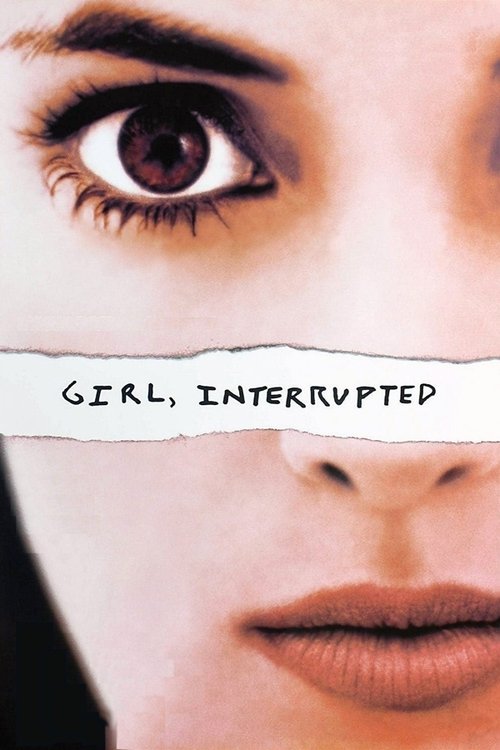
Girl, Interrupted
1999 · James Mangold
For when you want a serious, emotional drama about young women finding themselves — something to feel deeply and argue about afterward, more challenge than comfort.
What it's about
In 1967, eighteen-year-old Susanna checks into a New England psychiatric hospital for what's supposed to be a short rest after an ambiguous overdose — and discovers that getting out is far harder than getting in. Diagnosed with borderline personality disorder, she's absorbed into a ward of young women, each carrying her own damage, and falls under the spell of Lisa, a charismatic sociopath who treats the institution as her kingdom. What follows is a coming-of-age story set inside locked doors, about figuring out who you are when the world has already labeled you.
The experience
Intimate and slow-burning, it swings between the warmth of unlikely friendship and sudden jolts of cruelty and grief. It leaves you turning over the question of where eccentricity ends and illness begins.
Performances
Angelina Jolie won the Best Supporting Actress Oscar as Lisa — magnetic, dangerous, and impossible to look away from — while Winona Ryder does quieter, watchful work as Susanna, holding the film's center as the girl trying to decide whether she belongs inside or out.
The craft
James Mangold adapts Susanna Kaysen's memoir with a patient, character-first hand, letting the ward become a fully inhabited world rather than a gothic backdrop. The late-1960s period detail is precise without being showy, and the film gives its ensemble of young actresses room to build real, distinct people in the margins.
Why it matters
It launched Angelina Jolie into stardom and Oscar glory, and became a touchstone film about young women and mental illness — endlessly quoted, referenced, and rediscovered by new generations.
Snapshot
Girl, Interrupted adapts Susanna Kaysen's 1993 memoir of her roughly eighteen-month stay, beginning in 1967, at a prestigious New England psychiatric hospital. The film follows Susanna (Winona Ryder), an eighteen-year-old committed after an ambiguous aspirin-and-vodka incident and diagnosed with borderline personality disorder, as she is absorbed into a ward of young women and drawn to the magnetic, defiantly sociopathic Lisa (Angelina Jolie). Directed by James Mangold in his third feature, it sits at the intersection of the literary prestige adaptation, the female coming-of-age drama, and the institutional-confinement picture whose towering precedent is One Flew Over the Cuckoo's Nest. Its most durable legacy is Jolie's performance, which won the Academy Award for Best Supporting Actress and effectively launched her as a movie star; the film itself has aged into a touchstone of turn-of-the-millennium depictions of young women, mental illness, and diagnosis.
Industry & production
The project originated with Winona Ryder, then near the peak of her stardom, who optioned Kaysen's memoir and shepherded it through development as a producer over several years — an authorship stake worth foregrounding, since the film is in a real sense her passion project as much as its director's. It was produced by Douglas Wick's Red Wagon Entertainment together with Cathy Konrad and distributed by Columbia Pictures (Sony). The screenplay is credited to James Mangold with Lisa Loomer and Anna Hamilton Phelan, reflecting a multi-writer development process typical of a memoir with limited conventional plot that had to be shaped into dramatic scenes.
Mangold was a comparatively young director coming off the well-reviewed indie Heavy (1995) and the ensemble crime drama Cop Land (1997); Girl, Interrupted was his move into a studio-backed, star-driven prestige vehicle positioned for the late-1999 awards corridor. It opened in limited release in December 1999 to qualify for that season and expanded in January 2000. Commercially it was a modest performer rather than a breakout — a mid-budget adult drama that recouped respectably without becoming a hit — though precise budget and grosses vary across sources and I will not assert specific figures I cannot verify. Its commercial identity was decisively reshaped after the fact by Jolie's Oscar win, which became the film's principal marketing and cultural hook.
Technology
This is a conventional 35mm live-action production of the late 1990s, and there is little to flag technologically: no significant visual-effects program, no unusual capture format, and a workflow rooted in photochemical film finishing rather than the digital-intermediate pipeline that would become standard only a few years later. The film's ambitions are performative and dramatic, not technical. The one area where craft technology matters is period reconstruction — the 1967–68 setting is achieved through production design, costume, and a curated soundtrack of licensed period recordings rather than through any image-manipulation technique.
Technique
Cinematography
Cinematography is by Jack Green, a veteran best known for his long collaboration with Clint Eastwood (including the Oscar-nominated Unforgiven). Green's work here is restrained and character-serving rather than showy: warm, slightly desaturated interiors that render the ward as institutional but not gothic, and a preference for close and medium framing that keeps the film anchored to faces. The visual strategy resists the horror-adjacent expressionism that mental-hospital films can indulge; instead it treats Claymoore as a plausible, even comfortable, prison. Susanna's subjective disturbances — a recurring motif of tendons and bones felt beneath skin, moments where time and perception slip — are handled with modest, targeted devices rather than a sustained stylized register.
Editing
The film was cut by Kevin Tent, an editor closely identified with Alexander Payne's films. The memoir is episodic and non-linear, and the adaptation's central editorial problem is imposing forward momentum on material that is essentially a set of ward vignettes and reflections. The solution is a broadly chronological arc — arrival, immersion, crisis, departure — with the Lisa relationship supplying the escalating dramatic spine. The most discussed editorial-dramatic construction is the late-film sequence in which the two women flee the hospital and confront Daisy, a passage that shifts the picture's tone toward something darker and more confrontational and functions as its emotional climax.
Mise-en-scène / staging
Production design by Richard Hoover renders the ward as a specific late-1960s institutional world — communal spaces, group-therapy staging, the bureaucratic apparatus of confinement — while costume and hair signal both period and character (Lisa's leather-jacketed menace against the softer registers of the other patients). The staging is fundamentally ensemble-based: much of the film's meaning is carried by how the young women are grouped, who sits where, who is watching whom. The recurring iconography of the title — drawn from Vermeer's Girl Interrupted at Her Music, invoked explicitly in a museum-visit beat — frames the whole enterprise as a meditation on the arrested, watched young woman.
Sound
Sound design is naturalistic. The film's most defining sonic element is its use of licensed period music as needle-drops that both fix the era and comment on mood — a strategy common to 1960s-set American films of the era. The score is by Mychael Danna, whose contribution is spare and atmospheric, ceding foreground to the source songs and to the actors' voices. I want to be careful not to overstate specific cues from memory; the general design principle — period recordings as emotional and temporal anchor, with an unobtrusive underscore — is the reliable point.
Performance
Performance is the film's true medium. Ryder plays Susanna as an observer-narrator, deliberately more reactive and interior than her castmates, which was both a dramatic choice and, in some critics' view, a liability against the more flamboyant roles around her. Jolie's Lisa is the engine: charismatic, cruel, and destabilizing, a performance of predatory vitality that dominates every scene she enters. The ensemble is unusually deep — Clea DuVall as the delusional Georgina, Brittany Murphy as the wounded Daisy, Elisabeth Moss as the burned Polly, Angela Bettis as Janet — with Whoopi Goldberg as the ward nurse Valerie and Vanessa Redgrave as the analyst Dr. Wick supplying the film's adult moral counterweights. It is very much an actors' film, and its reputation rests there.
Narrative & dramatic mode
The film operates in a confessional, first-person mode inherited from the memoir: Susanna narrates, and the audience's access to the ward is filtered through her uncertain self-understanding. Dramatically it is a chamber piece — confined setting, fixed ensemble, incremental shifts in alliance and insight — closer to a psychological ensemble drama than to a plot-driven story. Its structural gamble is that its protagonist is passive by design, an intelligent witness to her own suspended life, with the more externally dramatic energy displaced onto Lisa. The arc it ultimately traces is one of self-authorship: Susanna's "recovery" is figured less as a cure than as her decision to reject Lisa's nihilism and choose the difficult work of ordinary life outside — a resolution some found earned and others found too tidy against the memoir's more open-ended ambivalence.
Genre & cycle
The film belongs to the institutional-psychiatric drama, a lineage running from The Snake Pit (1948) through David and Lisa (1962) to One Flew Over the Cuckoo's Nest (1975), the comparison that shadowed nearly every review. Against that male-coded tradition, Girl, Interrupted is pointedly a female ensemble, and it also participates in the coming-of-age and "troubled young woman" cycles. Its release coincided with a late-1990s cluster of American films preoccupied with adolescent alienation, therapy, and mental illness — a cultural moment in which Good Will Hunting (1997) had recently made the therapeutic-breakthrough drama commercially respectable and in which suburban and youthful malaise (American Beauty, The Virgin Suicides, both 1999) was much in the air.
Authorship & method
Mangold's authorship here is that of an actor's director and adaptor rather than a stylist; across his subsequent career (Walk the Line, 3:10 to Yuma, Logan, Ford v Ferrari) he would establish himself as a classical craftsman committed to performance and clear dramatic construction, and Girl, Interrupted is an early, formative instance of that sensibility applied to intimate material. The decisive collaborators are as much above the line as behind the camera: Ryder as originating producer-star, and Jolie as the performance that redefined the film's reception. Among craft heads, Jack Green (cinematography), Mychael Danna (score), and Kevin Tent (editing) are the significant names, each a respected professional whose work here is subordinated to the ensemble. The screenwriting was collaborative and iterative — Loomer and Phelan alongside Mangold — a reminder that adapting a plot-light memoir is itself a distinct authorial labor.
Movement / national cinema
This is mainstream American studio filmmaking of the prestige-adaptation kind, produced within the Hollywood system (Columbia/Sony) rather than the independent sector, even as Mangold carried indie credibility from Heavy. It reflects the late-1990s convergence in which star-driven, literarily respectable, awards-oriented dramas were still viable studio product. It is not affiliated with any formal movement; if it belongs to a tendency, it is the actorly American character drama of its moment.
Era / period
Two eras are in play. The film is set in 1967–68, and much of its texture is a reconstruction of that late-1960s world — a period the film treats less through overt historical event than through mood, music, and the era's evolving vocabulary of psychiatry and female possibility. It was made at the end of the 1990s, and it bears that moment's marks: a confidence in memoir and therapy narratives, a female-ensemble sensibility, and a star system in which a supporting role could catapult a young actor to the front rank. The gap between the two eras is part of the film's subject: it looks back at how a young woman's nonconformity was pathologized in 1967 from the vantage of 1999.
Themes
The film's governing preoccupation is the porous, socially constructed line between sanity and madness — Kaysen's diagnosis of borderline personality disorder is treated as much as a verdict on a difficult young woman as a medical fact. Around this cluster gathered its other themes: the gendering of psychiatry, in which female rebellion, sexuality, and refusal are read as symptoms; adolescence and the terror of ordinary adult life; institutional confinement and the paradox that the hospital is both trap and refuge; class and privilege, since Claymoore is an expensive shelter; and self-authorship, the memoirist's act of reclaiming her own story. Lisa embodies the seductive alternative — freedom as pure negation — and the film's moral movement is Susanna's turn away from that romance of self-destruction toward the harder claim of living.
Reception, canon & influence
Critical reception was mixed-to-favorable, with a consistent split: near-unanimous praise for Jolie, and reservations about the film's overall shape. A recurring line of criticism cast it as a softer, more sentimental "Cuckoo's Nest for girls," faulting the adaptation for smoothing the memoir's cool ambivalence into a more conventional redemptive arc and for leaving Ryder's deliberately recessive Susanna overshadowed by the vividness around her. The film's craft was generally judged competent and unshowy rather than distinguished; its power was located in its cast.
Its influences run backward to the psychiatric-institution canon already noted — The Snake Pit, David and Lisa, and above all One Flew Over the Cuckoo's Nest, whose ward dynamics and rebel-versus-institution structure it consciously reworks in a female register — and, of course, to Kaysen's memoir and the 1960s cultural anxieties about psychiatry and confinement it documents.
Its forward influence is concentrated and real. The Oscar win transformed Jolie's career and helped install a particular image — the dangerous, charismatic young woman — that shaped her subsequent stardom. More diffusely, the film became a lasting reference point in popular depictions of borderline personality disorder and of institutionalized young women, and its imagery enjoyed a marked cultural afterlife: in the 2010s, stills and lines from the film circulated widely on social media as part of a "sad girl" visual vocabulary, giving it a second life among audiences too young to have seen its release. That afterlife is well documented as a cultural phenomenon, even as scholarly assessment of the film's clinical portrait has grown more critical over time. Within Mangold's filmography it reads in hindsight as an early demonstration of the actor-centered classicism that would define his major work. It is not usually placed in the first rank of its decade's dramas, but as a star-making showcase and a cultural artifact of turn-of-the-millennium attitudes toward young women and mental illness, its place is secure.
A Deleuzian reading
A girl sits at a keyboard.
The full Deleuzian reading of Girl, Interrupted →
Reception
Dismissed in 1999 as awards-season Oscar bait with a lukewarm critical shrug, it's since been adopted wholesale by a younger generation — a Tumblr-era 'sad girl' touchstone that's now far more beloved than critics ever were.
How Girl, Interrupted was received, from release to now →
How to watch Girl, Interrupted: what to notice on a first viewing
- Watch Ryder's face stay still while Jolie's face keeps moving. Ryder plays reflexive, a smooth surface holding one feeling at a time. Jolie plays intensive, features and micro-movement climbing toward a threshold in the same scene. Mangold called this the reflexive vs intensive face: Lisa needs Susanna's stillness to burn against.
- Notice who sits where in every dayroom scene. The grouping of the young women shifts scene to scene: who faces whom, who is watched, who watches back. Ward staging carries the film's meaning about power and diagnosis more than dialogue does.
- Listen for period songs entering as needle-drops, not underscore. Mychael Danna's score stays spare and recedes; licensed 1960s recordings do the emotional work instead. The soundtrack fixes the film in 1967 while doing the commenting a score usually does.
- Watch how close Jack Green's camera stays to faces indoors. Interiors are warm, slightly desaturated, shot close or medium, with no gothic shadow anywhere on the ward. Claymoore reads as a plausible, comfortable prison instead of a horror-movie asylum.
- Track the stretches where nothing happens but a check-in or med line. Kevin Tent lets institutional routine sit on screen instead of cutting for momentum. This is what the reading calls dead time: held, empty time that is the honest shape of confinement.
The whole guide to watching Girl, Interrupted, with the keys for a rewatch →
Influences: the films it descends from and the films it influenced
- The Snake Pit (1948) — Establishes the female-institutional template Girl, Interrupted reworks — a woman's subjective first-person voiceover narrating her own confinement, staged against semi-documentary ward detail (hydrotherapy, group wards, the escalating tiers of treatment) that renders psychiatry itself as the film's antagonist-space.
- David and Lisa (1962) — Models the low-budget chamber approach to institutionalized youth — small ensemble of adolescent patients, each a distinct clinical 'type,' with drama generated by intimate two-person exchanges inside the ward rather than external plot, exactly the register Mangold adopts for Susanna and Lisa.
- Persona (1966) — Supplies the recessive-observer/magnetic-other dyad the film is built on: a near-silent, passive protagonist (Ryder's Susanna) paired with a vivid, transgressive companion (Jolie's Lisa) who threatens to absorb her identity — the same asymmetry critics noted when Jolie 'overshadowed' the memoirist.
- One Flew Over the Cuckoo's Nest (1975) — The film consciously transposes Forman's ward architecture into a female register — a charismatic rule-breaker galvanizing a gallery of passive patients against a controlling institutional-authority figure (Ratched → the nurses/Whitcomb), with ensemble ward staging as the primary dramatic engine.
- I Never Promised You a Rose Garden (1977) — Its most direct antecedent as adaptation-object: a young woman's psychiatric-hospital memoir (Joanne Greenberg) turned into a talk-driven, therapist-patient chamber drama, proving the 'plot-light memoir of a hospitalized girl' could be structured for the screen around clinical dialogue.
- Ordinary People (1980) — The prestige model for an actor's-director building a film around the therapy dyad and a traumatized, withheld protagonist — dramatic momentum sourced from psychiatrist-patient sessions, and a supporting player (Hutton, like Jolie) walking off with the Oscar from an ostensibly quiet ensemble.
- Frances (1982) — Prototype of the gendered-psychiatry showcase: a magnetic female lead (Lange) whose institutionalization is framed as the punitive containment of a 'difficult' woman, the exact reading later applied to Lisa and to the film's critique of mid-century psychiatric authority over young women.
- An Angel at My Table (1990) — Establishes the first-person female-memoir-of-confinement adaptation as an art form — faithfully rendering a writer's institutional years (misdiagnosis, ward life) through her own recessive, interior point of view rather than melodrama, the tonal ambition Girl, Interrupted reaches for.
- Prozac Nation (2001) — Near-immediate follow-on in the exact niche: a first-person female mental-illness memoir (Wurtzel) adapted as a star vehicle (Ricci) foregrounding depressive interiority and the same recessive-narrator-as-observer problem the memoir form imposes.
- Sylvia (2003) — Extends the gendered-breakdown biopic into the poet-memoir mode — a luminous star turn (Paltrow) organizing the film around a young woman's mental unraveling and institutional treatment, with period-1960s reconstruction and Vermeer-adjacent painterly interiors.
- Thirteen (2003) — Carries forward the charismatic-corrupter/impressionable-follower pairing (Lisa/Susanna → Evie/Tracy) as a study of a passive girl seduced into transgression, extending the film's diagnosis of adolescent female self-destruction into raw handheld naturalism.
- It's Kind of a Funny Story (2010) — Directly reworks the Cuckoo's Nest-via-Girl, Interrupted ward ensemble for youth — a voluntarily committed young protagonist finding self-definition among a gallery of vividly individuated fellow patients, the institution reframed as a warm coming-of-age crucible.
- Black Swan (2010) — Inherits the 'dangerous, charismatic young woman' star-image the film minted for Jolie — a magnetic transgressive double who both liberates and destabilizes a repressed heroine — deployed as the engine of a female psychological-unraveling star vehicle.
- The Virgin Suicides (1999) — Contemporaneous originator of the same turn-of-millennium 'sad girl' image-vocabulary — soft period-lit tableaux of confined adolescent girls scored to melancholic needle-drops — that gave both films their 2010s social-media afterlife as circulating stills.
- Girl with a Pearl Earring (2003) — Makes literal the Vermeer-iconography staging that Girl, Interrupted quotes — composing figures in soft window-light against still, painterly interiors — showing the same source (Dutch-master framing of a watchful young woman) driving cinematography in a period female-centered chamber film.
- Walk the Line (2005) — Mangold's own maturation of the method demonstrated here — actor-centered classicism that subordinates directorial style to transformative lead performances and clean dramatic construction, staging addiction and breakdown as an ensemble-of-two showcase built for awards-caliber acting.
- Identity (2003) — Mangold's own prior film rhymes through institutional confinement and fractured female psychology, establishing his interest in the diagnosed unstable mind that Identity abstracts into structure.
- Brainstorm (2001) — A near-simultaneous youth-committal drama adapted from an autobiographical account, using first-person narration and ward-ensemble dynamics — the same book-to-screen, inmate-solidarity approach Brainstorm takes from Carrano's memoir.
Similar films
- Persona (1966) — influence & lineage · same viewing thread
- Face to Face (1976) — same viewing thread
- Cries and Whispers (1972) — same viewing thread
- Walk the Line (2005) — influence & lineage · often watched together
- Black Swan (2010) — influence & lineage · often watched together
- Lady Bird (2017) — often watched together
- Promising Young Woman (2020) — often watched together
- Bound (1996) — often watched together
All the films related to Girl, Interrupted →
Watch it with: curated runs of related films
- The Fractured Self — A run of art films where identity, memory, and sanity refuse to stay solid — watch them near each other and the faces, silences, and doublings start to rhyme.