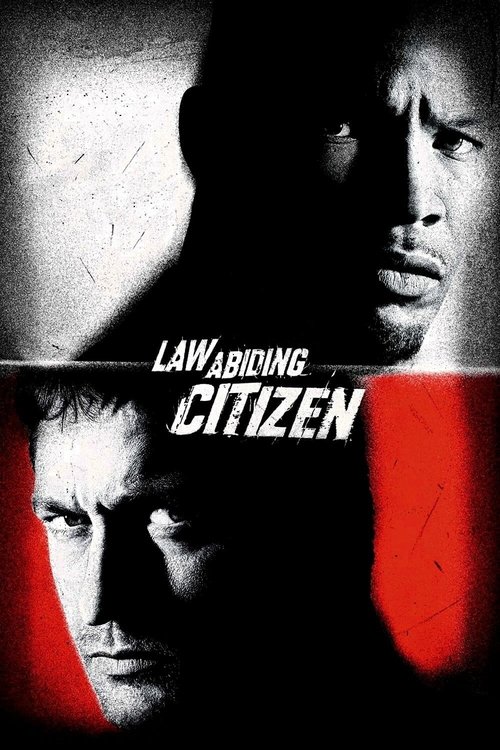
Law Abiding Citizen
2009 · F. Gary Gray
For a night when you want a loud, angry popcorn thriller that lets you argue with the screen — comfort food for anyone who's ever raged at a headline about a criminal walking free. Not one for a gentle evening; it earns its R rating early and often.
What it's about
A Philadelphia father watches the man who murdered his wife and daughter walk away with a light sentence, thanks to a plea deal cut by an ambitious assistant district attorney more interested in his conviction rate than in justice. Ten years later the grieving man strikes back — not just at the killer, but at every prosecutor, judge, and official who signed off on the deal. The twist in the setup: he lets himself be caught, and keeps the campaign running from inside a maximum-security cell, daring the DA to figure out how.
The experience
A blunt, propulsive cat-and-mouse thriller that keeps topping its own shocks — brutal in stretches, gleefully implausible in others, and hard to pause once the game between the two men is on. You spend half the film switching sides on who you're rooting for, which is exactly the hook.
Performances
Gerard Butler plays the avenger with an unnerving calm that's more menacing than any shouting, and Jamie Foxx gives the slick prosecutor a slow-burning conscience; the film runs on the charge between them across an interrogation table.
The craft
F. Gary Gray stages the escalating attacks with mainstream-thriller polish — clean, punchy set pieces, a couple of genuinely jolting explosions, and a script built like a series of traps snapping shut. It's engineered for jump-out-of-your-seat reactions rather than subtlety, and the big bangs land better with good speakers.
Why it matters
A critical punching bag that became an audience favorite and a cable and streaming perennial — one of those thrillers whose moral provocation (does the system protect the guilty?) keeps pulling in new viewers years later.
Snapshot
A revenge thriller that mutates, roughly at its midpoint, into something stranger and less stable: a procedural about the machinery of American criminal justice in which the machinery itself becomes the antagonist's instrument. Clyde Shelton (Gerard Butler) watches a plea bargain free the man who murdered his wife and daughter, then spends a decade engineering a punishment not of the killer alone but of the system that traded him away — including Nick Rice (Jamie Foxx), the ambitious assistant district attorney who signed the deal to protect his conviction rate. Clyde surrenders himself and conducts the remainder of the campaign from inside a maximum-security cell, which is the film's real premise and its most durable idea: incarceration as a chosen tactical position.
Released by Overture Films in October 2009 to broadly hostile reviews and strong commercial returns, it has become one of the more persistent second-life films of its decade — a cable and streaming perennial whose reputation among audiences never converged with the critical verdict. The gap is instructive. What critics identified as the film's fatal flaw — an ideological incoherence that lets it argue both for and against extralegal violence — is arguably the precise reason it retained an audience in a decade defined by institutional distrust.
Industry & production
Law Abiding Citizen is a specimen of a business model that was, at the moment of its release, in the process of dying. It was produced by The Film Department, the independent financing-and-production outfit founded in 2007 by former Warner Independent and Miramax executive Mark Gill, alongside Lucas Foster's production entity and Gerard Butler's own company — Butler took a producer credit as well as the lead. Screenwriter Kurt Wimmer also produced. This was the archetypal structure of the late-2000s independent boom: equity and debt assembled outside the studios, international rights presold, a domestic distributor attached for a fee, and a star's participation used as the collateral that made the arithmetic work.
The domestic distributor, Overture Films, was itself a creature of the same bubble — a Liberty Media–backed label launched in 2006 to prove that a well-capitalized outsider could compete for mid-budget adult product. Law Abiding Citizen became one of its most successful releases and one of its last: Overture's operations were wound down in 2010, its distribution and marketing apparatus absorbed by Relativity Media. The Film Department did not long outlast it. The film therefore stands as a kind of high-water mark for a financing ecosystem that the 2008 credit contraction had already fatally undermined — the mid-budget, R-rated, star-driven thriller, made outside the majors, aimed squarely at adults who still bought tickets on a Friday night.
Principal photography took place largely on location in Philadelphia, and the choice was more than a tax-incentive convenience, though it was that too. The film's civic architecture — courthouses, municipal corridors, a decommissioned prison — carries an irony the production exploits without ever quite naming: a story about the collapse of legal legitimacy staged in the city where American constitutional order was drafted.
The film's ending has attracted persistent discussion, with reports over the years that Wimmer's script originally concluded on a considerably darker and less resolved note before the finished film arrived at its more conventional conclusion. The specifics of what was altered, when, and at whose insistence are not well documented in the public record, and it would be irresponsible to reconstruct them. What can be observed is internal to the text: the third act's resolution sits awkwardly against the premise the first two acts construct, and the seam is visible.
Technology
The film belongs to the last confident years of 35mm origination in the mid-budget American thriller. In 2009 the digital transition was underway but not settled — the RED One and the Genesis were in circulation, and Avatar would arrive two months after this film to reorganize everyone's assumptions — yet a picture of this budget class and genre profile still defaulted to photochemical capture finished through a digital intermediate. The DI is where the film's identity is actually manufactured: the cold steel-blue of the institutional interiors, the sodium-amber of the prison, the crushed blacks of the underground sequences are grading decisions as much as lighting decisions, and they belong to a house style that had become near-universal in post-Se7en, post-Bourne American genre filmmaking.
Two other technological conditions shape the film. First, the DVD market's terminal decline: an unrated longer cut was prepared for home video, a standard practice of the period designed to double-dip a shrinking format. Second, and more consequentially, the film's plot depends entirely on a fantasy of technological mastery — remote-triggered devices, compromised surveillance, weaponized infrastructure. Clyde's genius is rendered as engineering, and the film's imagination of what a sufficiently clever person can do to a networked city is a recognizably late-2000s anxiety, contemporaneous with the first mainstream discussions of critical-infrastructure vulnerability.
Technique
Cinematography
Jonathan Sela's photography is the film's most disciplined element and, in retrospect, a significant credit in a career that would run through John Wick, Atomic Blonde, and Bullet Train. The anamorphic widescreen frame is used with a specific rhetorical purpose: institutions are shot wide and symmetrical — corridors receding, figures small against granite and glass — while the two-handers between Clyde and Nick are shot tight, with shallow focus that isolates each man in his own plane. The visual argument is that the system is large and the men inside it are not.
The prison cell sequences are the photographic centerpiece. Sela lights Clyde's cell as a stage: hard, top-heavy sources, a near-white cube, Clyde often composed dead-center and motionless. Nick, by contrast, is almost always in motion, covered handheld, hemmed by doorframes. The film's stillest character is its most powerful one, and the camera understands this before the script says it out loud.
Editing
Tariq Anwar's presence is the single most unexpected credit on the picture. Anwar came to it from American Beauty, for which he was Oscar-nominated, and would go on to The King's Speech; he is a prestige-drama editor working in a genre that normally hires for velocity. The result is a film that cuts far more patiently than its marketing implies. The dialogue scenes are allowed to breathe — long holds on reaction, resistance to the reverse-shot metronome — and the set pieces are consequently more shocking for arriving out of a calmer rhythm.
Anwar's cross-cutting also does the structural heavy lifting. The film's engine is a parallel montage of two men executing procedures: Clyde's elaborate preparations and Nick's investigative process are intercut so that legal method and criminal method rhyme visually. The film's thesis, such as it is, lives in these cuts rather than in the dialogue.
Mise-en-scène / staging
Philadelphia is staged as a city of thresholds — security checkpoints, holding areas, chambers, gates. Almost every significant scene occurs at a point of institutional transit, which suits a film about a man who has discovered that the system's control points are also its vulnerabilities. The prison is the governing space: Gray and his designers build it as a place of ostensible total control that Clyde has quietly hollowed out from beneath.
The film's most discussed staging decision is its opening execution sequence, in which a lethal injection is covertly rewired into an ordeal of agony. It is a sequence best understood through Foucault's account in Discipline and Punish of the historical shift from public torture to the hidden, hygienic, bureaucratic penalty — Clyde's intervention is a deliberate reversal of that shift, dragging punishment back into visibility and spectacle. Whether the film knows it is making that argument is debatable. That it makes it is not.
Sound
Brian Tyler's score works in two registers: a low, pulsing ostinato built on strings and electronics that functions as procedural clock, and a fuller orchestral mode reserved for grief and consequence. Tyler was by 2009 among the most reliably employed action composers in Hollywood, and the score is competent within that idiom without transcending it.
The sound design is more distinctive, particularly in its use of abrupt silence. The film's signature violent beats are preceded by an audio floor-drop — ambience stripped away — so that impacts arrive without cushioning. This is a horror-film technique imported into a legal thriller, and it is one of several places where the film's genre allegiance quietly slips toward the Saw cycle then dominating the American multiplex.
Performance
Butler, two years past 300, is playing against the physical iconography that made him a star: Clyde is soft-spoken, still, and almost never fights. The performance is calibrated as a seduction — the audience is meant to enjoy him — and Butler's control of that charm is genuinely skilled, even when the writing abandons him in the third act. He manages his native Scottish inflection unevenly, a recurring feature of his American-set work.
Foxx, five years after his Oscar for Ray, makes the harder and less rewarded choice. Nick Rice is written as a careerist who traded a family's justice for a statistic, and Foxx declines almost every opportunity to soften him. He plays ambition as a kind of narrowed attention — a man who processes moral catastrophe as a scheduling problem. That the film refuses to make its nominal protagonist likeable is its most interesting formal decision.
The supporting bench is deep and used efficiently: Colm Meaney and Bruce McGill supply the procedural texture of men who have made their peace with compromise, Regina Hall grounds the domestic stakes, and Viola Davis — a year after her Doubt nomination — brings disproportionate weight to a handful of scenes as the mayor.
Narrative & dramatic mode
The film operates as a duel of proceduralisms. Both men are specialists in systems; the drama is whether legal method or engineered vengeance is the more complete technology. This is a two-hander in the tradition of the professional-adversary thriller, and it is structured as a ratchet: each of Clyde's moves narrows Nick's options and forces him further outside the framework he is nominally defending.
The film's dramatic problem is that it cannot sustain the terms it sets. For roughly two-thirds of its length, Clyde is a critic — his targets are chosen for what they represent, and his argument about plea bargaining is a real argument, made with genuine force. In the final act he becomes a supervillain, his targets widen to include the essentially innocent, and the film converts a systemic indictment into a manhunt with a clear moral. The conversion is what allows the resolution to function, and it is also what critics correctly identified as a betrayal. The most generous reading is that the film is dramatizing how grief metastasizes past its object; the less generous reading is that it wants the pleasures of radical critique and the comfort of restored order, and is unwilling to pay for either.
There is also a "ticking bomb" structure embedded in the second half — information withheld, time running out, coercion contemplated — that places the film unmistakably inside the post-9/11 American torture debate, in the same discursive space as 24.
Genre & cycle
Law Abiding Citizen sits at the intersection of three lineages.
The first is the American vigilante film, descending from Dirty Harry (1971) and Death Wish (1974) through The Star Chamber (1983) — a direct thematic ancestor, likewise concerned with judges and lawyers who conclude the law has failed. The film arrives in the middle of a distinct revival of that cycle: Death Sentence and The Brave One (both 2007), Taken (2008), Harry Brown (2009). This clustering is not coincidental; it tracks a period of acute institutional distrust following the financial crisis.
The second is the judicial-indictment drama — …And Justice for All (1979) being the essential precursor, with its portrait of plea bargaining as an assembly line that processes cases rather than adjudicating them. Law Abiding Citizen takes that critique and gives it a weapon.
The third, and most immediately visible, is the incarcerated-mastermind thriller: The Silence of the Lambs (1991), Se7en (1995) with its antagonist who surrenders as a strategic move, and the Saw franchise, whose apparatus of elaborate moral traps the film borrows freely. The Dark Knight (2008), released the year before, had made the "captivity as tactic" structure a mainstream expectation. Behind all of them stands The Count of Monte Cristo as the ur-text of the decade-long engineered revenge, and, closer in time, Park Chan-wook's Oldboy (2003).
Authorship & method
F. Gary Gray came to features from music video — his work with Ice Cube, Dr. Dre, and TLC in the early 1990s won him significant recognition before Friday (1995) — and the training shows in his economy with information and his confidence in a set piece's internal geography. But the more revealing precedent in his filmography is The Negotiator (1998), a two-hander between professionals in which a man deliberately places himself inside an institutional trap in order to control it from within. Law Abiding Citizen is recognizably that film inverted: the same structure, with the sympathy and the moral clarity removed. Gray's earlier Set It Off (1996) demonstrated he could direct genuine social anger; the comparison exposes what Law Abiding Citizen lacks, which is not craft but conviction.
Kurt Wimmer's script is the film's authorial center of gravity, for better and worse. Wimmer — writer-director of Equilibrium (2002), writer of The Recruit (2003), and shortly afterward of Salt (2010) — specializes in high-concept genre premises with an ideological veneer: systems of total control, protagonists who weaponize the institution's own logic. The premise here is his best, and the third-act collapse is also his signature failure mode.
The key collaborators — Sela on camera, Anwar in the cutting room, Tyler on score — pull in noticeably different directions, and the film's texture is partly the product of that tension: a prestige editor's patience applied to a horror-adjacent sound design and a music-video director's set pieces.
Movement / national cinema
The film is American studio-adjacent independent cinema in the narrowest sense: financed outside the majors, made for the multiplex, indistinguishable in form from studio product. It belongs to no movement, but it is a useful index of a national one — the disappearance of the mid-budget adult thriller from American theatrical exhibition. Within five years, films at this budget and address had largely migrated to streaming or vanished; Law Abiding Citizen's commercial success is thus a data point in an argument the industry subsequently stopped making.
Its national character is more legible in content. This is a film about American exceptionalism turned inward — the conviction that the country's founding institutions have been captured by careerism, and that a sufficiently capable individual is therefore licensed to act outside them. That its hero is a former black-operations specialist, a man the state itself built and then discarded, makes the film a document of a specific American self-suspicion circa 2009.
Era / period
October 2009: the first year of the Obama administration, the first full year of the Great Recession's consequences, and a moment of unusually broad and bipartisan contempt for institutions — banks, courts, government. A film premised on the proposition that the justice system is a rigged machine found a receptive audience for reasons that had little to do with its merits as a thriller.
It is also a transitional artifact in exhibition terms. Released weeks before Avatar remade blockbuster economics, into a market where DVD revenue was collapsing and streaming had not yet replaced it, distributed by a company that would not survive the following year.
Themes
Justice against law. The film's central proposition is that legal procedure and just outcomes have decoupled, and that plea bargaining is the mechanism of that decoupling — a bureaucratic instrument that converts truth into throughput.
Weaponized expertise. Clyde's capability is state-manufactured; the film gestures, without pursuing it, at the idea that the security apparatus produces people it cannot subsequently govern.
Punishment as pedagogy. Clyde does not want the guilty dead so much as he wants the system to be taught. His violence is didactic, staged for an audience, and the film is at its most coherent when it treats spectacle as the point.
The cost of ambition. Nick's arc is a study in what careerism does to moral perception — the conviction rate as a metric that quietly replaces the value it was meant to measure.
Masculine grief without a language. Both men are defined by families they have failed differently, and neither is given any vocabulary for it besides action.
Reception, canon & influence
Critical reception was broadly negative. The consensus objection was not to the film's craft — the direction, photography, and lead performances were frequently granted — but to its narrative logic and its politics: reviewers found the mechanics of Clyde's scheme implausible on inspection and the film's moral position self-cancelling, alternately soliciting the audience's endorsement of vigilante slaughter and retreating into law-and-order affirmation. The third act took the heaviest fire. Against that, the film performed strongly in theaters, well beyond what its reviews would predict, and its home-video and cable afterlife has been substantial and sustained — one of that specific class of films that a large audience has seen many times and few critics have revisited.
Backward. The debts are numerous and mostly unconcealed: Se7en for its structure of tactical surrender and its palette; The Silence of the Lambs for the interview-as-duel; Saw for the apparatus of engineered punishment; Death Wish and The Star Chamber for the vigilante-and-the-courts premise; …And Justice for All for the specific indictment of plea bargaining; Gray's own The Negotiator for the two-hander architecture; The Dark Knight for the immediate template of a mastermind who wins by being imprisoned.
Forward. Its clearest legacy is in the consolidation of Gerard Butler's second-act persona — the wounded, competent, ethically compromised hard man — which he carried directly into Olympus Has Fallen (2013) and the Den of Thieves films, and which sustained a durable mid-budget action career after his romantic-lead phase ended. Jonathan Sela's work here is a legible bridge to the high-contrast, architecturally composed action photography he brought to John Wick (2014) and after, a look that became genre-standard. More diffusely, the film is a load-bearing entry in the 2007–2018 vigilante revival that runs through Blue Ruin (2013), Nobody (2021), and the Death Wish remake (2018), and its particular contribution to that cycle is the shift from a vigilante who hunts individuals to one who prosecutes an institution.
Sequel development has been reported at intervals over the years, with Butler attached; the project's status has been unstable enough that any account of it here would be speculation. What is certain is that the film has held its audience for well over a decade — an unusual outcome for a picture the critical establishment largely dismissed, and a reminder that a genre film's afterlife is often decided by the anxiety it names rather than the argument it wins.
Reception
Critics shredded it in 2009 (it sits in the 20s on Rotten Tomatoes), but audiences turned it into a $100M+ hit anyway — and it's since become one of those thrillers that resurfaces every couple of years to dominate Netflix top-10 charts like it just came out.
How Law Abiding Citizen was received, from release to now →
How to watch Law Abiding Citizen: what to notice on a first viewing
- Notice how many scenes happen at a checkpoint, gate or doorway. Gray stages Philadelphia as a city of transit points. Security screening, holding areas, chambers, corridors between one authority and the next. Almost nothing important happens in a room that somebody does not have to be admitted to. The control points of a system are also where it can be gotten at, and the staging keeps putting you at those points.
- Compare how Butler is framed with how Foxx is covered. Sela lights the cell like a stage, a near-white box with hard top light, and plants Clyde dead center and motionless. Nick is shot handheld, hemmed by doorframes, almost always walking. Institutions get wide symmetrical frames with small figures in them. The stillest man in the film is the one with the power, and the camera says so long before the script does.
- Listen for the sound dropping out just before something violent. The mix strips the ambience away a beat ahead of each impact, so the hit arrives with no cushion under it. That is a horror technique, and Tyler's pulsing string and electronic ostinato runs underneath like a clock. A legal thriller keeps borrowing the grammar of the horror cycle it was released into, and the violence lands harder because of it.
- Watch the film cut between two men preparing for something. Anwar intercuts Clyde's arrangements with Nick's investigation so that the two procedures fall into the same rhythm. One is legal method and one is not, and the edit keeps rhyming them shot for shot. The film's argument lives in these cuts. Nobody states it out loud, and the parallel does the work instead.
- Watch how rarely Butler raises his voice or throws a punch. Two years after 300 he plays quiet and physically still, and the part is built to be enjoyed. Foxx goes the other way, refusing to soften a man who treats a moral catastrophe as a scheduling problem. The film makes the calm one charming and the nominal hero cold, which is its most interesting decision.
The whole guide to watching Law Abiding Citizen, with the keys for a rewatch →
Influences: the films it descends from and the films it influenced
- The Negotiator (1998) — Gray's own two-hander architecture — a man who deliberately seals himself inside an institutional trap to run it from within, staged as alternating professional-vs-professional dialogue scenes held on long lenses across a fixed threshold — is reused here with the sympathy stripped out and the barricade replaced by a cell.
- Se7en (1995) — The structural coup of the killer walking into custody mid-film so that captivity becomes the delivery system for the remaining murders, plus the desaturated green-black institutional palette and the conceit of homicides authored as a legible sequence rather than discovered at random.
- The Silence of the Lambs (1991) — The interview-as-duel grammar: a caged intelligence trading information for privileges, shot in shot/reverse-shot across bars and glass with the camera creeping toward the lens axis so the audience is placed inside the interrogation rather than beside it.
- Saw (2004) — The apparatus of engineered punishment — a victim woken inside a purpose-built rig, the mechanism revealed by a slow tilt or pull-back before it operates — supplies both the lethal-injection opening's inversion and the film's habit of treating each killing as a designed device with an explanatory reveal.
- Death Wish (1974) — Establishes the template of a domestic-invasion prologue whose procedural aftermath fails on evidentiary technicality, licensing a civilian to prosecute the streets; Gray borrows the beat structure but redirects the target from street criminals to the courthouse itself.
- The Star Chamber (1983) — The direct plot ancestor of the exclusionary-rule grievance: killers freed on a suppression ruling and corrected extrajudicially, dramatized through judges' chambers and corridor conferences — the same institutional-threshold staging vocabulary of doors, elevators, and secure hallways.
- ...And Justice for All (1979) — The specific indictment of plea bargaining as a conveyor belt run for conviction statistics, delivered through docket-day montage and courtroom rhetoric that detonates decorum — the model for Nick's arraignment scenes and for Clyde's contempt set piece.
- The Dark Knight (2008) — The immediate template of the antagonist whose plan requires being arrested — the holding cell as command post, with parallel montage cross-cutting two simultaneously rigged crises so the imprisoned party dictates the tempo of the free one.
- Cape Fear (1991) — Max Cady's jailhouse legal literacy — the adversary who studies the statutes and then weaponizes due process, restraining orders, and representation against the lawyer who failed him — is the direct precedent for Clyde litigating pro se and using his own rights as ordnance.
- Equilibrium (2002) — Wimmer's authorial signature as writer-director: a high-concept premise in which the protagonist masters and inverts the system's own procedural logic, sold through declarative expository set pieces and a third act that resolves by force rather than by argument.
- Olympus Has Fallen (2013) — Consolidates the Butler persona minted here — the competent, grief-damaged hard man played against his romantic-lead casting, working alone inside a locked-down federal building while officials argue over monitors — and made it the engine of his mid-budget action second act.
- John Wick (2014) — Jonathan Sela's anamorphic, high-contrast, architecturally composed frames — hard practical sources, deep blacks holding legible figures, action blocked to the geometry of the room — carried forward from this film into the look that became the genre standard for the following decade.
- Den of Thieves (2018) — Extends both inheritances at once: Butler as the ethically compromised professional, and the mirrored-proceduralism structure in which two competent operations are cut against each other until it is revealed one side has been running the other from the start.
- Escape Plan (2013) — Takes incarceration-as-tactic literally — a protagonist who engineers his own imprisonment and reads the facility's routines, sightlines, and transfer protocols as an exploitable system, with the prison shot as architecture-puzzle rather than as ordeal.
- Nobody (2021) — Late entry in the same vigilante revival, built on the reveal that an unassuming man is a trained operator whose violence is pre-planned rather than desperate, and on the joke of a lockup scene where the captive is the one setting the terms.
- Oldboy (2003) — Revenge as a decade-long engineered apparatus in which confinement is the instrument rather than the punishment, with the reveal withheld until the architecture of the scheme can be presented as a single designed object.
- Unthinkable (2010) — Same-year variant on the detained mastermind who controls the room: a prisoner who has pre-committed to his own suffering, filmed in static wide masters of a bare institutional space where the state's escalating procedure is the thing being tested.
- Prisoners (2013) — Runs the duel-of-proceduralisms in parallel — a detective's methodical casework cross-cut against a private, extralegal interrogation — sustained by patient dialogue holds and an audio floor that drops to room tone before each act of violence.
Similar films
- Prisoners (2013) — influence & lineage · often watched together
- Cape Fear (1991) — influence & lineage
- Oldboy (2003) — influence & lineage
- The Negotiator (1998) — influence & lineage
- Se7en (1995) — influence & lineage
- The Dark Knight (2008) — influence & lineage
- The Silence of the Lambs (1991) — influence & lineage · often watched together
- A History of Violence (2005) — often watched together