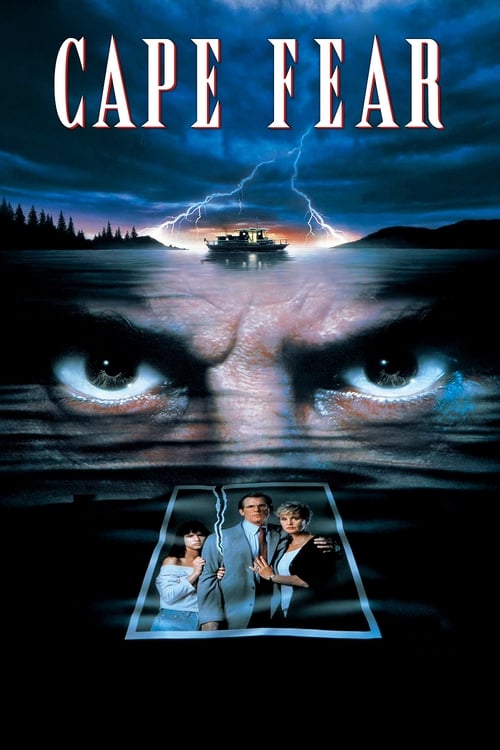
Cape Fear
1991 · Martin Scorsese
When you want a big, brazen, pulpy thriller that goes all the way — a storm-tossed Saturday-night movie that also gets under your skin. Challenge more than comfort; it plays rough.
What it's about
A tattooed, Bible-quoting convict walks out of prison after fourteen years with one purpose: to torment the lawyer who once defended him — and, he believes, betrayed him. He doesn't break laws at first; he just appears, everywhere, smiling. As the campaign of intimidation escalates, it pries open every fault line in the lawyer's seemingly comfortable family, including his uneasy teenage daughter.
The experience
Lurid, operatic, and skin-crawlingly tense — Scorsese cranks every dial, so the film feels less like a polite thriller than a nightmare with thunderstorms. Certain scenes are almost unbearably uncomfortable, by design.
Performances
Robert De Niro's Max Cady is one of the great screen monsters — physically transformed, funny, terrifying, impossible to look away from — and Juliette Lewis, in a breakout turn, matches him in a queasy, justly famous scene of teenage vulnerability; both were Oscar-nominated.
The craft
Scorsese directs like a man possessed: lurid color shifts, skewed angles, Bernard Herrmann's thunderous 1962 score reworked by Elmer Bernstein, and a storm-lashed finale that's pure expressionist filmmaking. It's a masterclass in turning pulp material into style — loud, gorgeous, and deliberately excessive.
Why it matters
His biggest commercial hit to that point, it proved Scorsese could dominate mainstream genre territory on his own terms, and Cady joined the permanent gallery of American movie villains — endlessly quoted and parodied since.
Snapshot
Cape Fear is Martin Scorsese's lurid, expressionist remake of J. Lee Thompson's 1962 thriller, itself drawn from John D. MacDonald's 1957 novel The Executioners. Robert De Niro plays Max Cady, a tattoo-covered ex-convict released after fourteen years who stalks the lawyer he believes betrayed him; Nick Nolte plays that lawyer, Sam Bowden, whose comfortable suburban family conceals fault lines Cady is determined to pry open. The film occupies an unusual place in Scorsese's career: a studio genre assignment, taken on partly as a commercial gambit, that he transformed into a baroque meditation on guilt, repression, and the violence latent in the American family. Released in November 1991, it became the most commercially successful film of his career to that point and earned Oscar nominations for De Niro and Juliette Lewis. It is at once a piece of muscular populist entertainment and a deliberately overwrought art object — a director of unimpeachable seriousness slumming, brilliantly, in the territory of the slasher and the home-invasion thriller.
Industry & production
The project reached Scorsese through a swap with Steven Spielberg. The remake had been developed at Spielberg's Amblin Entertainment with Universal, and Spielberg — reportedly uneasy about directing material this sadistic — handed it to Scorsese, while the two also had Schindler's List in their orbit (Scorsese had earlier been attached to that project before it returned to Spielberg). Spielberg's Amblin remained a producing presence, alongside Cappa Films, Scorsese's own company. The arrangement was, by Scorsese's own framing in interviews, partly pragmatic: after the commercially modest reception of films like The Last Temptation of Christ, taking a viable studio thriller was a way to demonstrate bankability and secure latitude for more personal work. That bargain shaped the film — a director's sensibility imposed on a producer's package.
Wesley Strick wrote the screenplay, substantially reworking the 1962 film's morally clean architecture. The single most consequential change was making Bowden culpable: in the original, the lawyer is an upstanding witness Cady simply resents; in Strick's version, Bowden buried evidence that might have helped his client, so Cady's vengeance carries a charge of legitimate grievance. Gregory Peck and Robert Mitchum, the original film's stars, both appear in supporting roles, as does Martin Balsam — a casting gesture that openly historicizes the remake. Mitchum, who had played Cady in 1962, here plays a detective; Peck, the original Bowden, plays Cady's sleazy lawyer. The film was a substantial box-office success, exceeding the gross of any prior Scorsese title, though I'd avoid citing exact figures from memory.
Technology
Cape Fear is a film of conventional early-1990s production technology pushed toward stylization rather than innovation. It was shot photochemically on 35mm in anamorphic widescreen. Its most distinctive technical signatures are optical rather than digital: reverse-exposure and color-reversal effects, negative-image inserts, superimpositions, and saturated filtered light. The famous title sequence by Saul and Elaine Bass — among the last of the Basses' collaborations with major directors before Saul Bass's death — uses water, ripple distortion, and an eye motif, executed through optical and photographic manipulation consistent with the period. The film predates the routine use of digital intermediates, so its aggressive color and contrast were achieved in-camera, through filtration, lighting, and laboratory timing. The result deliberately courts artifice; the technology is bent toward a heightened, almost hallucinatory register rather than transparency.
Technique
Cinematography
Freddie Francis, the veteran British cinematographer (and director of Hammer-era horror), shot the film, and his presence is central to its identity. Francis brings a frankly Gothic vocabulary: canted angles, expressionist pools of colored light, and a willingness to make the image strange. The camera is restless and predatory — Scorsese's signature crane moves, tracking shots, and sudden push-ins are deployed to align the viewer with Cady's omniscient menace. Skies are processed to unnatural reds and bruised purples; negative-image flashes punctuate moments of violence. Francis's horror background is not incidental: the film treats Cady as a near-supernatural force, surviving beatings and fire like a slasher revenant, and the cinematography supports that mythic register. Point-of-view is weaponized — overhead God's-eye shots, distorted close-ups, and a sense that Cady can see and reach everywhere.
Editing
Thelma Schoonmaker, Scorsese's lifelong editor, cut the film, and her work modulates between slow-burn tension and bursts of fragmented violence. The editing leans into disorientation: the negative-image and color-inverted inserts are an editorial as much as photographic device, splicing subliminal jolts into otherwise legible scenes. The set pieces — the houseboat climax in particular — are built through accelerating, overlapping cutting that fractures space and time. Schoonmaker's rhythm gives the film its operatic crescendos; the violence arrives not as documentary fact but as expressionist eruption.
Mise-en-scène / staging
The film's production design contrasts the Bowdens' tasteful, slightly airless suburban world with Cady's invasion of it. Cady's body is itself a designed surface: a near-total covering of tattoos — biblical verses, scales of justice, avenging crosses — turns the character into a walking text of vengeance and twisted piety. Staging repeatedly violates the family's domestic safety: Cady appears under the car, on the wall outside the house, in the family's spaces. The escalating set pieces move from the manicured town toward the wild, storm-lashed river of the title, a deliberate descent from civilization into a primal arena where the family must turn killer to survive.
Sound
The score is one of the film's defining choices: Elmer Bernstein adapted Bernard Herrmann's original 1962 Cape Fear music (Herrmann had also scored Psycho and Taxi Driver), preserving the brass-heavy, lacerating attack of the original while reshaping it. The lineage is pointed — Herrmann's idiom binds the remake to both the 1962 film and to the Hitchcockian tradition the whole project invokes. Sound design amplifies Cady's menace through his cigar smoke, his laugh, his Southern drawl; the climactic storm becomes an enveloping wall of sound. Music is used unironically as terror, swelling to the kind of full-throated emotional manipulation Scorsese usually approaches more obliquely.
Performance
De Niro's Max Cady is a performance of theatrical excess — a thick Southern accent, a hardened physique he reportedly trained intensely to achieve, a grinning, scripture-spouting sadism. It is broad by design, a monster-movie turn, and it earned a Best Actor nomination. Nolte plays Bowden as a weak, compromised man whose self-righteousness curdles under pressure — a deliberately unsympathetic protagonist. Jessica Lange brings brittle anxiety to the wife, Leigh. The performance most singled out by critics was Juliette Lewis as the teenage daughter, Danielle: her long, queasy seduction scene with Cady — much of it reportedly built through improvisation around the theater set — is the film's unsettling centerpiece, and it earned her a Best Supporting Actress nomination. The veterans Peck, Mitchum, and Balsam lend their performances a meta weight.
Narrative & dramatic mode
The film operates in the mode of the persecution thriller, but Strick and Scorsese complicate its moral mechanics. The classical version pits decent family against external evil; this version makes the family itself rotten with guilt, secrecy, and resentment. Bowden's professional betrayal, his apparent past infidelities, his daughter's adolescent restlessness, his wife's anxiety — Cady functions less as an alien intruder than as a return of everything the Bowdens have repressed. The dramatic engine is therefore double: the suspense of physical threat, and the slower exposure of a family already cracking. The narration is largely aligned with Cady's encroaching power, and the film occasionally frames Danielle as a retrospective narrator, lending it the cast of a remembered nightmare. The resolution refuses catharsis: surviving Cady requires the Bowdens to become violent themselves, and the final image offers no clean restoration.
Genre & cycle
Cape Fear sits at the intersection of several cycles. It belongs to the early-1990s wave of slick, sexually charged suburban-threat thrillers (Fatal Attraction, Pacific Heights, The Hand That Rocks the Cradle) in which middle-class security is invaded by a charismatic predator. It also consciously reaches back to the Hitchcockian suspense tradition — the Herrmann-derived score, the Bass titles, the architecture of an innocent (here, not so innocent) family menaced. And in its treatment of Cady as an indestructible avenging body, it borrows from the slasher film, the genre Freddie Francis's horror pedigree evokes. Scorsese plays these registers simultaneously and self-consciously, producing something closer to a critical commentary on the thriller than a straight example of it.
Authorship & method
The film is a fascinating case of Scorsese's authorship operating on assigned material. His recurring obsessions surface clearly: Catholic guilt and the wish for punishment, the violence underlying ordinary American masculinity, the impossibility of clean redemption. Cady as a self-appointed instrument of divine vengeance, tattooed with scripture, is unmistakably a Scorsese figure — punishment incarnate visited upon a guilty man. The method here is amplification: rather than restrain the pulpy material, Scorsese pushes it to operatic extremity, treating genre conventions as expressive opportunities. His key collaborators are the throughline of his career and of film history itself — Schoonmaker editing, Francis (the elder statesman) shooting, Bernstein orchestrating Herrmann's ghost. The casting of the 1962 stars is itself an authorial signature, a cinephile's insistence on inscribing the film's own lineage into its body. Strick's screenplay supplies the crucial moral complication that lets Scorsese turn a revenge thriller into a guilt drama.
Movement / national cinema
The film belongs to American studio cinema of the early 1990s, and to the particular phenomenon of the New Hollywood generation — Scorsese, Spielberg, Coppola — moving into mid-career and negotiating between personal vision and commercial imperative. It is a Hollywood genre picture made by an auteur shaped by both the American studio tradition and the European art cinema (the expressionist visual strategies, the willingness to alienate the audience from its protagonist). The collaboration with Freddie Francis also threads in a strand of British genre filmmaking. There is no national-cinema movement to assign it to beyond mainstream American film; its interest lies in how an art-cinema sensibility colonizes a commercial form from within.
Era / period
Made and set in the early 1990s, the film reflects the anxieties of its moment: the fragility of the prosperous family, the fear of the released predator and the failures of the justice system, a culture increasingly preoccupied with sexual violence and the vulnerability of children. It arrives at the leading edge of the decade's erotic-thriller and suburban-paranoia cycle. Its diagnosis of the American family as a structure of secrets and quiet betrayals belongs to a recognizable Reagan-aftermath disillusionment. At the same time, the film's nostalgic apparatus — Herrmann's music, the Bass titles, the 1962 cast — locates it in a deliberate dialogue with the classical Hollywood it both honors and dismantles.
Themes
The governing theme is guilt and its return. Cady is, in effect, Bowden's conscience made flesh — the punishment a guilty man both fears and, in the Scorsese-Catholic logic, may unconsciously invite. Around this revolve repression and its leakage: the family's buried resentments, the daughter's emergent sexuality, the husband's compromised integrity. The film also interrogates the justice system's inadequacy — the law cannot protect the Bowdens, and Bowden himself corrupted it — forcing a regression to primal self-defense. Religion runs throughout, perverted: Cady wraps his sadism in scripture, casting himself as an avenging angel and the Bowdens as sinners to be scourged. And persistently, the film is about the thinness of the membrane between civilized comfort and savagery, dramatized geographically in the descent from suburb to storm-wracked river.
Reception, canon & influence
Critical reception in 1991 was strong but divided in a characteristic way: many critics admired the film's technical bravura, De Niro's ferocity, and Lewis's performance, while some found the material beneath Scorsese, or the violence and stylization excessive. The Oscar nominations for De Niro and Lewis confirmed its prestige; its commercial success — the biggest of Scorsese's career to that date — confirmed its populist reach and effectively achieved the strategic aim behind taking the assignment.
Its influences run backward in clear lines: most obviously the 1962 Cape Fear and MacDonald's novel; the Hitchcock tradition channeled through Herrmann's recycled score and Bass's titles; and the horror and slasher idioms Francis embodied. The casting of Peck, Mitchum, and Balsam makes the backward influence literally visible on screen.
Forward, the film's most durable legacy may be in popular culture as much as in cinema: its imagery — the tattooed Cady, the cinema-seat seduction, the laughing menace — became widely recognized, parodied notably in The Simpsons ("Cape Feare"), which cemented its iconography for a generation. Within film, it stands as a key example of an auteur reworking genre material into something simultaneously commercial and authorial, and as a touchstone in discussions of the morally compromised protagonist and the indestructible-stalker thriller. Among Scorsese's own filmography it is often treated as a fascinating outlier — not first-rank like Taxi Driver or Goodfellas, but a revealing demonstration of how thoroughly his concerns reshape any material he touches. Its critical standing has, if anything, risen over time as viewers have come to value precisely its excess.
A Deleuzian reading
Freeze the frame where Max Cady strips off his shirt in the prison-yard flashback and you are no longer looking at a man but at a page.
The full Deleuzian reading of Cape Fear →
Reception
A big hit in 1991 — Scorsese's biggest box-office success to that point — but critics sniffed at it as a lurid director-for-hire job; it's since been reclaimed as gleefully unhinged Hitchcockian pulp, the fun 'trash' entry in the Scorsese canon.
How Cape Fear was received, from release to now →
Influences: the films it descends from and the films it influenced
- Cape Fear (1962) — The direct source: Scorsese retains Bernard Herrmann's original score (re-orchestrated by Elmer Bernstein) and re-casts its stars Peck, Mitchum, and Balsam in new roles, literally inscribing the older film's body into his own.
- The Night of the Hunter (1955) — Mitchum's scripture-marked preacher-predator and its expressionist religious-menace lighting are the direct model for Cady as a scripture-tattooed instrument of divine vengeance.
- Psycho (1960) — Supplies the Herrmann shrieking-strings idiom and Saul Bass's slashing graphic-shard titles, plus the shock-cut horror grammar Scorsese amplifies into the slasher register.
- Vertigo (1958) — Herrmann's obsessive romantic-dread orchestration and Bass's spiraling abstract title sequence are the template for the film's subjective, swooning expressionism.
- The Innocents (1961) — Freddie Francis's deep-focus CinemaScope and candle-lit expressionist shadow are the cinematographer's craft signature carried directly into Cape Fear's lensing.
- Dracula Has Risen from the Grave (1968) — Francis's Hammer-horror canted framing and lurid gothic lighting are the slasher-gothic idiom he physically embodies as DP here.
- Touch of Evil (1958) — The wide-angle, canted-angle compositions of encroaching moral corruption inform Cape Fear's distorted, vertiginous staging of menace.
- Fatal Attraction (1987) — Carries forward the intact-family-besieged-by-an-avenging-outsider structure, with the climax again relocating the threat into the family's own domestic sanctuary.
- Fear (1996) — Reworks the charming-psychotic-suitor seducing the teenage daughter (Juliette Lewis's role) as the engine of family terror, descending directly from Cady's cinema-seat seduction.
- Funny Games (1997) — Pushes the morally-implicating home-invasion persecution thriller to reflexive extremity, extending the stalker-as-instrument-of-judgment who indicts the audience's complicity.
- No Country for Old Men (2007) — Chigurh extends Cady's figure of the indestructible stalker as a self-appointed agent of inexorable fate, an unkillable predator embodying punishment.
- Shutter Island (2010) — Schoonmaker-edited expressionist paranoid thriller built from overt Hitchcock and Val Lewton pastiche, continuing Cape Fear's method of auteur amplification of genre into operatic dread.
- Cape Feare (The Simpsons) (1993) — Recreates Cady's tattoos, cinema-seat menace, and Herrmann cue note-for-note as parody, the act that cemented the film's iconography for a generation.
- Law Abiding Citizen (2009) — Max Cady's jailhouse legal literacy — the adversary who studies the statutes and then weaponizes due process, restraining orders, and representation against the lawyer who failed him — is the direct precedent for Clyde litigating pro se and using his own rights as ordnance.
- Taxi Driver (1976) — Herrmann's final score and De Niro's self-appointed avenger establish the Scorsese-Herrmann-De Niro persecution figure that Cady reprises in pulpier form.
- Goodfellas (1990) — Thelma Schoonmaker's aggressive associative cutting — freeze-frames, whip-pans, jarring inserts — is the editing engine carried straight from the prior year into Cape Fear's negative-image shocks.
- The Hand That Rocks the Cradle (1992) — Crowns the same early-'90s cycle of the bourgeois family home invaded by a calmly methodical intruder who weaponizes domestic intimacy.
- Unlawful Entry (1992) — Extends the indestructible-stalker-in-the-suburban-household thriller, the persecution structure that besieges a guilty bourgeois family from within its own home.
- Misery (1990) — Extends the obsessive-antagonist-besieges-domestic-life structure, an implacable fixated intruder invading the protagonist's home and forcing a war of wills in confined space.
Similar films
- Cape Fear (1962) — influence & lineage
- GoodFellas (1990) — influence & lineage
- Taxi Driver (1976) — influence & lineage
- Shutter Island (2010) — influence & lineage
- Carlito's Way (1993) — shared sensibility
- Raging Bull (1980) — shared sensibility
- The Last Temptation of Christ (1988) — shared sensibility
- The Godfather (1972) — shared sensibility
All the films related to Cape Fear →