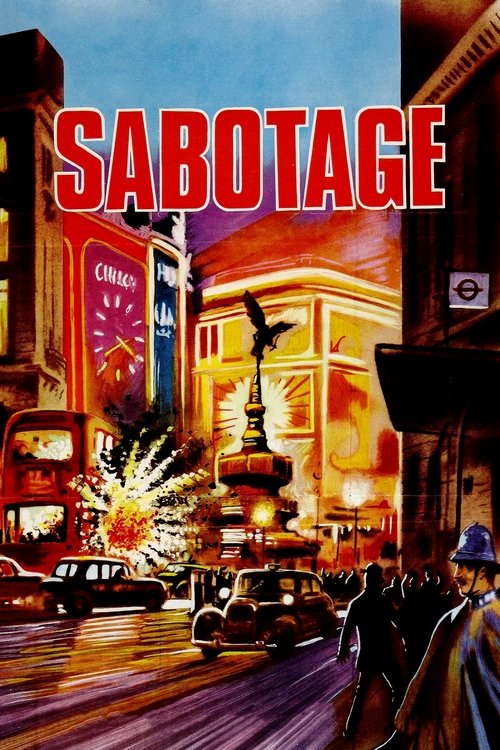
Sabotage
1937 · Alfred Hitchcock
For when you're craving classic suspense — a tight, black-and-white thriller you can finish in an evening — and you're willing to be rattled, because this is Hitchcock at his most ruthless, not his most playful.
What it's about
A husband and wife run a small cinema in a quiet London suburb, living what looks like an ordinary, contented life. What she doesn't know is that he's secretly working with saboteurs plotting attacks on the city — and his double life is about to reach into their home and endanger her teenage brother. Adapted loosely from Joseph Conrad's novel about a terrorist plot hiding behind a shopfront marriage.
The experience
Tense and unusually cold-blooded for its era — Hitchcock builds suspense out of everyday errands and ticking clocks, and one extended sequence remains genuinely nerve-shredding. It's a brisk watch that leaves a real chill.
Performances
Sylvia Sidney brings a quiet, wounded dignity to Mrs. Verloc, and Oskar Homolka makes the husband unsettling precisely because he seems so mild and ordinary.
The craft
This is a masterclass in pure suspense construction — cross-cutting, ticking time, and information the audience has that the characters don't, all engineered to make you squirm. The cinema-within-the-film setting lets Hitchcock play the screen against real life, and the set-piece sequences are still studied for how they wind tension tight.
Why it matters
One of the key films of Hitchcock's celebrated 1930s British thriller run, and famous for a suspense gamble so audacious Hitchcock himself later second-guessed it — a sequence that still shapes how filmmakers think about what an audience can bear.
Snapshot
Sabotage is Alfred Hitchcock's loose adaptation of Joseph Conrad's 1907 novel The Secret Agent, made for Gaumont-British and premiered in London in December 1936 (its wider release, including the United States — where it circulated as A Woman Alone — falls in 1937, the year affixed here). A titling tangle attends the film from birth: because Hitchcock had just released Secret Agent (1936), drawn from Somerset Maugham's Ashenden stories, the Conrad property could not carry its own name and became Sabotage instead — a confusion that has dogged the film's reputation ever since. It sits in the middle of the celebrated run of six thrillers Hitchcock directed at Gaumont-British and its associated studios between 1934 and 1938 (The Man Who Knew Too Much, The 39 Steps, Secret Agent, Sabotage, Young and Innocent, The Lady Vanishes). Compact, urban, and unusually grim, it is remembered above all for two set-pieces — a boy carrying a bomb across London, and a murder at a dinner table rendered through montage — and for Hitchcock's own later verdict that the first of those was a mistake. The film is a laboratory in which the director tested, and in one instance overreached, his emerging theory of suspense.
Industry & production
Sabotage was produced by Gaumont-British at the Lime Grove (Shepherd's Bush) studios, within Michael Balcon's production regime, with Ivor Montagu serving as associate producer. It belongs to a mature phase of Hitchcock's British career, when he was Gaumont-British's most prestigious director and the studio was pursuing the international, and specifically American, market. That ambition is legible in the casting of Sylvia Sidney, a Paramount star imported to play Mrs. Verloc — a bid for U.S. box office that shaped both the film's economy and its performances. The picture was budgeted and produced as a commercial thriller within Britain's studio system of the quota era, not as an art film, and its brisk running time and star-forward marketing reflect that. Documentation of exact budget and box-office figures for the Gaumont-British thrillers is uneven, and I will not invent numbers; what is secure is that the film was a mid-decade studio production designed to travel. One production fact bears directly on the finished film: the sympathetic detective role went to John Loder after Robert Donat — Hitchcock's original preference, and the star of The 39 Steps — proved unavailable, a substitution Hitchcock and several biographers regarded as a weakening of the romantic lead.
Technology
Sabotage is a standard 35mm black-and-white sound production of the mid-1930s, made with the studio-bound synchronized-sound technology that had become routine by 1936. Its interest on the technology axis is less about apparatus than about how apparatus is dramatized: the film is set in and around a suburban cinema, the Verlocs' "Bijou," so the machinery of exhibition — the projection booth, the auditorium, the celluloid reel itself — is woven into the plot. The bomb is concealed among film cans and passed off as a delivery of movie reels, making the physical stock of cinema literally explosive. The film also stages a power-station sabotage that plunges London into darkness, foregrounding the electrical infrastructure of the modern city as a target. In an era before location sound and lightweight cameras, the London-spanning bus sequence was necessarily assembled from studio work, process shots, and location plates cut together — an editorial rather than a technological feat, and one the film leans on heavily.
Technique
Cinematography
Photography is by Bernard Knowles, Hitchcock's regular cameraman across this period (The 39 Steps, Secret Agent, Young and Innocent). Knowles supplies a controlled, high-contrast urban look indebted to Hitchcock's German training: the opening sabotage of the power station is a near-abstract play of light failing and a lightbulb filament dying, and the London Zoo aquarium scene turns the tank glass into a screen on which Verloc imagines the city dissolving. The camera is used pointedly rather than flamboyantly — close inserts of hands, clocks, and objects that carry the suspense — and the overall register is grittier and more shadowed than the picaresque brightness of The 39 Steps.
Editing
Editing, credited to Charles Frend (later an Ealing director), is the film's signal achievement and the reason it is studied. Two sequences are canonical. The first is Stevie's journey across London with the bomb, built as an accelerating cross-cut between the boy, the street crowds and delays that hold him up, and clocks ticking toward the detonation time — a textbook demonstration of suspense generated by editing and by the audience knowing more than the character. The second is the killing of Verloc, in which Mrs. Verloc's gathering intent and the carving knife on the dinner table are assembled from fragmentary shots — glances, the knife, the meal, Stevie's empty chair — so that the murder seems to arise ambiguously between her will and circumstance. This montage construction reflects the Soviet theory circulating in Hitchcock's orbit through Ivor Montagu, co-founder of the Film Society and a conduit for Eisenstein and Pudovkin; the knife scene is often cited as Hitchcock's most nearly Kuleshovian passage.
Mise-en-scène / staging
The film's spaces are its meanings. The Verloc household is inseparable from the cinema it adjoins, so domestic life is staged against a backdrop of continuous public entertainment — a bitter irony the film exploits when Mrs. Verloc, numb after her brother's death, wanders into her own auditorium. There a Disney Silly Symphony, Who Killed Cock Robin?, plays on the screen, and the cartoon's mock-murder trial pulls her from laughter into grief and toward the resolve to kill her husband. The London Zoo aquarium, the crowded pavements of a festive London, and the cramped rooms behind the box office give the film a texture of ordinary metropolitan life into which terror is smuggled — Hitchcock's enduring strategy of locating menace in the everyday.
Sound
As a Gaumont-British production the score is under the musical direction of Louis Levy, the studio's music chief across Hitchcock's British films; the most pointed use of sound, however, is diegetic — the Disney cartoon, whose cheerful song "Who Killed Cock Robin?" ironically scores Mrs. Verloc's turn toward violence. The power-station blackout and the anticipatory silences around the bomb show Hitchcock already thinking of sound and its absence as suspense instruments. I have not found a secure attribution of a distinctive original concert score beyond Levy's supervision, and I won't manufacture one.
Performance
Oscar Homolka, the Austrian émigré actor, gives Karl Verloc an unusual heaviness and pathos: his saboteur is a tired, trapped man rather than a melodramatic villain, which deepens the film's moral discomfort. Sylvia Sidney — a Hollywood star associated with suffering working-class heroines — plays Mrs. Verloc with a banked restraint that pays off in the near-wordless murder scene; accounts of the production note her difficulty with Hitchcock's practice of shooting in tiny fragments for later assembly, a friction that is itself revealing about the montage method. Desmond Tester as the doomed boy Stevie and John Loder as the undercover detective round out the principals, with William Dewhurst memorable as the mild-mannered bird-shop owner who is in fact the bomb-maker.
Narrative & dramatic mode
The dramatic mode is domestic tragedy fused with the suspense thriller. Conrad's dense political-ironic novel is compressed into a tight melodrama of marriage, complicity, and retribution: a wife discovers that the husband she lives beside is a terrorist, and that his act has killed her brother. Hitchcock organizes the film around information asymmetry — the audience knows the bomb is in the boy's parcel long before catastrophe — and around the transfer of guilt, as the murder of Verloc becomes an act the film refuses to condemn outright, engineering a fire that erases the evidence and, morally, the crime. The famous violation of thriller convention is the detonation itself: having built extended suspense, Hitchcock lets the bomb kill the sympathetic child. He later told François Truffaut that this was a serious error — that once you make an audience suffer suspense on a character's behalf, you must not then punish them by letting the worst happen — and the sequence has become the standard case study in the limits of suspense as manipulation.
Genre & cycle
The film is a spy-and-sabotage thriller belonging to the mid-1930s British cycle of espionage entertainments that Hitchcock himself did much to define, alongside Charles Bennett's screenwriting. Within Hitchcock's own "thriller sextet" it is the darkest and least ingratiating — closer to crime tragedy than to the chase-romance template of The 39 Steps. Its subject, urban terrorism carried out by a foreign-directed cell operating under civilian cover, connects it to a longer lineage of anarchist-and-agitator fiction descending from Conrad, and anticipates the wartime saboteur films (including Hitchcock's own 1942 Saboteur, a wholly separate American picture with which it is frequently confused).
Authorship & method
Sabotage is a fully authored Hitchcock film and a key document of his method in transition. The director works here with the collaborators of his Gaumont-British peak: screenwriter Charles Bennett (with dialogue and adaptation contributions from hands including Ian Hay, Helen Simpson, and E.V.H. Emmett, and continuity work by Hitchcock's wife Alma Reville); cinematographer Bernard Knowles; editor Charles Frend; and musical director Louis Levy. The decisive creative partner for this particular film is associate producer Ivor Montagu, whose immersion in Soviet montage theory underwrites the film's most advanced editing. The picture shows Hitchcock consolidating the principles he would preach for the rest of his life — suspense as the sharing of superior knowledge with the audience, meaning built in the cutting room, menace concealed in ordinariness — while also, in the death of Stevie, discovering the point at which those principles can misfire.
Movement / national cinema
The film is a product of 1930s British studio cinema in its most confident, internationally minded phase, centered on Gaumont-British under Michael Balcon. Stylistically it is a meeting point of three currents: the narrative economy of the British thriller; the shadowed, expressive lighting Hitchcock absorbed during his mid-1920s apprenticeship in the German studios; and the Soviet montage theory imported through the Film Society milieu and Ivor Montagu. That triangulation — commercial British craft charged with Continental technique — is characteristic of Hitchcock's British period and helps explain why these films read as both popular entertainments and formal experiments.
Era / period
Sabotage is an interwar film with its ear to the ground. Made in 1936, in a Britain increasingly anxious about political violence and the deteriorating European situation, it dramatizes clandestine sabotage in the heart of London — an electrical blackout, a bomb aimed at a crowded public event — that would have read as topical dread rather than costume melodrama. Conrad's Edwardian anarchist plot is thus updated into a 1930s vocabulary of foreign-sponsored terror, three years before the outbreak of war. The film's suburban cinema, its bus queues and festive crowds, fix it precisely in the everyday texture of pre-war urban Britain.
Themes
The governing themes are the intrusion of catastrophic violence into domestic ordinariness; complicity and knowledge within a marriage; and guilt and its transfer. Cinema itself is a persistent motif — the family lives off exhibition, the bomb travels as film reels, and a cartoon precipitates a murder — so that the medium meditates on its own power to delight and to deceive. Running beneath is a moral inquiry into responsibility: Verloc is monstrous yet pitiable, Mrs. Verloc a killer the film absolves, and the state's agent an ineffectual protector. The death of a child, and the film's refusal to soften it, gives these themes an unusual severity for a commercial thriller.
Reception, canon & influence
On release, Sabotage was received as an accomplished but notably bleak entry in Hitchcock's thriller run, and its killing of the boy was controversial from the first — the objection Hitchcock himself later ratified. In the long view the film has risen in esteem precisely because of its formal daring: the knife-murder montage and the bomb-on-the-bus sequence are staples of film pedagogy, and the picture is routinely cited in accounts of the Kuleshov effect and of suspense construction.
Its backward-facing influences are clear and specific: Conrad's The Secret Agent as source; German Expressionist lighting from Hitchcock's Weimar training; and Soviet montage theory transmitted through Ivor Montagu. Its forward legacy runs in two channels. Within Hitchcock's own development it is a crucible: the lessons of Stevie's death directly inform his lifelong doctrine of suspense — most famously articulated in the "bomb under the table" formulation he gave Truffaut — and the domestic-murder-by-montage looks ahead to the shower killing of Psycho (1960). More broadly, the film stands as an early template for the terrorism thriller of ordinary life, and its dissection of editing has made it a touchstone for critics and filmmakers theorizing how meaning and dread are manufactured in the cut. It remains, in the Hitchcock canon, the film where the master both perfected a technique and learned, in public, its ethical limit.
A Deleuzian reading
A boy sits on a London bus with a parcel under his arm.
The full Deleuzian reading of Sabotage →
Reception
In 1936–37 it was received as one of Hitchcock's grimmer, less crowd-pleasing British thrillers, overshadowed by The 39 Steps; today critics routinely rank it among the very best of his British period, precisely for the darkness that once made audiences uneasy.
How Sabotage was received, from release to now →
Influences: the films it descends from and the films it influenced
- Battleship Potemkin (1925) — The Odessa Steps sequence supplies the collision-montage grammar — cutting fragments of a rising threat against helpless bystanders to manufacture dread — that Ivor Montagu carried directly into Sabotage's bomb-on-the-bus assembly.
- Strike (1925) — Its theory of 'intellectual montage,' meaning generated by the juxtaposition of shots rather than by any single image, is the Kuleshov-effect principle Hitchcock applies when Stevie's fate is built entirely from cutaways to clocks and street traffic.
- Intolerance (1916) — Griffith's cross-cut 'last-minute rescue,' accelerating parallel action toward salvation, is the exact convention Sabotage weaponizes by refusing it — the rescue montage runs its full course and the bomb still detonates.
- The Cabinet of Dr. Caligari (1920) — Its Weimar high-contrast, hard-shadow lighting design — absorbed during Hitchcock's German apprenticeship — underwrites Sabotage's expressionist chiaroscuro around the Verloc cinema and the knife-murder.
- The Lodger (1927) — Hitchcock's own first 'Hitchcock picture' establishes the template Sabotage refines: expressionist visual menace and subjective suspense built around a domestic space harboring a suspected killer.
- M (1931) — Lang's study of a child-murderer stalking an ordinary city — dread located in everyday streets, marked by a recurring diegetic sound motif — models the 'menace concealed in ordinariness' Hitchcock pursues through Stevie's errand.
- Psycho (1960) — The shower murder is the direct heir of Sabotage's knife-killing: a domestic homicide rendered not as a single act but as a rapid montage of fragmented body-and-object shots that the audience assembles into violence.
- Notorious (1946) — It formalizes Sabotage's 'suspense is shared superior knowledge' lesson — the cellar key and the ticking dread of discovery — into a sustained set-piece where the viewer knows more than the characters.
- The Battle of Algiers (1966) — The café-bombing sequence extends Sabotage's template of everyday terrorism, cross-cutting a planted device against oblivious civilians to make the audience complicit in a ticking-bomb it cannot stop.
- The Untouchables (1987) — The Union Station staircase shootout is an explicit revival of the Eisenstein-via-Sabotage suspense montage, cutting a runaway pram against gunfire in the ancestral cross-cut-rescue idiom.
- Dressed to Kill (1980) — Its elevator slashing carries forward the Sabotage-Psycho murder-by-montage, staging a killing through fragmented close-ups and edited fragments rather than a continuous depicted act.
- Blow Out (1981) — It literalizes Sabotage's cinema-self-reflexive strain, making the manufacture of meaning in the cut — here in synced sound and image — the film's explicit subject.
- Inglourious Basterds (2009) — The nitrate-fire climax turns the movie theater into a bomb site as Sabotage first did, and its long tables of dramatic irony run on the same audience-knows-more suspense engine Hitchcock codified here.
- The Conversation (1974) — It inherits Sabotage's reflexive fascination with meaning built in editing — a surveillance recording endlessly recut — dramatizing the very cutting-room construction of dread the earlier film theorized.
- The Man Who Knew Too Much (1956) — The bomb-under-table suspense mechanic receives its most concentrated deployment here — the audience watches a child unknowingly carry an explosive onto a London bus while characters remain ignorant, generating anguish through radical information asymmetry — the precise device the 1956 film extends structurally across its entire second act with Hank's kidnap.
- Foreign Correspondent (1940) — The Bennett collaboration's deployment of diegetic ambient sound as narrative misdirection — the cinema and bus sequences — establishes the technique Foreign Correspondent applies to the windmill's mechanical clattering and the closing radio broadcast.
- Carry-On (2024) — The bomb-on-a-timer carried through an oblivious crowd codifies the suspense-not-mystery contract — the audience holds foreknowledge of a threat the onscreen victims lack — which is exactly the tension engine of Carry-On's tracked package.
- Brighton Rock (1948) — Hitchcock disperses the carving-knife killing across fragmentary glances and cutaways rather than showing the blow — the fragmented-action grammar Boulting uses for the Kolley Kibber pursuit and Spicer's death — and shoots crime against real London traffic and shopfronts.
- The 39 Steps (1935) — The immediately preceding Gaumont-British thriller with the same Charles Bennett/Ivor Montagu team, sharing the set-piece suspense architecture and the ordinary-figure-caught-in-espionage structure.
- Secret Agent (1936) — Made the same year with the same unit, it likewise builds suspense on the audience's morally uncomfortable superior knowledge of a killing, the doctrine Sabotage pushes to its ethical breaking point.
- Final Destination 3 (2006) — Hitchcock's 'bomb under the table' principle — letting the audience see the lethal apparatus and its timing while the victim cannot — is the dramatic-irony engine FD3 runs in every set-piece, dread generated by superior audience knowledge.
Similar films
- The 39 Steps (1935) — influence & lineage
- Notorious (1946) — influence & lineage
- Psycho (1960) — influence & lineage
- The Lady Vanishes (1938) — shared sensibility
- The Man Who Knew Too Much (1956) — shared sensibility
- Foreign Correspondent (1940) — shared sensibility
- Rear Window (1954) — shared sensibility
- Gaslight (1944) — shared sensibility