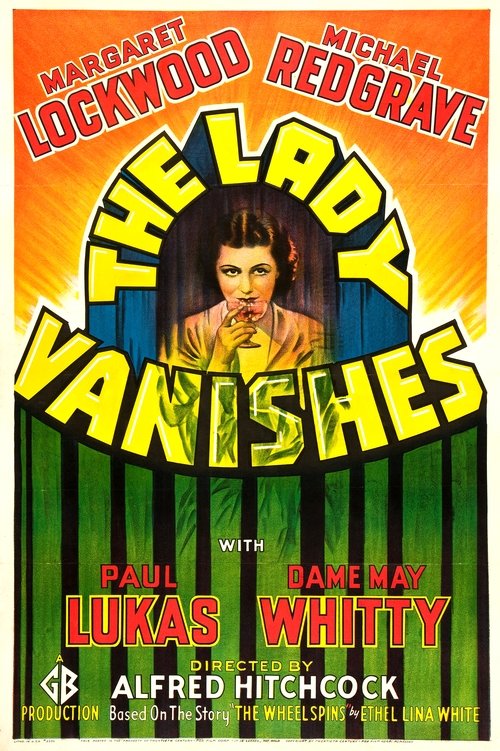
The Lady Vanishes
1938 · Alfred Hitchcock
When you want a mystery you can curl up with — classic, clever, and genuinely gripping, ideal for a rainy evening when you want suspense with charm rather than dread.
What it's about
An avalanche strands a hotel full of travelers in a small European country on the brink of something. On the train home, young Iris befriends Miss Froy, a sweet elderly governess — then takes a knock on the head, dozes off, and wakes to find the old lady gone and every other passenger calmly insisting she never existed. With only an infuriating young musicologist willing to half-believe her, Iris starts working her way down the train.
The experience
A comedy of manners that pivots into paranoid thriller without dropping the jokes — witty, brisk, and increasingly claustrophobic as the train rolls on. The gaslighting premise still gets under your skin: everyone is pleasant, everyone is lying, and you can't get off.
Performances
Margaret Lockwood makes Iris's slide from confidence to desperation completely convincing, Michael Redgrave is effortlessly charming as her exasperating ally, and Dame May Whitty's twinkly Miss Froy is exactly memorable enough to make her erasure feel impossible. The cricket-obsessed pair of English travelers steal every scene they're in.
The craft
Hitchcock's British period at its peak: a mystery engineered with total economy, where nearly every clue and character pays off, all staged in the corridors and compartments of a moving train. The balance of screwball banter and mounting menace is the trick later thrillers have been chasing ever since.
Why it matters
The film that capped Hitchcock's British career and helped carry him to Hollywood — a foundational text for the train thriller, the vanishing-witness plot, and the romantic bickering-couple mystery.
Snapshot
The Lady Vanishes is the film in which Alfred Hitchcock's British period arrives at its own summary — a comedy of manners that turns, roughly a third of the way in, into a paranoid thriller without ever quite surrendering the comedy. A landslide strands a hotel full of travelers in the fictional central European country of Bandrika. Among them are Iris Henderson (Margaret Lockwood), a wealthy young woman heading home to a marriage she has talked herself into; Gilbert (Michael Redgrave), an insufferable musicologist collecting folk dances; and Miss Froy (Dame May Whitty), a chirping English governess who takes her tea seriously. When the train resumes, Iris is struck on the head, sleeps, wakes — and Miss Froy is gone, together with every other passenger's memory of her.
What follows is one of cinema's cleanest engines. The film is essentially a single question asked at increasing pressure: is the evidence of your senses worth anything against the unanimous testimony of a carriage full of strangers? Hitchcock answers it inside a moving train built on a stage barely long enough to hold it, with a plot whose secret turns out to be a tune, and with a supporting cast — the cricket-mad Englishmen Charters and Caldicott, the adulterous Todhunters, the silken Dr Hartz — who between them constitute a portrait of British self-deception on the eve of a war.
Released in Britain in October 1938, weeks after the Munich Agreement, it was the last unambiguous triumph of Hitchcock's Gaumont-British/Gainsborough years, won him the New York Film Critics Circle award for Best Direction, and functioned as the calling card for a Hollywood career that began the following year with Rebecca. It has never really left circulation since — helped, and for decades visually harmed, by its lapse into public-domain ubiquity in the United States.
Industry & production
The film's origins are not Hitchcock's at all. Sidney Gilliat and Frank Launder adapted Ethel Lina White's 1936 novel The Wheel Spins on their own initiative, and the resulting screenplay — under the working title Lost Lady — was set up at Gainsborough with a different director, Roy William Neill, and a location shoot in Yugoslavia. The production collapsed before it began: the standard account is that Yugoslav officials obtained a copy of the script, took offense at its depiction of a Balkan state and its secret police, and the unit was sent home. The script went on the shelf.
Hitchcock, between projects and under contract in a studio system that was contracting around him, took it up. The circumstances matter, because they explain the film's unusual authorship: Gilliat and Launder always maintained that the structure, the dialogue and the comic architecture were substantially theirs, and later scholarship has generally agreed, crediting Hitchcock with revision, compression and — decisively — the visual and rhythmic grammar in which the material is delivered. It is an instructive case for anyone inclined to read the British thrillers as pure directorial invention. The Lady Vanishes is a superb screenplay that found the right director second.
Production was overseen by Edward Black, who had taken charge of Gainsborough's output after Michael Balcon's departure from Gaumont-British, and who had produced Young and Innocent the previous year. Black's Gainsborough operated at a moment of real difficulty for British production: the boom that followed the 1927 Quota Act had burst, American finance had retreated, and budgets were tightening sharply. The Lady Vanishes was made cheaply and quickly at Islington Studios, on a stage often cited as roughly ninety feet long — a space into which an entire express train had to be fitted. Firm budget figures for the picture are not reliably established in the public record, and are best left alone; what is not in doubt is that the film's most celebrated qualities are direct consequences of its poverty.
Casting was shrewd rather than expensive. Margaret Lockwood was a rising Gainsborough contract player who would become the studio's biggest star of the 1940s melodramas. Michael Redgrave was a stage actor of the Old Vic making effectively his film debut in a leading role, and was reportedly reluctant about the medium. Dame May Whitty, a grande dame of the English theater, had just made an impression in Hollywood with Night Must Fall. Paul Lukas, Hungarian-born and long established in American pictures, supplied a continental smoothness that the part of Dr Hartz requires and that no British character actor of the period could have counterfeited.
The film opened in Britain in October 1938 and in America late that year, where its reception was notably warmer and more attentive than that given most British imports. Negotiations that would take Hitchcock to David O. Selznick were already under way by then; the American success of The Lady Vanishes confirmed the bet rather than caused it. Only Jamaica Inn (1939) followed before he left.
Technology
Technically the film is a demonstration of what a resourceful studio could do with almost no room. Shot on 35mm nitrate in the Academy ratio with a single optical soundtrack, it depends on three technologies for nearly everything that reads as spectacle: miniatures, rear projection and the optical printer.
The opening is a model shot — a snowbound alpine village, plainly a miniature, over which the camera moves in toward the hotel. The artifice is not concealed, and the choice sets a tone: this is a storybook Europe, a stage set, and its unreality licenses everything that follows. Trains are similarly handled, with model work covering the exteriors that the stage could not, including the climactic shunting of the carriage onto a branch line.
Rear projection carries the burden of the journey. Gaumont-British had a strong process department by the mid-thirties, and Hitchcock was among the most enthusiastic users of back projection in world cinema — a preference that persisted, controversially, to the end of his career. Here the technique is load-bearing rather than decorative: nearly every window in the film is a projected plate, and the sense of continuous forward motion that makes the train feel like a trap is manufactured almost entirely in the process shots and in a mocked-up carriage rocked by hand.
Optical printing supplies the film's subjective effects — the superimpositions and swimming dissolves of Iris's concussion, and the celebrated moment when Miss Froy's face is overlaid on the nun who has replaced her. Sound recording was done under the ordinary constraints of the period, with blimped cameras, considerable post-synchronisation for the noisy train sequences, and a mix that is far more inventive in its use of near-silence and diegetic music than the technology's reputation would suggest.
Technique
Cinematography
Jack E. Cox photographed the film, the last of a long collaboration with Hitchcock that ran back through Blackmail (1929) and the silent period. His work here is disciplined rather than showy, organized around the problem of the corridor: a long, narrow, uniformly lit space that has to be made legible, repeatable and eventually frightening. Cox shoots it in depth, using the receding line of compartment doors as a perspectival spine, so that the train reads as a geography the audience can hold in mind — essential, since the second half is a search conducted along it.
The lighting divides sharply. The hotel and the daytime carriages are bright, high-key, comic. The luggage van is another film entirely: raked shadows, a single hard source, the clutter of a magician's props throwing expressionist shapes — a direct inheritance from the two years the young Hitchcock spent working at UFA in Germany. Cox also handles the film's most economical piece of visual storytelling, the tea sequence: Miss Froy writes her name in the condensation on the window, the camera holds it, and the train enters a tunnel. The evidence exists for a few seconds and is then erased by the world.
Editing
Alfred Roome cut the film under supervising editor R. E. Dearing, and the cutting is where Hitchcock's contribution is most audible. The first act is edited as ensemble comedy — wide, patient, letting overlapping business play. Once Miss Froy disappears, the film switches into a subjective mode: shorter takes, point-of-view inserts, Iris's face intercut with the placid, denying faces of the other passengers in a series that accumulates into something close to persecution. The rhythm of denial is the film's real suspense mechanism; each cut to another bland face tightens the same screw.
Two set pieces show the method at its most concentrated. The search along the corridor is built as a chain of small revelations and retractions — a label glimpsed, a face half-recognised — each shot planted for later payoff. The fight in the luggage van, by contrast, is cut fast and roughly, on movement rather than geography, and is one of the more physically convincing brawls in thirties British cinema precisely because it is assembled rather than performed whole.
Mise-en-scène / staging
Alex Vetchinsky's sets do a great deal with very little. The hotel is a comic machine of too few rooms and thin walls; the train is a machine of too many doors. Hitchcock stages almost the entire second half around thresholds — compartment doors sliding open to reveal the wrong occupants, connecting doors between carriages, the sealed door of the luggage van. The recurring gesture is the reveal that reveals nothing.
Objects carry the plot. A packet of Harriman's Herbal Tea, a pair of spectacles, a signature on glass, a nun's high-heeled shoes visible below her habit: the film is a chain of small physical proofs that keep being taken away. The magician's cabinet with a false back, into which Gilbert climbs, is the film's own emblem — a device for making people disappear, exposed as a trick and used as one.
Sound
The soundtrack is more sophisticated than the film's amiable surface suggests. There is very little non-diegetic scoring; Louis Levy served as musical director, as he did across the Gainsborough and Gaumont-British output, and the film's decisive musical element is the tune itself, which functions simultaneously as source music, as suspense cue and as the object of the plot.
Two uses stand out. In the opening act, a serenade beneath Miss Froy's window covers the strangling of the musician who is singing it — murder masked by melody, a device Hitchcock returned to throughout his career. And the Bandrikan dialogue is left untranslated and unsubtitled, so that the English travelers, and the audience with them, sit inside a wall of incomprehensible speech. The film's central anxiety — that the world will simply refuse to confirm what you know — is established acoustically before it is established dramatically.
Performance
Lockwood's Iris begins as a spoiled bride-to-be and is progressively stripped of every social advantage: money, status and finally credibility. Lockwood plays the transition without a visible pivot, and her stubbornness reads as temperament rather than heroism, which is what keeps the film from turning sentimental. Redgrave's Gilbert is deliberately obnoxious in his first scenes — noisy, entitled, patronizing — and his conversion into an ally is the film's romance, conducted almost entirely as bickering. The much-repeated anecdote that Redgrave, arriving from the theater, asked for rehearsal and received a curt Hitchcockian brush-off is exactly that: an anecdote, repeated in many accounts and impossible to verify in detail.
Dame May Whitty's Miss Froy is the film's finest joke, a twinkling English spinster who turns out to be a professional intelligence agent, and Whitty plays the second identity without discarding the first. Paul Lukas gives Dr Hartz a courteous menace that never raises its voice. Around them, Cecil Parker and Linden Travers make the Todhunters quietly wretched, Catherine Lacey's high-heeled nun is a small masterpiece of divided loyalty, and Basil Radford and Naunton Wayne, as Charters and Caldicott, created a double act so durable that they were reunited repeatedly through the 1940s and revived on television decades later.
Narrative & dramatic mode
The film's dramatic mode is the epistemological thriller: not whodunnit but did-it-happen. Hitchcock structures it as a deliberate genre switch. The first act is farce — bed shortages, cricket scores, an affair conducted under an assumed name — and it is played long enough that the audience settles into it. The disappearance detonates inside a comedy, which is why it lands so hard.
The secret at the center is the purest example of the device Hitchcock's British circle named the MacGuffin (the coinage is generally attributed to his colleague Angus MacPhail): a coded clause of an international agreement, memorized as a folk tune. It is deliberately trivial as content and total as motivation, and the film's final gag — Gilbert, at the Foreign Office, unable to recall the melody — turns the MacGuffin's arbitrariness into the punchline.
The romance is structured as antagonism converted by shared evidence, a pattern Hitchcock had used in The 39 Steps and would use again in North by Northwest. What distinguishes The Lady Vanishes is that the woman is the investigator and the man the recruit; Iris's sanity, not Gilbert's innocence, is what is at stake.
Genre & cycle
It belongs to the run of six thrillers Hitchcock made in Britain between 1934 and 1938 — The Man Who Knew Too Much, The 39 Steps, Secret Agent, Sabotage, Young and Innocent and this — a cycle that fused the English clubland spy story of Buchan and Oppenheim with continental technique and a distinctly music-hall sense of comedy. Within that cycle, The Lady Vanishes is the most confined and the most tightly plotted.
It also sits at the head of two lineages that outlived it: the train thriller as a closed society in motion, and the "no one believes her" narrative in which a woman's perception is systematically denied by the people around her — a form that would acquire its lasting name from Gaslight two years later. The setting of the fictional state was itself a genre convention with an administrative cause: British censorship discouraged the depiction of identifiable foreign governments in an unflattering light, and Bandrika is the standard workaround.
Authorship & method
The film is a useful corrective to strong auteurism, because its excellence is so evidently distributed. Gilliat and Launder supplied a screenplay of exceptional economy, and went on to become one of British cinema's most important writing-producing-directing partnerships (Millions Like Us, The Rake's Progress, Green for Danger, the St Trinian's films). Edward Black provided the production intelligence that assembled the cast and enforced the constraints. Jack Cox and Alex Vetchinsky solved the spatial problem; Alfred Roome and R. E. Dearing built the suspense in the cutting room; Louis Levy oversaw a musical design in which the plot's secret is a melody.
Hitchcock's contribution is method rather than material: pre-visualised cutting, the discipline of point of view, the conversion of exposition into objects, the willingness to let comedy and terror occupy the same shot. Charles Barr's English Hitchcock remains the standard scholarly treatment of how these British films were actually made, and it is largely on the strength of that kind of archival work that the collaborative picture has replaced the older account of the director as sole author.
Movement / national cinema
The Lady Vanishes is a landmark of the British studio cinema of the 1930s, a system defined by quota legislation, chronic undercapitalisation and a persistent inferiority complex toward Hollywood. Gainsborough under Black represents the intelligent middle of that system: modest budgets, contract talent, genre pictures made with craft. The film's specific national flavor comes from its class comedy — the cricket obsessives, the hypocritical barrister, the heiress — grafted onto a German-derived visual technique that Hitchcock had absorbed at Babelsberg in the mid-twenties.
Its export success also marks the point at which British genre cinema demonstrated it could travel. The film is frequently cited alongside The 39 Steps as the peak of the pre-war British thriller, and it stands directly behind the wartime and post-war cycle that produced Night Train to Munich and the Ealing and Archers pictures of the 1940s.
Era / period
The film cannot be separated from the autumn of 1938. Britain signed the Munich Agreement in September; The Lady Vanishes opened in October. Its politics are not subtle once you look. Todhunter, the lawyer who insists on negotiating with armed men and waves a white handkerchief out of the carriage door, is shot dead for it — a rebuke to appeasement delivered as plot. Charters and Caldicott, who spend the film refusing to notice anything that isn't a Test match, end it firing a revolver; the film's arc for them is the arc it wanted for the country. Miss Froy, meanwhile, is a reminder that the machinery of British intelligence might look like a harmless old woman.
That the film manages this while remaining fast, funny and unpreachy is precisely why it has aged so well. Its period anxieties are legible without being dated, because they are expressed as behavior rather than speeches.
Reception, canon & influence
British reviews were strong and American reviews stronger; the New York Film Critics Circle named Hitchcock best director for 1938, an unusual honor for a British picture and a significant marker of his transatlantic standing. The film has remained in the first rank of his work ever since, routinely grouped with The 39 Steps as the summit of the English period, and it featured in the British Film Institute's 1999 poll of the best British films of the century. Its long life on television and home video owes something to an accident of rights: the film circulated for decades in the United States in cheap, degraded prints, before archival restoration and a Criterion Collection release — one of the label's earliest — returned it to something like its intended condition.
Looking backward, its inheritances are clear. Ethel Lina White's novel supplies the plot; behind that stands the durable "vanishing hotel room" legend associated with the 1889 Paris Exposition, a story of uncertain provenance that has circulated in many forms and that also underlies So Long at the Fair (1950). The visual manner descends from German silent cinema; the spy plot from the English adventure fiction Hitchcock had already mined in The 39 Steps; the comic ensemble from the British stage and music hall.
Looking forward, its influence is unusually traceable. Night Train to Munich (1940), directed by Carol Reed from a Launder and Gilliat screenplay and starring Margaret Lockwood with Radford and Wayne again as Charters and Caldicott, is effectively a companion piece. The confined-transport thriller — Strangers on a Train, North by Northwest's sleeper-car stretch, Murder on the Orient Express, Silver Streak, Transsiberian, Snowpiercer — keeps returning to the grammar this film established. So does the disbelieved-woman thriller, from Bunny Lake Is Missing (1965) through Flightplan (2005), the latter close enough in premise to be discussed as a variation. The film has been remade directly at least twice: the 1979 Hammer production directed by Anthony Page with Elliott Gould, Cybill Shepherd and Angela Lansbury, and a BBC television adaptation in 2013. Neither displaced the original, which remains the rare canonical thriller that is also, minute for minute, one of the funniest films its director ever made.
A Deleuzian reading
A woman writes her name in the steam on a train window.
The full Deleuzian reading of The Lady Vanishes →
Reception
A smash hit on release — it won Hitchcock the 1938 New York Film Critics Circle prize and effectively bought his ticket to Hollywood — and it's never really dipped since, settling in as the crown jewel of his British period.
How The Lady Vanishes was received, from release to now →
How to watch The Lady Vanishes: what to notice on a first viewing
- Watch Miss Froy write her name in the window's condensation. The camera holds on the signature long enough to read it, then the train enters a tunnel and the name is gone. The evidence exists for a few seconds before the world simply erases it.
- Notice the corridor shot in depth, doors receding into the distance. Cox photographs the train corridor so its receding line of compartment doors reads as a geography you can hold in your head. You're always aware of the space you can't quite see into yet.
- Listen to the Bandrikan dialogue stay untranslated and unsubtitled throughout. The travelers, and the audience with them, sit inside a wall of speech nobody explains, established well before the plot's central anxiety kicks in. Not understanding what's said becomes its own kind of dread, well before the plot needs it.
- Watch the luggage van fill with raked shadow and hard light. Where the hotel and daytime carriages stay bright and high-key, the luggage van switches to a single hard source throwing expressionist shapes across a magician's props. The comedy's own furniture turns menacing the instant the lighting changes register.
The whole guide to watching The Lady Vanishes, with the keys for a rewatch →
Influences: the films it descends from and the films it influenced
- The Lodger: A Story of the London Fog (1927) — Hitchcock's UFA-trained expressionist chiaroscuro and his first engineered subjective devices (the glass ceiling that lets us 'hear' pacing overhead) become the toolkit for the Bandrika hotel's shadowed prologue and for the POV cutting that puts us inside Iris's unverifiable perceptions.
- Spione (1928) — Lang's spy apparatus — an encrypted document passed between agents in transit, a train sequence used as the mechanism of the plot's violence, an organization that can make a person disappear — supplies the structural grammar Hitchcock compresses into a single carriage.
- Rome Express (1932) — The Gaumont-British house template it inherits: a full-length corridor set with practicable compartment doors, so that dramatic geography is measured in thresholds crossed and passengers are introduced as a cross-sectional ensemble rather than a hierarchy of leads.
- The Man Who Knew Too Much (1934) — The Albert Hall cymbal crash establishes the principle Miss Froy's tune completes — that a piece of music can be simultaneously diegetic performance, clock, and carrier of the secret, so the audience must listen for plot rather than merely watch it.
- The 39 Steps (1935) — Mr Memory's memorized formula is the direct precedent for a MacGuffin stored as a melody in an old woman's head, and the antagonistic-couple-in-a-compartment routine (bickering strangers forced into shared jeopardy on a moving train) is transplanted almost intact onto Iris and Gilbert.
- Secret Agent (1936) — The sustained organ note held down by a dead man's body — a murder announced purely as sound — is the experiment that matures into the nun's scream and struggle masked by the trackside band, where noise is used to erase evidence rather than deliver it.
- Gaslight (1940) — Extends the film's central proof-problem: objects are removed from the world (a brooch, a picture, a name signed on tea-shop glass) so that a woman's accurate testimony is converted by consensus into evidence of her own instability.
- So Long at the Fair (1950) — Works the same 1889 Exposition vanishing-room legend, but stages the erasure as physical set-dressing — a door plastered over and a room repapered overnight — making production design itself the false witness that contradicts the heroine.
- Strangers on a Train (1951) — Reuses the dining car as the room where a stranger's chatter becomes a binding contract, and closes with the carousel brawl cut on continuous movement in a confined moving space — the mature version of the compartment fight assembled by Roome and Dearing.
- The Narrow Margin (1952) — Builds an entire feature from the corridor's spatial constraint — blocking that forces bodies to squeeze past each other, doors as the only cover, and a decoy woman whose identity the audience is invited to misread from partial glimpses.
- North by Northwest (1959) — Fuses the two mechanisms in color: the sleeper-car seduction and berth-hiding replay the compartment's threshold staging, while the police and the Townsend household calmly deny what Thornhill saw, restaging the disbelief structure with rear projection doing the same scenic labor Cox's process work did in 1938.
- Bunny Lake Is Missing (1965) — Systematically strips away the corroborating objects — the child's registration, her luggage, her belongings — so that, exactly as with Miss Froy's name written in dust on the window, the film's suspense rests on whether any physical trace of a person can survive institutional denial.
- Silver Streak (1976) — Reproduces the tonal switch wholesale — a comic passenger witnesses a body go past the window, is disbelieved by everyone aboard, and the farce hardens into thriller — with the running gag ensemble kept intact as the source of both jokes and false testimony.
- Flightplan (2005) — Transposes the mechanism to a sealed aircraft, keeping the crucial detail that the conspiracy must alter a document — the passenger manifest standing in for the falsified paperwork and the swapped tea packet as the object that proves the vanished person existed.
- Transsiberian (2008) — Revives untranslated dialogue as a suspense device — Russian left unsubtitled so the audience shares the protagonist's exact deficit of information — inside the same compartment-and-corridor geography, where a stopped train means jurisdiction has changed.
- Snowpiercer (2013) — Makes the threshold door the film's entire dramatic unit, structuring the narrative as carriage-by-carriage passage, and stages its axe fight as cutting-on-movement within a corridor whose width forbids any escape from frame.
- Glass Onion: A Knives Out Mystery (2022) — Hitchcock's sealed-transport mystery, in which an apparent solution is overturned by the revelation that a central figure has been disguised throughout, establishes the genre template of Christie-adjacent closed-environment puzzle with identity concealment that Glass Onion works within and against.
- Murder on the Orient Express (1974) — Codified the moving train compartment as a self-contained mystery box, staging investigation laterally along a corridor of sliding doors and adjoining berths.
- Night Train to Munich (1940) — A deliberate companion built from the same components — Launder and Gilliat's screenplay economy, Margaret Lockwood, and Radford and Wayne reprising Charters and Caldicott — re-running the comic-ensemble-inside-a-spy-plot construction with the tonal switch relocated to a cable car.
- Green for Danger (1946) — Gilliat carries forward the writing partnership's signature tonal engineering — a comic detective and genuine dread occupying the same scene without either deflating the other — proving the comedy-thriller switch was a screenplay method, not a Hitchcock mannerism.
Similar films
- The 39 Steps (1935) — influence & lineage
- Strangers on a Train (1951) — influence & lineage
- North by Northwest (1959) — influence & lineage
- Rebecca (1940) — shared sensibility
- Marnie (1964) — shared sensibility
- Stage Fright (1950) — shared sensibility
- Gaslight (1944) — shared sensibility
- Vertigo (1958) — shared sensibility