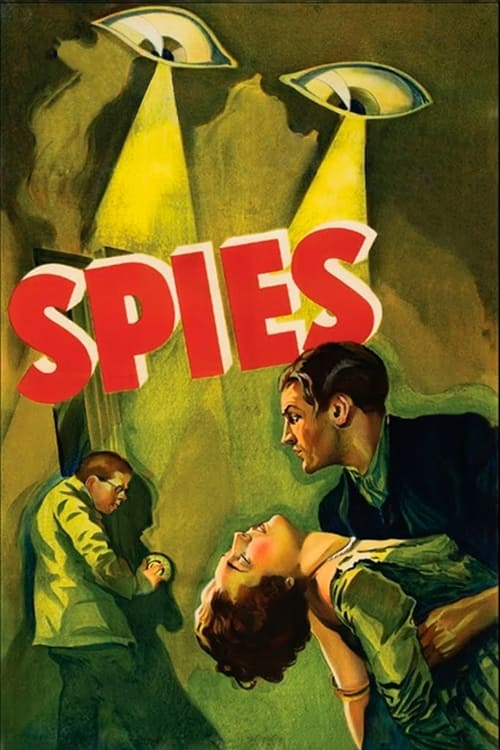
Spies
1928 · Fritz Lang
For when you're curious what silent cinema can really do and want adventure, not homework — a film-buff evening that turns out to be genuine pulpy fun. More thrilling than you expect going in.
What it's about
A criminal mastermind — a respectable banker in public, the paralyzed spider at the center of a global espionage web in secret — runs an operation that seems to have agents everywhere. When one of his operatives, a Russian woman, falls for the dashing government agent she's been set against, their romance becomes the loose thread that could unravel the entire network, and the chase is on across safehouses, speeding cars, and night trains.
The experience
Astonishingly fast and modern for a silent film — a relentless machine of pursuits, disguises, and double-crosses that barely pauses for breath across its epic length. Watching it feels like discovering the blueprint for a century of spy movies, still crackling with energy.
Performances
Rudolf Klein-Rogge is unforgettable as the mastermind Haghi — icy, immobile, and radiating control — one of the screen's first great supervillains.
The craft
Fritz Lang stages the mayhem with geometric precision: vast sets, careening automobiles, a spectacular train wreck, and cross-cutting that generates suspense mechanisms filmmakers still use today. Seen with a good score, its scale and momentum land remarkably well on a big screen.
Why it matters
It essentially founded the modern spy thriller — the numbered agents, the gadgets, the hidden lair, the seductive double agent all start here — decades before the genre's most famous franchise borrowed the playbook.
Snapshot
Fritz Lang's Spies (Spione) is a sprawling late-silent spy thriller built around one of cinema's first fully realized supervillains: Haghi, a wheelchair-bound banker and orchestrator of a global espionage network. Made immediately after the catastrophic commercial failure of Metropolis (1927), the film is Lang at his most commercially disciplined — kinetic, ruthless, and ceaselessly inventive within the constraints of genre entertainment. Its central romance, between Russian double agent Sonja and the government operative known only as 326, drives a narrative of loyalty and betrayal across elaborate sets, careening automobiles, and a climactic train wreck. At 143 minutes in its longest surviving form, Spies is a major work in Lang's filmography and a foundational document of the spy film as a modern genre. It has been consistently undervalued relative to Metropolis and M (1931), yet its structural influence — on the thriller, on the architecture of the screen villain, on the mechanics of the chase — is arguably more durable than either.
Industry & production
The commercial catastrophe of Metropolis at UFA forced a structural realignment for Lang. The vast Babelsberg production had run egregiously over budget; UFA was subsequently absorbed into the Hugenberg media empire under right-wing nationalist control, a development Lang found intolerable. For Spies, he established his own production company, Fritz Lang Film GmbH, nominally independent but reliant on UFA for studio facilities and distribution infrastructure. The arrangement gave Lang greater creative latitude while limiting his financial exposure to another overrun.
The source material was a novel by Thea von Harbou, Lang's wife and primary screenwriter, who adapted it herself. The collaboration was, at this stage, among the most productive writer-director partnerships in European cinema, though the marriage would collapse following Hitler's rise to power when von Harbou chose to remain in Germany and Lang emigrated to France and eventually the United States. Spies represents their partnership at high competence if not at its most ambitious — von Harbou's plotting is efficient, pulpy, and structurally sound in ways that Metropolis was not.
The production drew on several of the same artisans who had built Metropolis, including set designers Otto Hunte and Emil Hasler. The scale is deliberately more modest: where Metropolis demanded city-sized studio environments, Spies relies on a vocabulary of interior spaces — offices, vaults, hotel rooms, an underground operations center — punctuated by exterior location shooting for the chase sequences. The train crash near the film's conclusion required practical stunt work and miniature construction; the specifics of how it was achieved have not been fully documented in surviving production records.
Technology
Spies was produced at the precise inflection point of the sound transition. The Jazz Singer (1927) had reached Germany's major cities by early 1928, and the industry was convulsed with the question of conversion. Lang and von Harbou elected to complete Spies as a silent film — a decision that was commercially rational given the state of German sound infrastructure in 1927–28, when the film was shot, but that would age the picture almost immediately upon release. Some German exhibition contexts provided synchronized musical accompaniment; the exact nature of any original score or compiled accompaniment is not fully established in surviving records.
The film employs the full visual grammar of the late silent era: intertitles are sparse relative to earlier silent practice, used for dialogue punctuation rather than exposition, which pushes the image to carry narrative weight more continuously. The technical infrastructure of German studio filmmaking in this period was highly developed — Babelsberg's equipment was among the best in the world — and Lang exploited it for complex lighting setups and controlled deep-focus compositions.
The telephone is a notable technological motif within the film's diegesis: Haghi's network operates through a dense web of telecommunications, and Lang repeatedly visualizes calls as vectors of danger, information, and betrayal. This thematic preoccupation with communication technology as instrument of control is consistent across Lang's Weimar work.
Technique
Cinematography
Fritz Arno Wagner photographed Spies, bringing to the project the same chiaroscuro fluency he had demonstrated in F.W. Murnau's Nosferatu (1922) and would later bring to Lang's own M and The Testament of Dr. Mabuse (1933). Wagner's lighting in Spies is less expressionistically extreme than in Nosferatu — the film does not depend on distortion or shadow play for horror — but he consistently uses raking light and hard contrasts to map moral and psychological states onto space. Haghi's operations center is shot as a place of absolute control, clean and geometric; spaces beyond his reach are rendered with more naturalistic variation.
The exterior chase sequences adopt a different register: mobile, faster-cut, with a documentary roughness that draws on the emergent tradition of location-shot action cinema. Wagner and Lang cut between long shots that establish geography and tighter framings that create urgency, an editing logic that would become standard thriller grammar.
Editing
Lang edited with an instinct for building sequences rather than individual shots. The cross-cutting in Spies is deliberate and Griffithian in lineage — parallel action at moments of crisis — but Lang consistently deploys it at sustained lengths, allowing tension to build through repetition before releasing it. The rhythm is patient by contemporary standards, though the film never loses narrative momentum over its considerable length. The editing in the train crash sequence reportedly intercuts practical effects with studio work in ways that were considered technically sophisticated for their moment, though detailed documentation of the assembly is sparse.
Mise-en-scène / staging
Lang's staging reflects his background in architecture and visual art. He choreographs actors within environments rather than placing them in front of them, using furniture, doors, sight lines, and vertical space to create spatial hierarchies that express power relations. Haghi in his office commands space; those who enter him are diminished by the geometry of approach. This is Lang's most consistent directorial signature, visible from Dr. Mabuse the Gambler (1922) through his American noir period.
The underground headquarters set — Haghi's nerve center — stages surveillance and control as a spatial fact: a room from which everything is monitored, where information converges and decisions radiate outward. This spatial idea recurs throughout Lang's career and in the genre he helped establish.
Sound
Spies is a silent film. Lang would not work with synchronized sound until M (1931), where he used it with extraordinary deliberation — the whistled motif, the voice heard before the face is seen. The relative silence of Spies in retrospect makes certain of its compositional choices (the telephone, the visual emphasis on communication technology) read as anticipatory of the sound era, though this is retrospective projection rather than documented intent.
Performance
Rudolf Klein-Rogge as Haghi is the central performative achievement of the film. Klein-Rogge had played Rotwang in Metropolis and the title role in Dr. Mabuse the Gambler; he was von Harbou's former husband, a biographical detail that adds an ironic dimension to his recurring casting as monsters and masterminds in her adaptations. His Haghi is controlled where Rotwang was frenzied: a cold administrator of chaos, expressive through stillness and occasional eruptions of contempt. The wheelchair — deployed as a theatrical accessory concealing physical competence — is one of the film's few expressionist flourishes, and Klein-Rogge wears it as a costume of deception.
Gerda Maurus as Sonja brings emotional legibility to a role that requires rapid shifts of allegiance; she and Willy Fritsch as Agent 326 generate the romantic credibility on which the film's final act depends. Lang reportedly developed a close relationship with Maurus during the production; she went on to star in his subsequent film, The Woman in the Moon (1929).
Narrative & dramatic mode
Spies operates as an adventure serial in feature-length form — a structure inherited from Louis Feuillade's French serials (Fantômas, Les Vampires) and from the popular pulp fiction of the period, including Sax Rohmer's Fu Manchu novels. The narrative logic is episodic within an overarching quest: Agent 326 pursues Haghi's network, Sonja is compromised by love, Haghi adapts and retaliates. Von Harbou's plotting allows for self-contained setpieces — a car chase, an assassination, a burglary — within a coherent through-line.
The film's final image — Haghi unmasked as a stage clown, shooting himself before an audience who mistake his death for performance — is one of the period's most audacious narrative punctuations. It collapses the distance between spectacle and reality, between theatrical persona and annihilated self, in a way that anticipates the media-saturated villain of late-twentieth-century cinema. Lang reportedly considered this ending among his finest inventions, though the attribution rests on later interviews rather than documented production records.
Genre & cycle
Spies belongs to the spy-thriller cycle that emerged from the anxieties of the First World War, when actual espionage scandals, cryptography, and the industrialization of intelligence became public knowledge and cultural fixations. The figure of the criminal mastermind with global reach — coherent with Moriarty in Conan Doyle, with Fantômas, with Fu Manchu — finds its fullest early cinematic expression in Lang's Dr. Mabuse and then in Haghi. These villains are defined by system-building: they do not merely commit crimes, they architect conditions under which crime becomes structurally inevitable.
The film also participates in a cycle of German adventure films responding to Hollywood competition — films that sought to match American genre energy within a European production context. In this it sits alongside G.W. Pabst's concurrent work and anticipates the hybrid thriller-realist mode that would characterize European genre cinema through the sound transition.
Authorship & method
Lang worked as a meticulous autocrat on set, controlling visual composition with unusual directness. Contemporary accounts — though one must treat set anecdotes with appropriate skepticism — consistently describe a director who arrived with storyboarded sequences and demanded precise execution of pre-visualized plans. He was not a director who discovered films in the editing room; the grammar was conceived at the scripting and planning stage, with von Harbou's narrative architecture as the foundation.
Thea von Harbou (writer) provided not only the screenplay but the novel from which it derived, making Spies one of the most thoroughly von Harbou-authored works in their collaboration. Her contribution to the Weimar Lang films has been routinely undervalued in auteurist accounts; Spies's narrative economy, in contrast to the ideological incoherence of Metropolis, suggests she was capable of more disciplined storytelling when not required to allegorize at civilizational scale.
Fritz Arno Wagner (cinematography) brought technical precision and a coherent visual philosophy to the film. His career across Weimar cinema — Nosferatu, Spies, Westfront 1918, M, Kameradschaft — constitutes one of the most significant bodies of work in German silent and early sound cinematography.
Otto Hunte and Emil Hasler (set design) built the film's most elaborate environment, Haghi's underground operations center, as a functional expression of centralized power. Their work here is less architecturally utopian than the Metropolis cityscape but more dramatically effective — a place that feels genuinely operational rather than iconographically grand.
Movement / national cinema
Spies occupies a transitional position in Weimar cinema's stylistic history. German Expressionism — with its distorted sets, extreme chiaroscuro, and subjective spatial distortion — had peaked in the early 1920s with The Cabinet of Dr. Caligari (1920) and Nosferatu. By 1928, Neue Sachlichkeit (New Objectivity) had emerged as the dominant cultural tendency in German art: cooler, more documentary, interested in surface and system rather than inner torment. Spies is positioned between these poles — it retains expressionist darkness in its staging of power and villainy, but applies it to genre action rather than psychological horror. The world of the film is recognizably modern and technological; its monsters wear business suits.
Era / period
The film belongs to the final phase of silent cinema, produced as the industry was making irreversible commitments to sound. Lang would make one more silent feature (The Woman in the Moon, 1929) before his career-defining encounter with the sound medium in M. Seen in historical sequence, Spies functions as a consolidation and refinement of everything Lang had learned in the silent mode — the criminal-mastermind narrative from Dr. Mabuse, the architectural visual control from Metropolis — before the technical and expressive transformation of the sound era forced new inventions.
Themes
Surveillance and total power. Haghi's empire is an empire of information. He knows everything; the film's tension derives entirely from the possibility that he might not. Lang returns to this theme throughout his career — in M, in The Testament of Dr. Mabuse, in the American noirs — but Spies is among the purest statements: a villain defined entirely by his capacity to monitor.
The hidden face of capital. Haghi presents as a legitimate banker. His criminal network is financed through and concealed by financial respectability. This alignment of crime and capital reflects Weimar anxieties about the instability and opacity of financial power in the aftermath of hyperinflation — a social context that charges the film's villain with more than pulp energy.
Love as vulnerability and sabotage. Sonja's romance with Agent 326 is the crack in Haghi's otherwise total system. The film endorses romantic feeling as the one force capable of defeating structured evil, a somewhat conventional resolution that nonetheless derives genuine tension from Gerda Maurus's performance of divided loyalty.
Performance and identity. Haghi's theatrical final scene — appearing as a clown on a stage — crystallizes a theme running through the film: the spy's existence requires the performance of alternative selves. When Haghi's performance ends, the self beneath it cannot survive exposure.
Reception, canon & influence
Influences on the film (backward). Spies draws directly on Lang's own Dr. Mabuse the Gambler (1922), recycling the criminal mastermind concept with greater genre efficiency. The Feuillade serial tradition — Fantômas (1913–14), Les Vampires (1915–16) — provides the episodic action architecture. Sax Rohmer's Fu Manchu novels, widely read across Europe in the 1920s, supply the xenophobically inflected mastermind template, which Lang adopts and partially domesticates (Haghi is not racially othered in the same register). The German adventure serial tradition of the early 1920s, including the Stuart Webbs films, provides a local commercial context.
Critical reception. The film was commercially successful in Germany at its 1928 release — a relief given the Metropolis debacle — and was generally well-regarded by contemporary reviewers as an efficient thriller. It has subsequently been addressed less frequently than Lang's more formally radical works, a function partly of availability (surviving prints varied in completeness for decades) and partly of the critical tendency to prefer films that announce their ambitions loudly. Scholarly attention increased significantly following restorations in the late twentieth and early twenty-first centuries that made more complete versions accessible.
Legacy and forward influence. The most significant claim Spies can make on film history is architectural: Haghi is the template for the modern supervillain as genre figure. His underground headquarters, his global network, his double life as respectable civilian, and his theatrical self-destruction prefigure the Bond villain with unusual precision. Whether this lineage is direct (Ian Fleming was a naval intelligence officer who would have been aware of Weimar popular culture in various ways) or convergent (both drawing on the same pulp tradition) is a question the record does not resolve; the structural similarity is nonetheless striking.
Alfred Hitchcock's spy thrillers of the 1930s — The 39 Steps (1935), The Lady Vanishes (1938) — operate in terrain that Lang had mapped, though Hitchcock's tonal register (ironic, lighter) differs from Lang's grim mechanicism. The procedural spy film, from the Cold War novel adaptations of the 1960s onward, inherits from Spies the idea that espionage is fundamentally a conflict of systems rather than individual heroics — even if Hollywood convention requires that an individual ultimately defeat the system.
Within Lang's own career, Spies functions as a proof of concept for the American genre films he would make after emigrating: Man Hunt (1941), Ministry of Fear (1944), and the late noirs all revisit the machinery of Spies — paranoid environments, compromised women, villains who are systems as much as individuals — in a Hollywood context that both simplified and sharpened his preoccupations. Spies is, in this sense, the Rosetta Stone of Lang's generic imagination: the film in which his thematic and formal obsessions found their first fully calibrated commercial expression.
A Deleuzian reading
Start with the room.
The full Deleuzian reading of Spies →
Reception
A solid hit in 1928 — it put Lang back on commercial footing after Metropolis's ruinous budget — Spione then spent decades in Metropolis's shadow before restorations recast it as the blueprint of the entire spy-thriller genre.
How Spies was received, from release to now →
Influences: the films it descends from and the films it influenced
- Fantômas (1913) — The Feuillade serial's episodic architecture — a criminal mastermind operating through a cellular network, each episode a self-contained mission within an overarching chase — gives Spies its narrative unit structure and the model of villainy as a distributed system rather than a lone criminal.
- Les Vampires (1915) — Feuillade's Irma Vep, the criminal organization's chameleon operative whose loyalty is performed through disguise and seduction, supplies the direct template for Sonja: the woman embedded in the network whose allegiance is staged as a theatrical proposition.
- The Birth of a Nation (1915) — Griffith's alternating montage — cross-cut sequences compressing time toward a last-minute rescue — is absorbed wholesale into Spies' action sequences, where parallel editing between pursuer and quarry constitutes the film's primary suspense grammar, explicitly cited in its 'Griffithian crosscutting' facet.
- The Cabinet of Dr. Caligari (1920) — Caligari stages authority as architecturally expressed psychological domination — the office, the asylum, the sideshow booth as extensions of a controlling mind — prefiguring Spies' treatment of Haghi's headquarters as a spatial embodiment of his intelligence rather than merely a location.
- Destiny (1921) — Lang and von Harbou's first major collaboration establishes the formal partnership: her episodic novelistic structure mapped onto his architectural staging of fatalistic inevitability, the template the two would refine through Dr. Mabuse and into Spies.
- Nosferatu (1922) — Fritz Arno Wagner's cinematography here — deep shadow pools, high-contrast sources treating interiors as zones of menace — is the direct technical precursor to his identical methods in Spies; the visual grammar was carried into Lang's film by the same operator who developed it under Murnau.
- Dr. Mabuse the Gambler (1922) — Haghi is a structural compression of Mabuse: the same criminal mastermind with a legitimate civilian double identity and a global information network, refined into more efficient genre form with the social-critique ambiguity stripped down to melodramatic mechanism.
- M (1931) — Fritz Arno Wagner returns as cinematographer, deploying the same chiaroscuro depth-staging from Spies, while Lang extends Spies' concept of the criminal organization as a parallel system by giving the underworld its own justice apparatus — the city itself becoming the surveillance machine that closes around the fugitive.
- The Testament of Dr. Mabuse (1933) — Lang resurrects the Mabuse-Haghi mastermind with sound, now staging the villain as a disembodied voice — a system without a body — developing Spies' implication that the real threat is organizational logic rather than any individual operator, a claim amplified by the addition of recorded audio command.
- The 39 Steps (1935) — Hitchcock adopts Spies' structural device of the ordinary civilian drawn into a professional espionage network he cannot decode, retaining the cross-cutting suspense mechanics while shifting tonal register from Lang's grim mechanicism to ironic comedy-of-errors lightness.
- The Lady Vanishes (1938) — Hitchcock inherits from Spies the device of communication systems — coded messages, misdirected signals, intercepted channels — as the primary threat vector, staging espionage as a contest over information rather than physical confrontation, the telephone-as-threat-vector logic extended to rail travel.
- Man Hunt (1941) — Lang's first American spy film transplants the Spies machinery — paranoid environment, compromised woman operative, the villain as systemic force rather than individual — into a Hollywood studio context, demonstrating that the formal grammar of 1928 was directly portable across national production systems.
- Ministry of Fear (1944) — Lang revisits the Spies model of a civilian protagonist infiltrated by a professional intelligence network, foregrounding the psychological disorientation of a man who cannot trust sensory evidence — the surveillance space of Spies internalized as paranoid subjectivity in a Graham Greene adaptation.
- Dr. No (1962) — The Bond villain template — underground headquarters, global criminal network, theatrical double identity as respectable civilian, theatrical self-destruction when cornered — maps with structural precision onto Haghi, making Spies the architectural origin of the supervillain genre figure that Fleming and Broccoli industrialized.
- The Spy Who Came in from the Cold (1965) — The Cold War procedural's core argument — that espionage is a conflict between institutional systems in which individual agents are expendable instruments of policy rather than heroic actors — develops the structural claim already present in Spies, where Haghi's organization and the counter-espionage bureau mirror each other's methods with equal moral weight.
- Woman in the Moon (1929) — The immediately preceding Lang-Von Harbou film establishes the espionage-within-adventure narrative structure — an infiltrator embedded in the protagonist's enterprise, cross-cutting between competing parties pursuing parallel objectives — that Woman in the Moon adopts almost structurally for the Turner subplot and the competing financial interests surrounding the expedition.
- Foreign Correspondent (1940) — Lang's proto-espionage visual grammar — institutional headquarters as spatial obstacle, parallel cutting between agent and quarry, physical performance under bureaucratic constraint — furnishes Foreign Correspondent's embassy corridors and windmill interior staging.
- Metropolis (1927) — Produced in immediate succession by the same Lang-von Harbou partnership, Metropolis and Spies share the architectural logic of underground command spaces as expressions of totalizing surveillance-and-control — the functional design of Haghi's bank headquarters mirrors the Machine City's panoptic infrastructure.
Similar films
- Dr. Mabuse, the Gambler (1922) — influence & lineage
- The Testament of Dr. Mabuse (1933) — influence & lineage
- Metropolis (1927) — influence & lineage
- M (1931) — influence & lineage
- Rififi (1955) — shared sensibility
- Dishonored (1931) — shared sensibility
- Notorious (1946) — shared sensibility
- Die Nibelungen: Siegfried (1924) — shared sensibility
All the films related to Spies →