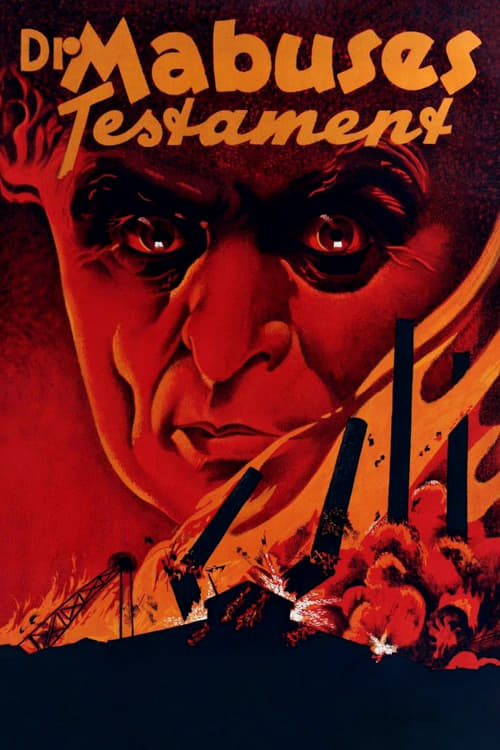
The Testament of Dr. Mabuse
1933 · Fritz Lang
For when you're in the mood for a classic that doesn't feel like homework — a pulpy, propulsive mystery with a chill of real history behind it. Great for viewers curious where the modern thriller comes from.
What it's about
Weimar cinema's great criminal mastermind sits in an asylum cell, silently scribbling perfect crimes — which somehow keep being committed in the world outside. Inspector Lohmann follows a trail of terror through the underworld toward an enemy who may no longer have a body at all, while the asylum's own director grows dangerously fascinated with his star patient.
The experience
Startlingly tense and modern for 1933 — disembodied voices behind curtains, ticking-clock set pieces, an atmosphere of creeping paranoia that gets under your skin. It moves like a thriller and lingers like a warning.
Performances
Otto Wernicke's Inspector Lohmann is a wonderful creation — gruff, funny, doggedly human — while Rudolf Klein-Rogge makes Mabuse terrifying while barely speaking a word.
The craft
Fritz Lang, working in the first years of sound, treats it as a weapon: voices with no visible source, mechanical noise as menace, a ghostly superimposed will radiating from a silent man. The set pieces are engineered with a watchmaker's precision, and good speakers bring out how radical the sound design still is.
Why it matters
Shot as the Weimar Republic collapsed and banned by Goebbels in 1933 — after which Lang left Germany — it plays as a study of how a doctrine of terror outlives its author, and its faceless-mastermind blueprint echoes through decades of crime and thriller cinema.
The criminal mastermind of Weimar cinema returns — confined to an asylum cell, scribbling perfect crimes that somehow keep being committed in the world outside. Fritz Lang's sequel to his 1922 Mabuse films is a marvel of early sound design: disembodied voices behind curtains, a ghostly superimposed will radiating from a silent man, and the dogged Inspector Lohmann (carried over from M) chasing an enemy who may no longer have a body at all. Lang shot it as the Weimar Republic collapsed; Goebbels banned it in 1933, and Lang — by his own much-embellished account offered control of Nazi cinema the same week — left Germany instead. Whether or not the film was conceived as anti-Nazi allegory, it plays as one: a study of how a doctrine of terror outlives and dissolves its author, issued at the precise moment such a doctrine took power. Its DNA runs through every faceless-mastermind thriller since, Bond villains included. Lang would close the circle in 1960, ending his career with one last Mabuse film — the idea, like its subject, refusing to die.
A Deleuzian reading
A curtain hangs across one end of a room.
The full Deleuzian reading of The Testament of Dr. Mabuse →
Reception
Banned by Goebbels' censors in March 1933 before it could open in Germany — it premiered abroad and Germans didn't see it legally for decades. Now it's canonized as one of cinema's great acts of political prophecy, the film where Lang claimed he put Nazi slogans in the mouths of criminals.
How The Testament of Dr. Mabuse was received, from release to now →
Influences: the films it descends from and the films it influenced
- Fantômas (1913) — Established the serial criminal-overlord who never dirties his own hands, orchestrating a city's crimes through disguised proxies — the faceless-mastermind-directing-a-network staging Lang inherits wholesale.
- Les Vampires (1915) — Codified the invisible criminal syndicate issuing orders from a hidden command center, the underworld-as-corporation structure that Mabuse's gang, chain of couriers, and sealed HQ replicate.
- Das Cabinet des Dr. Caligari (1920) — Framed its narrative inside a lunatic asylum where a mad authority's will controls another man to commit crimes; Testament literalizes this by making the incarcerated doctor dictate murders from his cell.
- Dr. Mabuse, der Spieler (1922) — Introduced Mabuse himself — the hypnotist master-of-disguise who plays society like a card game — whose defeat and madness set up the asylum premise this sequel is built on.
- Metropolis (1927) — Lang's in-camera superimposition and optical-ghost effects (the transformation, the visions) supply the technique for Testament's apparition of the dead Mabuse looming over Baum's desk.
- Spione (1928) — Perfected the unseen kingpin pulling levers from a wheelchair-bound control room, cross-cut against methodical police procedure — the exact detective-versus-hidden-overlord architecture Testament reuses.
- M (1931) — Directly supplies Inspector Lohmann as a recurring protagonist and pioneers Lang's early-sound method of using offscreen voices and audio motifs to bind scenes, which Testament escalates into a plot device.
- Die 1000 Augen des Dr. Mabuse (1960) — Lang's own return to the franchise, transposing the faceless-mastermind-behind-a-screen into an age of hidden surveillance monitors — the voice/eyes-of-the-overlord updated to CCTV.
- Im Stahlnetz des Dr. Mabuse (1961) — The 1960s German Mabuse revival serials extend the 'terror outliving its author' conceit — a new mastermind inheriting the Mabuse name and method precisely as Baum inherits it in Testament.
- Kiss Me Deadly (1955) — Builds its dread around an unseen criminal authority known mainly by a disembodied voice on the phone, carrying Lang's curtain-and-loudspeaker mastermind into American noir.
- The Manchurian Candidate (1962) — Extends the hypnotic-control device — a conditioned man executing crimes at a hidden handler's command — the Caligari/Mabuse mind-domination lineage recast as Cold War brainwashing.
- Dr. No (1962) — The Bond villain SPECTRE model — a criminal genius issuing orders from a concealed lair, often as a voice from an unseen chair — is a direct descendant of Mabuse's off-screen overlord, as the seed's own facets note.
- Contempt (1963) — Godard casts Lang as himself directing an Odyssey adaptation, a meta-homage that treats the Mabuse-era German master's cinema as living authorship — the 'terror outliving the author' turned into cinephile reverence.
- Se7en (1995) — Its unseen planner engineers a sequence of crimes that keep executing even after his capture, the Testament structure of an incarcerated mind whose scheme runs autonomously beyond the author's confinement.
- The Dark Knight (2008) — The Joker as an agent-of-chaos mastermind who orchestrates the city's terror through proxies and contingency, and whose menace persists from within a cell, is a modern reworking of Mabuse's confined-yet-omnipotent criminal will.
- Cure (1997) — The mesmerist-villain who compels ordinary people to kill via suggestion and a hypnotic instrument is the template Cure literalizes in Mamiya's flame-and-water induction; the menace is propagated mind-to-mind, never by the antagonist's own hand.
- Hangmen Also Die! (1943) — Models the veiled-Nazi-allegory of an omniscient criminal network and an authority that surveils from off-screen, the surveillance-as-dread device the film redeploys on occupied Prague.
- Le Corbeau (1943) — The unseen manipulator whose anonymous messages seed criminality across a community anticipates the invisible 'Corbeau' whose letters spread moral contagion.
- Blackmail (1929) — A parallel early-sound experiment using subjective, distorted audio to convey dread — kin to Lang's disembodied-voice-behind-the-curtain trick as directors first weaponized the new soundtrack.
Similar films
- M (1931) — influence & lineage · same viewing thread · often watched together
- Dr. Mabuse, the Gambler (1922) — influence & lineage · same viewing thread
- The Cabinet of Dr. Caligari (1920) — influence & lineage · often watched together
- Spies (1928) — influence & lineage
- Metropolis (1927) — influence & lineage
- Touch of Evil (1958) — same viewing thread · often watched together
- Kiss Me Deadly (1955) — influence & lineage · same viewing thread
- Mr. Arkadin (1955) — same viewing thread
All the films related to The Testament of Dr. Mabuse →
Watch it with: curated runs of related films
- The Long Shadow of M — A run from Lang's Weimar crime films through their noir and neo-noir children — killers, con men, masterminds, and manhunts — where you can watch expressionist menace mutate step by step into the modern thriller.