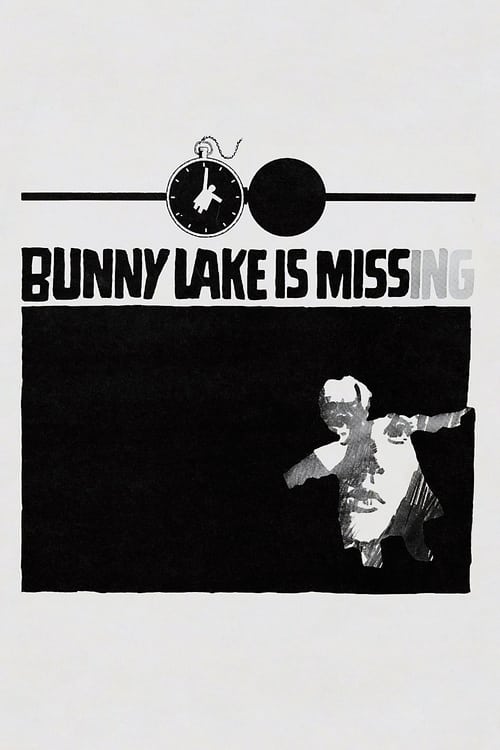
Bunny Lake Is Missing
1965 · Otto Preminger
For a night when you want a grown-up, brainy thriller to chew on — the kind you watch leaning forward, trading theories. More unsettling than cozy, but stylish enough to go down like a classic.
What it's about
Ann Lake, an American newly arrived in London, goes to collect her four-year-old daughter Bunny from her first day of nursery school — and the child isn't there. Worse: no record of her enrollment exists, the new flat holds no toys, and no one in England can confirm Bunny was ever real. As a wry police superintendent investigates, the question tightens: conspiracy, delusion, or a crime being methodically erased?
The experience
Coolly unnerving rather than loud — a black-and-white thriller that keeps pulling the floor out from under you, so you spend the film second-guessing the heroine, the witnesses, and yourself. It's tense, strange, and quietly distressing.
Performances
Laurence Olivier underplays beautifully as the investigating superintendent, all dry patience and watchfulness, while Carol Lynley keeps Ann's desperation pitched exactly on the line between credible victim and unreliable witness.
The craft
Otto Preminger shoots the mystery in elegant black-and-white widescreen with long, roving takes that refuse to tell you whom to believe, and Saul Bass's famous torn-paper title sequence sets the mood of erasure before a word is spoken. London itself — schools, hospitals, a doll repair shop — becomes a gallery of politely sinister spaces.
Why it matters
A cult favorite of the paranoid-thriller tradition, its central hook — a missing person no one else believes existed — became a template that mysteries and thrillers still borrow.
Snapshot
Bunny Lake Is Missing is Otto Preminger's black-and-white psychological thriller in which an American woman newly arrived in London, Ann Lake, reports her four-year-old daughter missing from a nursery school — only to find that no one can confirm the child ever existed. School records show no enrollment, the flat holds no toys, and every witness who might vouch for Bunny has conveniently vanished or forgotten. The film sustains this vertiginous uncertainty for most of its length: is Ann the victim of an elaborate conspiracy, a delusion, or a crime whose evidence is being methodically erased? Adapted from Evelyn Piper's 1957 novel, the picture belongs to Preminger's mature period as an independent producer-director, and it marries his signature procedural coolness — long takes, roving camera, an investigator's patient neutrality — to a genuinely unsettling study of pathological attachment. It is remembered today as much for its surfaces (a Saul Bass title sequence, cameos by Noël Coward and the pop group the Zombies) as for its central gaslighting premise, which has proven durably influential on the "did-she-imagine-it" thriller.
Industry & production
The film was produced and directed by Otto Preminger under his own independent banner and released through Columbia Pictures in 1965. By this point Preminger had spent more than a decade as one of Hollywood's most conspicuous independents — a producer-director who assembled his own packages, negotiated distribution rather than working under studio contract, and courted controversy as a marketing instrument. Bunny Lake arrived after a run of large-canvas, socially themed productions (Exodus, Advise & Consent, The Cardinal, In Harm's Way), and it represented a deliberate contraction of scale: an intimate, monochrome thriller shot in England with a compact principal cast.
The production relocated Piper's American source novel to contemporary London, a choice that let Preminger draw on a formidable roster of British acting talent — Laurence Olivier as the investigating police superintendent, Noël Coward as a lecherous landlord, Martita Hunt as a retired schoolmistress — while casting two young Americans, Carol Lynley and Keir Dullea, as the sister and brother at the story's center. Shooting took place in and around London using real locations alongside studio interiors; the exact studio and budget figures are not something I can state with confidence, and I won't invent them. Contemporary commercial performance is likewise not well documented in the sources I can reliably draw on: the film is generally described as a modest performer that found its stronger reputation later, but I would treat any specific box-office claim as unverified.
Technology
Bunny Lake was made with the standard professional apparatus of a mid-1960s British-based feature: 35mm black-and-white photography and a widescreen anamorphic presentation. The decision to shoot in black and white in 1965 — well into the era when color had become the commercial default, especially for a director who had recently worked in large-format color spectacle — was an aesthetic one, keying the film to a bleak, high-contrast London and to the tradition of the monochrome suspense picture. The combination of widescreen framing with black and white is itself notable, since the wide anamorphic frame was by then strongly associated with color epics; here it is turned toward claustrophobia and the disorienting placement of figures in deep, sparsely furnished rooms. (I'd flag the precise aspect ratio and lens system as a detail worth confirming against a technical source rather than asserting a specific format number.)
Technique
Cinematography
The cinematography is by Denys Coop, a British cameraman associated with the kitchen-sink realism of the early 1960s (This Sporting Life, Billy Liar). Coop's work here is central to the film's effect. The camera is notably mobile and patient, favoring sustained takes that follow characters through space rather than cutting to dramatize reactions, in keeping with Preminger's long-held preference for the extended, choreographed shot. The monochrome palette runs to hard whites and deep shadow, and the widescreen frame is often composed to isolate Ann within large, under-populated interiors — the nursery school, the flat, the doll hospital — so that the environment itself seems to withhold evidence of the child. The visual strategy is one of surveillance and skepticism: the camera watches Ann as coolly as the police do, refusing to underline whether she is reliable.
Editing
The editing sustains the film's ambiguity by resisting the reassurance of conventional coverage. Where a more emphatic thriller would cut in for close-ups to guide sympathy, Bunny Lake tends to hold, letting scenes play in longer units that keep the viewer at an investigator's distance. This restraint is what allows the picture to keep both readings — victim and delusion — alive for so long, and it makes the eventual shift into overt menace in the final act feel like a rupture rather than a payoff prepared by the cutting.
Mise-en-scène / staging
Preminger's staging is the film's most characteristic feature. He blocks actors in depth and moves them through connected spaces, using the architecture of rooms, corridors, and stairwells to organize dramatic information. Several settings function almost as set-pieces of atmosphere: the nursery school with its cook alone in an empty building; the eccentric upper flat of a retired teacher who has made a hobby of recording children's nightmares; a doll "hospital" full of maimed and dismembered toys that becomes the film's most resonant image, literalizing the theme of a child reduced to broken objects. The landlord's rooms, cluttered with masks and riding crops, add a note of decadent menace. These environments do heavy thematic work, surrounding the search for a real child with images of childhood distorted, archived, and mutilated.
Sound
The score is by Paul Glass and leans toward the unsettling rather than the lushly melodramatic, supporting the film's clinical tone. The most-discussed sound element, however, is diegetic: the British beat group the Zombies appear via a pub television and on the soundtrack, their contemporary pop threading through the film as an ironic counterpoint to the gathering dread. That collision of swinging-London pop culture with a story about a possibly imaginary child gives the film part of its uncanny period texture.
Performance
Carol Lynley carries the film as Ann, and the performance has to walk a deliberate tightrope: she must be sympathetic enough to hold our belief yet unstable enough to license doubt. Keir Dullea plays her brother Steven with a smooth, protective solicitude that the ending recodes retrospectively. Laurence Olivier, as Superintendent Newhouse, supplies a grounding intelligence — courteous, watchful, neither cruel nor credulous — that anchors the investigation. The film's supporting turns are vivid to the point of grotesquerie: Noël Coward as the seedy, insinuating landlord and Martita Hunt as the nightmare-collecting schoolmistress are the kind of eccentric character studies Preminger liked to plant along the edges of a procedural.
Narrative & dramatic mode
The dramatic mode is the epistemological thriller — a mystery in which the primary uncertainty is not "who did it" but "did it happen at all." For much of its running time the film withholds confirmation of its own premise, staging an investigation in which the absence of evidence is the evidence. This structure aligns the audience with the skeptical police and against, or at least alongside, the increasingly frantic mother, generating suspense from doubt about the protagonist's sanity rather than from an external threat. In its final movement the film abandons ambiguity for a more classical suspense register, resolving the question of Bunny's existence and shifting into a direct confrontation with the person responsible. That two-part architecture — sustained gaslight, then decisive reveal and physical danger — is the film's signature narrative gamble, and critics have long debated whether the resolution honors or cheapens the eerie ambiguity that precedes it.
Genre & cycle
Bunny Lake sits at the intersection of the police procedural, the woman-in-peril thriller, and the psychological horror of domestic derangement. It belongs to a recognizable mid-century cycle of "vanishing" narratives in which a person insists on the existence of someone others deny — a lineage that reaches back to Alfred Hitchcock's The Lady Vanishes (1938) and the "gaslight" dramas of the 1940s. Made in 1965, it also participates obliquely in the wave of monochrome psychological thrillers that followed the commercial shock of Psycho (1960), films that relocated horror from the gothic exterior into the family and the mind. Its London setting and pop-cultural garnish tie it, too, to the emerging cinema of "swinging" 1960s Britain, even as its sensibility remains that of an older Hollywood craftsman.
Authorship & method
The controlling authorial intelligence is Preminger's, and the film exemplifies his method: the long take and the fluid, unobtrusive camera; a refusal of editorializing close-ups; a cool, quasi-judicial neutrality toward characters whose guilt or innocence is in question — the same detachment that structures Laura, Anatomy of a Murder, and Advise & Consent. Preminger habitually treats his stories as investigations, presenting evidence and letting ambiguity stand, and Bunny Lake pushes that tendency to an extreme by making ambiguity the subject itself.
His key collaborators shape the result decisively. The screenplay is credited to John Mortimer and Penelope Mortimer, the British writing couple, who transposed Evelyn Piper's novel — Piper was the pen name of the American writer Merriam Modell — from New York to London and reworked its ending. Cinematographer Denys Coop supplied the mobile, high-contrast monochrome look. Composer Paul Glass provided the astringent score. The title designer Saul Bass, one of Preminger's most important recurring collaborators, contributed a celebrated main-title sequence built on the motif of black paper torn away to reveal the credits beneath — an image of concealment and exposure that neatly encodes the film's theme. (The film's editor is a matter I'd want to confirm from a reliable credit list rather than assert from memory.)
Movement / national cinema
The film is a transatlantic hybrid rather than the product of a single national movement. It is an American independent production, financed and directed by an émigré Austrian-American working in the classical Hollywood tradition, but physically made in Britain with a largely British cast and crew and a British source-adaptation team. It brushes against the concerns of contemporaneous British cinema — the location realism of the era's cameramen, the pop iconography of mid-decade London — without belonging to any of its self-conscious movements. Preminger's own lineage runs from Viennese theater and the studio system rather than from any postwar new wave, and the film is best understood as late classical Hollywood craft applied to a British setting.
Era / period
Released in 1965, Bunny Lake stands at a hinge between old and new. It is the work of a filmmaker formed in the studio era, deploying black-and-white photography and long-take classicism at the moment those techniques were being displaced by color and by faster, more fragmented styles. At the same time it registers the surrounding cultural change — pop music on the pub television, a modern London of transient flats and impersonal institutions. The film's unease can be read as period-specific: a story of dislocation and unrooted identity set among people with no established place in the city, arriving just as the certainties of the classical thriller were themselves coming apart.
Themes
Its central theme is the fragility of proof and identity — the terror of a reality that no one else will confirm, and the ease with which a person, especially a woman, can be maneuvered into doubting her own mind. The film is a study in institutional skepticism: schools, police, and neighbors withhold the recognition that would make Ann's daughter real. Running beneath this is a darker theme of pathological attachment and the perversion of familial love, worked out in the sibling relationship and echoed throughout the imagery of damaged childhood — the doll hospital, the recorded nightmares, the toys that stand in for a vanished child. The picture is finally about possession: the desire to keep another person so completely that one would rather erase them than share them.
Reception, canon & influence
Contemporary critical reception was mixed. The film drew admiration for its atmosphere, its Bass-designed presentation, and the poise of its cast, but a recurrent reservation concerned its resolution — the sense that the final revelation dissipated the extraordinary ambiguity the film had built. I'd characterize the initial reviews as respectful but divided rather than enthusiastic, and I won't attribute specific quotations I can't verify. Over time the film's standing has risen, aided by the general critical reappraisal of Preminger's directorial method — the long take, the moral neutrality, the fluid mise-en-scène — that gained force from the 1960s onward.
Looking backward, the film's influences are clear: the vanishing-person suspense of Hitchcock's The Lady Vanishes, the gaslight dramas of the 1940s in which a woman's grip on reality is deliberately undermined, and the family-centered psychological horror that Psycho had recently legitimized. Looking forward, its premise — a mother insisting on the existence of a child whom authorities cannot trace — has echoed through later thrillers that turn on a protagonist's contested reality and a possibly imaginary missing person, from the anxious-parent suspense of films like The Forgotten (2004) to the airborne variation of Flightplan (2005). Whether or not these later films cite it directly, Bunny Lake Is Missing is one of the touchstone treatments of the idea, and its central conceit — the missing person who may never have existed — remains its most enduring bequest to the genre.
A Deleuzian reading
Preminger puts Ann Lake in a room full of broken dolls.
The full Deleuzian reading of Bunny Lake Is Missing →
Reception
Met with mixed reviews and modest box office in 1965, it spent decades as a Preminger footnote — now it's a rediscovered cult favorite, prized as one of his strangest and most stylish films.
How Bunny Lake Is Missing was received, from release to now →
Influences: the films it descends from and the films it influenced
- The Lady Vanishes (1938) — Supplies the core plot engine — a person vanishes and fellow passengers and officials insist she never existed, forcing the protagonist to prove a reality everyone else denies.
- Gaslight (1944) — Establishes the gaslight-then mechanics Preminger borrows: a methodical, deliberate erosion of a woman's confidence in her own perception as an engineered scheme.
- Laura (1944) — Preminger's own template of quasi-judicial neutrality and a fluid, non-editorializing camera building an investigation around an absent, possibly-unreal woman.
- So Long at the Fair (1950) — Near-identical vanishing conceit — a sibling disappears from a hotel that erases every physical trace of his stay, so the search becomes a fight over whether he existed.
- Les Diaboliques (1955) — Monochrome dread constructed on a body/person whose very existence is thrown into doubt, the confirming reveal withheld until a final-reel shock.
- Vertigo (1958) — Pairs a Saul Bass main-title design with an obsessive contested-identity plot in which the person the protagonist insists upon may not exist as imagined.
- Anatomy of a Murder (1959) — The Preminger–Bass title collaboration plus the long-take, evidence-presenting method that lays out facts and lets guilt and ambiguity stand unresolved.
- Psycho (1960) — Legitimized family-rooted psychological horror and the last-reel psychiatric reveal keyed to a damaged childhood and a sibling identity gone wrong.
- The Innocents (1961) — Anamorphic black-and-white deep-focus staging around an ambiguous protagonist whose insistence on an unseen presence may be delusion rather than fact.
- Rosemary's Baby (1968) — Extends the gaslit-parent structure — a mother whose maternal reality and instincts are systematically denied by a conspiring, respectable establishment.
- The Vanishing (1988) — Pushes the epistemological-thriller obsession with a disappeared person to its limit, making the fate of the vanished woman the film's sole organizing question.
- The Forgotten (2004) — Direct descendant of the central conceit — a mother insists her erased child existed while every authority and record produces no trace of the boy.
- Flightplan (2005) — The airborne variation of the premise: a mother is certain her child is aboard the plane though no passenger record, witness, or crew member confirms the child ever existed.
- Whatever Happened to Baby Jane? (1962) — A parallel post-Psycho psychological horror whose terror grows out of warped, arrested sibling and childhood dynamics inside a claustrophobic house.
- Seance on a Wet Afternoon (1964) — A contemporaneous British monochrome thriller organized around a missing child and a psychologically unstable protagonist whose grip on reality is the real subject.
- Repulsion (1965) — A subjective London monochrome study of a mind coming apart, the camera bound to a disturbed perception so the viewer cannot separate reality from delusion.
Similar films
- Gaslight (1944) — influence & lineage
- Laura (1944) — influence & lineage
- The Lady Vanishes (1938) — influence & lineage
- Rosemary's Baby (1968) — influence & lineage
- Diabolique (1955) — influence & lineage
- Psycho (1960) — influence & lineage
- The Vanishing (1988) — influence & lineage
- Repulsion (1965) — influence & lineage