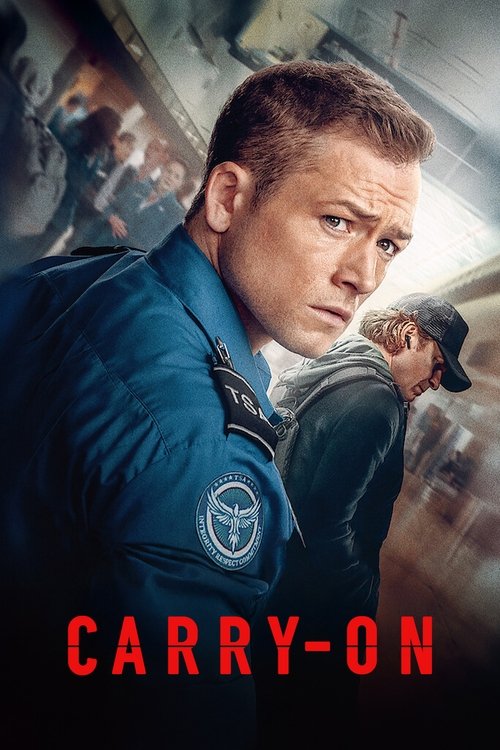
Carry-On
2024 · Jaume Collet-Serra
For when you want to be gripped for two hours and let go — an ideal one-sitting couch thriller, especially around the holidays when you want stakes with your eggnog.
What it's about
Ethan Kopek is a young TSA screener stuck in a rut, working the Christmas Eve shift at LAX, when a voice comes through an earpiece: let one bag slide through your lane, or the person you love gets hurt. The stranger on the line seems to see his every move, and the terminal keeps filling with holiday travelers. What follows is a cat-and-mouse duel fought almost entirely through glances, phone screens, and security monitors.
The experience
A tight, propulsive squeeze — the film keeps ratcheting the pressure in close quarters, and the constant hum of the crowded terminal makes every quiet threat land harder. It's tense without being punishing, with a streak of sleek, old-fashioned thriller pleasure.
Performances
Taron Egerton sells an ordinary guy improvising under impossible pressure, and Jason Bateman is the standout — his mild, reasonable-sounding menace, delivered mostly through a phone line, is the film's best weapon.
The craft
Jaume Collet-Serra is a specialist in exactly this: ordinary people trapped in tightening procedural vises, staged with clean geography so you always know where the danger is. The single-location construction is the show — conveyor belts, scanners, and sightlines turned into an obstacle course, cut for maximum momentum.
Why it matters
A word-of-mouth streaming hit that became instant holiday-thriller canon, it reaffirmed the appetite for contained, high-concept suspense built on stars and craft rather than franchise branding.
Snapshot
Carry-On is a single-location suspense thriller that unfolds almost entirely inside a Los Angeles airport terminal across one Christmas Eve shift. Ethan Kopek, a young, disillusioned TSA screener (Taron Egerton), is contacted through an earpiece by a coolly menacing operative (Jason Bateman) who coerces him, under threat to his pregnant girlfriend, into waving a lethal package through his security lane and onto a departing flight. The film belongs recognizably to director Jaume Collet-Serra's signature mode — the ordinary man trapped in a tightening procedural vise — and to a lineage of confined holiday-set action thrillers that runs back through Die Hard and Collet-Serra's own Non-Stop. Released by Netflix in December 2024, it was conceived and marketed as a platform tentpole: a star-driven, high-concept entertainment engineered for the streaming holiday window rather than a theatrical run. Its interest for an atlas of influence lies less in formal innovation than in how efficiently it synthesizes a well-worn thriller grammar — the surveillance-saturated airport, the disembodied controlling voice, the countdown — into a clean genre machine.
Industry & production
Carry-On is a Netflix original feature, produced for the service rather than acquired, and situated within the streamer's ongoing strategy of commissioning mid-to-upper-budget genre vehicles built around a recognizable director and a marquee lead. The screenplay is credited to T.J. Fixman, a writer who had built his reputation in video games (notably the Ratchet & Clank series) before moving into features; Carry-On represents one of his first produced feature screenplays. The script circulated in Hollywood as an admired unproduced property before Netflix moved it into development — it is frequently described as having appeared on an industry "Black List" survey of well-liked scripts, though the precise year of that listing is the kind of detail worth confirming against primary sources rather than asserting flatly here.
The production paired Collet-Serra, a director with a long and profitable track record in exactly this register, with a producing apparatus oriented toward polished commercial thrillers. Taron Egerton, coming off franchise work (Kingsman) and prestige performance (Rocketman), anchors the film as a leading man asked to carry sustained on-screen anxiety; Jason Bateman is cast conspicuously against his comic persona as the antagonist, a piece of casting that is itself part of the film's promotional logic. The supporting ensemble — including Sofia Carson as Ethan's girlfriend Nora, Danielle Deadwyler as an LAPD detective pursuing the plot from outside, plus performers such as Theo Rossi, Logan Marshall-Green, and Dean Norris — reflects a mid-budget streaming production's ability to stock secondary roles with familiar faces.
Because it was a streaming release, Carry-On has no conventional theatrical box-office record; its performance is measured instead in Netflix's own viewership metrics, which the company reports selectively. I won't cite specific figures, as those numbers are easy to garble and should be drawn from Netflix's disclosures directly. What is uncontroversial is that the film was positioned as a major December title and received a heavy promotional push as holiday-season counter-programming.
Technology
The film is a contemporary digital production, and its technological texture is inseparable from its subject: airport surveillance. Much of the story's tension is generated through screens, CCTV feeds, X-ray scanner displays, and the mediated intimacy of an earpiece — a design that lets the film dramatize modern security infrastructure as both threat and instrument. This foregrounding of monitors-within-the-frame is a technique Collet-Serra has used before (the text-message overlays of Non-Stop, the phone-bound entrapment of The Commuter), and here it is native to the milieu rather than superimposed on it.
Digital acquisition serves the film's need for low-light terminal interiors, long lens work in crowded concourses, and clean compositing of screen content. Any use of virtual production, set extension, or a constructed terminal set versus location shooting would need verification from production notes; airport thrillers frequently build controlled sets precisely because live airports are impractical to shoot in, but I won't assert which approach this production took without the record in front of me. The film's evident reliance on background extras, practical crowd staging, and the choreography of foot traffic through checkpoints is, however, plain on screen.
Technique
Cinematography
Visually the film commits to the airport as a closed system: hard fluorescent institutional light, reflective surfaces, the desaturated palette of a terminal at night warmed only intermittently by Christmas decoration. The camera favors mobility that tracks Ethan through the choreographed geography of the security zone — behind the scanners, along the queue, into back offices — sustaining a sense of a bounded world the protagonist cannot leave. The cinematography is attributed to Lyle Vincent; readers should treat that specific crew credit as one to confirm against the film's titles, as director-of-photography attributions are exactly the sort of detail worth checking rather than trusting to memory.
Editing
The picture's suspense depends on editorial control of information and time. It cross-cuts between Ethan at the checkpoint, the antagonist watching remotely, and the external investigation, using parallel action to widen the audience's knowledge beyond the trapped hero's — a classic Hitchcockian suspense structure in which we see the danger the protagonist cannot fully perceive. The cutting also manages the film's countdown logic, tightening rhythm as the flight's departure and the villain's deadline converge. I don't have a confident editor credit to attach, and would rather flag that gap than name the wrong artisan.
Mise-en-scène / staging
The single-location constraint is the film's dominant formal fact, and its staging is organized around it. The security checkpoint becomes a stage with fixed marks — the belt, the scanner, the pat-down station, the supervisor's booth — and much of the drama is blocking: who stands where, whose bag goes through which lane, how Ethan must physically comply while signaling distress he cannot voice. Christmas dressing (garlands, holiday music, festive crowds) supplies ironic counterpoint, the warmth of the season set against the coldness of the coercion, in a manner the "holiday thriller" tradition has long exploited.
Sound
Sound is arguably the film's most important expressive channel, because the antagonist exists for long stretches only as a voice in Ethan's ear. The design must sustain the uncanny proximity of that voice against the ambient roar of a terminal — announcements, crowd murmur, machinery — so that the villain feels simultaneously intimate and untraceable. The musical score is credited (per common report) to Lorne Balfe, a composer strongly associated with propulsive contemporary action-thriller scoring; as with other crew credits above, that attribution is worth confirming against the film itself.
Performance
Egerton's performance is a study in constrained reaction: for much of the runtime he must convey mounting terror and improvised resistance while maintaining an outward composure that will not alert his coworkers or the traveler he's been ordered to pass. Bateman's antagonist is built on the actor's gift for unhurried, articulate menace — a villain who reasons rather than rages — and the casting deliberately trades on the audience's affection for Bateman's usual affable screen presence. Deadwyler, as the investigator working the case from the outside, provides the film's countervailing agency, and her presence lends gravity to the procedural strand.
Narrative & dramatic mode
The film operates in the suspense mode rather than the mystery mode: the audience learns the threat early and watches its execution tighten, generating tension from anticipation rather than from concealment. Its architecture is the "ordinary person coerced into complicity" thriller — a protagonist who is neither spy nor soldier but a low-level functionary weaponized by his own position. The dramatic engine is a moral vise: every choice that protects Ethan's loved one endangers a planeload of strangers, and the plot advances by forcing him to negotiate the margins of that impossible bargain. A parallel investigative track supplies external momentum and the possibility of rescue, converting what could be a purely reactive premise into a race. The Christmas Eve setting supplies both a ticking clock (the flight) and a thematic frame of home, family, and the promise of safety under threat.
Genre & cycle
Carry-On sits at the intersection of two durable cycles. The first is the confined-space action thriller — Die Hard and its many descendants, and more specifically the sub-strain of transit thrillers set on planes, trains, and in terminals, to which Collet-Serra himself contributed Non-Stop (aboard an aircraft) and The Commuter (aboard a train). The second is the holiday-set thriller, in which the iconography of Christmas ironizes and intensifies scenes of danger. The film's high-concept logline — a security screener blackmailed into letting a threat through — places it squarely within the "everyman coerced by an unseen mastermind" formula that films like Phone Booth crystallized. It is, in cycle terms, a late and highly polished entry rather than an originator: its craft lies in recombination.
Authorship & method
The clearest authorial signature is Collet-Serra's. Across Unknown, Non-Stop, Run All Night, and The Commuter — his run of thrillers built largely around Liam Neeson — he refined a house style: an everyman (or an aging tough) trapped in a bounded, procedural environment; an antagonist who controls the hero through information and communication technology; a plot that is essentially a series of constrained problem-solving beats under time pressure. Carry-On transplants that method from Neeson's weathered heroism to Egerton's younger, more anxious protagonist, but the structural DNA is continuous. Collet-Serra's broader filmography (Orphan, House of Wax, The Shallows, and studio tentpoles Jungle Cruise and Black Adam) shows his range, but Carry-On is a return to the contained-thriller register in which he is most distinctive.
On the writing side, Fixman's screenplay supplies the clean high-concept scaffolding; the film's efficiency of premise reflects a script admired in the industry before production. Among the key collaborators, the most confident attributions are director (Collet-Serra), lead performers (Egerton, Bateman, Carson, Deadwyler), and writer (Fixman). The cinematographer (reported as Lyle Vincent) and composer (reported as Lorne Balfe) I have flagged as credits to verify, and I do not have a reliable editor attribution — better to note the gap than to fabricate a name.
Movement / national cinema
The film belongs to no art movement; it is a product of the contemporary American commercial thriller as reconfigured by streaming economics. Its relevant "national cinema" context is really an industrial one: the rise of the platform original as the natural home for the mid-budget adult genre film that theatrical distribution has increasingly abandoned. Collet-Serra is himself a Spanish-born director working entirely within the Hollywood system, and the film reflects the globalized, English-language, streaming-first mode of production rather than any regional tradition.
Era / period
Carry-On is emphatically a film of the post-9/11, surveillance-saturated present, and specifically of the 2020s streaming era. Its entire premise depends on the audience's lived familiarity with airport security theater — the TSA checkpoint as a site of ritual anxiety, delay, and asymmetric power. It dramatizes a security apparatus designed to catch threats and imagines its inversion: the checkpoint as the very mechanism through which a threat is smuggled in. That the film could exist only in a world of ubiquitous cameras, wireless earpieces, and instant remote coercion marks it firmly as a product of its technological moment.
Themes
The central theme is coercion and the ethics of complicity: how far an individual will go, and whom he will sacrifice, when an unseen power turns his own duty against him. Around it cluster related concerns — the illusion of security in a system built to promise it; surveillance as a double-edged instrument that watches everyone including its operators; and the tension between private loyalty (protecting one's family) and public responsibility (protecting strangers). The Christmas setting deepens the thematic weave, opposing the season's imagery of home, safety, and reunion against the possibility of mass violence in transit. There is also a quieter theme of agency reclaimed: a protagonist introduced as passive and disaffected who must, under extremity, discover initiative.
Reception, canon & influence
As a December 2024 Netflix release, Carry-On was received primarily as accomplished commercial entertainment — praised in general terms for its tight premise, Collet-Serra's assured handling of confined tension, and Bateman's against-type villainy, while noted by some as a familiar recombination of established thriller parts rather than a reinvention. I'm deliberately not attaching specific review quotations, scores, or viewership rankings, since those are precisely the figures that should be sourced directly rather than paraphrased from memory.
Influences on the film (backward): The clearest antecedents are Die Hard (holiday-set siege thriller with an everyman under duress), Phone Booth and Speed (a protagonist controlled and constrained by an unseen antagonist enforcing rules in real time), and Collet-Serra's own Non-Stop and The Commuter, whose transit-bound, communication-driven suspense the film directly extends. Behind all of these stands the Hitchcockian suspense tradition of the innocent man ensnared in a plot he did not choose and the audience's privileged foreknowledge of danger.
Legacy / what it shaped (forward): As a recent release, its downstream influence cannot yet be assessed with any confidence, and it would be irresponsible to claim one. What can be said is that its production reinforces a now-established pattern — the streaming platform as the reliable home for the star-and-director-driven adult genre thriller — and that its success or failure feeds into Netflix's continued investment in exactly this kind of high-concept, single-location suspense vehicle. Whether Carry-On comes to be regarded as a durable entry in the confined-thriller canon or as an efficient, disposable holiday release is a judgment the historical record has not yet had time to render.
A Deleuzian reading
A bag rides the belt into the scanner and comes out the other side as false color on a monitor — orange where the machine reads organic, blue where it reads metal.
The full Deleuzian reading of Carry-On →
Reception
Dropped quietly onto Netflix in December 2024 and became a monster — one of the platform's biggest film launches ever — while critics shrugged 'surprisingly solid.' A year and a half on, it's already settling into the annual December-rewatch rotation rather than vanishing like most Netflix originals.
How Carry-On was received, from release to now →
How to watch Carry-On: what to notice on a first viewing
- Watch the fixed marks: belt, scanner, pat-down station, supervisor's booth. Collet-Serra blocks the checkpoint like a stage with fixed marks, and each scene forces Ethan to comply physically while signaling distress he cannot voice. The architecture turns his job description into the very leash that controls him.
- Listen for the antagonist's voice at whisper-close range inside the terminal's roar. Bateman speaks at conversational distance no one standing near Ethan could match, so the voice feels closer than anyone in the room. That intimacy is the coercion: a stranger occupying the space reserved for someone Ethan trusts.
- Notice the fluorescent light and the garland strung over the scanner. Collet-Serra keeps the terminal cold and institutional, warmed only by scattered Christmas decoration, so festive cheer never actually reaches the light itself. The mismatch between season and setting keeps the danger feeling ordinary instead of foreign.
- Track the cuts between Ethan, the antagonist, and the investigator. The film keeps cross-cutting to what Ethan cannot see, so your knowledge of the danger stays wider than his the whole time. Cross-cutting builds suspense from watching, not from surprise.
- Watch Egerton's face and hands stay composed while he complies under threat. Egerton keeps his outward manner steady for coworkers even as his body carries mounting terror underneath, scene after scene. That gap between visible calm and hidden panic is the whole tension of the role.
The whole guide to watching Carry-On, with the keys for a rewatch →
Influences: the films it descends from and the films it influenced
- Sabotage (1936) — The bomb-on-a-timer carried through an oblivious crowd codifies the suspense-not-mystery contract — the audience holds foreknowledge of a threat the onscreen victims lack — which is exactly the tension engine of Carry-On's tracked package.
- Rear Window (1954) — A physically constrained protagonist reads unfolding danger only through a mediated frame, the template for staging a thriller around a hero pinned to a station and forced to watch threat play out on surveillance screens.
- Die Hard (1988) — The holiday-set single-location siege in which an everyman weaponizes intimate knowledge of a building's geography against organized attackers — the confined-space, working-stiff-vs-plot architecture Carry-On imports to an airport terminal.
- Speed (1994) — An unseen antagonist imposes a lethal real-time rule set, converting the hero into a continuous problem-solver under a hard countdown — the coercion-by-rules mechanic Carry-On runs through a security lane.
- Nick of Time (1995) — Near-identical hostage-leverage engine: an ordinary man is coerced in real time to carry out a killing because a loved one is held, structured as unbroken continuous-time pressure rather than mystery.
- Phone Booth (2002) — The named touchstone — a protagonist immobilized in a single spot and ruled entirely by a disembodied antagonist's voice, the disembodied-voice-as-controller device Carry-On routes through an earpiece.
- Panic Room (2002) — A single-location siege navigated through banks of surveillance monitors, with the camera gliding through impossible architecture — the marriage of surveillance-screen staging and restlessly mobile tracking Carry-On adopts.
- Cellular (2004) — The live phone connection becomes the sole tether between an imperiled party and the coerced rescuer, sustaining real-time duress across a single unbroken line of communication.
- Non-Stop (2014) — Collet-Serra's transit-locked thriller conducted through anonymous text-message threats — the direct method template of communication-technology coercion inside a sealed environment.
- The Commuter (2018) — The immediate predecessor: a stranger's voice assigns a deadly task to a commuter under time pressure inside a sealed public-transit space, a premise Carry-On transplants almost wholesale to an airport.
- The Guilty (2021) — A streaming-era single-location suspense film sustained almost entirely through disembodied voices on a headset, the same disembodied-voice-driven confined-thriller pattern Netflix reinforces with Carry-On.
- Red Eye (2005) — A confined two-hander in which a suave, against-type villain sits inches from a service-industry everyperson and calmly coerces them into abetting an assassination — the intimate constrained-reaction performance mode Carry-On builds on.
- Collateral (2004) — A coerced everyman is trapped in a bounded transit space with an against-type-cast villain who runs the night through calm menace, extending the constrained-two-hander-under-instruction dynamic.
- Unknown (2011) — Collet-Serra's own procedural everyman-in-a-bounded-city thriller establishing his signature series of constrained problem-solving beats, the structural DNA Carry-On reuses.
- Source Code (2011) — A countdown thriller built from iterated real-time problem-solving to locate and defuse a bomb on public transit, extending the countdown-structure-plus-hidden-device craft.
- The Shallows (2016) — Collet-Serra's single-location survival exercise wringing sustained suspense from one performer trapped in a tiny space, proving his contained-thriller register outside the transit format.
- Kimi (2022) — A streaming-era thriller whose plot is driven by surveillance feeds and audio screens monitored by a constrained protagonist, a contemporary sibling in the surveillance-tech confined suspense mode.
Similar films
- Die Hard (1988) — influence & lineage
- Kingsman: The Secret Service (2015) — same viewing thread
- Captain America: The Winter Soldier (2014) — same viewing thread
- Captain America: Brave New World (2025) — same viewing thread
- Number 24 (2024) — shared sensibility
- Tenet (2020) — shared sensibility
- The Gift (2015) — shared sensibility
- Train to Busan (2016) — shared sensibility
All the films related to Carry-On →
Watch it with: curated runs of related films
- Rogue Heroes, Rigged Systems — A run of slick, propulsive 21st-century spectacle — spies, super-soldiers, sci-fi survivors, and dystopian rebels all squaring off against some vast machine or shadowy apparatus — best watched back-to-back when you want momentum, style, and a lone figure taking on the whole board.