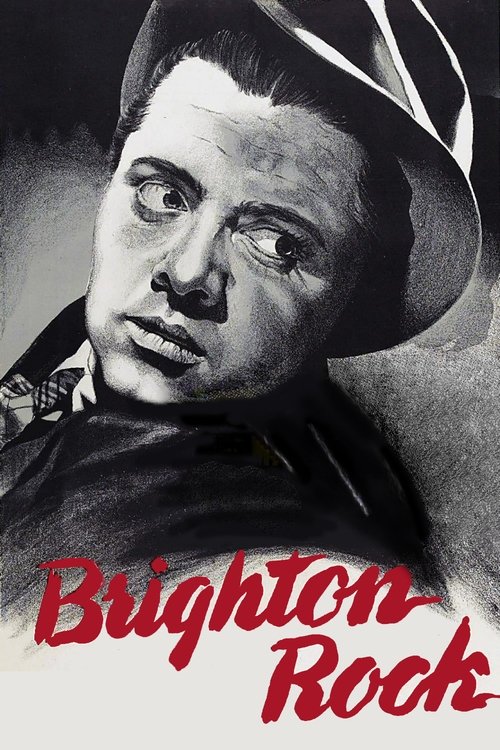
Brighton Rock
1948 · John Boulting
For a night of vintage crime with real teeth — when you want noir atmosphere and a villain who genuinely unnerves rather than charms. A classic that still feels dangerous.
What it's about
Brighton between the wars: Pinkie, a seventeen-year-old gang leader with a razor in his pocket and damnation on his mind, murders a journalist amid the holiday crowds. A guileless young waitress can place him near the scene, so he courts and marries her — not out of love, which repels him, but to keep her from testifying. As rival gangs and a persistent showgirl close in, the marriage becomes its own kind of trap.
The experience
Cold-blooded and gripping, with a nastiness startling for its era — menace threading through funfairs, piers, and boarding houses. It plays like a thriller but leaves a moral chill, and the ending delivers one of British cinema's most quietly devastating final scenes.
Performances
Richard Attenborough, young and baby-faced, is chilling as Pinkie — all coiled contempt and dead eyes — a performance that made him the most frightening face in postwar British film.
The craft
Graham Greene adapted his own novel, keeping its unusual charge: a gangster story that is also a story about sin and salvation. John Boulting shoots Brighton's piers and back lanes in shadowy black and white, turning the seaside resort — a place built for pleasure — into a moral abyss.
Why it matters
The peak of Britain's postwar "spiv" crime cycle and a cornerstone of British noir, it proved homegrown crime films could match Hollywood for menace and fixed Attenborough's early stardom.
Snapshot
A seventeen-year-old gang leader with a razor in his pocket and damnation on his mind murders a journalist on Brighton's Palace Pier, then marries the waitress who can place him at the scene — not out of love, which he finds physically repellent, but to stop her testifying. Brighton Rock is the film in which the British cinema discovered that its own seaside could be a moral abyss. Adapted by Graham Greene from his 1938 novel, with Terence Rattigan sharing screenplay credit, and directed by John Boulting for the brothers' Charter Film Productions under the Associated British umbrella, it took a young Richard Attenborough — until then the boy who cracks in In Which We Serve — and made him the most frightening face in postwar British film.
It arrived at the crest of the so-called "spiv cycle," the run of postwar British crime pictures that scandalised critics and drew audiences, and it was attacked on release for brutality while a foreword card hurried to reassure viewers that the Brighton of the story belonged to a vanished pre-war past. Reissued in the United States in 1951 under the frank title Young Scarface, it has since been reclaimed as the central text of British film noir and the founding document of the British gangster film: a picture whose subject is not crime as spectacle but sin as a closed system, in which the most terrifying thing about Pinkie Brown is that he believes, absolutely, in Hell.
Industry & production
The production sits inside one of the worst years in British film history. In August 1947 the Labor government imposed the ad valorem duty — a punitive tax on imported American films — and the Hollywood studios responded with an embargo. British producers scrambled to fill the vacuum; when the duty was withdrawn in 1948 and the withheld American backlog flooded the market at once, the resulting glut helped precipitate the collapse of the Rank Organisation's expansion program. Brighton Rock was conceived, shot and released across exactly this hinge. It was made for the Associated British Picture Corporation, with studio work at Welwyn and substantial location shooting in Brighton itself, and it was produced by Roy Boulting while his twin John directed — the alternating arrangement the brothers used throughout their careers, and one they treated as a genuine division of labor rather than a courtesy credit.
The property came to the screen by way of the stage. Frank Harvey's 1943 theatrical adaptation of Greene's novel had given Attenborough the role of Pinkie in the West End, and his casting in the film followed directly from that. Greene wrote the screenplay and Rattigan shares the credit; the documentary record of who contributed what is thinner and more contested than the credit implies, and it is safer to say that the finished script bears Greene's structural fingerprints — the Kolley Kibber pursuit, the boarding-house scenes, the theological architecture — than to apportion lines between them.
The film's most conspicuous production compromise is visible in its first frames. Brighton's civic authorities and traders were alarmed at the prospect of a film depicting their town as a nest of razor gangs, and the picture opens with a title card distancing the events from the present day, locating them in the inter-war years and characterizing modern Brighton as a cheerful holiday resort. This is a piece of appeasement rather than period-setting: the costumes, cars and streets are unmistakably those of 1947, and the disclaimer sits on the film like a label on the wrong bottle. Censorship pressure ran in the same direction — the British Board of Film Censors was uneasy about the violence and about the depiction of racecourse protection rackets, and the film's razor slashings are handled almost entirely by implication.
Technology
Technically the film is orthodox for its moment: 35mm black-and-white nitrate, Academy ratio, optical sound. What is interesting is how hard it pushes against the limits of that orthodoxy. Postwar raw stock was rationed and studio space contested, which made the extensive Brighton location work — pier, seafront, the Lanes, the racecourse on a genuine race day — both an economy and a risk. Location sound recording in 1947 was cumbersome enough that crowd sequences of this kind were conventionally post-synchronised, and the film's soundtrack has the slightly detached, built quality that comes from dubbing exterior material.
The film also makes a consumer technology into its final image. Seaside amusement arcades of the period offered direct-to-disc recording booths, where for a few pence you could cut your voice onto a soft acetate or shellac blank. Pinkie records a message for Rose in one of these booths; the disc's characteristic failure mode — a damaged groove that loops a single phrase indefinitely — becomes the film's last shot. Few films have found their ending so precisely in the physical properties of a machine. The pier itself is the other technological presence: the ghost train, the automatic machines, the piled amusement apparatus of mass leisure, all of it photographed as menace rather than fun.
Technique
Cinematography
Harry Waxman's photography is the reason the film is spoken of as British noir at all. The Brighton material divides sharply between two registers. In daylight and in crowds the camera is loose, mobile and quasi-documentary — the opening pursuit of the journalist Fred Hale through the holiday throng is shot among real crowds, with a reportorial mobility that owes something to the Boultings' wartime service-unit filmmaking. Then the film goes indoors and at night, and the style hardens: low key, heavy blacks, faces raked from below or sliced by a single hard source, the boarding house and Prewitt's chambers rendered as pits of shadow. Waxman uses wide lenses in cramped interiors so that rooms bulge and Pinkie's face swims toward the lens; the seafront at night becomes a black field with points of light in it.
The contrast is the argument. The bright public Brighton of the disclaimer card and the black private Brighton of the gang occupy the same frame lines, and the film keeps cutting between them until the holiday town reads as a thin skin over something else.
Editing
Peter Graham Scott — remarkably young for the job, and later a prolific television director and producer — cut the film with a tension between accumulation and withholding. The Hale sequence is the showpiece: a long, patiently built pursuit that establishes geography, crowd, victim and hunters before the kill, and then declines to show the kill at all. That withholding is the film's editorial signature. Violence is repeatedly displaced onto reaction, aftermath, or sound; the racecourse affray is cut into a scramble of partial views. The rhythm elsewhere is unhurried, almost novelistic, giving the boarding-house scenes room to curdle.
Mise-en-scène / staging
John Howell's art direction and Boulting's staging systematically deny Pinkie any comfortable space. He is placed in rooms too small for the number of bodies in them, at tables where he sits apart, on a pier railing with the sea behind him. The gang's boarding house is a warren of stairs and landings that permits eavesdropping and traps — geography as fate. Against this, Brighton's public spaces are staged as swarm: piers thick with trippers, the racecourse a heaving mass, Ida moving through both with the ease of someone who belongs to the crowd and to the world. The single most efficient staging idea in the film is the recurring use of vertiginous drops — the pier, the balcony, the cliff road — so that when the last of them is used, it has been rehearsed three times.
Sound
Hans May's score, from an Austrian émigré composer working in the British industry, works two ways at once: a lyrical, almost sentimental strain associated with Rose, and a nagging figure attached to Pinkie that undercuts it. But the film's real soundscape is diegetic — pier organ, brass band, fairground barking, the sea. Greene's Brighton is loud, and the film uses that noise as insulation: a murder can happen inside it and nobody hears. The stuck record at the close is the point where diegetic sound seizes control of the film entirely and becomes its final statement.
Performance
Attenborough's Pinkie is the performance the film is built around, and its intelligence lies in what it refuses. He does not swagger. He is small, still, precise, with a schoolboy's neatness and a flicker of nausea whenever anyone touches him; the menace comes from the gap between his adolescent body and the absolute conviction with which he contemplates damnation. It was a deliberate demolition of the sympathetic-youth persona Attenborough had built during the war, and he spent much of the following decade escaping it — before returning to psychopathology as John Christie in 10 Rillington Place (1971).
Around him, Carol Marsh, in her film debut, plays Rose with a genuine and painful ordinariness — the performance depends on her not being secretly knowing. Hermione Baddeley's Ida Arnold supplies the film's countervailing life force: blowsy, decent, tenacious, a woman whose morality is entirely of this world. William Hartnell's Dallow (Hartnell would later become television's first Doctor Who), Wylie Watson's frightened Spicer, Nigel Stock's Cubitt and Harcourt Williams's ruined lawyer Prewitt fill out a gang defined by exhaustion rather than glamour.
Narrative & dramatic mode
The film runs on a double engine: a crime thriller with a pursuer (Ida) closing on a killer, and a theological drama in which the killer's real jeopardy has nothing to do with the police. Ida's investigation supplies the forward motion — she is the only character who behaves like a protagonist in a conventional sense — while Pinkie's marriage to Rose supplies the moral action, since it is a sacrament entered into as a legal maneuver by a man who believes the sacrament is real.
Greene's own distinction, carried over from the novel, organizes everything: Ida operates by right and wrong, Pinkie and Rose by good and evil. Ida cannot be made to understand that the girl she is trying to save regards being saved as irrelevant beside the state of Pinkie's soul, and Rose cannot be made to accept rescue on Ida's terms. The film honors this and then flinches at the last moment. Greene's novel ends with Rose walking toward what he calls the worst horror of all — the record she has not yet heard. The film ends with the needle stuck, so that she hears only "I love you" repeating. Greene subsequently defended the change as ambiguous rather than consoling: the disc is damaged, the needle will move or the record will break, and the horror is postponed rather than canceled. Critics have argued the point ever since. It remains the most discussed ending in British cinema of the period, and the reason is that it is genuinely double — a cruelty and a mercy in the same shot.
Genre & cycle
Brighton Rock is the summit of the British crime cycle of 1945–50, the group of films that critics of the day condemned as imported American nastiness: They Made Me a Fugitive (1947), Good-Time Girl (1948), No Orchids for Miss Blandish (1948), and shortly after, Jules Dassin's London-set Night and the City (1950). The cycle fed on demobilisation anxiety, black-market culture and the figure of the spiv, and it was met with a press campaign about screen violence and juvenile delinquency that helped end it. By 1950 the genre had been recuperated into the consensual police procedural of The Blue Lamp.
Its relation to American noir is one of parallel evolution rather than imitation. The visual grammar is shared, and the American retitling as Young Scarface frankly invited comparison with the Cagney lineage and with the contemporaneous baby-faced killers of Kiss of Death (1947). But the American gangster is an aspirant, a man climbing; Pinkie has no ambition beyond holding a small pitch against a bigger operator, and no interior life beyond his fear of Hell. That substitution of metaphysics for social ascent is what makes the film irreducibly English.
Authorship & method
John and Roy Boulting are usually filed under the satires — Private's Progress (1956), Lucky Jim (1957), I'm All Right Jack (1959) — but their formation was in earnest social-purpose cinema (Pastor Hall, 1940; Thunder Rock, 1942) and in wartime service filmmaking: Roy's Desert Victory (1943) for the Army Film Unit and John's Journey Together (1945) for the RAF Film Unit, in which Attenborough also appeared. That documentary training is legible in the location work and in the film's refusal to prettify. Their method as producer-director twins, swapping functions film to film, makes conventional auteurist attribution awkward; the Boulting signature is a body of work rather than a directorial style.
Greene is the other author, and arguably the dominant one: he supervised the adaptation of his own novel and the film preserves its theology more faithfully than most literary adaptations of the era manage. Rattigan's credited contribution is genuine but its extent is not well documented, and claims about who wrote which scenes should be treated with caution. Waxman's cinematography is the film's most transferable technical achievement — he worked long and widely afterwards across British genre production. Hans May's score belongs to the substantial body of work by Central European émigré composers who shaped British film music from the 1930s onward. Peter Graham Scott's cutting, done very early in a career that ran mostly through television, is more disciplined than the film's reputation for lurid material suggests.
Movement / national cinema
The film occupies a productive contradiction within British cinema. On one side stands the documentary tradition — Grierson, the wartime units, the postwar realist consensus that a British film ought to be sober and socially useful. On the other stands the disreputable, commercially vital strain of melodrama and Gothic that critics of the period despised. Brighton Rock draws on both: real crowds and real streets photographed with reportorial directness, then lit and staged as nightmare. It anticipates the argument, made forcefully by later scholarship on the period, that the "quality" realist account of British cinema had systematically written out the country's best genre filmmaking. Steve Chibnall's book-length study of the film and Robert Murphy's work on the postwar crime cycle are the standard points of entry to that revaluation.
Era / period
The film is set, per its own disclaimer, in the inter-war years of racecourse gangs — a world with a documented real-world basis in the Sabini organization and the racetrack protection wars of the 1920s and '30s, and in newspaper promotions like the News Chronicle's "Lobby Lud," whose fictional counterpart Kolley Kibber sets the plot moving. But the film is unmistakably about 1947: austerity, rationing, black markets, demobilised young men with no place, and a national argument about whether the war had produced a generation without moral restraint. The disclaimer's insistence that all this is safely past is itself period evidence — a document of how nervous postwar Britain was about looking directly at its own criminality.
Themes
Damnation is the subject. Pinkie's Catholicism is not color or motivation; it is the reality he inhabits, and the film's most disturbing proposition is that he is theologically literate and entirely unrepentant — he expects Hell and has organized his life around that expectation. Rose is his mirror: she shares the belief system and chooses, knowingly, to be damned with him rather than saved without him, which is why Ida's secular rescue mission cannot reach her.
Under that sits a second theme: sexual revulsion. Pinkie's violence is inseparable from his physical disgust, and the marriage is a torment precisely because it obliges him to enact intimacy he experiences as filth. Third, the film is about the doubleness of the holiday town — the stick of Brighton rock that gives the novel its title runs the same word through its whole length, and the film keeps proving that what is written through the pleasure resort does not change however far you bite. And fourth, mercy: the priest's counsel to Rose about the strangeness of divine mercy is the one aperture the story allows, and the film's ending places it in ironic tension with a broken machine.
Reception, canon & influence
Backward, the film's inheritances are legible. Greene's novel is the primary source, and its own debts run to the American hard-boiled tradition he read closely and to the Catholic novel of Mauriac and Bernanos. Visually the film draws on the German-derived expressionist lighting that reached Britain through émigré technicians and through the American crime picture. Structurally, the Boultings brought wartime documentary practice; dramatically, Harvey's stage version had already stripped the novel into scenes and given Attenborough three years to build the role.
Contemporary reception was sharply split. The film drew significant hostility in the British press for its violence and for the moral vacancy of its young protagonist, arriving as it did during an active public argument about crime films and youth; it also drew serious praise for Attenborough's performance and for Waxman's photography. Reliable box-office figures for individual British films of this period are notoriously poor, and any precise gross quoted for it should be treated skeptically; what is clear is that the picture found an audience and that its critical standing was low relative to what it became. The 1951 American release as Young Scarface, cut for that market, did little for its reputation.
Forward, the influence is large. Brighton Rock is routinely identified as the point of origin for the British gangster film, and the line from Pinkie runs through the cold provincial violence of Get Carter (1971) to the doomed criminal patriarchs of The Long Good Friday (1980) and beyond; the British crime film's characteristic fusion of grubby location realism with moral extremity begins here. Attenborough's Pinkie also inaugurated a durable British type — the articulate, undersized, terrifying young man — whose descendants are easy to trace even where direct influence cannot be documented. The film's Brighton became a permanent site in British screen mythology, revisited from a different subculture in Quadrophenia (1979) and re-entered directly by Rowan Joffé's 2010 remake, which relocated the story to the Mods-and-Rockers Brighton of 1964 with Sam Riley as Pinkie, Andrea Riseborough as Rose and Helen Mirren as Ida — a version generally judged handsome and less frightening.
Canonically, the film's rise came with the reassessment of British genre cinema from the 1980s onward: repertory programming, the British-noir revaluation, a dedicated critical literature, and a digital restoration and reissue around the time of the remake that returned Waxman's blacks to something like their intended density. It now sits securely among the essential British films of the 1940s — and, unusually for a picture once condemned as sensationalism, it is the theology rather than the razors that has kept it alive.
A Deleuzian reading
A man in a hat walks too fast along the Palace Pier on a hot morning, and the crowd won't let him hurry.
The full Deleuzian reading of Brighton Rock →
Reception
British critics in 1948 were rattled by its viciousness — one tabloid famously damned it as 'false, cheap, nasty sentimentality' — but it's since been canonized as one of the great British noirs, landing at #15 on the BFI's 1999 list of the top 100 British films.
How Brighton Rock was received, from release to now →
How to watch Brighton Rock: what to notice on a first viewing
- Watch how bright Brighton looks in daylight crowds. The same seafront that looks like a cheerful holiday town in daylight sequences turns into cramped, shadowed rooms once the film goes indoors with the gang. The pleasure resort and the criminal underworld share the same streets, one just a skin over the other.
- Watch Pinkie's stillness break for a flicker when touched. Attenborough plays Pinkie small, neat, and still, and lets a flash of near-nausea cross his face whenever anyone touches him, the one crack in an otherwise composed surface. That flicker tells you more about what is wrong with him than any line of dialogue does.
- Watch rooms bulge and faces swell as the camera nears. Waxman shoots interiors with wide lenses in cramped spaces, low key and heavy black, so walls bulge outward and Pinkie's face swims toward the lens. The distortion turns ordinary rooms into something that presses on you the way dread does.
- Listen for pier organs and crowd noise crowding out quiet. Brass bands, fairground barkers, and the sea fill the soundtrack so completely that the film's real quiet moments stand out sharply against it. A town this loud is loud enough to hide almost anything happening inside it.
- Notice Pinkie placed in rooms too small for everyone in them. The staging repeatedly denies Pinkie a comfortable space, cramped rooms, a table where he sits apart, a warren of stairs and landings built for eavesdropping. The architecture itself closes in on him before anyone else does.
The whole guide to watching Brighton Rock, with the keys for a rewatch →
Influences: the films it descends from and the films it influenced
- M (1931) — Establishes the repeated sound cue as moral marker — Beckert's whistled Grieg motif functions exactly as Pinkie's recorded voice does, a mechanical sound that outlives and condemns the speaker — and gives Britain the template of the soft-faced, undersized killer tried by his own underworld.
- Scarface (1932) — Hawks's habit of staging murders as shadows and off-screen sound (the bowling-alley strike standing in for the kill) is the direct model for Waxman and Boulting's elided razor work; the film's underling-kills-upward succession plot is Pinkie's plot, and the 1951 US release retitled Brighton Rock 'Young Scarface' to say so.
- Sabotage (1936) — Hitchcock disperses the carving-knife killing across fragmentary glances and cutaways rather than showing the blow — the fragmented-action grammar Boulting uses for the Kolley Kibber pursuit and Spicer's death — and shoots crime against real London traffic and shopfronts.
- Le Jour se lève (1939) — Trauner's besieged single room as a fatalist machine — the doomed criminal shrinking inside an interior that has already sentenced him — is the design logic behind Pinkie's boarding-house rooms and the Frank's Place staircase.
- Citizen Kane (1941) — Toland's wide-angle deep focus and floor-level camera, which distend faces and press ceilings down on characters, is the optical vocabulary Waxman imports for Attenborough's close-ups and the low-ceilinged Brighton interiors.
- This Gun for Hire (1942) — The first screen version of Greene's own hard-boiled template — the hunted child-killer whose damage is written on the face and whose interiority is withheld from the audience — worked out by Greene before Boulting inherited it, with Greene again supervising the terms of adaptation.
- Desert Victory (1943) — Roy Boulting's Army Film Unit compilation practice — grainy actuality footage, available light, no cosmetic lighting on faces — is the discipline that produces Brighton Rock's refusal to prettify the racecourse, the pier and the back streets.
- Journey Together (1945) — John Boulting's RAF Film Unit feature mixes real service locations and non-actors with a young Attenborough, establishing both the semi-documentary method and the director–actor working relationship that Brighton Rock builds on two years later.
- Odd Man Out (1947) — Krasker's low-key expressionist lighting laid over real provincial streets, in service of a dying gunman's explicitly Catholic reckoning, sets the immediate British precedent for fusing location grit with theological thriller structure.
- The Third Man (1949) — Greene again supervising his own material, Krasker's canted wide-angle distortion, a vertiginous drop staged as moral argument (the Ferris wheel replacing the pier rail), and a final shot that withholds resolution rather than delivering it.
- The Blue Lamp (1950) — Bogarde's Tom Riley is Pinkie domesticated for Ealing — the jittery, undersized young gunman whose nerves are the threat — and the film ends with the same device Brighton Rock uses at the racecourse: a manhunt run through a real crowd venue, the White City dog track, shot documentary-style.
- Get Carter (1971) — Suschitzky shoots provincial England as location fact — boarding houses, seafronts, industrial edges — around a protagonist drained of interiority, and Hodges twice converts Brighton Rock's vertiginous drop into structure: the multi-storey car park throw and the terminal coastal ending.
- A Clockwork Orange (1971) — Kubrick's extreme wide-angle interiors and the articulate, undersized young man addressing us over his own violence extend the Pinkie type and Waxman's distorting optics; the violence is again stylized and elided rather than anatomically shown.
- Quadrophenia (1979) — Re-enters Brighton as a screen site with the same geography of pier, seafront and cliff — the finale converting the film's vertiginous drop into the scooter going over the edge — and shoots the mob action with location-documentary crowd coverage rather than staged choreography.
- The Long Good Friday (1980) — Ends on a sustained close-up of the criminal's face as damnation arrives — the terminal fixation Brighton Rock invented — and marries real Docklands location shooting to moral extremity, with the abattoir violence largely displaced off-frame.
- Brighton Rock (2010) — Direct remake that reproduces the stuck-record ending shot for shot but cuts to a religious image that resolves what Boulting deliberately left ambiguous, and relocates the location work to 1964 Mods-and-Rockers Brighton with Mathieson's glossier stock replacing Waxman's dense blacks.
- They Made Me a Fugitive (1947) — Cavalcanti and Otto Heller run the same spiv-cycle experiment months earlier — distorting wide-angle lenses, bombed-out real locations, violence staged for cruelty rather than spectacle — and drew the identical press hostility about brutality in British crime pictures.
- It Always Rains on Sunday (1947) — Slocombe's low-key photography of real East End streets and cramped domestic interiors, climaxing in a pursuit through railway marshalling yards, is the contemporaneous Ealing version of the entrapping-interior-plus-location-chase construction.
Similar films
- The Long Good Friday (1980) — influence & lineage
- Get Carter (1971) — influence & lineage
- The Third Man (1949) — influence & lineage
- Look Back in Anger (1959) — shared sensibility
- Peeping Tom (1960) — shared sensibility
- Frenzy (1972) — shared sensibility
- Lock, Stock and Two Smoking Barrels (1998) — shared sensibility
- The Postman Always Rings Twice (1946) — shared sensibility