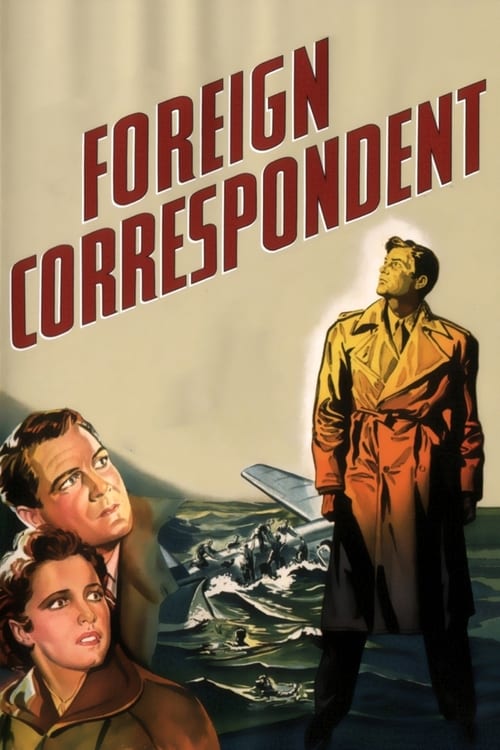
Foreign Correspondent
1940 · Alfred Hitchcock
For a rainy-night classic — when you want old-school intrigue, charm, and momentum, a thriller you can relax into that still surprises you with how modern its set pieces feel.
What it's about
A brash American crime reporter, chosen precisely because he knows nothing about politics, is shipped to Europe in 1939 to get a fresh angle on the coming war. He promptly walks into an assassination in the Amsterdam rain and tumbles into a conspiracy of spies and kidnappers, with a politician's sharp daughter and a suave English journalist pulled in alongside him — the chase running through windmills, hotels, cathedrals, and a transatlantic flight.
The experience
Fast, witty, and inventive — a ride from one bravura set piece to the next, with romance and banter keeping the mood buoyant even as the world darkens around the edges. It's suspense played as pure entertainment, with a surprisingly urgent conscience underneath.
The craft
Hitchcock conjures all of Europe on Hollywood soundstages — a sea of umbrellas at an assassination, a sinister windmill turning against the wind, a plane crash into the Atlantic that still astonishes as practical effects craftsmanship. The set pieces are little machines of suspense, each built around one indelible image.
Why it matters
Made in the anxious months before America entered the war, it doubles as an open plea for intervention — its closing radio broadcast is one of Hollywood's boldest political statements — and it helped cement Hitchcock's mastery in his new American career.
Snapshot
Alfred Hitchcock's second American film is a propulsive spy thriller built around a deliberately naïve protagonist dropped into a Europe already sliding into war. Shot almost entirely on Hollywood soundstages, it conjures Amsterdam, London, and the Atlantic with such conviction that its studio origins feel like a formal argument rather than a limitation. The film is simultaneously a bravura exercise in suspense mechanics and an explicitly interventionist political statement — unusual candor for Hollywood in the months before Pearl Harbor. Its closing radio broadcast, delivered during a simulated Blitz, remains one of the most audacious endings in the Hitchcock canon: propaganda and art fused without embarrassment.
Industry & production
The project reached Hitchcock indirectly. Producer Walter Wanger had acquired the rights to journalist Vincent Sheean's 1935 memoir Personal History but retained little more than the title and the broad premise of an American reporter awakening to European dangers. Hitchcock, newly arrived in Hollywood under contract to David O. Selznick, was loaned to Wanger's independent production company for United Artists release — an arrangement that gave him more latitude than the prestige pressure surrounding his Selznick debut, Rebecca (also 1940). The two films, released within months of each other, bracket an extraordinary year and display almost nothing in common in tone or method.
Charles Bennett, who had co-written several of Hitchcock's most important British pictures (The 39 Steps, Sabotage, The Man Who Knew Too Much), drafted the screenplay alongside Hitchcock's personal secretary and creative collaborator Joan Harrison. James Hilton — novelist of Lost Horizon and Goodbye, Mr. Chips — contributed additional dialogue, as did actor and humorist Robert Benchley, who also appears on screen as the London-based bureau chief Stebbins, lending the comic-relief passages a worn, self-aware authenticity. The result is a script of unusual tonal range: romantic comedy, procedural thriller, and anti-fascist sermon coexist without obvious seams.
Production unfolded in the summer and early autumn of 1940, precisely as the Battle of Britain intensified. That timing permeates every frame. The film was reviewed and reportedly altered after the fall of France; its final speech was added or revised close to the release date (August 1940 in the United States) to reflect the bombing of London, though the exact sequence of these revisions is not fully documented in the surviving record. What is clear is that Hitchcock and Wanger were conscious participants in the broader Hollywood movement toward interventionism, an increasingly fraught position given official American neutrality.
Technology
The film's most celebrated technical achievement is the ocean plane-crash sequence, which demanded a solution that no standard process photography could provide convincingly. Hitchcock and his effects team built a partial fuselage — just the cockpit section — on a studio stage, with large tanks of water positioned behind a breakaway windshield. Stunt players took their positions, the camera was mounted inside the cockpit looking forward, and the water was released on cue. The flooding of the lens itself records the moment of impact from within, a point-of-view that places the audience inside the disaster rather than observing it from outside. The effect is still startling. The sequence won the film an Academy Award nomination for Best Special Effects, a relatively new category established in 1939.
The Amsterdam assassination scene deploys a different but equally inventive approach. A large crowd fills the wide exterior steps of a public building; when the gunshot sounds, scores of umbrellas snap open simultaneously, transforming a mass of individual figures into an abstract field of black discs. The image works as kinetic misdirection — the umbrellas mask movement, swallow the assassin, and substitute visual chaos for narrative clarity in a way that feels simultaneously realistic and expressionist. The sequence required careful choreography of extras and camera placement and represents Hitchcock at his most architectural.
A more subtle technological note: the windmill sequence, in which the sails turn against the wind as a signal to enemy aircraft, required the effects team to reverse the mill's rotation in a way that would register as perceptible but not immediately legible to a viewer watching at normal speed — a small engineering problem with large narrative consequences.
Technique
Cinematography
Rudolph Maté, the Hungarian-born cinematographer who shot the film, brought to Hollywood a visual sensibility formed in the European art cinema of the late silent and early sound eras. He had been Carl Theodor Dreyer's director of photography on The Passion of Joan of Arc (1928) and Vampyr (1932) — two of the most formally radical films of their moment — before working across French and British productions. His collaboration with Hitchcock produces images of precise, controlled contrast: high-key light for comedy, deep shadow for menace, and a specifically architectural sense of depth in the larger set pieces. The overhead shots in the assassination sequence — a perspective Hitchcock would return to throughout his career — are among the film's most reproduced images. Maté received an Academy Award nomination for Best Cinematography (Black and White).
Editing
Otto Lovering and Dorothy Spencer edited the film under Hitchcock's close supervision. Hitchcock famously maintained that his cutting was pre-determined at the storyboard stage, leaving editors little creative latitude, though the degree to which this held in practice varied. The pacing of Foreign Correspondent is notably faster than Rebecca — scenes establish and cut away before they resolve, and chase sequences are compressed into efficient blocks of cross-cutting. The windmill sequence uses editing tempo as information: longer takes as the hero observes, rapid cuts as comprehension dawns.
Mise-en-scène / staging
The film's set design — art direction credited to William Cameron Menzies, Alexander Golitzen, and Richard Irvine — achieves the difficult feat of making studio Amsterdam, studio London, and studio The Hague feel distinct without resorting to obvious tourism. The Dutch sequences have a particular visual character: wet cobblestones, narrow sightlines, compressed vertical space. The windmill interior exploits its industrial geography — grinding gears, steep ladders, trap-doors — as a series of physical obstacles that impose choreography on the chase. The climactic meeting in the villain's office is staged with flat, undramatic lighting, the banality of the décor functioning as a moral comment on evil concealed within the ordinary.
Sound
Alfred Newman's score modulates between march-inflected urgency and a subtler, more melancholy register during the film's romantic passages. The sound design makes deliberate use of ambient noise in the assassination sequence — crowd murmur, rain — to absorb the gunshot and reinforce the chaos of the umbrellas. The closing radio broadcast abandons non-diegetic scoring entirely; the speech plays over a natural acoustic that is conspicuously raw after ninety minutes of polished Hollywood sound, and the transition to "America" playing under the final titles lands as an emotional shock precisely because the preceding silence has earned it.
Performance
Joel McCrea, cast after Gary Cooper reportedly declined the role, plays John Jones — rechristened "Huntley Haverstock" by his editor as a more marketable byline — with an open, slightly baffled decency that serves the film's ideological needs. His Americanness reads as both asset and liability: enterprising, unguarded, and periodically outmanoeuvred. Laraine Day provides romantic interest with competent restraint. The film's more flavorful performances belong to its supporting cast: George Sanders as the cynical, ultimately heroic English journalist ffolliott deploys sardonic detachment to comic and eventually affecting effect; Herbert Marshall as the seemingly idealistic peace organizer Van Meer performs with the precise blankness of a man concealing something, a quality that accrues retroactive meaning. Albert Bassermann, in the smaller role of the Dutch diplomat, received an Academy Award nomination for Best Supporting Actor. Robert Benchley's scenes as the amiably dissolute bureau man are a model of the kind of professional comedy-by-personality that Hollywood could deploy and which Hitchcock, enjoying his new surroundings, permits himself more generously here than in most of his work.
Narrative & dramatic mode
The film operates on the fish-out-of-water model Hitchcock had refined across his British spy thrillers: an amateur — here a crime reporter with no European experience and minimal sophistication — is thrust into a professional intelligence world whose rules he must learn under fire. The dramatic engine is specifically episodic; Jones moves from set piece to set piece (assassination, windmill, hotel, rooftop, conference, ocean) with each sequence generating the next through escalating revelation. The love plot with Carol Fisher (Day) is integrated into the conspiracy rather than parallel to it: her father turns out to be a traitor, which means the romantic relationship is itself an intelligence problem. This compression of personal and political stakes is one of the characteristic Hitchcock moves.
The film does not resolve all its tensions neatly. The ending is formally incomplete — the war has been acknowledged but not ended, the villains defeated locally but the larger catastrophe still unfolding. The radio broadcast that closes the film is not a resolution but a direct address, breaking the fiction. This is unusual for a Hollywood thriller of the period and signals that Hitchcock understood he was working in a moment that outpaced the conventions of the genre.
Genre & cycle
Foreign Correspondent belongs to a cycle of late-1930s and early-1940s interventionist Hollywood thrillers that includes Confessions of a Nazi Spy (1939), The Mortal Storm (1940), and Man Hunt (1941). These films emerged from a period in which the major studios were navigating official neutrality while many of their filmmakers — disproportionately European émigrés — had strong personal investments in the outcome of the European conflict. The cycle drew on the man-on-the-run spy thriller form developed in British cinema during the 1930s, a form Hitchcock himself had helped codify.
More broadly, the film contributes to the screwball-inflected adventure picture: a genre in which romantic comedy manners and espionage action share screen time without tonal crisis. This combination, managed awkwardly in many contemporary examples, is handled with relative fluency here, partly because McCrea's persona naturalizes the comedy and partly because Hitchcock had been practicing the synthesis since The 39 Steps.
Authorship & method
Hitchcock's working methods at this stage of his career centered on elaborate pre-production preparation. He storyboarded sequences in detail, worked closely with writers on structure before a word of dialogue was finalized, and approached the studio machinery — sets, lighting, extras — as a precision instrument for pre-visualised effects. His relationship with Charles Bennett, dating to the early British sound period, meant that the screenplay arrived with a particular understanding of what Hitchcock required from a narrative: clear MacGuffin mechanics, a mobile protagonist, escalating physical jeopardy, and at least one set piece built around a visually spectacular location.
The collaboration with Rudolph Maté gave the film a visual ambition that Hitchcock's subsequent work with Robert Burks (his cinematographer from Strangers on a Train through The Wrong Man) would maintain at a different register. Maté's European training in high-contrast expressionist lighting proved compatible with Hitchcock's instinct for staging, and several of the film's images bear the marks of genuine co-authorship rather than directorial dictation.
Alfred Newman's score, though functional rather than interpretive, demonstrates the resource Hitchcock could draw on in Hollywood after the more modest musical productions of his British period. The orchestral range available in the American studio system opened possibilities that later became central to his collaborations with Bernard Herrmann.
Movement / national cinema
Foreign Correspondent occupies an unusual position in the national-cinema taxonomy. It is a Hollywood film made by a British director, funded by an independent American producer, starring a predominantly Anglo-American cast, and set almost entirely in Europe — specifically Western Europe under threat of fascist takeover. Hitchcock's transition from British to American cinema is typically periodised as a clean break, but the film complicates this: it is structured around the British thriller conventions he had developed, populated by British character actors (Marshall, Sanders), and filtered through a distinctly English irony about American ingenuousness.
At the same time, it is not a British film. Its politics are American-interventionist in a way that British cinema — already at war — did not need to argue; its comic register deploys a specifically American brand of wisecracking; and its final appeal is to American audiences to wake up. The film is best understood as a transitional work, one in which Hitchcock had not yet fully calibrated his new industrial and cultural environment but was already exploiting it for scale.
Era / period
The film's release in August 1940 places it at the pivot point of the Second World War's first full year. France had fallen in June; the Battle of Britain was underway; the United States remained officially neutral under the Neutrality Acts even as public opinion shifted. Hollywood was simultaneously under pressure from isolationist legislators (the Senate would hold hearings on alleged studio war-mongering in 1941) and home to a substantial émigré community of directors, writers, and actors with direct knowledge of what was happening in Europe. Foreign Correspondent is a document of this suspended moment: urgently political, formally genre-bound, and conscious that events were outrunning its own narrative.
Themes
The film's central thematic concern is the vulnerability of democratic institutions to manipulation by those who have learned to speak their language. Van Meer (Edmund Gwenn in a role often confused; the Dutch diplomat is actually played by Albert Bassermann while Van Meer is played by the great character actor Edmund Gwenn — a detail worth clarifying: the peace advocate Van Meer is played by Albert Bassermann and the hired impostor/assassin is played by a double, while the villain Fisher is played by Herbert Marshall) — the peace-movement infrastructure is revealed as cover for enemy intelligence operations. Idealism is weaponized; the rhetoric of negotiation and goodwill is precisely the camouflage that fascism requires. This is the film's darkest perception, and it is delivered without satire or irony: Hitchcock plays it straight.
A secondary theme concerns the epistemology of journalism — what a reporter can know, what counts as evidence, and the relationship between personal experience and publishable truth. Jones is dismissed repeatedly because he has seen something that nobody will corroborate; the film is structurally about the difficulty of making evidence legible to authority. This preoccupation with the credibility gap between witness and institution recurs throughout the Hitchcock canon.
Reception, canon & influence
Backward: influences on the film. The film draws directly on Hitchcock's own British thriller cycle — particularly The 39 Steps (1935) and The Lady Vanishes (1938) — in its combination of naïve hero, romantic double-act, and espionage conspiracy. Fritz Lang's German thrillers of the early sound period (M, Spies) contributed to the visual grammar of crowd scenes and surveillance. The screwball comedy tradition, at its peak in the late 1930s, supplied the idiom of romantic antagonism that McCrea and Day deploy. The journalistic adventure picture — a popular Hollywood form of the 1930s with examples across the major studios — provided the professional framework.
Critical reception. The film was received with substantial enthusiasm on release. Critics noted its technical virtuosity, particularly the crash sequence, and its explicit political commitments. It received six Academy Award nominations: Best Picture, Best Supporting Actor (Albert Bassermann), Best Cinematography (Rudolph Maté), Best Art Direction, Best Original Screenplay (Bennett and Harrison), and Best Special Effects — the last of which it won. Rebecca was the prestige Hitchcock of that season, and Foreign Correspondent has often been treated as the second-order achievement, but this hierarchy reflects the award results more than the quality of the filmmaking. In several respects — formal ambition, tonal range, structural assurance — it surpasses Rebecca.
Forward: legacy. The film's influence operates on several levels. Its set-piece construction — each sequence built around a specific location and a specific visual conceit — anticipates the anthology structure of the postwar Bond films and the broader tradition of globe-trotting espionage cinema. The ocean crash sequence was referenced and imitated in subsequent disaster and war films through the 1940s and beyond. The concept of the reluctant amateur thrust into professional espionage, refined here to a high degree, became a genre template; it runs through North by Northwest (1959), Hitchcock's own most polished version of the formula, and outward through three decades of spy cinema.
More broadly, Foreign Correspondent represents an early model of the politically committed Hollywood genre film — entertainment that does not apologize for its ideological content but builds it into narrative structure. That this approach was possible in 1940, in the ambiguous political climate of pre-war Hollywood, and that it produced a film both commercially and critically viable, is a historical fact that influenced subsequent filmmakers working in similar modes. The closing radio broadcast, in particular, has been studied as an example of how genre cinema can shed its fictional frame and speak directly to an audience without losing its accumulated authority.
A Deleuzian reading
Start with the windmill.
The full Deleuzian reading of Foreign Correspondent →
Reception
A hit in 1940 with six Oscar nominations including Best Picture — which it lost to Hitchcock's own Rebecca, released the same year. It's spent decades in Rebecca's shadow, but cinephiles now routinely rank it among the best of his British-to-Hollywood transition, powered by a handful of all-timer set pieces.
How Foreign Correspondent was received, from release to now →
Influences: the films it descends from and the films it influenced
- The 39 Steps (1935) — Charles Bennett's screenplay architecture — MacGuffin mechanics, mobile amateur male protagonist, comic romantic antagonism as jeopardy substitute — is directly transposed into Foreign Correspondent's narrative chassis without structural modification.
- The Man Who Knew Too Much (1934) — Bennett's set-piece-around-landmark method — one spectacular public venue, one concealed act of violence, suspense derived from the spectator's superior knowledge — established the formula the Royal Albert Hall sequence proves and Foreign Correspondent's windmill and crash sequences scale.
- Sabotage (1936) — The Bennett collaboration's deployment of diegetic ambient sound as narrative misdirection — the cinema and bus sequences — establishes the technique Foreign Correspondent applies to the windmill's mechanical clattering and the closing radio broadcast.
- M (1931) — Lang's overhead shot as crowd-surveillance instrument and expressionist high-contrast lighting for suspense in public spaces are absorbed directly into the assassination-in-the-rain sequence and the umbrella-mass choreography staging.
- Spies (1928) — Lang's proto-espionage visual grammar — institutional headquarters as spatial obstacle, parallel cutting between agent and quarry, physical performance under bureaucratic constraint — furnishes Foreign Correspondent's embassy corridors and windmill interior staging.
- It Happened One Night (1934) — Established the screwball template of hostile romantic antagonism softening under shared physical ordeal, which McCrea and Day's dynamic inherits wholesale as the film's tonal counterweight to thriller mechanics.
- Saboteur (1942) — Hitchcock transferred the amateur-falsely-accused-in-espionage structure to American national geography, using the Statue of Liberty's armature as industrial landmark for a climactic set piece — the same method of staging jeopardy in monument-as-obstacle that the windmill sequence established.
- North by Northwest (1959) — Hitchcock's definitive elaboration of the reluctant-amateur-into-espionage formula, with storyboard-predetermined set pieces — crop duster, Mount Rushmore — that systematize and scale what Foreign Correspondent's windmill and ocean crash established as repeatable method.
- Dr. No (1962) — Converts Foreign Correspondent's set-piece anthology structure — each segment built around a specific location with a dedicated visual conceit — into franchise template, with globe-trotting geography as the primary dramatic architecture rather than incidental setting.
- Blow-Up (1966) — The photographer-protagonist whose professional recording apparatus becomes inadvertent surveillance radicalizes Foreign Correspondent's journalist-as-accidental-spy conceit, while ambient diegetic sound as evidence that misdirects rather than confirms drives the sound-as-misdirection device to ontological crisis.
- Z (1969) — Deploys the journalist-investigator as protagonist in a genre thriller explicitly committed to political intervention, shedding fictional frame to address political reality directly — the propaganda-art fusion mode Foreign Correspondent's closing radio broadcast inaugurated as structural possibility.
- The Conversation (1974) — Elevates Foreign Correspondent's diegetic ambient sound-as-misdirection into the film's total formal and narrative subject: a surveillance professional whose own recording deceives him, converting Hitchcock's technique into self-consuming structure.
- Three Days of the Condor (1975) — Analyst-as-amateur-spy thrust into professional intelligence jeopardy with urban architecture staged as obstacle terrain — Foreign Correspondent's amateur-in-the-machine formula transposed into Cold War institutional geography and bureaucratic paranoia.
- All the President's Men (1976) — Journalist protagonist whose reportorial methodology functions as spy-craft substitute in political thriller, with institutional architecture — parking garages, newsroom floor, government corridors — staged as obstacle geography in the mode Foreign Correspondent established for journalism-as-intelligence work.
- Gilda (1946) — Maté shot this Hitchcock thriller five years before Gilda, developing the high-contrast chiaroscuro shadow architecture and diagonal-line interior staging that he carries directly into Gilda's noir visual grammar; the specific technique of illuminating a face from one acute angle while leaving the surrounding space in deep shadow is a throughline between the two films.
- The Stranger (1946) — Models the wartime spy-thriller suspense set-piece around mechanical architecture (the windmill, the tower fall) that The Stranger reworks as its lethal clock mechanism.
- The Mask of Dimitrios (1944) — Models the literate, politically-aware continental spy-thriller in which espionage is conveyed through conversation and atmosphere over set-piece spectacle.
- Lifeboat (1944) — The clipper ditching and survivors clinging to a floating wing is the literal prototype — Hitchcock already testing the tank, the unstable horizon, and suspense built on a shrinking piece of floating debris.
- His Girl Friday (1940) — Released the same year, it deploys the journalist-as-professional-armature framework and screwball romantic rivalry as identical generic synthesis — Hawks's overlapping-dialogue solution versus Hitchcock's staggered-suspense solution to the same formal problem.
Similar films
- The Conversation (1974) — influence & lineage · often watched together
- North by Northwest (1959) — influence & lineage
- The 39 Steps (1935) — influence & lineage
- His Girl Friday (1940) — influence & lineage
- Z (1969) — influence & lineage
- Rear Window (1954) — shared sensibility
- Notorious (1946) — shared sensibility
- Lifeboat (1944) — shared sensibility
All the films related to Foreign Correspondent →