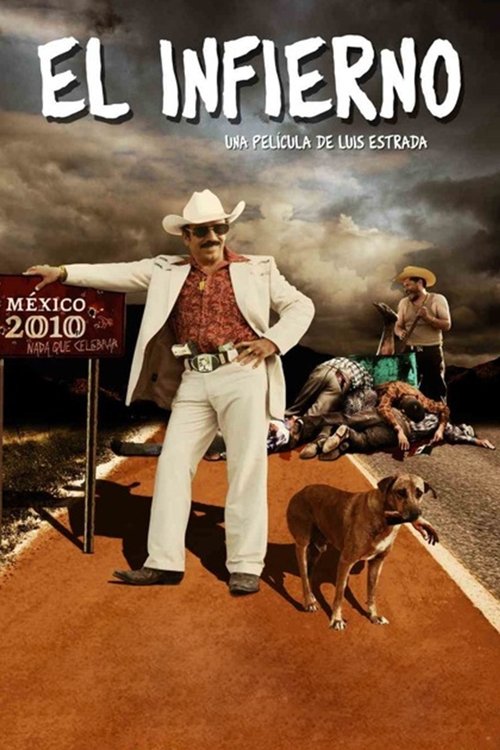
El Infierno
2010 · Luis Estrada
When you want a film with teeth — dark comedy that's actually about something, for a night when you can stomach violence in service of fury. Emphatically a challenge, not a comfort watch.
What it's about
After twenty years working in the United States, Benny García is deported back to his Mexican hometown — and finds it hollowed out: his brother dead, every honest trade gone, the whole economy run by a drug cartel. With no other way to survive, Benny joins the business, and the film follows his rise through the trade as a pitch-black comedy about a country celebrating its bicentennial while the drug war eats it alive.
The experience
Savage and funny in the same breath — it plays like a western crossed with a satire, where the jokes keep landing right up until they curdle into horror. Long, violent, and deliberately excessive; you laugh, then feel implicated for laughing.
Performances
Damián Alcázar anchors the film as Benny, playing the everyman's slide from decency to complicity with a hangdog charm that makes the satire sting.
The craft
Luis Estrada stages the drug war as bitter carnival — narco baroque excess, kitsch shrines, gaudy violence — with the scope of an epic and the timing of a farce. Released against Mexico's official bicentennial festivities, every frame is built as a furious inversion of national self-celebration.
Why it matters
The most incendiary panel of Estrada's trilogy of political satires, it became a cultural event in Mexico — a mainstream film saying out loud, during a state celebration, what the drug war had actually done to the country.
Snapshot
El Infierno is a Mexican black comedy of the drug war, staged as a bitter carnival for the country's bicentennial. Deported after twenty years in the United States, Benjamín "El Benny" García returns to his home town of San Miguel Narcángel to find his brother dead, the local economy captured entirely by the cartels, and no honest livelihood left standing. He drifts into the trade himself, rises, and is destroyed by it, the arc completing in a cycle that hands the gun to the next generation. Directed and co-written by Luis Estrada, the film arrived in September 2010, timed against the official festivities marking two hundred years of Mexican independence, and it functions as a sustained, furious inversion of national self-celebration. It is the third and most incendiary panel of Estrada's loose trilogy of political satires, following La Ley de Herodes (1999) and Un mundo maravilloso (2006). Anchored by Damián Alcázar in the lead and Joaquín Cosío as the cartel enforcer "El Cochiloco," it became one of the most decorated and most argued-over Mexican films of its decade.
Industry & production
The film was produced through Estrada's own production apparatus (Bandidos Films) in association with the Mexican state film bodies — the sort of IMCINE/CONACULTA-adjacent public-funding structure that supports a large share of Mexican auteur cinema. That financing is central to the film's public story: a savage satire of the state's failure in the drug war, made partly with state money and released into the middle of the state's bicentennial pageant, drew immediate charges of hypocrisy and biting-the-hand controversy from various quarters. Estrada was, by 2010, an established name precisely because of this friction; La Ley de Herodes had itself become a landmark case of a film nearly buried by the political establishment it mocked.
The project's title history is part of the record: the film was widely reported to have been developed under the working title El Narco before being released as El Infierno, a change generally read as a distancing gesture around its subject and the sensitivities of a bicentennial release. The picture ran long for a satire — roughly two and a half hours — signaling an intent toward the epic and the panoramic rather than the tight genre exercise. Exact budget and box-office figures I won't assert here, as I cannot confirm reliable numbers; what is firmly established is that the film performed strongly enough in Mexican release, and gathered enough awards momentum, to become a reference point in national conversation about narco-cinema.
Technology
El Infierno is a conventionally produced theatrical feature of its moment, shot for widescreen presentation and finished for standard 2010 distribution. The specific capture format — whether photochemical 35mm or a digital system, and the particulars of the digital intermediate — I cannot confirm from memory, so I will not specify it. What the technology serves is legible on screen: a broad, sun-bleached widescreen frame built for dusty small-town exteriors, cartel compounds, and highway spaces, with the picture's scale used to hold the town and its landscape as a full social world rather than a backdrop. Nothing about the film's technological approach is experimental; its ambition is representational and satirical, and the tools are deployed toward a polished, accessible commercial surface that makes the escalating violence land harder against its glossy naturalism.
Technique
Cinematography
The photography — credited to Damián García — leans on a hard northern-Mexican palette: dust, sun, ochre and brown, the visual vocabulary of the border Western transplanted into contemporary narco territory. The framing favors a certain deadpan clarity, letting absurd and brutal events play out in composed wide shots so that the comedy and the horror share the same unhurried image. Where I cannot confirm specific lens or lighting choices, I'll note the general strategy instead: the film's look is naturalistic enough to read as reportage yet stylized enough — in its landscapes and its stagings of ritual violence — to carry the mythic, Western register the satire needs.
Editing
The most consequential editorial fact is duration and shape. At roughly 145 minutes, the film is built as a rise-and-fall epic, patiently accumulating episodes as El Benny climbs and then chronicling the machinery of his undoing. The cutting has to modulate between broad comic set-pieces and sudden, graphic brutality, and the film's tonal signature depends on that management of rhythm — jokes and executions edited into uncomfortable proximity. I cannot confirm the editor's name from memory and will not invent an attribution.
Mise-en-scène / staging
Estrada builds a complete satirical microcosm in the fictional town of San Miguel Narcángel, whose very name folds "narco" into the language of provincial Mexican Catholicism. The town is dressed as a place where the cartel is simply the economy: the church, the local officials, the businesses, the fiestas all orbit the trade. Production design and staging lean into iconography — narco excess, religious kitsch, patriotic bunting — so that the bicentennial's national symbols and the cartel's symbols keep colliding in the same frame. The staging of communal rituals (parties, funerals, celebrations) as sites of casual violence is the film's central mise-en-scène idea.
Sound
The soundscape is saturated with the music of the milieu — the corrido and narcocorrido tradition that both narrates and glamorizes cartel life — used pointedly, so that the songs comment on the action with the same doubled edge (celebration and indictment) that governs the whole film. I cannot confirm the composer of any original underscore and won't name one; what is safe to say is that the film's aural identity is driven substantially by this vernacular regional-Mexican music rather than by a conventional symphonic score, and that gunfire and fiesta are mixed to keep bleeding into one another.
Performance
Performance is where the film's tonal tightrope is walked. Damián Alcázar plays El Benny as a fundamentally ordinary man — bewildered, decent by default, corruptible by circumstance — so that his descent reads as everyman tragedy rather than villain origin. Joaquín Cosío's El Cochiloco is the film's great grotesque: garrulous, philosophical, monstrous and weirdly likable, a figure who articulates the trade's fatalistic code. Elizabeth Cervantes anchors the film's domestic and romantic dimension. The ensemble is directed to play the absurdity straight, never winking, which is what allows the comedy to curdle into genuine dread.
Narrative & dramatic mode
The dramatic mode is picaresque tragicomedy — a naïf's journey through a corrupt world, structured as a rise-and-fall crime epic but shot through with black satire. The engine is dramatic irony: the audience always understands what the trade will cost before El Benny does, and the film's comedy is largely the comedy of a man rationalizing each step deeper. The narrative arc is explicitly cyclical rather than redemptive. It closes not on catharsis but on continuation — the violence passing to the young, the machine resetting — which converts the personal tragedy into a structural, national verdict. The bicentennial framing operates as an ironic chorus: two hundred years of independence measured against a town owned by cartels.
Genre & cycle
The film is a deliberate hybrid — narco-crime drama fused with the deported-man-returns Western and driven by black comedy. It sits squarely inside the "narco cinema" wave that expanded across Mexican film and television as the country's drug war intensified after 2006, but it distinguishes itself from the exploitation end of that cycle (the direct-to-video narcopelícula tradition) by its satirical ambition and its refusal to glamorize. Its Western DNA is structural: an exile crosses back into a lawless frontier town and is remade by its code. Within Estrada's own filmography it belongs to a personal cycle of state-of-the-nation political satires, extending the method of La Ley de Herodes from party-machine corruption to the narco-state.
Authorship & method
Estrada is the film's clear author. His method across the trilogy is to take a load-bearing institution of Mexican life — the PRI, the promise of economic modernity, and now the drug war and the state's response to it — and stage its failure as farce that hardens into tragedy. The screenplay is credited to Estrada with Jaime Sampietro; the writing is built around a naïve protagonist whose journey exposes every level of a rotten system, a satirical device Estrada reuses deliberately. His key on-screen collaborator is Damián Alcázar, who had already served as Estrada's satirical everyman in La Ley de Herodes and Un mundo maravilloso; that continuity of actor-and-director is itself a signature, letting the trilogy feel like successive chapters observed through the same ordinary face. On the craft side, cinematographer Damián García supplies the film's Western-inflected look. For the composer and editor I cannot supply confirmed names and decline to guess; the film's musical identity, in any case, is carried heavily by its diegetic corrido tradition, which functions as authorial commentary in its own right.
Movement / national cinema
El Infierno belongs to a specific current in twenty-first-century Mexican cinema: politically engaged, commercially viable auteur filmmaking that uses genre to interrogate the state. It is separate from the international art-house lineage of the "Three Amigos" (Cuarón, del Toro, Iñárritu) and closer to a domestically oriented tradition of satire and social realism aimed primarily at a Mexican audience and Mexican institutions. Its production through public film bodies places it inside the ongoing debate about what state-supported national cinema is for — and the film weaponizes that position, turning public money into a public indictment. It is also a central artifact of the narco-cinema surge, and one of the works most often cited when that phenomenon is discussed as culture rather than exploitation.
Era / period
The film is inseparable from its exact moment: 2010, the bicentennial of independence (and centennial of the Revolution), and the depths of the militarized drug war launched under President Felipe Calderón from late 2006 onward. The mounting death toll, the army's deployment against cartels, and the visible capture of towns and institutions by organized crime form the film's real-world substrate. Releasing this particular story during the official year of national celebration was the film's defining provocation — a deliberate counter-programming of grief and satire against pageantry. The film reads, in retrospect, as one of the era's sharpest cinematic responses to the guerra contra el narco.
Themes
The governing theme is the corruption of an entire social order — the argument that in the narco-state there is no "outside" to the trade, no clean choice available to an ordinary person, and thus no individual moral escape. Around this sit the film's recurring concerns: the collapse of the Mexican promise (independence, revolution, modernity) into violence and impunity; the collusion of church, state, and cartel; masculinity and violence as an inherited script; and cyclicality — the way the system reproduces itself in the young. Migration and deportation frame the whole: El Benny is a man with nowhere that will have him, expelled from the north and swallowed by the south. The bicentennial motif turns all of this into a single ironic question about what, after two hundred years, the nation actually amounts to.
Reception, canon & influence
Critically and within the industry, El Infierno was received as a major, provocative work. It swept a large share of the 2011 Ariel Awards (Mexico's national film honors), taking top prizes including recognition for the film and its lead and supporting performances; I'll flag that while the film's dominance at that ceremony is well established, I won't enumerate the exact category-by-category tally beyond what's certain, to avoid misattribution. Its public reception was inseparable from controversy — over its state financing, its bicentennial timing, and its unsparing portrait of the drug war — which amplified its visibility and cemented its status as a talking point beyond film circles.
Looking backward, the film's influences are legible: Estrada's own satirical trilogy and the broader Mexican tradition of political black comedy; the American and Mexican Western, especially the returning-exile frontier tale; and the vast vernacular archive of the narcocorrido, which the film both draws on and critiques. Looking forward, El Infierno became a reference point for the subsequent wave of narco-themed Mexican and international screen storytelling, a benchmark for treating cartel violence satirically rather than as pure genre spectacle, and a recurring case study in debates about narco-cinema and about what publicly funded national cinema may say about the state that funds it. Its clearest legacy is that combination — a commercially potent, award-laden crowd-pleaser that is also a direct political indictment — which is precisely the balance Estrada had been refining across his career and brought to its harshest expression here.
Reception
A scandal at home in 2010 — bicentennial-funded, government-denounced, slapped with Mexico's adults-only C rating — it still broke box office records and swept the Ariels; abroad it flew under the radar for years before becoming a word-of-mouth 'best narco film you haven't seen' discovery.
How El Infierno was received, from release to now →
How to watch El Infierno: what to notice on a first viewing
- Notice the dust and ochre color washing every scene. Cinematographer Damián García shoots the town in the hard sun and brown dust of a border Western, the same palette whether the scene is a fiesta or a killing. The look stays consistent no matter what happens, which is part of the joke and the horror.
- Watch violence and comedy play out in the same wide shot. Estrada keeps the camera composed and unhurried for both a joke and a killing, refusing to change registers visually even when the tone underneath shifts completely. The steadiness of the image is what lets comedy and brutality sit this close together.
- Track the religious icons and cartel insignia sharing a frame. Church statues, patriotic bunting, and narco excess are staged so they visually crowd each other in the same shots, church, state, and trade openly overlapping. The town's decoration argues that these three things were never actually separate.
- Listen for a corrido song commenting on the scene. Ballads from the narcocorrido tradition play under the action, songs that both celebrate and narrate cartel life at the same time the images show its cost. The music is doing two things at once, glamorizing and indicting, and never quite resolves which.
- Watch how likable the film makes its most violent character. Joaquín Cosío plays El Cochiloco as talkative, philosophical, and strangely warm, never letting the character's menace cancel out his charm. You end up enjoying a character the film is also asking you to be afraid of.
The whole guide to watching El Infierno, with the keys for a rewatch →
Influences: the films it descends from and the films it influenced
- La Ley de Herodes (1999) — First panel of Estrada's trilogy that invents El Infierno's core device — a naïve small-timer who ascends a rotten institution — and casts Damián Alcázar's ordinary face as the moral test-strip through which the corruption is measured.
- Un mundo maravilloso (2006) — Second panel that carries forward the deadpan satirical framing of a Mexican national promise collapsing into farce, again routing the indictment through Alcázar's everyman as conduit.
- Los olvidados (1950) — Bequeaths the unsentimental Mexican fatalism in which the social system, not individual vice, drives a cyclical descent and clamps shut with an ironic ending that traps the protagonist.
- El ángel exterminador (1962) — Model for staging the story as a satirical microcosm — a confined social order whose absurd rituals expose an entire nation in miniature.
- Vámonos con Pancho Villa (1936) — Founding template for the film-as-corrido, using ballad structure and revolutionary betrayal to convert heroic myth into disillusioned, cyclical tragedy — the mode El Infierno turns on the narcocorrido.
- The Wild Bunch (1969) — Supplies the returning-outlaw-crosses-into-Mexico frontier archetype and the elegiac, ritualized slow-motion bloodletting that Estrada restages as narco-war spectacle.
- Bring Me the Head of Alfredo Garcia (1974) — Bequeaths the seedy Mexican-underworld road picaresque in which a small man chases cartel-style money toward doom amid corrido-scored squalor.
- Once Upon a Time in the West (1968) — Source of the deadpan widescreen frontier compositions and operatic, ironic mythmaking that Estrada's dusty border palette and long held wide shots directly quote.
- Scarface (1983) — Template for the returnee's operatic rise-and-fall through the drug economy — the arc of ascent, excess, and annihilation the naïve protagonist is made to follow.
- La dictadura perfecta (2014) — Later Estrada that extends the identical method — indicting one load-bearing Mexican institution (media–political collusion) through escalating black farce that hardens toward tragedy.
- Sicario (2015) — Continues the border-western visual lineage with sun-scorched, wide frontier compositions that frame the drug war as a lawless frontier zone.
- No Country for Old Men (2007) — Shares the deadpan border-western grammar: laconic wide desert framing and drug-money violence rendered with dry, fatalistic irony rather than genre thrill.
- Fargo (1996) — Sibling in the tonal engine El Infierno runs on — crime staged as absurd regional farce whose comedy curdles into moral tragedy across deadpan wide landscapes.
- Miss Bala (2011) — From the same 2010–11 narco-cinema wave, built on the innocent swept helplessly through the interlocked cartel-and-state machinery.
- Heli (2013) — Extends the drug-war microcosm into a single ordinary family, sharing the deadpan-wide observation of cartel violence as banal, ambient state reality.
- Machete (2010) — Extends the grotesque, over-cranked satire of cartel–state corruption with cartoonish excess, working the same broad grotesque register as Cosío's performance.
Similar films
- Herod's Law (1999) — influence & lineage
- The Young and the Damned (1950) — influence & lineage
- The Exterminating Angel (1962) — influence & lineage
- No Country for Old Men (2007) — influence & lineage
- Bring Me the Head of Alfredo Garcia (1974) — influence & lineage
- Y Tu Mamá También (2001) — shared sensibility
- The Executioner (1963) — shared sensibility
- Wild Tales (2014) — shared sensibility