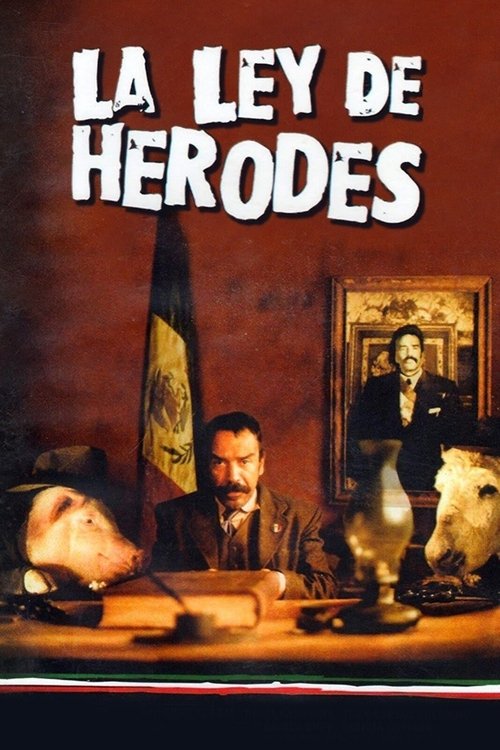
Herod's Law
1999 · Luis Estrada
For when you want a political satire with real teeth — comedy that's angry underneath and leaves a mark. Not a comfort watch; reach for it when you're in the mood to laugh darkly at power and come away with something to argue about.
What it's about
In 1949, a dusty Mexican backwater has buried three mayors in quick succession, so the ruling party installs a nobody — a mild-mannered junkyard caretaker named Juan Vargas — as the next disposable municipal president. Armed with a copy of the Constitution, a pistol, and a head full of party slogans about modernity and social justice, he arrives believing he can fix the town. What follows is his education in how power actually works, surrounded by opportunists, hypocrites, and criminals who all know the rules better than he does.
The experience
It plays as broad, sun-baked comedy that keeps curdling into something nastier — you laugh, then catch yourself, because the joke is always on how casually corruption becomes normal. The tone is cynical and gleeful at once, and it builds a slow-motion moral collapse you can't look away from.
The craft
The film works as a fable: one invented town stands in for a whole political system, and the writing methodically escalates each small compromise into the next bigger one. Its power is in structure and tone — the way farce and menace share every scene — rather than spectacle.
Why it matters
A landmark of Mexican political cinema, famous for daring to name the ruling party's corruption outright at the end of its seven-decade grip on power, and a defining work of Luis Estrada's career as Mexico's premier political satirist.
Snapshot
Herod's Law (La ley de Herodes) is a corrosive political satire from Mexican director Luis Estrada, set in 1949 in the invented backwater of San Pedro de los Saguaros. Its premise is a fable of institutional rot: after the town's mayors keep turning up dead, the ruling party installs Juan Vargas — a mild, ambitious junkyard caretaker — as the disposable new municipal president, arming him with a copy of the Constitution and a pistol and promising him the machinery of "modernity and social justice." Vargas begins as a naïf who genuinely believes the party's slogans and ends as a swindler, extortionist and killer, his moral collapse presented as the logical output of the system rather than a personal failing. The film's title comes from a crude Mexican proverb — roughly, o te chingas o te jodes, you're either the one doing the screwing or the one getting screwed — which functions as its entire political thesis. Beyond its merits as comedy, Herod's Law is historically important as one of the first Mexican fiction films to name the Partido Revolucionario Institucional (PRI) directly and mock it by name, and its near-suppression by state cultural institutions in 1999 turned it into a landmark case about censorship at the twilight of seven decades of one-party rule.
Industry & production
The film was produced through Estrada's own company, Bandidos Films, with the participation of Mexico's state film apparatus — the national film institute IMCINE and the public production fund then associated with CONACULTA (the Foprocine/Fidecine sphere of late-1990s state financing). That co-production arrangement is the crux of the film's notoriety: the Mexican state had helped finance a picture that savaged the ruling party, and when officials grasped what they had funded, elements of the cultural bureaucracy attempted to keep it from being seen. The most widely reported episode is that the film was pulled or blocked from its intended premiere at a major national festival showcase in 1999, prompting a public outcry from filmmakers and press who framed it as political censorship. Estrada and his collaborators went public, the dispute became front-page cultural news, and the film ultimately reached theaters — its release now inseparable from the story of its near-burial. The precise administrative sequence (which official ordered what, on which dates) is reported variably in secondary accounts, and I won't reconstruct specifics I can't verify; the essential, well-established fact is that a state-funded satire of the PRI was very nearly suppressed by state cultural authorities and was rescued largely by publicity.
The timing amplified everything. The film appeared in 1999–2000, as the PRI faced the election that would, in July 2000, end its unbroken hold on the presidency with the victory of Vicente Fox. Herod's Law was received not merely as a period comedy but as a document of, and contributor to, that political opening.
Technology
Herod's Law is a conventionally shot late-1990s 35mm feature; there is nothing technologically avant-garde about its capture or finishing, and the record does not indicate any notable use of digital tools, which were only beginning to enter Mexican production at the time. Its technical ambition lies not in apparatus but in art direction — the reconstruction of a 1940s rural municipio on a modest budget. The "technology" that matters here is period-craft: vintage vehicles, weapons, telephones, currency, party propaganda and municipal furnishings assembled to make the fictional town read as a specific historical moment. Any claim about lab processes, aspect ratio specifics, or lenses would be speculation, so I note only that the film's technical profile is that of a well-mounted but not experimentally engineered production.
Technique
Cinematography
The photography (credited, to the best of the record, to Norman Christianson) serves the satire through a sunbaked, dust-toned realism rather than stylization. San Pedro is rendered as arid, sparse and unglamorous — earth, adobe, harsh daylight — a visual plainness that lets the absurdity of the politics play against an unironic, "documentary" backdrop. The camera generally favors legible, classical coverage that keeps the ensemble's scheming visible; the comedy is staged and framed to be read clearly rather than fragmented. Where the film wants menace, it leans on the flat cruelty of open light and empty space, the isolation of a town no one is coming to save.
Editing
The cutting follows a picaresque escalation: a series of discrete encounters — with the priest, the doctor, the brothel madam, the Indigenous townspeople, the party bosses, a stranded American — each of which ratchets Vargas one notch further into corruption. The editorial rhythm is comic and cumulative, building on repetition (each new shakedown a variation on the last) until the accumulation itself becomes the argument. The film is feature-length (roughly two hours) and paced as a downward spiral rather than a plotted thriller.
Mise-en-scène / staging
Production and costume design do heavy thematic work. The municipal office, with its portrait of the nation's leaders and its dog-eared Constitution, becomes a stage for the gap between revolutionary rhetoric and predatory practice. Props are weaponized as motifs: the pistol and the little red Constitution that Vargas is handed early function as twin instruments of "the law," and the film stages their use — the book as pretext, the gun as enforcement — as interchangeable. The brothel, the church and the party headquarters form a triangle of complicit institutions, and Estrada blocks scenes to show how easily Vargas moves among them.
Sound
The soundscape is grounded and naturalistic — a provincial town's ambience — punctuated by a score that underlines the film's dark-comic register. I can't reliably attribute the composer credit and won't guess; the salient point is that the music and sound support satire rather than pathos, keeping the audience oriented to the absurdity even as the violence turns real.
Performance
The film belongs to Damián Alcázar, whose Juan Vargas is a masterclass in graduated transformation. He begins with the soft, eager body language of a small man handed importance, and Alcázar lets the corruption enter incrementally — a new suit, a harder mouth, a growing ease with cruelty — so that there is never a single moment of turning, only a man becoming what the office requires. The performance is calibrated to keep Vargas pitiable and monstrous at once. The surrounding ensemble plays broad archetypes with precision: the compromised priest, the cynical doctor, the party superiors who speak in slogans, the world-weary madam, and the outsiders (including a role for filmmaker Alex Cox as a gringo passing through). Pedro Armendáriz Jr. lends institutional weight to the party hierarchy. Salma Hayek is generally reported to appear in a small role; I flag that as widely stated rather than something I can independently confirm here.
Narrative & dramatic mode
The dominant mode is the picaresque descent — a lowly, roguish everyman rising through a corrupt society and being deformed by it. Structurally the film is closer to a moral fable or exemplum than to a whodunit, despite the genre tag of mystery: the unsolved murders of prior mayors are a device establishing the office as a death trap, not a puzzle to be cracked. Dramatic irony saturates every scene — the audience always understands the machinery Vargas is only slowly learning to operate — and the tone is that of black comedy curdling into tragedy. The Constitution and the party's language of "justice" function as recurring ironic refrains, invoked precisely at the moments of greatest injustice.
Genre & cycle
Herod's Law sits at the intersection of political satire, black comedy and crime film, with a strong strain of the Latin American "dictator/caudillo" tradition transposed to the municipal scale. It belongs to a lineage of Mexican cinema critical of official power, but it broke a specific taboo by naming the PRI and dramatizing its methods without allegorical cover. Within Estrada's own work it is the founding entry of an informal trilogy on Mexican political corruption, later extended by Un mundo maravilloso (2006) and El infierno (2010), each escalating the satire toward the present day. The film thus reads both as a period piece and as the opening statement of a career-long project.
Authorship & method
Estrada is the film's driving authorial intelligence, working as director and co-writer. The screenplay is a collaborative document credited to Estrada with co-writers — accounts name Jaime Sampietro and Fernando León among them, and the veteran novelist-screenwriter Vicente Leñero is frequently listed as a contributor, which would place Herod's Law within Leñero's broader body of politically pointed Mexican screenwriting; I present the Leñero attribution as reported rather than as something I can verify with certainty. Estrada's method here is satire built on specificity — real party iconography, recognizable political language, a precisely dated setting — which is exactly what made the film dangerous to its funders. His long partnership with Damián Alcázar begins to define his cinema in this film; Alcázar becomes the recurring face of Estrada's Mexico across the trilogy. On the craft side, the cinematography credit (Norman Christianson) and the film's art direction are the most consequential collaborations; I'll refrain from asserting editor and composer credits I cannot confirm, and note that the granular below-the-line record is thin in accessible sources.
Movement / national cinema
The film is a key artifact of the "Nuevo Cine Mexicano" resurgence that crested around 1999–2001, the same wave that produced the international breakthroughs of Amores perros (2000) and Y tu mamá también (2001). Where those films redefined Mexican cinema's global image through urban energy and formal daring, Herod's Law represents the movement's directly political wing — cinema as intervention in national reckoning. Its significance to national cinema is inseparable from its censorship saga: it became a test case for whether state-funded Mexican film could criticize the state, and its survival was read as evidence of a loosening grip. Few films so cleanly embody the moment when Mexican cinema and Mexican politics were simultaneously breaking with the old order.
Era / period
The film is set in 1949 but speaks unmistakably to 1999. The choice of the mid-century, the height of PRI consolidation, lets Estrada present the party's founding self-image — revolution institutionalized, order and progress — and then demolish it, implying continuity across the intervening half-century. Made and released at the very end of the one-party era, the film functions as a retrospective indictment delivered at the exact hinge of change: a look back at the system's origins issued just as that system was about to lose the presidency. The doubled temporality — 1949 subject, 2000 audience — is central to its meaning.
Themes
The governing theme is that corruption is systemic and self-perpetuating rather than a matter of individual vice: the office corrupts whoever holds it, and idealism is not protection but fuel. Adjacent themes include the cynical instrumentalization of law and constitution as tools of power; the collusion of church, commerce, sexuality and state; the exploitation of Indigenous and poor rural communities by a predatory bureaucracy; and the seductive logic of o te chingas o te jodes — a social order in which the only choices offered are to victimize or be victimized. The film also probes national mythology, dismantling the PRI's revolutionary rhetoric of justice and modernity by showing it as a mask for extraction. Its bleak conclusion is that reform-minded innocence, absent structural change, simply produces more capable predators.
Reception, canon & influence
Critically, the film was received as a bracing, taboo-breaking satire, and the censorship controversy dramatically raised its profile; it became a cultural cause célèbre precisely because authorities tried to bury it. Damián Alcázar's central performance was widely praised, and the film was recognized within Mexico's national awards ecosystem, the Ariel Awards, where it and its lead were honored — I note the recognition in general terms rather than tallying specific wins, which vary in secondary accounts. Backward, the film draws on the Latin American literature and cinema of the caudillo and on a picaresque, moral-fable tradition, filtered through a very Mexican vernacular of political cynicism; its DNA is more literary-satirical than genre-cinematic. Forward, its influence is threefold. It licensed an explicit, name-naming political satire in Mexican film that had previously required allegorical distance. It launched Estrada's political trilogy and cemented the Estrada–Alcázar partnership as one of the era's signature collaborations. And as a censorship case, it became a reference point in debates about state funding, artistic freedom and the PRI's decline — a film remembered not only for what it depicts but for the fight over whether it could be shown at all. Within the canon of the Mexican New Wave, it stands as the movement's sharpest, most consequential act of direct political speech.
Reception
The Mexican government part-funded it, then tried to bury it — IMCINE dumped it into just two Mexico City theaters with zero promotion in late 1999. The censorship scandal backfired spectacularly: it became a national cause célèbre, a wide-release hit, and is now canonized as the film that dared to name the PRI on screen right before the party lost power in 2000.
How Herod's Law was received, from release to now →
How to watch Herod's Law: what to notice on a first viewing
- Notice how bright, dusty, and unglamorous every location looks. The town is shot in harsh daylight and dust-toned realism, an almost documentary plainness that never dresses up the corruption unfolding inside it. The flat, sunlit look tells you this is meant to feel ordinary, not like a stylized crime story.
- Watch what Vargas is handed on his very first day in office. He receives a pistol and a small copy of the Constitution together, and the film keeps staging the two objects as interchangeable tools of the same job. The book and the gun end up doing the same work, which is the film's whole argument delivered as a prop.
- Watch Vargas's posture and clothes change from scene to scene. Alcázar lets the corruption enter incrementally, a new suit here, a harder mouth there, so there is never one single moment where he visibly turns. The transformation is gradual on purpose; you have to watch closely to catch exactly when he stops being the naive man he started as.
- Notice each new encounter following the same basic shape. Vargas moves from the priest to the doctor to the brothel madam to party bosses, and each meeting ratchets him one notch further into the same pattern of extortion. The repetition itself is the argument; watching the pattern repeat is more damning than any single act of corruption would be alone.
- Notice how easily Vargas moves between church, brothel, and party office. The film blocks these three institutions as equally accessible to him, part of one continuous circuit rather than separate moral worlds. Their interchangeability tells you these supposedly different institutions are actually one single system working together.
The whole guide to watching Herod's Law, with the keys for a rewatch →
Influences: the films it descends from and the films it influenced
- La sombra del caudillo (1960) — Its frank dramatization of PRI-era political assassination and military intrigue got it banned for three decades, making it the suppressed precedent for Herod's Law's willingness to put the party's own machinery of murder on screen.
- Vámonos con Pancho Villa (1936) — De Fuentes founds the Mexican political-disillusionment fable in which revolutionary idealism curdles into betrayal — the moral-arc grammar Estrada inverts into an ascent-through-corruption.
- El compadre Mendoza (1934) — Builds its drama on a man triangulated among warring powers, staging complicity as an ever-shifting allegiance to whoever currently holds the gun — the complicit-institutions triangle Herod's Law reprises.
- Los Olvidados (1950) — Buñuel's harsh, sun-flattened realism refuses its poor any sentimental redemption, supplying the unsentimental visual grammar Estrada borrows for his dusty, indifferent village.
- El ángel exterminador (1962) — Establishes the technique of playing institutional absurdity dead straight — a ruling class trapped by its own rituals — the deadpan-satire register Herod's Law runs on.
- El verdugo (1963) — The black comedy of an ordinary man incrementally swallowed by a monstrous state function, each compromise rationalized as survival — the graduated-complicity engine driving Vargas's descent.
- A Face in the Crowd (1957) — Kazan charts the graduated transformation of a nobody into a corrupt power as an escalating performance arc, the exact acting trajectory Alcázar traces as Vargas hardens.
- All the King's Men (1949) — The political-machine morality fable of a populist corrupted by the office he seizes, structured as an escalating ironic cautionary tale — Herod's picaresque-escalation template.
- Canoa: A Shameful Memory (1976) — Cazals' sunbaked docudrama indicts institutional complicity in mob violence, modeling Mexican political cinema's move to arraign the whole apparatus rather than a single villain.
- Rojo amanecer (1989) — Fons breaks the taboo on directly depicting state violence (Tlatelolco), the immediate domestic precedent that licensed Herod's Law's confrontational, allegory-free political directness.
- Barry Lyndon (1975) — An ironic episodic picaresque of a nobody climbing through a corrupt order via escalating vignettes of opportunism — the picaresque-escalation structure Estrada adopts for Vargas's rungs of graft.
- Un mundo maravilloso (2006) — The second Estrada–Alcázar panel, turning neoliberal economic doctrine into black farce with the same collaborator method Herod's Law inaugurated.
- El Infierno (2010) — Extends the exact picaresque-descent-into-a-corrupt-system arc with Alcázar, escalating episodic complicity into the narco era.
- La dictadura perfecta (2014) — The trilogy's culmination of name-naming satire, aiming Herod's real-iconography method squarely at the PRI–television complex.
- El crimen del Padre Amaro (2002) — Shares screenwriter Vicente Leñero and the post-Herod appetite for naming and indicting a real institution (the Church), extending the same taboo-breaking specificity-as-provocation mode.
- The Death of Stalin (2017) — Names a real regime's actual actors and stages institutional terror as farce, deploying the same specificity-as-danger satirical method against a historical apparatus.
- No (2012) — A Latin American political satire that dissects the operating machinery of an authoritarian regime through ironic distance rather than allegory, extending Herod's mechanism-of-power dissection.
Similar films
- El Infierno (2010) — influence & lineage
- The Executioner (1963) — influence & lineage
- The Young and the Damned (1950) — influence & lineage
- The Exterminating Angel (1962) — influence & lineage
- Waiting for the Hearse (1985) — shared sensibility
- Mr. Smith Goes to Washington (1939) — shared sensibility
- Nazarín (1959) — shared sensibility
- Güeros (2014) — shared sensibility